Toronto to Niagara Falls Weekend Trip: 2-Day Itinerary
Overview
The combination of Toronto and Niagara Falls is the most popular short itinerary in Ontario and arguably in all of Canada — and for good reason. Two of the country’s most compelling destinations sit within 130 kilometres of each other, connected by one of the most beautiful drives in southern Ontario along the Niagara Escarpment. Over two days, you can experience the energy of Canada’s largest city and stand at the edge of one of the world’s great natural spectacles without rushing either.
This itinerary assumes no car — the logistics work well without one. Visitors with a car have more flexibility, particularly for Day 2 along the Niagara parkway and in Niagara-on-the-Lake, which is covered in the car-optional notes.
At a glance
| Day | Focus | Highlights |
|---|---|---|
| Day 1 | Toronto | St. Lawrence Market, CN Tower, Harbourfront, Distillery District |
| Day 2 | Niagara Falls | Maid of the Mist, Journey Behind the Falls, Niagara parkway |
Best time to do this trip: May through October. Summer gives the full Niagara experience with all boat tours running; May and September are excellent with smaller crowds.
Without a car: Coach from Toronto to Niagara Falls (GO Bus seasonal service or commercial coach operators). Journey time 1.5–2 hours. Multiple departures daily in season.
With a car: Drive from Toronto via the QEW highway. Journey approximately 1 hour 15 minutes in normal traffic. Allows flexibility to visit Niagara-on-the-Lake and drive the Niagara Parkway.
Day 1: Toronto
Morning: St. Lawrence Market and Old Town (8am–11am)
Start your Toronto morning at the St. Lawrence Market at Front and Jarvis Streets — Canada’s finest food market, open since 1803. The peameal bacon sandwich from Carousel Bakery is the first essential eat of the trip. Arrive by 8am for a manageable queue and the full market experience.
After the market, walk west along Front Street through Old Town Toronto — passing the beautifully restored Flatiron Building at Wellington and Front, and through to Union Station’s Great Hall (a Beaux-Arts barrel-vaulted concourse that deserves 10 minutes of your attention even if you are not taking a train). This area is the historical heart of Toronto.
Mid-morning: CN Tower (11am–1pm)
Walk south from Union Station to the CN Tower — a 10-minute walk. Book tickets online in advance. At 553 metres, the tower held the world record for tallest free-standing structure for over three decades. The glass floor at the main observation deck level — looking straight down 342 metres to the street — is the signature experience. Allow 90 minutes.
Book CN Tower tickets and skip the lineLunch: Steam Whistle Brewery in the historic Roundhouse building adjacent to the CN Tower — solid food, excellent Ontario craft beer, and a beautiful heritage building. The patio is excellent in warm weather.
Afternoon: Waterfront and Distillery District (2pm–6pm)
Walk south to the Harbourfront Centre and east along the waterfront path to the ferry terminal area — one of Toronto’s most pleasant afternoon walks with continuous lake views and the city skyline behind you. If time allows, the Power Plant Contemporary Art Gallery at Harbourfront offers free entry and rotating exhibitions.
Take a taxi or the 504 King streetcar east to the Distillery Historic District (15 minutes). Spend the late afternoon in this pedestrian-only village of Victorian industrial architecture turned galleries and restaurants. Walk the cobblestone lanes, visit Mill Street Brewery taproom or Balzac’s Coffee Roasters, and browse the galleries.
Evening: Distillery District dinner (7pm)
Dinner in the Distillery District before an early evening (a full Niagara day requires an early start). El Catrin is the top pick for the space and the food. Cluny Bistro for a quieter French brasserie option. Book ahead for weekend evenings.
Return to your hotel — ideally in the downtown core near Union Station for an easy start on Day 2.
Day 2: Niagara Falls
Getting to Niagara Falls
By coach (no car): GO Bus operates seasonal service from Union Station Coach Terminal to Niagara Falls in summer (check gotransit.com for current schedule). Multiple commercial coach operators (Megabus, Flixbus, various tour operators) also serve the route. Depart Toronto by 8:30–9:00am to reach Niagara by 10:30am.
By guided tour from Toronto: This is an excellent option for visitors without a car. Several operators run full-day guided Toronto to Niagara Falls tours that handle all transport and include key activities (Maid of the Mist, Journey Behind the Falls) with an experienced guide. These depart from downtown Toronto hotels and return in the evening.
Book a guided Toronto to Niagara Falls day tour with transport includedBy car: QEW from downtown Toronto south toward Niagara. Follow signs for Niagara Falls. Journey 1 hour 15 minutes in normal traffic. Park at the Niagara Falls Visitor Centre or along the Niagara Parkway — municipal lots are available.
Morning: Maid of the Mist (10:30am–12pm)
The Maid of the Mist boat tour is the defining Niagara experience — a boat ride into the mist cloud at the base of the Horseshoe Falls, the most powerful waterfall by volume in North America. The falls drop 57 metres at a rate of 168,000 cubic metres per minute during peak flow, and at the bottom of the falls the sound, the spray, and the scale are genuinely overwhelming. Blue ponchos are provided.
The Maid of the Mist departs from the American side (Niagara Falls, New York) and the Canadian side (Niagara Falls, Ontario). For visitors without a car or cross-border transfer, the Canadian side operator is Hornblower Niagara Cruises — the equivalent experience running from the same basin on the Ontario side. Book tickets online.
Book Niagara Falls boat tour ticketsLate morning: Journey Behind the Falls and Table Rock (12pm–2pm)
Journey Behind the Falls at Table Rock Welcome Centre takes you through tunnels carved into the bedrock behind Horseshoe Falls to viewing portals directly behind the curtain of falling water. The roar, the vibration, and the proximity to millions of litres of falling water per second is disorienting in the best possible way.
Table Rock — the observation terrace at the very edge of Horseshoe Falls — is the most dramatic overland viewpoint. Standing at the rail as the Horseshoe Falls curves away and the mist rises is an experience that photographs cannot adequately capture.
Lunch at the Table Rock Centre restaurant has a direct view of the falls from every table — not the city’s finest cuisine, but the view makes it a legitimate choice. Book a window table.
Afternoon: The Niagara Parkway and Clifton Hill (2pm–5pm)
The Niagara Parkway runs 56 kilometres from Niagara-on-the-Lake south to Fort Erie along the river — one of the most beautiful parkways in North America, lined with fruit trees and overlooking the Niagara River Gorge. On foot or by bicycle (rentals available in town), the stretch north from the falls to Queenston is excellent.
Clifton Hill — the commercial entertainment strip above the falls — has everything from wax museums and haunted houses to the SkyWheel observation wheel. It is unabashedly kitsch and very popular with families. For those who find the spectacle of the falls sufficient, it is easy to skip.
Whirlpool Aero Car: About 4 kilometres north of the falls, the Whirlpool Aero Car carries visitors across the Niagara Gorge on a cable car above the Niagara Whirlpool. The view down into the churning rapids below is excellent and very different from the falls experience.
Return to Toronto
Depart Niagara Falls by 5pm to reach Toronto by early evening (coach or car). The return journey provides a gentle wind-down from the day.
For visitors with a car and a third day available: a night in Niagara-on-the-Lake adds one of Ontario’s most charming historic towns, excellent wineries, and the Shaw Festival to the experience. See the Niagara Falls weekend itinerary for a Niagara-focused extension.
Budget breakdown
Costs per person, based on two people sharing:
| Category | Budget (CAD) | Moderate (CAD) |
|---|---|---|
| Accommodation (1 night Toronto) | 150–200 | 250–400 |
| Food and drink (2 days) | 80–120 | 150–250 |
| CN Tower admission | 43 | 43 |
| Niagara boat tour | 30–40 | 30–40 |
| Journey Behind the Falls | 20–25 | 20–25 |
| Transport (coach or car) | 25–40 | 25–40 |
| Estimated total per person | ~350–470 | ~520–800 |
A guided tour from Toronto to Niagara (all-inclusive with transport) costs approximately CAD $90–150 per person and simplifies logistics considerably.
Understanding Niagara Falls: the basics before you go
First-time visitors to Niagara Falls often have questions about what to expect that are worth addressing before the Day 2 experience.
The two sides: Niagara Falls straddles the international border between Ontario, Canada and New York State, USA. There are falls on both sides — the larger Horseshoe Falls (also called Canadian Falls) on the Ontario side, and the smaller American Falls and Bridal Veil Falls on the New York side. The Horseshoe Falls are significantly more impressive in volume and visual impact, which is why most visitors want to be on the Canadian side.
Visiting both sides: If you have a valid passport and appropriate visa/eTA status, crossing to the American side is straightforward via the Rainbow Bridge or Whirlpool Bridge. The American side offers a different angle on the falls (more frontal on the American Falls) and access to Niagara Falls State Park — the oldest state park in the United States, opened in 1885. The American side is generally quieter and less commercially developed than the Canadian side. For this two-day itinerary, the Canadian side is sufficient; crossing is an option for those with extra time.
Crowds and expectations: Niagara Falls is one of the most visited natural attractions in North America — the Canadian side receives over 12 million visitors per year. In peak summer (July to August), the area around Table Rock and Clifton Hill is genuinely busy. Managing expectations about the crowds is important: the falls themselves are worth every visitor, but the surrounding commercial district of Clifton Hill is relentlessly commercial. Knowing this in advance allows visitors to engage with the falls directly and ignore the surrounding kitsch without disappointment.
Booking essentials
- CN Tower: Book online to avoid queues; summer peak can mean 30–45 min wait at the gate
- Niagara boat tours: Book online, especially June through August; popular tours sell out on peak days
- Toronto hotel: Book at least 2–3 weeks ahead for summer weekends
- Guided day tour (if choosing): Book at least 1 week ahead, earlier for peak summer
Extending the trip: a third day
If you have a third day, several options extend the Toronto-Niagara combination into a genuinely comprehensive Ontario experience.
Niagara-on-the-Lake: Rather than returning directly to Toronto from Niagara Falls, drive north on the Niagara Parkway to Niagara-on-the-Lake — 25 kilometres from the falls along one of Ontario’s most beautiful scenic drives. NOTL is a beautifully preserved 19th-century Ontario town with wineries, the acclaimed Shaw Festival theatre, and excellent restaurants. A night in NOTL followed by a morning wine country tour and an afternoon drive back to Toronto makes for a third day that is entirely different in character from the waterfall experience. See the Niagara Falls weekend itinerary for the full NOTL extension plan.
Hamilton and the waterfalls: Halfway between Toronto and Niagara Falls along the QEW, Hamilton is a former industrial city with over 100 waterfalls within its city limits — more waterfalls than any other urban area in the world. The Dundas Valley Conservation Area and the Webster’s and Tews Falls in the Niagara Escarpment are accessible on a half-day excursion. Hamilton’s rapidly growing arts and food scene (James Street North is one of Ontario’s most interesting arts corridors) adds a further dimension. A Hamilton afternoon between Toronto and Niagara turns the weekend into a road trip with genuine variety.
Prince Edward County: Two hours east of Toronto (and somewhat removed from the Toronto-Niagara axis), Prince Edward County is Ontario’s emerging premier wine region with a completely different landscape — flat limestone farmland, sandy Sandbanks Provincial Park beaches, and a growing constellation of wineries and farm restaurants. A PEC addition requires a car and extends the weekend to three days with significant additional driving, but the combination of Niagara and PEC covers both of Ontario’s main wine appellations in a single extended weekend.
Tips for the Niagara boat tour
The Maid of the Mist (US side) and Hornblower Niagara Cruises (Canadian side) are similar experiences — both excellent. A few practical notes:
What to expect: You will get wet. The ponchos provided cover the body but not the face, and in windy conditions the spray reaches into the crowd significantly. This is not a gentle misting — at the base of the Horseshoe Falls, the air is saturated with water droplets. Children and adults are universally delighted. Plan for everyone to need a clothing change or dry layers afterward.
Photography: Phone cameras and DSLR cameras can survive the boat tour if kept in a waterproof case or bag when not actively shooting. The spray at the base of the falls will coat a lens within seconds. The best photograph opportunities are during the approach to the horseshoe, before the boat enters the most intense spray zone. A waterproof phone pouch is a worthwhile investment.
Timing: Morning tours (first departure of the day) often have clearer visibility and slightly lighter crowds than afternoon tours. By mid-afternoon in peak summer, the tours can be running at capacity.
Seasonal operation: The Hornblower/Maid of the Mist season typically runs from late April through November. Check current operating schedules and book ahead in peak summer (July to August).
Niagara Falls in winter
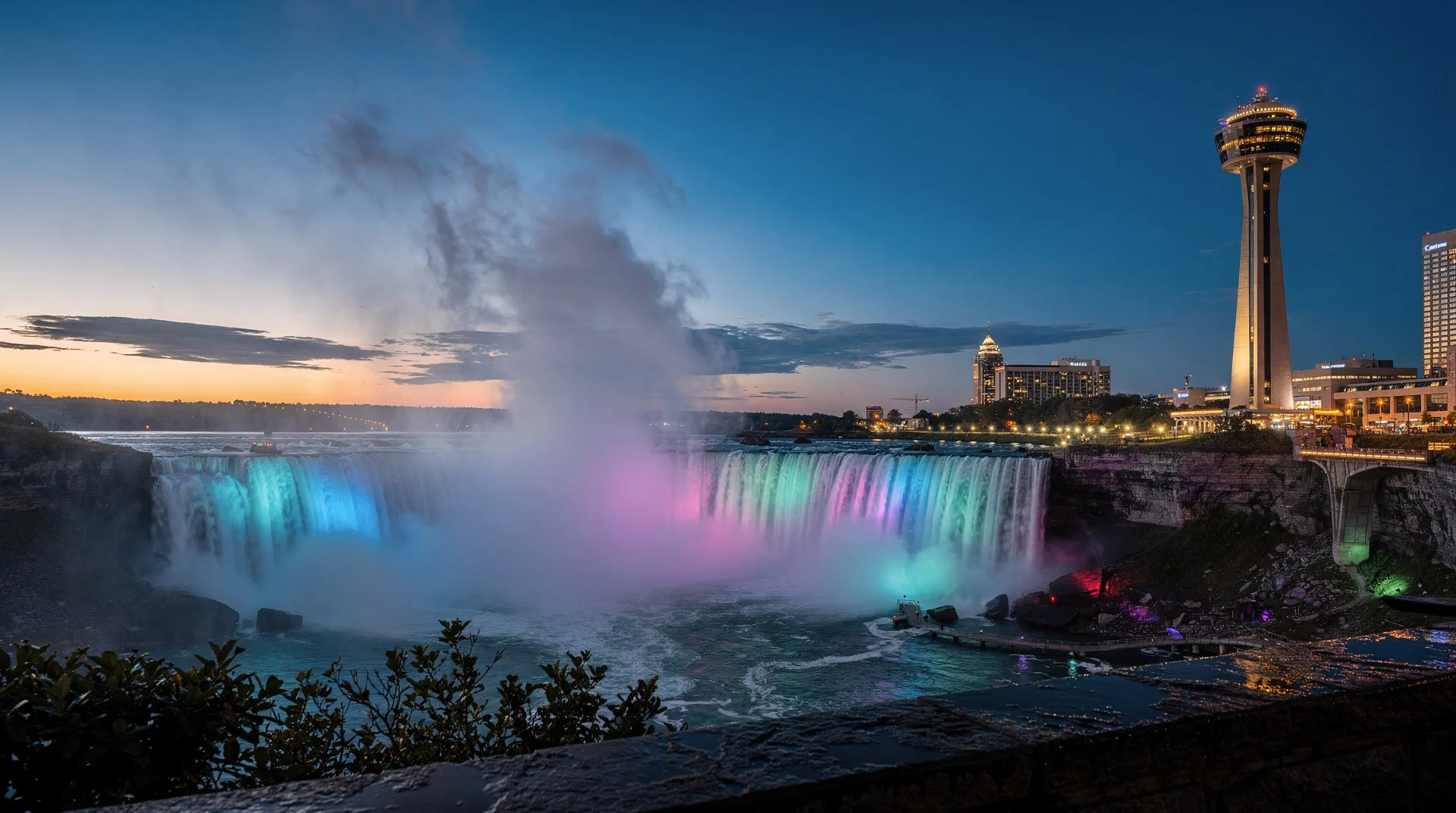
If your weekend falls between December and March, the Niagara Falls experience is completely different but still worth making. The falls do not freeze — the volume of water is too great — but the surrounding structures (railings, observation platforms, trees) accumulate spectacular ice formations. The Festival of Lights (November through January) illuminates the falls nightly with coloured light in the absence of crowds. Winter is also the peak Icewine harvest season in nearby Niagara-on-the-Lake, making a winter wine tour a particularly timely addition.
The boat tours and Journey Behind the Falls do not operate in winter. The clifftop views and the illuminated falls remain accessible year-round.
Where this trip fits against other Ontario options
Toronto-Niagara is the easiest possible introduction to Ontario, but it is not the only weekend option out of the city. Comparing it honestly to the alternatives helps set expectations:
| Weekend option | Distance from Toronto | Character | Best for |
|---|---|---|---|
| Niagara Falls (this trip) | ~130 km | Iconic waterfall, busy, easy without a car | First-timers, couples, families |
| Toronto to Ottawa | ~450 km | Historic towns, Thousand Islands, needs a car | Road trippers with more time |
| Toronto to Blue Mountain | ~150 km | Georgian Bay resort town, skiing/hiking | Outdoor-focused couples |
| Toronto to Thousand Islands | ~300 km | River islands, quieter pace | Nature lovers with a car |
Visitors deciding between a car-free weekend and a driving trip should also read our comparison of Toronto and Niagara as a home base — it covers whether to sleep in Niagara Falls itself rather than commuting from Toronto.
Practical logistics before you go
Passports and eTA: Visa-exempt air travellers to Canada generally need a valid eTA (Electronic Travel Authorization) rather than a visa; this applies whether flying into Toronto Pearson or elsewhere. If any part of this itinerary includes crossing to the American side of Niagara Falls, a valid passport (and any applicable US entry requirements) is required separately — the eTA does not cover US entry.
Currency and tipping: Canada’s currency is the Canadian dollar (CAD). Tipping in restaurants and for tour guides is customary, typically in the 15-20% range on the pre-tax total.
Getting around Toronto on Day 1: The TTC (subway, streetcar, bus) covers the Day 1 route well if you would rather not walk the full distance between St. Lawrence Market and the Distillery District. See getting around Toronto for fare and route details.
Frequently asked questions about Toronto to Niagara Falls Weekend Trip
Do I need a car for this itinerary? No. The itinerary is designed to work entirely without a car, using coach service or a guided day tour between Toronto and Niagara Falls. A car adds flexibility, particularly for reaching Niagara-on-the-Lake, but is not required for the core two-day plan.
Is one day enough to see Niagara Falls properly? One full day covers the essentials well — the boat tour, Journey Behind the Falls, and the clifftop viewpoints — if you arrive by mid-morning and stay until early evening, as this itinerary is structured. Visitors who also want Niagara-on-the-Lake or the wineries should plan a third day rather than compressing everything into one.
Related guides
- Toronto weekend itinerary — full two-day Toronto plan
- Niagara Falls guide — comprehensive Niagara information
- Niagara-on-the-Lake guide — extend into wine country
- Getting around Toronto — TTC and transit for Day 1