Niagara Falls Weekend Itinerary: 2 Days (Including Niagara-on-the-Lake)
Overview
Niagara Falls and Niagara-on-the-Lake are two of Ontario’s most visited destinations — and they are only 25 kilometres apart, connected by one of the most beautiful drives in the province along the Niagara Parkway. A two-day weekend itinerary that combines both gives you the full Niagara experience: the raw natural power of the falls on Day 1, and the manicured charm of Niagara-on-the-Lake’s wineries, heritage architecture, and the Shaw Festival on Day 2.
A car is required to do this itinerary as written — the Niagara Parkway drive and the winery hopping on Day 2 are both significantly better with your own transport. Visitors without a car can use the Niagara Falls transit system and NOTL taxis, but flexibility is reduced.
This itinerary works as a standalone Niagara trip from Toronto (1 hour 15 minutes by car on the QEW) or as a continuation of a Toronto city stay. The accommodation base is Niagara Falls on Night 1.
At a glance
| Day | Morning | Afternoon | Evening |
|---|---|---|---|
| Day 1 | Arrival + Maid of the Mist | Journey Behind the Falls, Table Rock | Niagara Falls lights and dinner |
| Day 2 | Niagara Parkway drive | Niagara-on-the-Lake and wineries | Return to Toronto or overnight NOTL |
Best months: May through October. June through August for full boat tour and outdoor operation; September and October for harvest season at the wineries and smaller crowds.
Winter: Niagara Falls in winter (December to February) has a unique beauty — the falls continue through winter, ice forms on the surrounding structures, and the Festival of Lights (November to January) illuminates the falls nightly. Wine tours continue year-round. Winter travel requires a car with winter tires.
Day 1: Niagara Falls
Getting to Niagara Falls
By car from Toronto: Take the QEW (Queen Elizabeth Way) south from Toronto toward Niagara. The drive takes 1 hour 15 minutes to 1 hour 45 minutes depending on traffic. Arrive in Niagara Falls mid-morning.
Parking: The Niagara Parks Commission operates several paid parking areas near Table Rock and the falls. The Table Rock parking lot is the most convenient for the day’s activities.
Morning: Maid of the Mist and the Canadian Horseshoe Falls (10am–12pm)
The Maid of the Mist (American side) and Hornblower Niagara Cruises (Canadian side) are both excellent — if you are approaching from the Canadian (Ontario) side, Hornblower is the direct choice. Boats depart from below the Fallsview area (take the Incline Railway down or walk the steep path).
The boat ride into the mist at the base of Horseshoe Falls is the defining Niagara experience. The falls drop 57 metres at a volume of 168,000 cubic metres per minute at peak flow. Standing in the mist basin with the Horseshoe crashing around you, the sound and scale are genuinely overwhelming. Blue ponchos are provided and genuinely necessary.
Book Niagara Falls Canadian side boat tour and experience ticketsLate morning: Journey Behind the Falls (12pm–1:30pm)
Journey Behind the Falls at Table Rock Welcome Centre descends through tunnels carved into the bedrock to emerge in two observation portals directly behind the curtain of the Horseshoe Falls. The roar of the water through the rock, the vibration, and the sight of the falls from inside is unlike anything available from the surface viewpoints. Budget 45–60 minutes.
Table Rock Welcome Centre at the very edge of Horseshoe Falls has the most dramatic overland viewpoint — and a restaurant directly overlooking the falls for lunch. The food is acceptable and the view is spectacular; booking a window table in advance is worth the effort.
Afternoon: Whirlpool, Niagara Gorge, and Clifton Hill (2pm–5pm)
Drive north on the Niagara Parkway from the falls — one of Winston Churchill’s “prettiest Sunday afternoon drives in the world” — past the Dufferin Islands, through the gorge, to the Whirlpool Aero Car about 4 kilometres north.
The Aero Car carries passengers across the Niagara Gorge on an antique cable car above the churning Niagara Whirlpool below. The Whirlpool rapids are Class 6 — among the most powerful commercially navigable rapids in North America — and the aerial view from the cable car is extraordinary.
Continue driving north along the parkway to Queenston Heights Park, where a monument marks the battle site of the War of 1812. The viewpoint over the Niagara Gorge and toward Lake Ontario is excellent.
Return south to Niagara Falls for the late afternoon. Clifton Hill — the commercial entertainment strip — is unabashedly touristy: wax museums, haunted houses, mini-golf, and the SkyWheel observation wheel. It is great fun with children and easy to skip if it is not your style.
Evening: Illuminated falls and dinner (6pm onward)
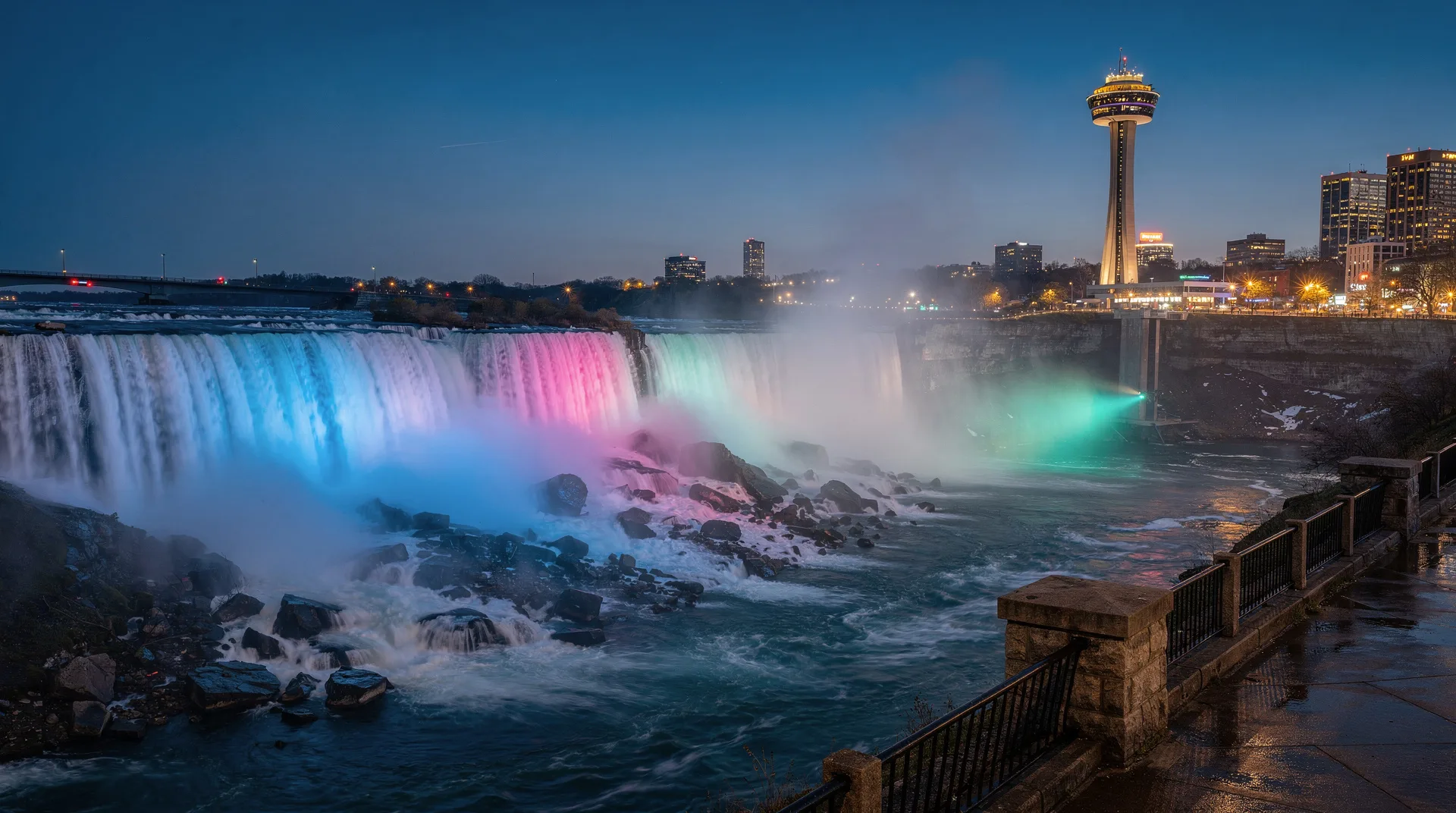
After dark, the Niagara Falls are illuminated by a powerful coloured light show that operates nightly throughout the year. Viewing is free from any waterfront vantage point. The fireworks over the falls on Friday and Sunday evenings (in summer, and some holidays) are spectacular from the Canadian side.
Dinner: The Niagara Falls dining scene is not the reason to visit, but the Fallsview Casino Resort has several decent restaurants with falls views, and Brasa Brazilian Steakhouse on Falls Avenue is a reliable mid-range option. For something more serious, drive 15 minutes toward Niagara-on-the-Lake for dinner at one of the wine-country restaurants — Treadwell Cuisine in Port Dalhousie or The Oban Inn in NOTL for a more elegant evening.
Accommodation in Niagara Falls: The Sheraton Fallsview Hotel has direct falls views from its upper floors. The Marriott Fallsview Hotel & Spa is the other major falls-view option. Both carry premium rates for falls-view rooms; standard rooms at the same hotels are considerably cheaper. Budget options are abundant in the surrounding town, away from the falls-view premium.
Day 2: Niagara Parkway and Niagara-on-the-Lake
Morning: The Niagara Parkway drive north (9am–11am)
The Niagara Parkway from Niagara Falls north to Niagara-on-the-Lake is one of Ontario’s finest scenic drives — 25 kilometres of parkway through heritage orchards, the Niagara Escarpment, and historic War of 1812 sites with continuous views over the Niagara River toward the American shore.
Drive slowly. Queenston Heights Park (already visited yesterday evening, or fresh in the morning) has excellent viewpoints and the monument to General Isaac Brock, who died at the battle here in 1812. Queenston village below the heights is a pretty heritage settlement with the Laura Secord Homestead (a historic site relating to the War of 1812 period).
The Niagara Escarpment — the ancient limestone ridge that runs from Niagara Falls northwest to the Bruce Peninsula — is most visible from the upper parkway. The vineyards that produce Niagara’s celebrated wines are planted on its slopes, benefiting from the lake’s moderating influence and the escarpment’s excellent drainage.
Late morning to afternoon: Niagara-on-the-Lake (11am–5pm)
Niagara-on-the-Lake (NOTL) is one of Ontario’s most beautiful and best-preserved 19th-century towns — a compact historic district of Georgian and Regency architecture along Queen Street, with wineries on the surrounding benchlands, and the world-renowned Shaw Festival theatre season running from April through October.
Queen Street: Park near the visitor centre and walk Queen Street from end to end. The heritage commercial strip has excellent independent shops, several notable restaurants, and the colourful mix of theatregoers, wine tourists, and locals that give the town its particular energy. The Niagara-on-the-Lake Museum (free or low admission) provides good context on the town’s remarkable history as the first capital of Upper Canada.
The Shaw Festival: If the timing of your visit aligns with the Shaw Festival (spring through autumn), booking tickets is strongly recommended. The Shaw is one of Canada’s premier theatre festivals, dedicated primarily to the plays of George Bernard Shaw and his contemporaries. The main stage Festival Theatre is architecturally beautiful and the productions are consistently excellent. Check shawfest.com for the current season and availability.
Wineries: The Niagara-on-the-Lake wine appellation (Niagara-on-the-Lake VQA) produces some of Ontario’s finest wines, with particular strength in Chardonnay, Pinot Noir, and the Icewine for which the region is internationally famous. Several wineries are located within the town boundaries or a short drive:
- Inniskillin Wines on Line 3 Road — one of Canada’s most famous wineries, credited with establishing Icewine as an internationally recognised wine style. Tours and tastings daily.
- Peller Estates Winery — a larger operation with excellent tastings, a restaurant, and the world’s coldest wine bar (a cellar at -10°C where Icewine is served in glasses made of ice)
- Wayne Gretzky Estates — owned by the legendary hockey player, this mid-sized winery has a well-run tasting room and a whisky distillery producing Ontario single malt
For lunch: Treadwell Cuisine in NOTL’s old town is a farm-to-table restaurant that has been at the forefront of Ontario’s locavore dining movement for years. The wine list focuses exclusively on Ontario VQA wines. Book ahead for weekend lunches.
Browse Niagara Falls and Niagara wine country tours and experiencesReturn journey (5pm onward)
Depart Niagara-on-the-Lake by 5pm for the return to Toronto (1 hour 15 minutes via the QEW). If returning in summer, allow extra time for QEW congestion on Sunday evenings — the 4–6pm window is typically the busiest.
Alternatively: Stay a second night in NOTL. The Prince of Wales Hotel on Picton Street is one of Ontario’s most charming historic hotels — a Victorian property with an excellent spa and restaurant. A second night in NOTL extends the wine country exploration and allows a relaxed return on Monday morning.
Budget breakdown
Costs per person, based on two people sharing, including one overnight in Niagara Falls:
| Category | Comfort (CAD) |
|---|---|
| Accommodation (1 night, Niagara Falls) | 180–350 |
| Food and drink (2 days) | 150–250 |
| Niagara boat tour | 35–45 |
| Journey Behind the Falls | 20–25 |
| Winery tastings and wine | 50–120 |
| Car fuel and parking (from Toronto) | 30–50 |
| Estimated total per person | ~465–840 |
Booking essentials
- Boat tour tickets: Book online, especially June through August
- Shaw Festival: Book at least 2–3 weeks ahead for popular productions; the season sells out weeks in advance for top shows
- Treadwell Cuisine lunch: Reserve at least a week ahead for weekend bookings
- Peller Estates Restaurant dinner: Book ahead — it fills quickly on summer weekends
- Hotels: Book at least 3–4 weeks ahead for summer weekends in Niagara
The Niagara wine region in detail
The Niagara wine region is one of Canada’s two internationally significant wine appellations (the other being the Okanagan Valley in British Columbia). The region divides into two sub-appellations:
Niagara-on-the-Lake appellation: The flat benchland between the Niagara Escarpment and Lake Ontario, where the lake’s moderating influence extends the growing season significantly beyond what the latitude would normally allow. This is where the large, well-known wineries are concentrated. Strengths: Chardonnay, Riesling, Cabernet Franc, and Icewine.
Niagara Escarpment appellation: The slope and benchlands of the escarpment itself, with more varied soils and exposures. Less accessible for casual visitors but producing some of the region’s most distinctive wines from Pinot Noir and Riesling.
The Icewine question: Niagara is one of the world’s premier Icewine regions — the climate reliably delivers the deep freezes (below -8°C) necessary to freeze the water in grapes on the vine while leaving the concentrated sugars liquid. The resulting wine (harvested in January or February) is intensely sweet, richly flavoured, and genuinely distinctive. Every Niagara winery produces Icewine; the quality varies considerably. Inniskillin and Jackson-Triggs are the best-known producers; Cave Spring Cellars and Tawse Winery produce more refined versions at higher price points.
Winery touring logistics: The wine country is best explored by car (alcohol is a concern — designate a driver or hire a car with driver for the day). Several guided winery tour operators run small-group experiences from both Niagara Falls and Niagara-on-the-Lake. These combine 3–4 winery visits with lunch and transport, which is significantly more relaxing than self-driving.
The Grape and Wine Festival (September): Niagara-on-the-Lake hosts one of Canada’s largest wine festivals each September, coinciding with the harvest. Winery events, outdoor concerts, and the Grand Parade through NOTL’s historic streets make this the peak visitor weekend of the wine country year. Book accommodation 2–3 months ahead for the festival weekend.
The Niagara Escarpment
The Niagara Escarpment — the ancient limestone ridge that runs 725 kilometres from Niagara Falls northwest through the wine country, across to the Bruce Peninsula, and across Georgian Bay to Manitoulin Island — is one of Ontario’s defining geological features and a UNESCO World Biosphere Reserve.
From the falls, the escarpment is most visible at Queenston Heights, where the ridge drops sharply to the river below. The view from the top of the escarpment north over the wine country and Lake Ontario is one of the finest panoramas in southern Ontario.
The Bruce Trail — Canada’s oldest and longest marked hiking trail — follows the escarpment for its entire length. The Niagara section of the Bruce Trail runs north from Queenston through NOTL’s wine country, offering day hike options that combine the escarpment views with wine country landscapes. Trail maps are available from the Bruce Trail Conservancy.
Practical notes for the Niagara weekend
Currency: Ontario uses Canadian dollars. Credit cards are universally accepted at wineries, restaurants, and attractions. Cash is useful for small market purchases and tips; ATMs are available in both Niagara Falls and Niagara-on-the-Lake.
Mobile data: Canadian roaming from US or international numbers can be expensive. Consider a temporary Canadian SIM card (available at Pearson Airport and in downtown Toronto) if data access is a priority throughout the weekend.
Dress: The falls experience involves guaranteed water exposure — bring a change of clothing or at least a dry top layer. The wine country in September is warm during the day but can be cool in the evenings — a light jacket or layer is advisable.
Photographers: The falls offer extraordinary photography opportunities. The best light for Horseshoe Falls photography is early morning (before 10am) when the sun is lower and the mist cloud is most visible. The Canadian side viewpoints (Table Rock) photograph the falls from the side; the American side viewpoints give a more frontal view. For helicopter photography overhead, several operators run scenic flights from both sides.
Related guides
- Niagara Falls guide — complete falls information
- Niagara-on-the-Lake guide — NOTL in detail
- Toronto to Niagara Falls weekend — adding Toronto to the front of this trip
- Ontario weekend trips from Toronto — broader Ontario planning
Canadian side versus American side
Nearly everything in this itinerary is deliberately on the Canadian side, which has the better views of Horseshoe Falls (the American side looks mostly at the back of American Falls) and the more developed visitor infrastructure. Crossing to the American side (a passport is required, plus possible eTA/visa considerations depending on nationality) adds a border-crossing queue that is rarely worth it for a two-day trip focused on the falls themselves. See our Niagara Canada versus US side guide if a border crossing is part of a longer plan.
If you only have one day, not two
Travellers pressed for time sometimes ask whether this trip compresses into a single long day from Toronto. It can, but something has to go: the realistic single-day version keeps the Maid of the Mist/Hornblower boat tour and Journey Behind the Falls on Day 1’s itinerary above, and drops the Niagara-on-the-Lake wine country entirely — which is a genuine loss, since the wine country is arguably the more distinctive half of the region. If wine is the priority and time is short, flip the plan and spend the single day in NOTL instead of at the falls. See our Toronto to Niagara Falls guide for one-day logistics.
Frequently asked questions
Do I need a passport for this itinerary?
No, if you stay on the Canadian side as this itinerary does. A passport (and possibly an eTA or visa depending on nationality) is only needed if you cross to the American side of the falls.
Is Niagara-on-the-Lake worth visiting if I don’t drink wine?
Yes. The heritage architecture along Queen Street, the Shaw Festival, and the Niagara Parkway drive to get there all stand on their own regardless of interest in the wineries.