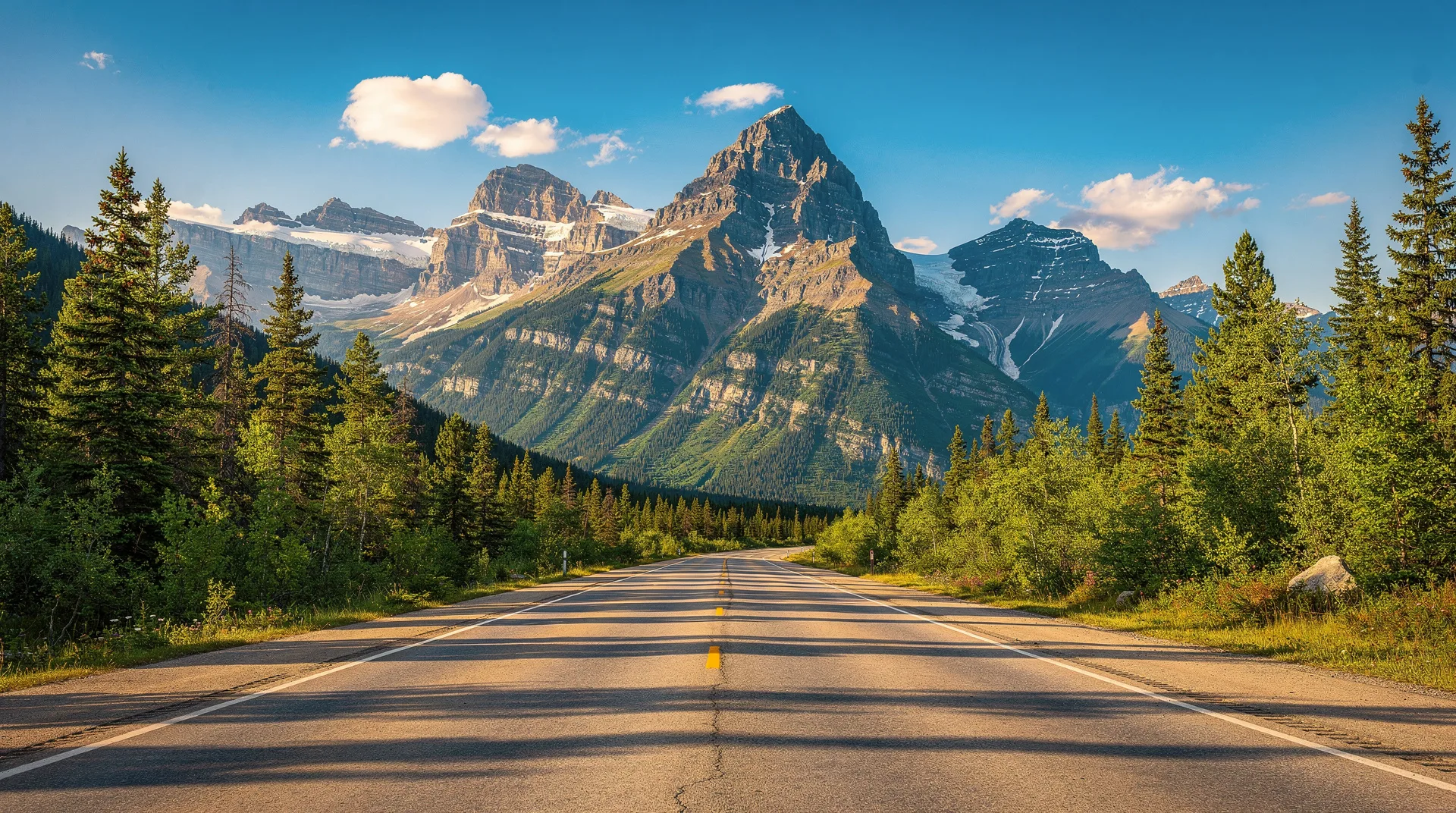
7 days in the Canadian Rockies: Calgary to Jasper
Overview
Seven days is the perfect length for the Canadian Rockies road trip. Long enough to absorb the scale of the landscape without rushing, short enough to stay focused on the very best of what this UNESCO World Heritage corridor offers. This itinerary runs the classic route: fly into Calgary, drive west to Banff for three nights, north through Lake Louise and the Icefields Parkway to Jasper for two nights, then back south to Calgary for your return flight.
The distances are manageable — Calgary to Banff is 128 km, Banff to Jasper via the Icefields Parkway is 288 km — and the roads are excellent year-round. A rental car is essential; this is a self-drive itinerary. Driving here is not an inconvenience but a central part of the experience.
At a glance
| Where | Calgary → Banff (3 nights) → Lake Louise → Jasper (2 nights) → Calgary |
| Duration | 7 days, one rental car |
| Cost | Comfort budget; a Parks Canada Discovery Pass (around CAD 72) covers both parks for the year |
| Getting there | Fly into Calgary International Airport, drive west |
| Best time | Mid-June to mid-October for full road and attraction access |
Shorter on time? Our 3-day Banff itinerary and 5-day Banff itinerary both fit into a long weekend without Jasper. Want more depth in both parks instead of a week? See the banff-national-park guide and jasper-national-park guide for extending specific days.
| Day | Destination | Driving |
|---|---|---|
| 1 | Calgary → Banff | 128 km, 1.5 hrs |
| 2 | Banff exploration | Day hikes from town |
| 3 | Banff Gondola + Hot Springs | Local drives |
| 4 | Lake Louise + Moraine Lake | 58 km from Banff |
| 5 | Icefields Parkway drive | 288 km to Jasper |
| 6 | Jasper exploration | Local day trips |
| 7 | Jasper → Calgary | 362 km via Hwy 16/93 |
Best season: Mid-June to mid-October for fully accessible roads and all attractions open. Moraine Lake Road typically opens in late June. July and August are peak season — book everything (accommodation, restaurant tables, shuttle tickets) months in advance. Late September offers smaller crowds, larch tree colour, and elk rutting season.
Day 1: Calgary to Banff — arriving in the Rockies
Land at Calgary International Airport, collect your rental car, and head west on the Trans-Canada Highway (Highway 1). The city falls away quickly and within 45 minutes the Rocky Mountain front ranges appear on the horizon — a dramatic and satisfying introduction.
Stop en route: Canmore, 20 km east of Banff, is worth a 30-minute walk through its main street. The Three Sisters peaks loom directly above the town; the coffee shops and galleries on Main Street are significantly less crowded than anything in Banff. If you arrive with time and energy, hike the Ha Ling Peak trail (6.4 km return, 730 m elevation gain) for a classic mountain view.
Enter Banff National Park through the park gates (buy your Parks Canada Discovery Pass here — it covers all national parks and pays for itself in a few days of parking fees). The town of Banff is 8 km inside the park boundary.
Check into your hotel and spend the afternoon on Banff Avenue — the main street — and down to the Bow River. The hot springs on Sulphur Mountain Road are a good first-evening option: soaking in the Banff Upper Hot Springs at 40°C with mountain views is the ideal way to acclimatise. The springs were what prompted the park’s creation in 1885.
Where to stay in Banff: The Fairmont Banff Springs is the iconic choice — a castle-like railway hotel built in 1888 in a position of breathtaking grandeur above the Bow River valley. For comfortable mid-range options, the Moose Hotel and Suites and the Mount Royal Hotel on Banff Avenue are both well-positioned. Book far in advance for July and August.
Dinner in Banff: The Bison Restaurant serves excellent Alberta beef and local game in a warm room above a food court. Saltlik steakhouse does justice to the province’s exceptional beef. The Maple Leaf has been a Banff institution for decades.
Day 2: Banff — hiking, wildlife, and the valley floor
This is a full day to explore the area around Banff town. Start early to beat the crowds at the most popular trails.
Johnston Canyon (morning)
Drive 18 km west of Banff to Johnston Canyon, one of the most popular short hikes in the park — and popular for excellent reasons. The canyon trail (5.1 km return to the Upper Falls, 11.5 km return including the Inkpots) follows metal catwalk bridges bolted to the canyon walls just above the creek. The Lower Falls (1.1 km in) are framed in a narrow slot of rock; the Upper Falls (2.7 km) drop 30 metres into a pool of turquoise water. Arrive before 9 AM in summer to get parking and avoid the worst of the crowds.
Bow Valley Parkway (afternoon)
Instead of returning on the Trans-Canada, take the Bow Valley Parkway (Highway 1A) back east toward Banff. This older, slower road through the Bow Valley was the main route before the highway was built and remains one of the best wildlife corridors in the park. Wolves, bears, elk, and deer are frequently seen from the road. Stop at the Muleshoe picnic area, Castle Cliffs Viewpoint, and the Backswamp Viewpoint. The drive takes about 45 minutes without stops.
Book a Banff National Park small-group day tour from CalgaryEvening: Vermilion Lakes
Drive 2 km west of Banff to the Vermilion Lakes Road, which skirts three shallow lakes in the valley floor with perfect views of Mount Rundle reflected in the water. This is the best spot in the Banff area for sunrise and sunset photography. Beavers are active in the evenings; great blue herons and osprey are common.
Day 3: Banff Gondola, Sulphur Mountain and Lake Minnewanka
Morning: Banff Gondola and Sulphur Mountain summit
Take the Banff Gondola to the 2,281-metre summit of Sulphur Mountain for the best 360-degree view of the Bow Valley. The 8-minute gondola ascent covers 698 metres of elevation change. At the summit, the boardwalk connects to Sanson Peak and the historic Banff Cosmic Ray Station, a National Historic Site. On a clear day (most days between June and October), the panorama takes in the Bow Valley, the Spray Valley, and the front ranges stretching in both directions.
Book gondola tickets in advance — they sell out regularly in peak season.
Afternoon: Lake Minnewanka
Drive northeast of Banff to Lake Minnewanka, the park’s largest lake at 21 km long. The lake is backed by the sharp ridges of the Front Ranges and feels wilder and less manicured than the showpiece lakes further north. Boat tours of the lake depart from the dock. The lakeside trail heads east to Stewart Canyon (3.4 km one way, easy) through forest and alongside the lake shore. Bighorn sheep are almost always visible somewhere on the rocky slopes above the parking area.
Book a Banff, Lake Louise, Moraine Lake, gondola and hot springs full-day tourDay 4: Lake Louise and Moraine Lake
This is the most logistically complex day of the itinerary and requires careful planning. Both Lake Louise and Moraine Lake require either shuttle bookings or extremely early arrival in peak season.
Lake Louise (early morning)
Drive 58 km northwest of Banff to Lake Louise village (about 45 minutes). For the classic lakeshore experience, arrive before 8 AM in July and August to guarantee parking at the lake. The view of the Fairmont Chateau Lake Louise reflected in the turquoise water with the Victoria Glacier at the head of the valley is as extraordinary as photographs suggest — it is not a case of the reality failing the images.
If you want to hike, the Plain of Six Glaciers trail (13.8 km return, 365 m elevation gain) is one of the finest walks in the Rockies, passing the Victoria Glacier and ending at a historic teahouse. The Lake Agnes Tea House trail (7.4 km return, 380 m elevation gain) climbs to a mountain lake and an even more atmospheric teahouse. Both teahouses are hike-in only and serve simple meals; cash only.
Moraine Lake (late morning to noon)
Access to Moraine Lake is by shuttle reservation only during peak season (typically June to mid-October). Book the Parks Canada shuttle through the reservation system months in advance — slots sell out within hours of opening.
The view from the Rockpile trail (0.8 km, 30 m elevation) looking back over Moraine Lake and the Valley of the Ten Peaks is one of the most photographed perspectives in North America, and it earns its reputation completely. The ten named peaks above 3,000 metres that form the valley wall create a backdrop of extraordinary scale and drama. The lake’s blue-green colour, from glacial rock flour, is almost impossibly vivid in the morning light.
Afternoon: Return to Banff or stay at Lake Louise
Either return to Banff for the night or, if your itinerary allows, spend the night at Lake Louise village to begin the Icefields Parkway drive early the next morning without backtracking.
Day 5: The Icefields Parkway — Banff to Jasper
This is the centrepiece day of the itinerary. The Icefields Parkway (Highway 93 North) runs 232 km from Lake Louise to Jasper and is widely considered one of the world’s great scenic drives. Allow a full day — ideally 8-10 hours including stops — and do not rush it.
Key stops from south to north:
Bow Lake (40 km from Lake Louise): The turquoise lake fed by the Bow Glacier is one of the finest views in the park, with Crowfoot Mountain reflected in the water. The Num-Ti-Jah Lodge on the lakeshore has been welcoming travellers since 1920. A short walk along the lakeshore from the parking area reveals the full panorama.
Peyto Lake Viewpoint (76 km): A short but steep 20-minute walk from the parking area leads to what is arguably the most spectacular lake view on the entire parkway. Peyto Lake, a wolf-head-shaped body of water, sits far below the viewpoint in an electric blue-green that intensifies in mid-summer when glacial melt is at maximum. One of the most photographed viewpoints in Canada.
Columbia Icefield Discovery Centre (127 km): The midpoint of the drive and the most dramatic geological encounter. The Athabasca Glacier extends from the Columbia Icefield — the largest accumulation of ice and snow in the Rocky Mountains south of Alaska — and its toe is accessible on a short walk from the road. The glacier has retreated dramatically since measurements began; interpretive markers along the trail show where the ice reached in previous decades.
The Glacier Skywalk, a 1-km interpretive trail that ends at a glass-floored cliff platform 280 metres above the Sunwapta Valley, is open by timed entry (book in advance). The Ice Explorer tour drives buses onto the surface of the Athabasca Glacier — book well ahead.
Sunwapta Falls (177 km): A 10-minute walk from the parking area reaches a powerful double waterfall where the Sunwapta River drops over quartzite ledges into a canyon. The lower falls, accessible via a short additional walk, are often missed and equally impressive.
Athabasca Falls (200 km): The Athabasca River’s full force channelled through a narrow quartzite gorge — powerful and photogenic. Less than a kilometre of walking from the parking area, and genuinely impressive.
Arrive in Jasper by late afternoon and check in to your accommodation.
Where to stay in Jasper: Jasper is smaller and more relaxed than Banff. The Fairmont Jasper Park Lodge, set on Lac Beauvert 5 km from town, is a sprawling 1920s resort in an extraordinary lakeside setting. In town, the Crimson Jasper and the Sawridge Inn are both comfortable options. The Tonquin Inn is good value.
Day 6: Jasper — Maligne Lake and Spirit Island
Jasper National Park is larger and wilder than Banff. The town itself, with just 4,500 residents, feels quieter and more authentic. Day 6 explores the park’s highlights.
Maligne Lake and Spirit Island (morning)
Drive 48 km southeast of Jasper to Maligne Lake, the largest glacially-fed lake in the Canadian Rockies and one of the most beautiful bodies of water in the world. The lake stretches 22 km between mountain walls, its surface the same extraordinary blue-green as the lakes in Banff.
Spirit Island, accessible only by boat, is the most photographed scene in Jasper — a tiny forested island in the narrows of the lake with mountains rising on both sides. The Parks Canada boat tour to Spirit Island is the recommended way to reach it; book through Maligne Lake Boat Tours well in advance. Canoe rentals are available for the south end of the lake.
Maligne Canyon (afternoon)
On the return drive toward Jasper, stop at Maligne Canyon, which is deeper and more dramatic than Johnston Canyon in Banff. The canyon cuts 55 metres deep through limestone bedrock; six footbridges cross the gorge at various depths, with each bridge offering a different perspective on the sculpted walls. The First and Second Bridge viewpoints near the parking area give the most dramatic views; the trail continues deeper into the canyon for those who want more distance.
Evening: Jasper wildlife and Pyramid Lake
Drive the Pyramid Lake Road north of Jasper in the late afternoon for the best chance of wildlife encounters. Elk are common in the Jasper townsite itself — they wander the streets with the nonchalance of urban deer. The Pyramid Lake area at dusk often produces moose, deer, and occasionally black bears.
Day 7: Jasper to Calgary — the return drive
Allow a full day for the return to Calgary. The most direct route (Highway 16 east, then south on Highway 2) covers about 362 km and takes approximately 4 hours without stops. Alternatively, double back on the Icefields Parkway to Lake Louise and return via the Trans-Canada — the same 288 km in the other direction looks different in the reverse direction and in different light.
Stop at Jasper for breakfast and coffee. The Bear’s Paw Bakery (two locations in town) serves exceptional cinnamon rolls and is a local institution.
Return your rental car at Calgary Airport and depart. The final drive east from the mountains — watching the Rockies recede in the rearview mirror as the foothills flatten toward Calgary — is a memorable conclusion to an extraordinary week.
Practical information
Car rental: Book early, especially for summer. Calgary Airport has all major rental companies. A standard SUV is ideal for the mountain roads — no off-road driving required, but the extra visibility and ground clearance are useful. Fuel up in Banff and Jasper; there are no petrol stations on the Icefields Parkway itself.
Parks Canada passes: The Discovery Pass (valid for all national parks for a year) is strongly recommended for a 7-day Rockies trip. Available at park gates or online. Required for parking at most trailheads and viewpoints.
Accommodation booking: Book 3-6 months in advance for July and August stays in Banff and Jasper. Both towns operate at capacity through the peak summer months, and last-minute accommodation is either unavailable or extremely expensive.
Wildlife safety: Black bears and grizzly bears are present throughout the parks. Carry bear spray, hike in groups of 3 or more, and make noise on trails. Read Parks Canada bear safety guidelines. Never approach, feed, or photograph wildlife from a closer distance than the park regulations specify. Elk in rut (September-October) are also unpredictable.
For more on planning, see our Banff National Park guide, Jasper National Park guide, and our first-time visitors guide.
Where this itinerary can flex
Seven days is comfortable, not tight, which leaves room to adjust. Travellers who find they prefer Banff’s lakeshore scenery to Jasper’s wilder, quieter feel can add a fourth night in Banff and reduce Jasper to a single overnight — the Banff vs Jasper guide walks through the trade-offs in more detail. Skiers visiting outside the June-October window should look at the dedicated 5-day winter Rockies itinerary instead, since Moraine Lake Road and several trailheads on this itinerary close in winter. Anyone extending beyond a week should compare against the 10-day Canadian Rockies itinerary, which adds Yoho and Kananaskis.
Cell service and driving notes
Cell coverage is patchy to nonexistent for long stretches of the Icefields Parkway and around Lake Minnewanka — download offline maps in Banff or Jasper town before setting out. Wildlife jams (cars stopped for elk, bears, or bighorn sheep) are common on the Bow Valley Parkway and Highway 16; slow down early rather than braking hard. Fuel up in Banff or Jasper before the Icefields Parkway drive, since there are no petrol stations on the parkway itself between the two towns.
Frequently asked questions about 7 days in the Canadian Rockies: Calgary to Jasper
Do I need a car for this Rockies itinerary?
Yes, for this specific itinerary. A rental car is the best and really the only practical way to travel between Calgary, Banff, Lake Louise, and Jasper at your own pace. Some elements (Banff Gondola, tours) can be done with operators, but the Icefields Parkway drive and the freedom to stop at viewpoints require a vehicle.
When should I book Moraine Lake shuttle tickets?
Book Moraine Lake shuttle tickets as early as possible — the Parks Canada reservation system opens in April and the most popular time slots sell out within hours of opening. If you cannot get a shuttle, some tour operators include Moraine Lake access as part of guided day tours.
Is this itinerary suitable for families with children?
Yes. The driving distances are reasonable, the short hikes to the major viewpoints (Peyto Lake, Johnston Canyon Lower Falls, Vermilion Lakes) are accessible to older children, and the wildlife encounters are genuinely thrilling for young travellers. For families with young children, reduce the hiking ambition and add more time at the major viewpoints.
Can I do this itinerary in winter?
A modified version is possible and spectacular in winter. The Icefields Parkway stays open in winter (weather permitting), and Banff and Jasper are beautiful under snow. Moraine Lake Road closes in winter. Lake Louise is accessible and the lake freezes over for skating. However, expect significantly colder temperatures (-20°C or below) and adapt your plans to winter driving conditions.
What should I pack for this trip?
Layers are essential in the mountains regardless of summer forecasts — weather can change rapidly at elevation. Pack waterproof hiking boots, a rain jacket, warm mid-layers even in July, sun protection (UV is stronger at altitude), bear spray (rent or buy in Calgary or Banff), and a good camera. Trekking poles are helpful for longer hikes.
How does this itinerary compare to doing Banff and Jasper as separate trips?
Combining them into one 7-day loop is more efficient than two separate trips, since the Icefields Parkway between them is itself one of the highlights rather than a transit day. Travellers with less time who must choose should read the Banff vs Jasper guide: Banff has denser infrastructure and the iconic lakes, Jasper is larger, quieter, and better for stargazing and wildlife.
Should I stay in Banff or Canmore instead?
Banff town puts you inside the national park and within walking distance of the gondola and hot springs, at a price premium. Canmore, 20 km east and just outside the park boundary, is noticeably cheaper with a similar mountain backdrop, at the cost of a short daily drive in. Compare the trade-offs in the Banff vs Canmore guide before booking.