Safety in Canada: is it safe to travel?
Is Canada safe for tourists?
Canada is one of the safest countries in the world for travellers. Crime rates are low, the healthcare system is excellent, and most risks are environmental rather than human. Wildlife, weather, and remote terrain are the primary hazards to manage.
Canada is consistently ranked among the world’s safest travel destinations. By the metrics that matter to travellers — violent crime, street safety, political stability, healthcare quality, and infrastructure reliability — Canada outperforms most countries and compares favourably even within the developed world.
That said, Canada does have genuine risks. They are just different from the risks visitors imagine. Wildlife encounters, extreme weather, and the hazards of remote wilderness are the real concerns for most Canadian travellers — not pickpocketing or tourist scams. This guide addresses both.
At a glance
| Overall risk level | Very low by global standards; environmental risks outweigh crime risk |
| Emergency number | 911 (police, fire, ambulance) nationwide |
| Main real risks | Wildlife encounters, winter cold, driving on ice, unfamiliarity with wilderness terrain |
| Health cover needed | Comprehensive travel medical insurance — essential, not optional |
| When to worry most | Winter driving (Dec-Mar) and backcountry hiking in bear country (spring-fall) |
The overall safety picture
Canada ranks in the top 10 globally in most safety indices. For context:
- Violent crime: Canada’s violent crime rate is significantly lower than the United States. Homicide rates in Canada are approximately 1.8 per 100,000 people (vs. approximately 6.3 in the USA).
- Tourist safety: The Global Peace Index consistently places Canada in the top 10–15 most peaceful countries. Incidents targeting tourists are rare.
- Political stability: Canada has strong democratic institutions and has not experienced political instability in modern history.
- Infrastructure: Roads, bridges, emergency services, hospitals — all maintained to high standards. Power outages and infrastructure failures are uncommon except in extreme weather.
The most common health and safety issues visitors face in Canada are not crime-related: they are sprains and injuries from outdoor activities, cold-related illness, sunburn (UV is intense at altitude), and insect bites.
City safety
Major cities
Toronto, Vancouver, and Montreal are all very safe by international standards. The core tourist areas, transit systems, and downtown neighbourhoods are safe to walk at any hour of the day or night for the vast majority of visitors.
Toronto: Downtown, Midtown, Harbourfront, the Distillery District, and most tourist areas are safe. The Moss Park/Regent Park area east of downtown has higher rates of drug-related activity — not a tourist area, and not a place where visitors typically find themselves.
Vancouver: Downtown and tourist areas (Gastown, Yaletown, Granville Island, the seawall) are very safe. The Downtown Eastside (DTES), particularly around Hastings and Main, is Canada’s most visible area of drug addiction, poverty, and homelessness. It is not dangerous for visitors who pass through — it is deeply sad to witness — but it is not an area to explore after dark.
Montreal: Old Montreal, Plateau-Mont-Royal, Mile End, and the downtown core are all safe and well-monitored. No specific areas of significant concern for tourists.
Quebec City: One of the safest cities in Canada. Crime is very low; the tourist areas are extremely safe. For a relaxed way to see it, you can browse guided tours across Canada. If you are planning time there, the Old Quebec guide and the Quebec City destination page cover the walkable historic core, which is a comfortable place to explore on foot in the evening.
Calgary and Edmonton: Largely safe. Edmonton has a higher crime rate than other major Canadian cities by Canadian standards, particularly in some inner-city areas — but these are not tourist areas.
Petty crime
Pickpocketing and bag theft exist in Canada as in any urban environment, but are far less common than in most European cities. Standard precautions apply:
- Keep bags in front of you on crowded transit
- Don’t leave valuables visible in a parked car
- Use ATMs inside banks or stores rather than isolated street machines at night
- Keep your passport stored safely at your accommodation (a travel insurance-covered copy on your phone is sufficient for most daily needs)
Car break-ins are the most commonly reported property crime affecting tourists — particularly in national parks and scenic viewpoints where rental cars with luggage visible are targets. Never leave valuables in a car in any national park or tourist parking area.
Common tourist worries that are not real risks in Canada
Visitors sometimes arrive braced for problems that are simply not significant in Canada: organised scams targeting tourists, currency exchange fraud, and violent street crime against travellers are all genuinely rare. The realistic risk profile is closer to “twisted ankle on a hike” or “underdressed for a cold snap” than anything resembling personal safety threats common in some other popular destinations. That mismatch between perceived risk and actual risk is worth internalising before the trip, so energy goes toward the things that do matter — see the wildlife safety and weather safety sections below.
Wildlife safety
Wildlife is the primary safety concern in Canada that most visitors underestimate. Canada has genuine apex predators in its national parks and wilderness areas — and they need to be respected.
Bears
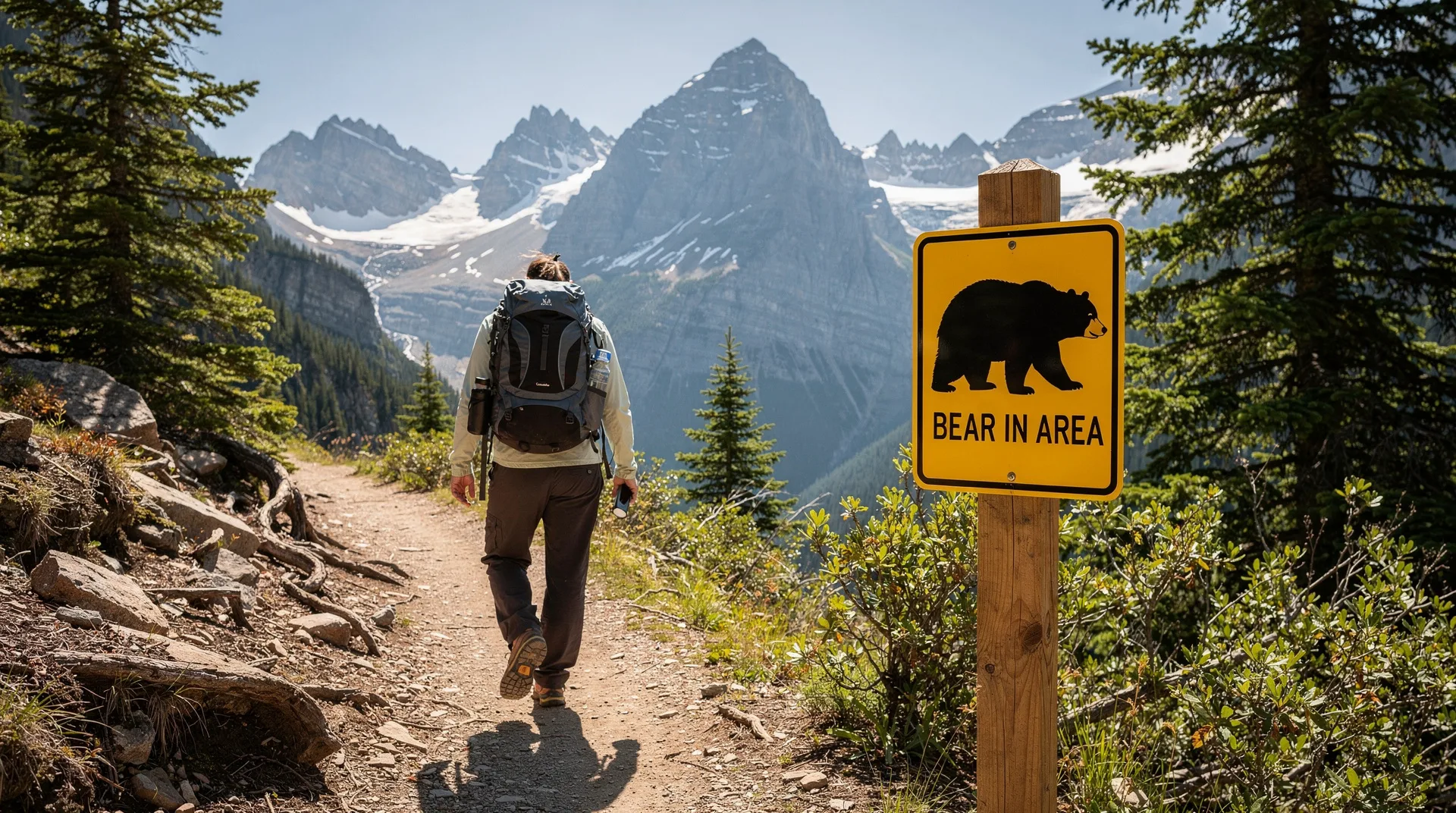
Canada has both black bears and grizzly bears. Both are present in national parks across Western Canada and in wilderness areas throughout the country. Bears are not inherently aggressive, but surprised bears, mother bears with cubs, and food-conditioned bears are dangerous.
Essential rules for bear country:
- Make noise while hiking (talk loudly, clap, call out around blind corners) to avoid surprising a bear
- Hike in groups of three or more when possible — solo hikers have a disproportionate share of bear encounters
- Carry bear spray and know how to use it (available for rent in Banff, Jasper, and most national park towns)
- Never approach bears for photos — ever
- Keep all food, garbage, and scented products secured in a vehicle or bear locker when camping — not in a tent
- If you see a bear on a trail, assess: a bear that spots you and moves away is fine. A bear that approaches is not. Back away slowly and calmly. Use the bear spray if it charges within 10 metres.
Bear spray is more effective than firearms at stopping a bear charge, according to studies. Carry it on your person while hiking in grizzly country, not in your pack.
Grizzly bears are primarily in BC, Alberta, the Yukon, and parts of the Northwest Territories. Black bears are found across most of Canada including Ontario, Quebec, and Nova Scotia.
If you are heading to the busiest bear country, it helps to read the park-specific pages before you arrive. The Banff National Park guide and the Jasper National Park guide explain how those parks are laid out, and the best hikes in Canada overview is a useful way to choose trails that match your experience, rather than improvising on the day.
Cougars (mountain lions)
Rare to see but present in BC and some parts of the Rockies. If you encounter a cougar: do not run (triggers chase instinct). Stand tall, face the animal, back away slowly. Make yourself look large. Make noise. Do not crouch.
Moose
Moose are large, unpredictable, and significantly more dangerous than most people realise. A moose is bigger than a horse and can be extremely aggressive — particularly mothers in spring and bull moose in autumn rut (September–October). Give moose a wide berth, never approach them, and never get between a mother and calf.
Moose are also a major road hazard on highways at night — particularly in New Brunswick, Nova Scotia, Ontario, and Newfoundland. Their eyes don’t reflect headlights well and they can step onto a highway suddenly. Drive cautiously at dusk and dawn in moose territory.
Ticks and insects
Ticks: Blacklegged ticks (deer ticks) carry Lyme disease and are present in Southern Ontario, parts of BC, and increasingly in Quebec and the Maritimes. After any walk through long grass or forested areas in these regions, check for ticks on your body and clothing. The DEET-based insect repellents are effective deterrents. Wear long sleeves and long pants in high-tick areas in spring and early summer.
Mosquitoes: Significant in northern Canada, the Prairies, and anywhere near lakes and wetlands in summer. Not a disease vector of concern in Canada for most travellers (West Nile Virus is very rare). DEET or picaridin repellent handles them effectively.
Blackflies: Intense in northern Ontario, Quebec, and other forested regions in May and June. Not harmful beyond the itch, but can be truly oppressive in number. Head nets are the most effective protection if you’re spending time in heavily affected areas.
Wildlife in the ocean
Orcas and other whale species are safe to observe — they do not attack humans. If you would rather watch them with an experienced crew, you can book wildlife tours in Canada. Seals and sea lions are generally safe if given space; territorial bulls on haul-outs can be aggressive if approached too closely. No sharks pose a realistic threat to Canadian coastal swimmers.
Weather safety
Canada’s climate is the most serious safety risk that visitors consistently underestimate.
Cold
Winter temperatures in Canada are not merely uncomfortable — they can be life-threatening. In Quebec, Ontario, the Prairies, and northern Canada, temperatures of -20°C to -40°C (with wind chill) are normal in January. Exposed skin freezes in 10–30 minutes at these temperatures.
Rules for cold weather travel:
- Dress in layers — wool or synthetic base layer, insulating mid-layer, windproof/waterproof outer shell
- Cover all exposed skin at temperatures below -15°C
- Watch for frostbite signs: numbness, whitening skin, loss of sensation
- Watch for hypothermia signs: uncontrollable shivering, confusion, difficulty speaking
- Never underestimate the wind chill factor — a -10°C day with 30km/h wind feels like -20°C
Even summer weather in the Rockies can be dangerously cold if you are underdressed. Temperature drops of 15–20°C between morning and evening are common. See our packing list guide for season-appropriate clothing.
Avalanches
In winter and spring, avalanche risk is real in mountain terrain. Do not go off-trail in backcountry ski areas without avalanche training, an avalanche beacon, probe, and shovel. In national parks, check the Avalanche Canada (avalanche.ca) forecast before any backcountry activity. On established ski runs, follow resort closures strictly.
Extreme heat
Canadian summers can bring extreme heat, particularly in cities (the urban heat island effect is significant in Toronto and Montreal) and in the BC interior. The 2021 “heat dome” event that killed hundreds of people in BC was a stark reminder that extreme heat is a real Canadian risk, not just a concern for warmer countries.
In heat waves:
- Stay hydrated
- Seek air-conditioned spaces (malls, libraries, community cooling centres)
- Never leave children or animals in parked vehicles
- Check on elderly neighbours
Lightning
Afternoon thunderstorms are common in the Rockies from June through August. If caught above tree line, descend immediately. Lightning strikes above tree line are a real risk on exposed ridges and peaks. Check weather forecasts before alpine hikes and carry a plan for what to do if a storm develops.
Wildfire smoke
BC and Alberta experience wildfire seasons that can produce dense smoke affecting air quality in entire regions. In poor air quality conditions (AQI above 150), outdoor exercise is inadvisable and people with respiratory conditions should stay indoors. Check AirHealth.ca or AirNow for real-time air quality.
Health
Healthcare in Canada
Canada has an excellent public healthcare system — but it is not free for visitors. Medical treatment in Canada without insurance is extremely expensive. An emergency room visit costs CAD $1,000–5,000 depending on the province and treatment. A hospitalisation can run CAD $5,000–15,000 per day.
Travel insurance with comprehensive medical coverage is essential for all visitors to Canada. This is not optional. Verify your insurance covers:
- Emergency medical treatment and hospitalisation
- Medical evacuation (particularly important for wilderness trips)
- Trip interruption and cancellation
Pharmacies and medications
Pharmacies (Shoppers Drug Mart, Rexall, Jean Coutu in Quebec, and independent pharmacies) are well-stocked and available in all cities and most tourist towns. Pharmacists can provide advice and dispense some medications over the counter that require a prescription elsewhere. However, prescription medications must be prescribed by a Canadian doctor or brought from home with original packaging and a doctor’s letter. See our packing list guide for medication packing advice.
Drinking water
Canada’s tap water is safe to drink in all cities and most towns. In backcountry camping and wilderness areas, treat water from natural sources (boil, use a filter, or use iodine/purification tablets). Giardia is present in Canadian backcountry water sources.
Sun safety
UV radiation is intense in Canada, particularly at altitude in the Rockies (1,500–3,500m) and in northern Canada during the long summer days. Sunscreen SPF 50+, sunglasses, and a hat are important even on overcast days at elevation.
Driving safety
Wild animals on roads: As noted above, moose are a serious road hazard in many regions, particularly at dawn and dusk. In national parks, watch for elk, deer, and bears on roads at all times.
Winter driving: Roads in Canada can be extremely hazardous in winter. If you’re renting a car in winter, ensure winter tires are fitted (legally required in some provinces, including BC and Quebec on certain roads). Drive at reduced speed on icy roads, leave much greater following distance, and carry an emergency kit (blanket, jumper cables, shovel, sand or kitty litter for traction).
Remote driving: The Trans-Canada and major highways are well-maintained. Remote highways (Dempster, Cassiar, parts of the Alaska Highway) have long gaps between services and potential for road damage. See our RV guide for remote driving preparation.
Unfamiliar rules of the road are another quiet source of stress for visitors. Our guides to driving on the right-hand side in Canada and to renting a car in Canada walk through the practical points, and the getting around guide is worth a read if you would rather avoid long drives altogether, especially in winter.
For general wildlife encounter guidance beyond bears, cougars and moose, see our Canada wildlife safety guide and, for a deeper dive on bear country specifically, the bear watching Canada guide. Comprehensive travel insurance should be arranged before departure, not after arrival.
Emergency services
Canada’s emergency number is 911 across all provinces and territories. This connects to police, fire, and ambulance.
In remote wilderness areas with no cell coverage, a personal locator beacon (PLB) or satellite communicator (Garmin inReach, SPOT) is strongly recommended. Many hiking trails in national parks have no cell service.
The Canadian Red Cross and various provincial search and rescue services respond to wilderness emergencies. Most national parks have park rangers who conduct safety patrols — register your hiking plans (required for some backcountry routes) so they know to look for you if you don’t return.
Recommendations by traveller type
City-focused travellers: Crime is genuinely low risk. Follow standard urban common sense. Your biggest risk is probably the cost of healthcare if something goes wrong — buy travel insurance.
Outdoor and hiking travellers: Wildlife, weather, and terrain are the real risks. Carry bear spray in bear country, check weather forecasts before alpine activities, and tell someone your plan.
Winter travellers: Dress properly. Frostbite and hypothermia are preventable with the right clothing. Don’t underestimate Canadian winter temperatures. The Canada in winter guide gives a fuller picture of what to expect, and the first-time visitors guide is a good companion for anyone planning their first trip.
Families with children: Canada is extremely safe for families. The main things to teach children: wildlife rules (never approach animals) and cold weather precautions. See our family trip planning guide.
Frequently asked questions about Safety in Canada: is it safe to travel?
Is Canada safer than the United States?
Yes, by almost every measurable metric. Canada’s violent crime rate is roughly 3–4 times lower than the US rate. Gun violence is significantly less common. Canada also has universal healthcare, which means emergency medical costs are not a factor for Canadian residents (though visitors are not covered).
Are there any areas of Canada I should avoid?
No region of Canada is off-limits for tourists. Some inner-city neighbourhoods in Vancouver (Downtown Eastside), Toronto (some areas), and Edmonton are best avoided after dark, but these are not tourist areas and visitors rarely encounter them.
What should I do in a wildlife emergency?
Call 911 if in an area with cell coverage. For a bear encounter that turns into a charge — deploy bear spray. For a cougar — make yourself large, face the animal, don’t run. For any wildlife emergency in a national park, contact Parks Canada rangers (numbers posted at all park entry points and campground kiosks).
Do I need vaccinations to enter Canada?
No vaccinations are required for entry to Canada. Standard up-to-date travel vaccinations (hepatitis A, tetanus) are recommended as general good practice. Rabies vaccination is occasionally recommended for extended wilderness travel. Check your home country’s travel health advisory.
How do I stay safe in extreme cold?
Dress in layers (wool or synthetic, never cotton next to skin in serious cold), cover all exposed skin below -15°C, and know the signs of frostbite and hypothermia. Staying dry is as important as staying warm — wet clothing conducts heat away from the body rapidly. See our winter packing guide for detailed advice.
Is Canada safe for solo female travellers?
Yes — Canada is consistently rated as one of the safest countries for solo female travel. The same sensible urban precautions apply as anywhere: be aware of surroundings, trust your instincts, and let someone know your itinerary if heading to remote areas. Canada’s cities have an active nightlife culture that solo female travellers navigate safely every day.
What is the biggest safety risk most visitors to Canada don’t think about?
Driving on icy roads in winter. Canada’s winter driving conditions are severe and most international visitors have never driven on ice and compacted snow. If you’re renting a car in winter, take it very slowly until you understand how the vehicle behaves on slippery surfaces. Many serious accidents in Canada involve tourists unfamiliar with winter driving conditions.
Do I need to worry about scams as a tourist in Canada?
Organised tourist scams are rare compared to many other popular destinations. Standard caution around unofficial “tour guides” approaching you on the street, unlicensed taxis at airports, and inflated informal currency exchange still applies, but Canada does not have the scam density seen in some heavily touristed countries.
Should I get travel insurance even for a short city trip?
Yes. Even a short trip carries the risk of an accident, illness, or trip disruption, and Canadian healthcare costs for visitors are high regardless of trip length. Comprehensive coverage including medical evacuation is worth the modest cost for any trip length.