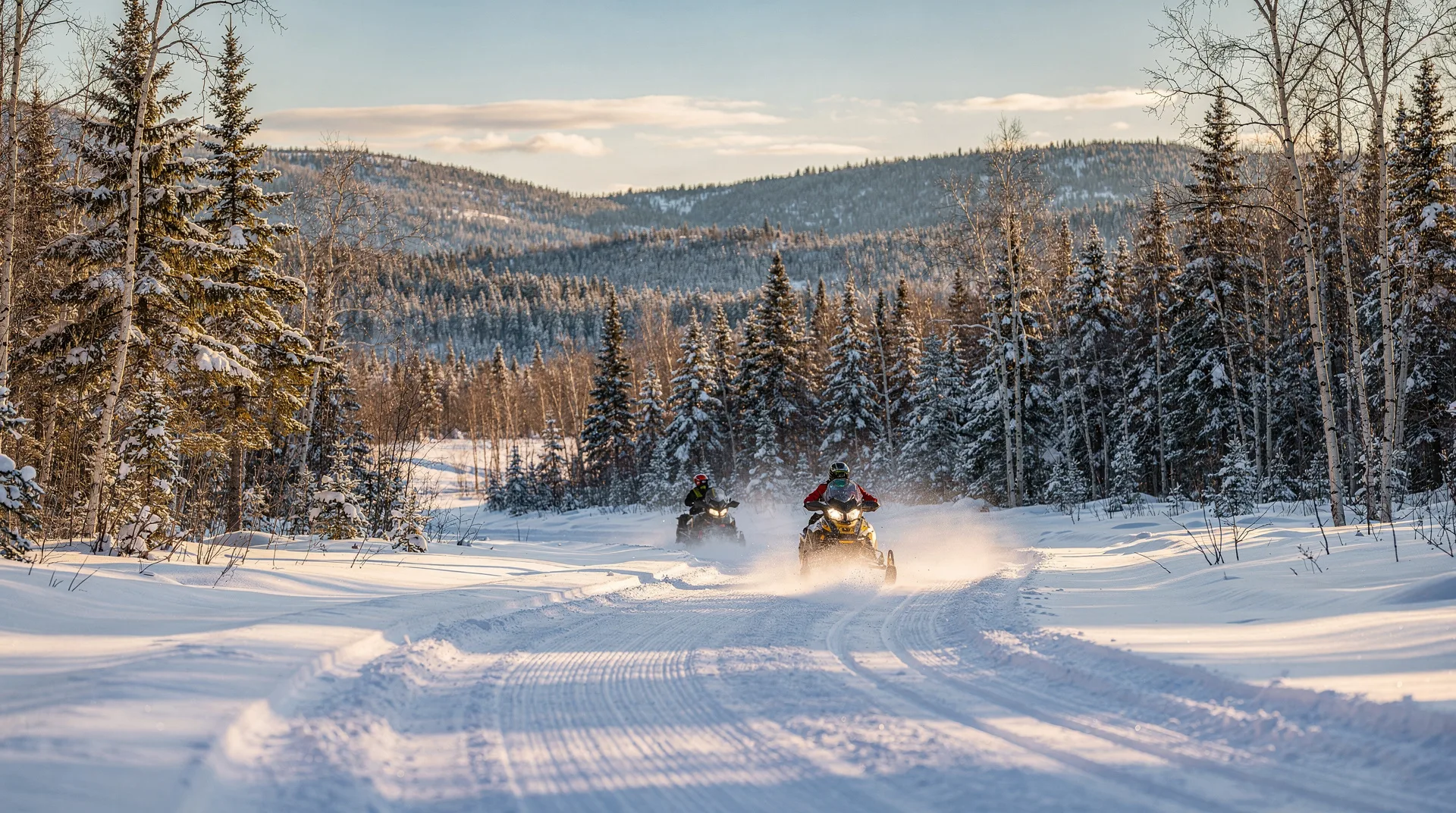
Quebec snowmobiling: guide to the world's best trail network
Quebec operates the largest organised snowmobile trail network on earth: 33,000 kilometres of groomed trails maintained by 200 volunteer clubs under the Fédération des clubs de motoneigistes du Québec (FCMQ). The network connects every region of inhabited Quebec, from the Laurentians outside Montreal to the far north of the Saguenay and the Gaspé Peninsula, and the system is the backbone of a genuine winter economy — with lodging, restaurants, gas stations and repair shops specifically designed around snowmobiling travellers. For international visitors interested in the sport (or a guided first experience), Quebec is arguably the best place in the world to do it.
This guide covers the permit system, trail basics, the best regions for different levels, and how to organise a trip — including the guided package options most international visitors choose.
| At a glance | |
|---|---|
| Where | Laurentians (closest to Montreal), Saguenay-Lac-Saint-Jean, Charlevoix, Gaspésie, Abitibi-Témiscamingue, far north Nord-du-Québec |
| Cost | around $180-300 CAD for a guided half-day, $70-360 for a self-guided permit depending on duration |
| Time needed | a half-day taster is possible, but a 2-5 day guided expedition is where the network’s scale pays off |
| Getting there | fly into Montreal or Quebec City, then drive or transfer to a regional hub — see Canada car rental |
| Best time | roughly early December to mid-March, with February as the reliable deep-snow peak; see Quebec in winter |
The basics
The FCMQ trail system
- Length: 33,000 km of official groomed trails.
- Rating: trails designated “sentier régional” (regional), “sentier Trans-Québec” (long-distance), and local connectors.
- Grooming: club volunteers groom trails after snowfalls; condition reports on the FCMQ website.
- Season: typically early December to mid-March, varying by latitude. Far north regions extend to April.
Permits — required for all riders
Every snowmobile on Quebec trails requires a valid trail permit (droit d’accès). This is separate from provincial registration.
- Annual permit: ~$360 for the full season (best value for residents or heavy users).
- 7-day permit: ~$215.
- 3-day permit: ~$150.
- Day permit: ~$70.
Permits purchased online at FCMQ.qc.ca; display the permit sticker on your sled.
Licensing
- Drivers 16-17: must hold a Quebec ATV/snowmobile certification (take course in advance).
- Drivers 18+: no special licence required for visitors.
- Alcohol: zero-tolerance for operators. Treat trails like public roads.
Insurance
Liability insurance is mandatory. Rental operators include it; own-sled visitors need their own policy.
Best regions by type of trip
Laurentians — closest to Montreal
The Laurentians offer the most accessible snowmobile trails for Montreal-based riders or international visitors. Trail density is high, services plentiful.
- Access hub: Sainte-Agathe-des-Monts, Mont-Tremblant, Saint-Donat.
- Experience: mid-range trails, many connecting to each other; good for multi-day loops without long distance commitment.
Saguenay-Lac-Saint-Jean — the classic trail region
The go-to region for serious Quebec snowmobilers. Lac Saint-Jean’s 200-km perimeter is a legendary loop; Saguenay Fjord trails offer dramatic scenery with trail-side snowmobile lodges.
- Access hub: Saguenay city (YBG airport), Alma, Jonquière.
- Experience: long-distance Trans-Québec trails, deep-winter scenery (Feb is peak), classic Saguenay lodges like Auberge des Îles and Chalets Lanaudière catering specifically to sleds.
- Season: reliable mid-December to late March.
Charlevoix — dramatic terrain
Charlevoix’s meteorite-crater topography creates dramatic snowmobile trail scenery — river valleys, steep ridges, forested plateaus. Narrower trail network than the Saguenay, but one of the most scenic.
- Access hub: Baie-Saint-Paul, La Malbaie.
- Experience: shorter distances but high-scenery; great for pairing with ski trips.
Gaspésie — the adventure option
Gaspésie’s Chic-Chocs mountains host Quebec’s most challenging snowmobile terrain. Trails cross the mountain range at 1,000-metre elevations.
- Access hub: Sainte-Anne-des-Monts, Murdochville.
- Experience: Trans-Québec trails with legitimate mountain character. For serious riders only.
Abitibi-Témiscamingue — the long-distance wilderness
Far-western Quebec offers the sense of deep wilderness riding, with 4,500 km of trails and genuinely remote lodging. For riders prioritising solitude.
Far North — Nord-du-Québec
Beyond the grid. Fly-in snowmobile expeditions across Nunavik and north of La Vérendrye reserve. Specialist outfitters only.
First-time or guided options
For international visitors without their own gear and experience, guided packages are the standard approach.
Day-trip guided tours
Half-day or full-day tours from Laurentians resorts (Mont-Tremblant, Saint-Sauveur) and Charlevoix (Fairmont Le Manoir Richelieu). Include sled rental, gear, fuel, guide, trail fees.
- Cost: $180-300 adult for half-day; $350-500 full-day.
- Languages: bilingual French/English.
You can compare departure points, durations and prices on this list of guided tours in Quebec before choosing a half-day taster.
Multi-day expedition packages
2-5 day guided tours including lodging, meals, and inter-lodge snowmobile transport. Classic options include the 3-day Saguenay Fjord loop and the 5-day Eastern Quebec Route (Charlevoix-Saguenay-Lac-Saint-Jean).
- Cost: $1,500-3,500 per person for 3-day packages.
- Operators: Motoneige Expert, Aventure Écotourisme Québec members.
Self-guided with rental
Rent a sled from a dealer (Sherbrooke, Sainte-Agathe, Saguenay, Alma) and plan your own route. Requires FCMQ permit, insurance, experience with trail navigation.
- Rental cost: $250-400/day plus permit and fuel.
What to wear
Proper gear is non-negotiable; ride temperatures are 10-20°C colder than ambient due to wind.
- Snowmobile suit: one-piece insulated suit (rental operators supply).
- Helmet: full-face with face shield or goggles (supplied).
- Boots: insulated waterproof boots; neoprene covers if available.
- Mittens: heated mittens are a quality-of-life upgrade for long days.
- Base layers: merino wool.
- Balaclava: essential.
Trail etiquette and safety
- Single file: on marked trails.
- Cross only at marked crossings: public roads and railways.
- Speed limits: 70 km/h general; 50 km/h approaches to villages; 30 km/h in villages.
- Stay on trails: off-trail riding damages forest and is illegal on private land.
- Alcohol: illegal while operating; designate a sober rider if evening activities include drinking.
- Emergency: inform someone of route and ETA; cell coverage patchy in far regions.
Where to stay
“Relais motoneige” — snowmobile-oriented lodges — exist across Quebec. Many offer trail-side check-in, secure sled parking with plug-in for heat packs, fuel on site, and hearty meals. Classic examples:
- Auberge des Îles (Saint-Gédéon, Lac Saint-Jean).
- Hôtel Motel Boreal (La Doré).
- Auberge La Pinsonnière (La Malbaie, Charlevoix).
- Hôtel Gouverneur (Sainte-Marie, Beauce).
Most are book-direct; snowmobile clubs often have negotiated rates.
Practical tips
- Conditions: check the FCMQ interactive trail map before departure. Some trails close after thaws.
- Fuel: trail gas stations are spaced roughly every 50-80 km. Fill up at every opportunity on long tours.
- Navigation: GPS devices with FCMQ trails preloaded are standard. Paper map backup advised.
- Insurance: verify coverage specifically includes Quebec trails; some US policies exclude.
- Currency / language: French is dominant in rural Quebec; English welcomed in tourism settings.
- Pair with: Quebec winter 7-day itinerary, Quebec in winter, Saguenay-Lac-Saint-Jean.
Choosing a region: how they compare
| Region | Best for | Difficulty | Access |
|---|---|---|---|
| Laurentians | first-timers, short multi-day loops close to Montreal | Easy-moderate | closest hub, see Mont-Tremblant |
| Saguenay-Lac-Saint-Jean | serious long-distance riders wanting the classic experience | Moderate | fly into Saguenay or drive from Quebec City |
| Charlevoix | scenery-focused riders pairing snowmobiling with skiing | Moderate | close to Charlevoix ski country |
| Gaspésie | experienced riders wanting genuine mountain terrain | Hard | remote, long drive from Quebec City |
| Abitibi-Témiscamingue / far north | solitude-seekers and specialist expeditions | Hard | fly-in or long-distance driving only |
Combining snowmobiling with the rest of a Quebec winter trip
Snowmobiling rarely stands alone in a Quebec winter itinerary — most international visitors pair a day or two of riding with skiing, a sugar shack visit, or a city stop. A Laurentians-based rider can easily add a day in Mont-Tremblant for skiing, or drive back to Montreal for the Quebec Winter Carnival if the dates line up.
A Charlevoix trip pairs naturally with a stop at Hôtel de Glace near Quebec City, and the classic Saguenay expedition slots well into a broader Quebec winter 7-day itinerary that also covers Quebec City’s Old Town. For visitors deciding how much of the trip to dedicate to snow sports versus culture, Quebec winter activities gives the wider picture.
Planning the logistics before you go
Getting to the trail network
Most visitors arrive through Montreal or Quebec City, and the choice shapes the whole trip. The Quebec entry gateways guide compares the options, and from Montreal covers the road side for anyone heading straight to the Laurentians. The run north is covered in Montreal to Mont-Tremblant, which is the simplest way into the closest snowmobiling country. Anyone driving in January or February should read driving in Quebec in winter first: the road to the trailhead can be as demanding as the trail itself, and a rental car needs the right tyres and a patient driver.
Choosing your dates
The deep-snow weeks make the best riding, but they are also the busiest and coldest. Canada in February explains what that month feels like on the ground, and Canada in winter gives the wider seasonal picture. Early-season and late-season trips are quieter, though trail conditions depend more on recent weather, so keep the plan flexible and check grooming reports before committing to a long loop.
Packing and preparation
Rental operators supply the sled-specific gear, but you still bring everything that sits under the suit. The packing list is a useful starting point for cold-weather layers, and the advice above on merino base layers, a balaclava and warm mittens applies on every ride. Pack a spare pair of gloves and a dry change of clothes for the evening, because a sweaty layer left on after a stop cools quickly. Before leaving home, read Canada travel insurance alongside your sled rental terms, so you know exactly what is covered if a day goes wrong.
Language on the trail
Tourism operators handle English comfortably, but trail signs, club notices and small-town lodges lean heavily on French. A few phrases go a long way when asking about trail conditions or ordering a meal at a relais. Speaking French in Quebec and English in Quebec set realistic expectations, and the Quebec English reality piece is worth a read for anyone heading well outside the main cities.
Making the most of the day on the trail
A good snowmobiling day is paced rather than rushed. Plan the ride in stages, with a warm-up stop mid-morning, a proper lunch at a trail-side restaurant, and an early finish so the last hour is not spent riding tired in fading light. Short winter days make the afternoon the part to protect. Riders who push on to cover extra distance usually remember the cold more than the scenery.
Keep a steady spacing behind the sled ahead, stay alert at every crossing, and agree on hand signals with your group before leaving the lodge. If you ride in a group, the least experienced rider sets the pace, and the strongest rider takes the back so no one gets left behind. Take the time to look up from the trail too: frozen lakes, snow-loaded spruce and open river valleys are the reason this network is worth riding. Safety basics that apply across Canadian winter travel are collected in the safety guide, and the Canada wildlife safety page is useful for riders heading into remote forest.
Other winter experiences to combine with a ride
Snowmobiling pairs well with other cold-weather activities, and many lodges can arrange them on the same stay. For extra days off the sled, browse winter tours across Canada to book other activities.
- Dog sledding gives a quieter, slower contrast to engine-powered travel. See dog sledding in Canada.
- Snowshoeing suits a rest day when you want to walk the same forests at your own pace: snowshoeing in Canada.
- Cross-country skiing uses similar groomed corridors in many regions: cross-country skiing in Canada.
- Ice fishing is a social, low-effort afternoon on a frozen lake: ice fishing in Canada.
- Stargazing rewards clear, cold nights away from city light: Quebec dark-sky preserves.
If snowmobiling is one of several stops rather than the whole trip, the broader snowmobile tours in Canada guide shows how Quebec compares with other provinces, and the Quebec 7-day itinerary shows how winter days can be spread across the region.
Regional notes worth knowing
The Laurentians suit riders who want comfort and short transfers, with plenty of lodging and a gentle way to learn the rhythm of the trail system. Charlevoix and the nearby Tadoussac area reward those who value views and river-side villages over raw distance. Saguenay-Lac-Saint-Jean remains the place for long days and a real sense of travelling across the landscape, while Gaspésie is where experienced riders go once they trust their skills and their gear. Whichever region you choose, treat the trail network as a shared resource maintained by volunteers: stay on the marked route, respect closures, and leave villages quiet when you pass through.
Frequently asked questions about Quebec snowmobiling
Do I need snowmobiling experience to book a guided tour in Quebec? No. Guided half-day and full-day tours from Laurentians and Charlevoix resorts are designed for first-timers, with a guide, basic instruction, and all gear included. Multi-day expedition packages generally assume at least some prior riding comfort.
Is Quebec snowmobiling only for experienced cold-weather travellers? Not exclusively, but proper gear and respect for the cold are non-negotiable. Rental operators supply insulated suits, boots and helmets, and guided tours pace the day around warm-up stops, so a fit first-timer with the right clothing can manage a half or full day comfortably.