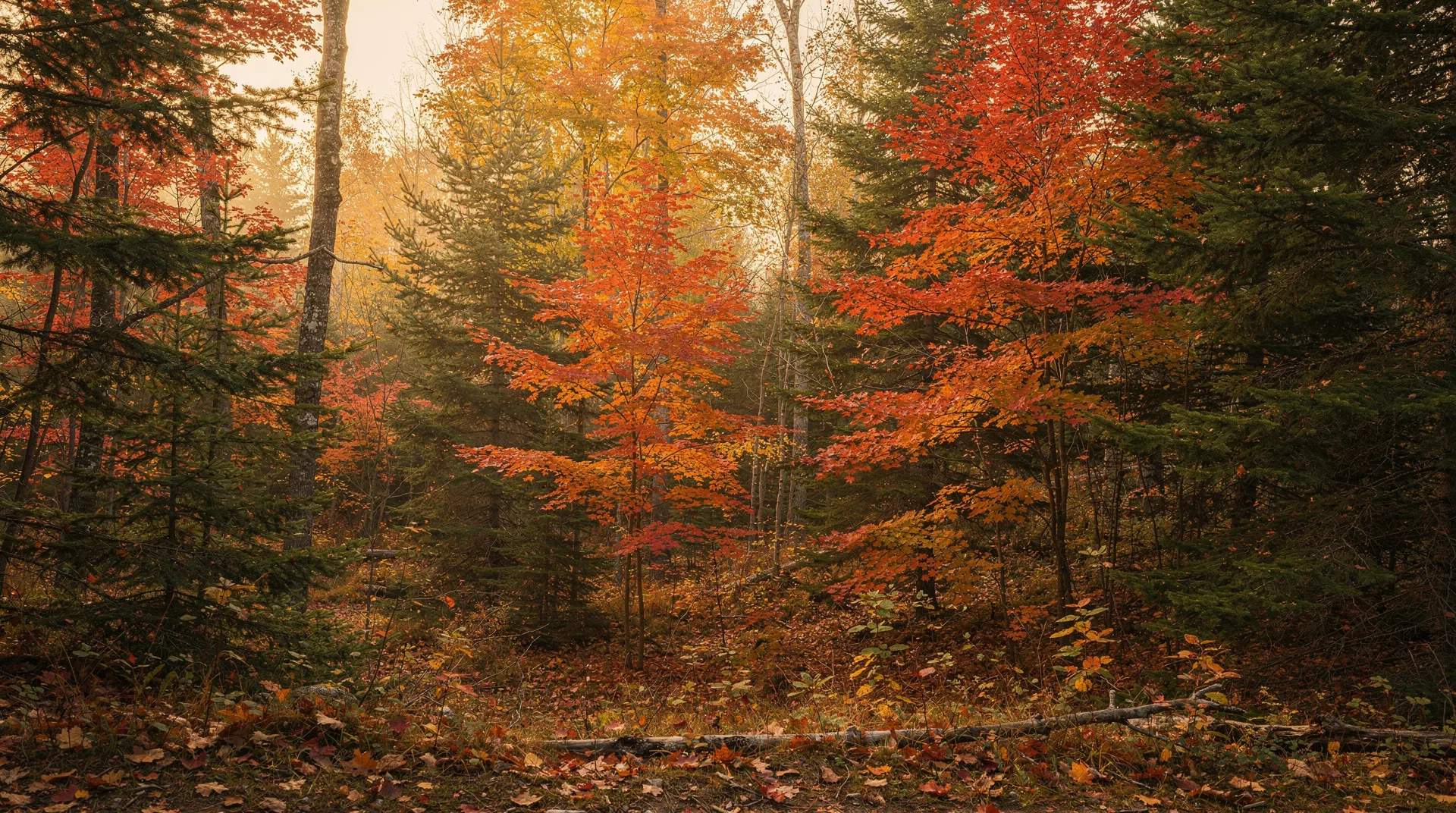
Where to See Quebec Fall Foliage: Charlevoix, Mauricie, Laurentians Week by Week
Where is the best fall foliage in Quebec?
Quebec's finest fall foliage concentrates in four regions: Charlevoix (best late September), Mauricie national park (best first week of October), the Laurentians around Mont-Tremblant (first two weeks of October), and the Eastern Townships (second week of October). Each region has a distinct character beyond the colour itself.
Quebec’s fall foliage season is one of the most spectacular natural events in North America, and arguably the most underappreciated. New England’s autumn colours receive international attention; Quebec’s are comparable in intensity and dramatically superior in scale, covering hundreds of thousands of square kilometres of sugar maple, red maple, yellow birch, and trembling aspen. The province’s French-speaking culture, historic villages, and local food scene add layers of experience that a pure foliage-chasing trip cannot find in Vermont or Maine.
The challenge is timing. Quebec’s colour season is condensed — roughly three to four weeks from peak-northern to peak-southern — and varies by one to two weeks between years depending on summer rainfall and September temperatures. This guide provides a week-by-week framework for the main foliage regions and the practical information needed to position yourself at the right place at the right time.
| At a glance | |
|---|---|
| Where | Charlevoix, Mauricie, the Laurentians, Eastern Townships and Quebec City — all reachable from Montreal or Quebec City by car |
| Cost | Free to view from public roads and viewpoints; ticketed extras like the Mont-Tremblant gondola or Le Massif run roughly CAD 30-50 per adult |
| Time needed | A long weekend covers one region well; 7 days lets you chase the colour gradient across three or four regions (see our 7-day fall itinerary) |
| Getting there | Fly into Montreal (YUL) or Quebec City (YQB) and rent a car — see renting a car in Canada |
| Best time | Late September (Charlevoix, northern Laurentians) through mid-October (Eastern Townships, Montreal) |
Understanding Quebec’s foliage calendar
The science of fall colour is well established. Shorter days trigger the cessation of chlorophyll production in deciduous trees; as the green pigment fades, the underlying yellow, orange, and red pigments become visible. Red maples and sumacs are typically the first to colour, followed by sugar maples (the primary source of Quebec’s most intense reds and oranges), yellow birch, and aspens. The exact timing depends on temperature — specifically, the number of nights below 10°C and the arrival of the first hard frost.
In Quebec, this process moves from north to south and from higher elevations to lower, providing a predictable geographic sequence:
Week 1 (typically late September): Colour begins at the highest elevations and northernmost regions — the highlands of Charlevoix, the Saguenay–Lac-Saint-Jean plateau, and the upper Laurentians. Approximately 25–40% colour in these zones.
Week 2 (typically first week of October): Peak colour arrives in Charlevoix’s coastal areas, Parc national de la Mauricie, and the upper Laurentians (including Mont-Tremblant). This is often the single best week in the entire season for the most dramatic, most photogenic conditions.
Week 3 (typically second week of October): Peak colour in the lower Laurentians, the Quebec City region and surrounding hills, and the Eastern Townships. The season’s climax for the most populous regions.
Week 4 (typically mid-October): Late colour on Montérégie flatlands, the St. Lawrence lowlands, and Montreal’s island itself. Mont-Royal Park holds maple colour well into mid-October.
These are averages. In a warm autumn (which delays colour onset), everything shifts one to two weeks later. In a cold, wet September, colour can arrive a week early and be less intense. Quebec’s Sépaq (provincial parks) publishes a weekly colour report from mid-September onward that is the most reliable real-time source.
Charlevoix: the river view and the highland colour
Charlevoix is where Quebec’s fall foliage is at its most dramatic in terms of landscape setting. The region occupies a meteor impact crater (the Charlevoix astrobleme) that created a bowl of hills rising steeply from the St. Lawrence. The combination of hardwood forest on the hillsides and the broad, tidal river below — with the Laurentian mountains visible across the water on clear days — produces a foliage experience unlike anything in the province.
When to go
Charlevoix typically reaches peak colour in the last week of September and the first days of October. The highland forests above Baie-Saint-Paul and Les Éboulements colour slightly earlier than the coastal strip along Route 138. Aim for the last full week of September for the most complete highland-to-river colour display.
Best viewing spots
Route 362 between Baie-Saint-Paul and La Malbaie: This coastal road — slower and more winding than Route 138 — follows cliff-edge terrain above the river through a series of hamlets and farm properties. The views combine patchwork agricultural fields, maple forest, and the St. Lawrence in a sequence of panoramas that rewards slow, frequent stops. La Malbaie is an attractive town with good hotels for a one or two-night base.
Le Massif de Charlevoix ski mountain: The ski mountain (also the location of the Charlevoix Railway terminal) rises to 770 metres above sea level. The summit trail network is accessible by foot in fall, and the views from the top — looking out over the river valley and the coloured hillsides — are exceptional. In October before the ski season opens, hiking the upper slopes is a genuine alpine colour experience.
Cap-Tourmente: Technically in the greater Quebec City area, Cap-Tourmente at the eastern end of Île d’Orléans marks the beginning of the Charlevoix coastal zone. In addition to the snow geese that stage here in fall (see our Quebec in October guide), the hillside maple forests above the tidal flats turn in late September.
Les Éboulements: This village inland from the Route 138 coast road offers panoramic views over the crater landscape. The Moulin de l’isle-aux-coudres and the farms of the Hautes-Charlevoix plateau provide a pastoral context to the colour.
Book a Quebec City to Charlevoix fall foliage day tourMauricie: the lake reflections
Parc national de la Mauricie, located midway between Montreal and Quebec City on Highway 55, is Quebec’s most photogenic fall foliage national park. The park’s interior is a landscape of rocky outcrops, boreal lakes, and dense mixed forest. The combination of colour-reflected lakes and hillside maples produces conditions ideal for canoe photography.
When to go
Mauricie peaks in the first week of October in a typical year. The park’s position at mid-latitude means it follows Charlevoix by approximately a week. The colour here is not as early as the northern Laurentians but is often more sustained — a longer period of near-peak colour before the leaves drop.
Best viewing spots
Lac Wapizagonke: The park’s centrepiece lake, accessible by canoe from the Wapizagonke day-use area. Paddling its 17-kilometre length in early October, with the surrounding hills in full colour reflected in the lake surface, is one of Quebec’s finest fall experiences. Canoe rentals are available from the park until mid-October.
Le belvédère de la Roche: A short trail from Highway 55 leads to an elevated viewpoint with broad views over the Mauricie plateau. The 2.4-kilometre walk is accessible to most fitness levels and rewards the effort in peak colour season.
Camping Wapizagonke and the interior lakes: For visitors willing to spend a night in the park, interior camping in October offers the combination of fall colour and the near-silence of a park with dramatically reduced crowds after Labour Day. The park’s interior campsites are accessible by canoe portage.
The Highway 55 corridor: The access road through the park itself — a 60-kilometre scenic route connecting Saint-Jean-des-Piles to Saint-Mathieu-du-Parc — passes through mature mixed forest that creates a tunnel of colour in peak season. Even without leaving the car, the drive is worth the detour.
The Laurentians: the mountain village season
The Laurentians — the ancient rounded mountains that rise north of Montreal — are Quebec’s most visited fall foliage region for the simple reason that they are closest to the province’s largest population centre. But the region also offers genuine quality: Mont-Tremblant in fall colour, with its car-free pedestrian village and gondola to the summit, is a legitimately spectacular destination rather than merely a convenient one.
When to go
The upper Laurentians (Mont-Tremblant, Saint-Jovite, Labelle) peak in the first week of October in a typical year, approximately in sync with Mauricie. The lower Laurentians (Saint-Sauveur, Sainte-Adèle, Sainte-Agathe-des-Monts) follow by approximately three to five days.
The Festival des couleurs at Mont-Tremblant — with live music, local food markets, and gondola access to the summit — runs on weekends through early October and coincides with peak foliage.
Best viewing spots
Mont-Tremblant gondola: The eight-person gondola rises to the 875-metre summit of Mont-Tremblant. In fall colour, the 360-degree view from the summit — 675 metres above the valley floor — covers the Laurentian plateau in every direction, a sea of orange, red, and gold extending to the horizon. Allow two hours for the gondola round-trip and summit walk.
Route 117 north from Saint-Sauveur to Mont-Tremblant: The main highway through the Laurentians passes through the heart of the fall colour zone. While not a scenic road in itself, the side roads connecting the villages — through Sainte-Adèle, Sainte-Agathe-des-Monts, and Saint-Faustin-Lac-Carré — provide more intimate colour experiences. The road between Val-David and Val-Morin, following the Rivière du Nord valley, is particularly attractive.
Parc national du Mont-Tremblant: The larger provincial park surrounding the ski resort encompasses over 1,500 square kilometres of boreal and mixed forest. The La Pimbina sector near Saint-Donat has excellent walking trails above a series of lakes. The park’s entrance at L’Assomption sector offers the most accessible colour hiking.
Lac Ouimet and Lac Mercier viewpoints: Several small lakes near Mont-Tremblant village provide excellent morning reflection photography when conditions are calm. Lac Mercier, within walking distance of the pedestrian village, colours beautifully in the first week of October.
Book a Montreal to Laurentians fall foliage guided day tourEastern Townships: farmland and vineyard colour
The Cantons-de-l’Est (Eastern Townships) southeast of Montreal offer the most pastoral fall foliage experience in Quebec. The region’s rolling hills, covered bridges, white-steepled churches, farmsteads, and growing number of vineyards create a countryside that combines autumn colour with a distinct agrotourism culture.
When to go
The Eastern Townships peak approximately one week after the Laurentians — typically in the second week of October. The region’s position south of Montreal, at lower elevation than the northern zones, gives it the latest foliage peak of the major regions. This makes it a natural final stop on a foliage progression from north to south.
Best viewing spots
Sutton and the Brome-Missisquoi hills: The hills around the village of Sutton are among the most consistently scenic in the region. Mont Sutton ski area provides viewpoints; the roads through the villages of Abercorn and West Bolton pass through dense maple forest. Sutton itself has excellent independent restaurants and art galleries.
Knowlton (Lac-Brome): This anglophone village on the shores of Lac-Brome is one of the most attractive in the Eastern Townships. In fall, the village’s heritage buildings and lakeside position make for appealing wandering. The Lac-Brome Duck Festival (fêtes des canards — a different kind of fall tradition) runs in early October.
Route 112 through Granby and Waterloo: The main east-west highway through the region is lined with farms and orchards in fall harvest mode. Apple orchards (cideries), pumpkin farms, and vineyard tasting rooms line the road in October.
Orford and the Memphrémagog lake shore: Mont Orford provincial park provides elevated viewpoints above the Eastern Townships, and the lake shore south toward Magog is at its most colourful in mid-October. The Circuit des Arts, a regional studio tour, runs in September and early October.
Quebec City region: the city in colour
Quebec City itself — specifically the Plains of Abraham, the valley of the St. Charles River, and the hillsides of Beauport — provides exceptional fall colour with the additional context of the historic fortified city.
The Plains of Abraham battlefield park, now a broad public green space on the cliff top above the St. Lawrence, is lined with mature sugar maples that turn brilliant gold and orange in the second week of October. Walking the plains in peak colour, with the Citadel at one end and the Château Frontenac visible from multiple vantage points, is one of the finest urban fall foliage experiences in Canada.
The Valcartier gorge north of the city and the hills of Charlevoix-East visible from the Observatoire de la Capitale (the glass-topped tower in downtown Quebec City, 31st floor observation deck) provide panoramic colour views. The island of Île d’Orléans, a 30-minute drive from the city, keeps its agricultural patchwork of apple orchards, pumpkin fields, and maple woodlots in warm colour through mid-October.
Practical tips for planning a foliage trip
Check real-time reports: Quebec’s Sépaq parks system publishes weekly foliage status reports beginning in mid-September. These are reliable and region-specific. Check them the week before your departure rather than relying on average dates.
Weekdays over weekends: Fall foliage weekends in Quebec — particularly the Thanksgiving long weekend (second Monday of October) — are the busiest travel period of the autumn. Roads into the Laurentians can back up significantly on Friday evenings. Mid-week visitors enjoy dramatically better conditions: empty viewpoints, available parking, restaurant tables without waits.
Book accommodation early: Mont-Tremblant specifically fills completely on October peak weekends months in advance. If you are targeting the Festival des couleurs weekend, book at minimum two months ahead. Quebec City hotels are somewhat easier to secure but also fill in peak colour weeks.
Car is essential: Quebec’s fall foliage regions are not accessible by public transport in any meaningful way. A rental car is required for the Mauricie, Charlevoix, Eastern Townships, and Laurentians experiences. See the Quebec entry gateways guide for airport options.
Quick reference: peak week by region
| Region | Typical peak week | Character |
|---|---|---|
| Charlevoix (highlands) | Late September | Dramatic crater topography above the St. Lawrence |
| Mauricie national park | First week of October | Reflective lakes, canoe photography, longer-lasting colour |
| Upper Laurentians (Mont-Tremblant) | First week of October | Mountain village, gondola access, most crowded |
| Quebec City region | Second week of October | Urban maples on the Plains of Abraham, Île d’Orléans orchards |
| Lower Laurentians | Three to five days after the upper zone | Village roads, less crowded than Mont-Tremblant |
| Eastern Townships | Second week of October | Farmland, vineyards, covered bridges — the latest of the major regions |
| Montreal / Montérégie | Mid-October | Last colour of the season, Mont-Royal holds late |
Because the peak moves south over roughly three weeks, a single well-timed trip can realistically catch two or even three regions near peak if you follow the gradient rather than fixing on one destination and date. Our 7-day fall itinerary is built around exactly this progression, and pairs well with the wider best time to visit Quebec overview if your dates are flexible.
Combining regions without overreaching
The single biggest planning mistake is trying to cover all five regions properly in under a week. Charlevoix and Mauricie sit roughly two hours apart via Quebec City, but the Eastern Townships are a further two-and-a-half to three hours south, on the opposite side of Montreal from the Laurentians. A realistic long weekend covers Charlevoix and Quebec City, or the Laurentians alone; a full week can add Mauricie or the Townships without feeling rushed. If hiking is a priority alongside the driving, the Quebec hiking guide and the Quebec national parks overview cover trail options inside Mauricie, Hautes-Gorges and Mont-Tremblant park in more depth than this guide has room for.
Related guides
- Quebec in October: fall foliage, cranberry harvest and snow geese
- Charlevoix 4-day foodie escape
- 7 days in Quebec: Montreal, Quebec City and a day in Charlevoix
- 14 days in Quebec: complete province grand tour
Frequently asked questions about Where to See Quebec Fall Foliage: Charlevoix, Mauricie, Laurentians Week by Week
What is the exact week for peak fall colour in Quebec?
There is no single week — Quebec’s foliage peak runs from late September (Charlevoix and northern Laurentians) through mid-October (Eastern Townships and Montreal area). The province-wide colour window spans approximately three weeks. If you must choose a single date, the first week of October covers the maximum number of regions at or near peak simultaneously.
Which Quebec foliage region is best for photography?
Mauricie national park offers the best combination of reflective lakes, accessible viewpoints, and dense foliage density for photography. Charlevoix provides the most dramatic landscape scale. The Laurentians around Mont-Tremblant offer the best infrastructure and gondola access to elevated viewpoints. For morning light photography, the lakes of Mauricie and the coastal road of Charlevoix are the highest-quality locations.
Is it worth renting a car specifically for fall foliage in Quebec?
Yes, without question. Quebec’s fall foliage is fundamentally a rural, driving experience. The most spectacular locations — Charlevoix coastal road, Mauricie interior, Laurentian valley routes — are inaccessible by bus or train. Guided day tours from Montreal and Quebec City cover some ground, but the freedom to stop at a viewpoint for an hour, double back on a particularly beautiful road, or add a detour to a lake trail is the essential characteristic of a genuine foliage trip.
How many days do you need to see Quebec’s fall foliage properly?
A long weekend (3-4 days) is enough to see one region well — Charlevoix or the Laurentians, paired with a day in Quebec City or Montreal. A full 7 days lets you follow the colour gradient from the northern highlands down to the Eastern Townships, catching two or three regions close to their individual peaks rather than compromising on timing for any one of them. See the 7-day fall foliage itinerary for a day-by-day plan.