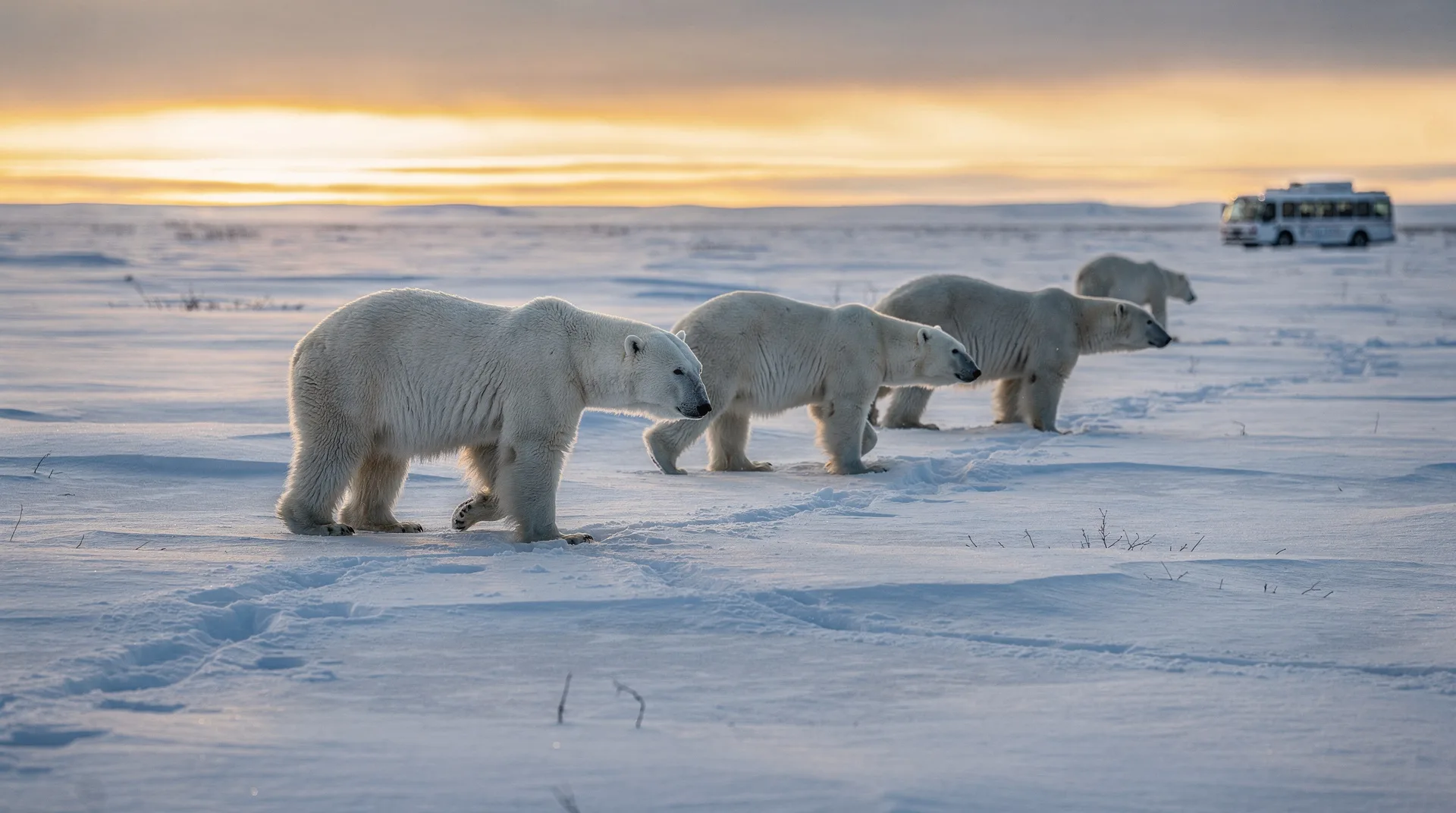
Polar bears in Churchill: the complete visitor guide
When is the best time to see polar bears in Churchill?
Late October to mid-November is peak season. Polar bears gather near Churchill waiting for Hudson Bay to freeze, making it the most accessible place on earth to observe them in the wild. October sees younger bears play-fighting; November brings the freeze-up and the bears' departure onto the ice.
Churchill, Manitoba, sits at the end of a rail line in the sub-Arctic, 1,000 kilometres north of Winnipeg, accessible only by air or by a two-night train journey across the boreal forest. Its permanent population is around 900 people. It has no road connection to the rest of Canada. And yet, for a few weeks each autumn, it becomes one of the most visited wildlife destinations on the planet — because the polar bears come.
Each October and November, polar bears gather on the tundra near Churchill waiting for Hudson Bay to freeze. The bears have spent the ice-free summer fasting on land, conserving energy, and the freeze-up means they can return to the sea ice to hunt ringed seals, their primary food source. Churchill happens to sit at a natural aggregation point, where bears from a broad area converge before the bay freezes. The result is the most accessible polar bear viewing in the world — dozens of bears visible in a single day, often within metres of purpose-built tundra vehicles.
| Where | Churchill, Manitoba, on Hudson Bay, around 1,000 km north of Winnipeg |
| Cost | Tundra buggy day tour around CAD $250-$400; multi-night packages CAD $2,500-$9,000+ per person |
| Time needed | 3-5 days is typical for a proper bear-season trip |
| Getting there | Fly Winnipeg-Churchill (around CAD $500-$900 return) or take VIA Rail’s Canadian prairies route (about 44 hours) |
| Best time | Mid-October to mid-November for peak polar bear numbers |
Why Churchill is the polar bear capital of the world
The geography is decisive. Hudson Bay is the southernmost body of water where polar bears are found, and it freezes later in the southwest — the Churchill area — than anywhere else in the bear’s Arctic range. This forces bears to wait on land for an unusually long time each autumn, and Churchill’s position on a peninsula creates a natural funnel where bears concentrate before moving onto the ice.
The town’s relationship with bears is long and complicated. Churchill has lived alongside polar bears for generations, developing protocols for human-bear coexistence that are studied worldwide. The “Polar Bear Jail” — officially the Polar Bear Alert Program holding facility — temporarily detains bears that wander into town before relocating them. The conservation infrastructure is formidable, and the tolerance of Churchill residents for their unusual neighbours is a model worth understanding.
The bears themselves are mostly waiting — resting, sleeping, occasionally play-fighting — and this lethargic availability is precisely what makes viewing so productive. A bear that might cover 20 kilometres in a day on sea ice is conserving energy on land. You find them on tundra ridges, in willow thickets, along the shoreline of the bay. They are magnificent: creamy white against the grey and rust of the late-autumn tundra, far larger in person than any photograph prepares you for.
The tundra buggy experience
The tundra buggy is the iconic Churchill vehicle — essentially a school bus on enormous balloon tyres, capable of crossing the boggy tundra without damaging the permafrost. Windows open fully for photography. The high clearance means bears sometimes stand below to investigate the enormous metal thing parked in their territory, producing the surreal experience of a 450-kilogram predator at arm’s length on the other side of an open window.
Several operators run tundra buggy day tours. The Tundra Buggy Lodge — a connected set of carriages parked overnight on the tundra — allows multi-night stays directly among the bears, waking to bears passing camp at dawn and watching sunsets over the tundra before dinner. These lodge-based experiences are extraordinary but expensive, typically CAD $5,000–$8,000+ per person for a multi-night package.
Day buggy tours from Churchill cover the Wapusk National Park buffer zone east of town, the same terrain where the lodge is situated. These are significantly more affordable and still deliver excellent bear encounters. The key variables are how many bears are present on any given day (which depends on weather and how close the bay is to freezing) and your guide’s knowledge of bear movements.
Book an exclusive tundra buggy day trip in Churchill, ManitobaWalking tours and other wildlife activities
Not all Churchill bear-watching involves tundra buggies. Guided walking tours operate in town and on the tundra, with licensed bear guards carrying deterrents. The protocol is strict — groups stay together, guides lead and tail the group, and the experience of walking in bear country is itself memorable even before any sighting. You can compare guided tours around Churchill, Manitoba to see which formats and dates are available.
Churchill Wild and other operators offer walking safaris with an accompanying bear guard on the Cape Churchill peninsula. These are small-group, high-end experiences that provide an intimacy impossible from a vehicle — though the safety protocols are understandably conservative.
Beyond polar bears, Churchill offers a remarkable concentration of Arctic wildlife. Snowy owls appear in October–November. Arctic foxes are frequently seen, their coats turning white for winter. Ravens are ubiquitous. In July and August, Churchill transforms into one of the best places in North America to see beluga whales, with thousands gathering in the Churchill River — see our whale watching guide for details.
The town is also a globally significant shorebird staging site in July, and northern lights viewing in autumn and winter (November–March) can be spectacular. Churchill’s remote location guarantees dark skies, and the aurora borealis here is frequently among the best in Canada. For dedicated aurora experiences, see our northern lights in Yukon guide.
Season breakdown
Early October (1–15): Bears beginning to arrive in the Churchill area. Younger males often present first. Weather can be mild by local standards (around -5°C to +5°C). Good viewing; fewer bears than peak.
Peak season (mid-October to mid-November): Maximum bear concentration. Play-fighting between young males is at its most theatrical — these sparring matches, practiced for the serious fights of mating season months ahead, are one of the signature Churchill spectacles. Weather deteriorating: expect -10°C to -25°C, wind chill significant.
Freeze-up (mid-November): As the bay freezes, bears begin moving onto the ice. The exodus is gradual and bears can still be numerous until the freeze is complete. By late November most bears have departed.
December–March: Very few bears near Churchill; most are on sea ice hunting seals. The main wildlife draw shifts to northern lights viewing under Arctic skies.
July–August: No polar bears (they are far out on the ice or ashore elsewhere), but Churchill offers world-class beluga whale watching in the river estuary.
How to get to Churchill
By air: Calm Air and First Air operate flights from Winnipeg to Churchill (approximately 2 hours). This is the fastest option; fares are high by comparison with southern Canada (expect CAD $500–$900 return depending on advance booking and season).
By train (Via Rail): The Winnipeg–Churchill service departs Winnipeg twice weekly and arrives approximately 44 hours later, crossing 1,700 kilometres of boreal forest and muskeg. The journey is itself an experience — watching the landscape transition from farm country to boreal forest to tundra, with frequent moose sightings from the dome car. Book well ahead as polar bear season trains fill months in advance.
Most visitors book through tour operators who arrange flights, accommodation, and wildlife activities as a package. This is by far the simplest approach given Churchill’s limited accommodation and the complexity of logistics.
Costs
| Item | Approximate cost (CAD) |
|---|---|
| Return flight Winnipeg–Churchill | $500–$900 |
| Tundra buggy day tour | $250–$400 per person |
| Tundra Buggy Lodge (3 nights) | $5,000–$8,000+ per person |
| Budget hotel per night | $150–$220 |
| Mid-range package (3 nights, tours) | $2,500–$4,000 per person |
| Premium package (5 nights, full program) | $5,000–$9,000 per person |
Prices spike dramatically in peak season (late October–early November). Booking 6–12 months ahead is not excessive.
What to pack
Churchill in October–November is genuinely cold, with temperatures regularly reaching -20°C to -30°C with wind chill. Tundra buggies are heated, but you will spend time outside, and the walk from hotel to vehicle in town can be unpleasant in poorly chosen clothing.
- Insulated waterproof parka rated to at least -30°C
- Insulated trousers (snow pants) or ski pants
- Wool or synthetic thermal base layers (two pairs minimum)
- Insulated and waterproof boots rated to -40°C (Baffin or Sorel)
- Wool or fleece mid-layers
- Neck gaiter and balaclava
- Heavy mittens with liner gloves
- Hand and foot warmers (essential for photography)
- Telephoto lens (at least 300mm); camera batteries drain fast in cold — keep spares inside clothing
- Headlamp for early morning and after dark
Most Churchill tour operators provide a kit list well in advance. Do not improvise cold-weather gear; the consequences of being under-dressed in Churchill are genuinely unpleasant.
Planning your Churchill trip
The mechanics of booking a tundra buggy tour — vehicle types, day-tour versus lodge formats, and operator comparisons — are covered in detail in our Churchill tundra buggy tours guide. For a full trip budget beyond the buggy tours themselves, see what a Churchill trip costs, and for transport options in more depth see how to get to Churchill. A ready-made 5-day Churchill polar bear itinerary is a useful starting point for structuring the trip day by day.
Where to stay in Churchill
Churchill has limited accommodation, particularly during peak bear season when the town is essentially sold out. Book as far in advance as possible.
Lazy Bear Lodge: The most popular mid-range option. Locally owned, excellent wildlife programming, communal dining. A genuine Churchill institution.
Churchill Northern Studies Centre: Scientific research station that accepts tourist visitors. Spartan but fascinating; the opportunity to talk to working researchers is a bonus.
Tundra Inn: Basic but well-located in town. Good budget option if Lazy Bear is full.
Tundra Buggy Lodge: Parks overnight on the tundra; guests eat, sleep and wake up among the bears. The ultimate Churchill experience but priced accordingly.
Most independent travellers book a package through operators like Natural Habitat Adventures, Frontiers North, or Churchill Wild that include accommodation, transfers, and wildlife activities. This dramatically simplifies logistics in a town where self-catering is limited and bear safety protocols apply even in the town centre.
Frequently asked questions about Polar bears in Churchill: the complete visitor guide
Is it safe to be around polar bears?
In the controlled setting of a tundra buggy or guided walking tour with trained bear guards, it is safe. Churchill operators have decades of experience and impeccable safety records. Bears are habituated to tundra vehicles and largely ignore them. Wandering alone in bear country without a guide is a different matter — the town has strict protocols about solo movement outside town during bear season.
Can I see polar bears from town?
Bears occasionally wander into or near Churchill town, but this is increasingly rare due to active management by the Manitoba Conservation Polar Bear Alert Program. Most viewing is on the tundra east of town in the Wapusk National Park buffer zone. Day tours are necessary for reliable sightings.
How many bears can I expect to see in a day?
On a good day in peak season, 20–40 bears might be seen on a tundra buggy tour. Five to fifteen bears would be a typical day. Rarely, conditions are poor and sightings are limited — weather, wind direction, and whether the bay is close to freezing all affect bear distribution.
What if I’m not physically fit?
Tundra buggy tours involve boarding a high vehicle (steps are steep; some operators have assistive steps) and sitting for 6–8 hours. There is modest walking involved. Most reasonably mobile adults can manage this. Walking safaris are more physically demanding. Let your operator know of any limitations when booking.
Can I take my children?
Churchill is appropriate for children old enough to understand safety protocols and tolerate a cold, long day outdoors. The bear sightings are spectacular for children and the sense of being somewhere genuinely remote and wild is educational. Most tour operators welcome children aged 8 and above; check with your specific operator.
Is the climate changing the polar bear season?
Yes, significantly. Later freeze-ups due to warming temperatures mean bears spend longer on land each year, arriving in increasingly poor physical condition. Earlier spring melt shortens the hunting season. Churchill’s polar bears are a sentinel species for climate change impacts in the Arctic; their population and condition are closely monitored. This makes the experience of seeing them both magnificent and sobering.
What other wildlife will I see?
Arctic foxes, snowy owls, ravens, ptarmigan and (in good years) great grey owls are reliably seen. Caribou pass through the area seasonally. In July–August, Hudson Bay is full of beluga whales and Churchill becomes a completely different kind of wildlife destination.
Do I need travel insurance for Churchill?
Strongly recommended. Medical evacuation from Churchill is expensive and there are no specialist medical facilities in town. Comprehensive travel insurance including emergency evacuation is standard for any Arctic wildlife trip.
Should I book a day tour or the Tundra Buggy Lodge?
A day tour (around CAD $250-$400 per person) covers the essential experience for most visitors. The Lodge (CAD $5,000-$8,000+ per person for 3-5 nights) suits dedicated photographers and wildlife enthusiasts who want maximum bear time and dawn-to-dusk access on the tundra. See our tundra buggy tours guide for a full comparison.
Is there another way to see Churchill’s wildlife outside bear season?
Yes. July and August bring world-class beluga whale watching in the Churchill River estuary — see our whale watching in Canada guide — and the aurora borealis is often excellent from late autumn through winter; see our Churchill aurora guide.