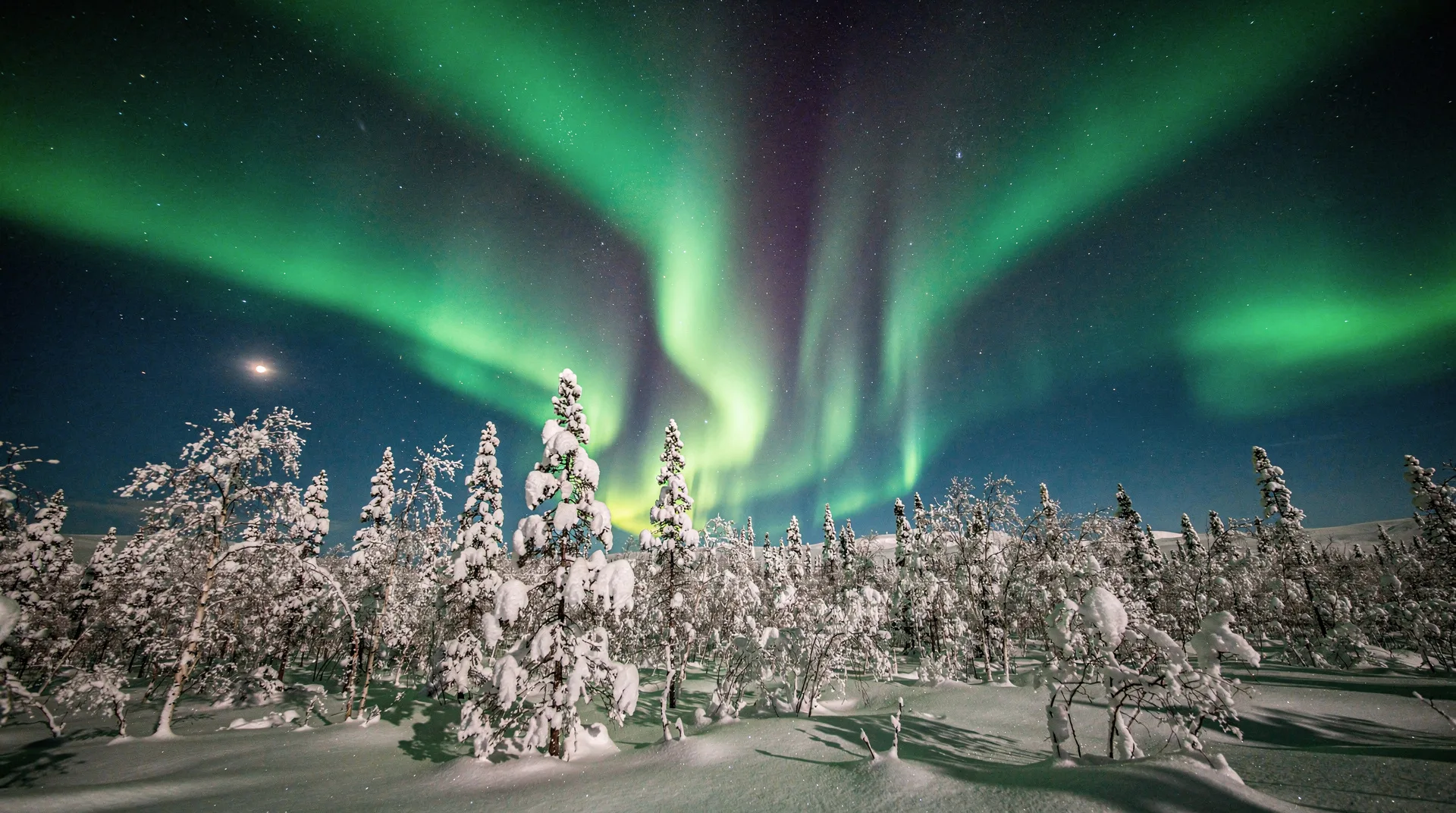
Northern lights in Yukon and the Northwest Territories
When is the best time to see the northern lights in Yukon?
Late August through April offers darkness sufficient for aurora viewing, but mid-September to mid-March is the sweet spot. The equinoxes (September and March) are statistically peak periods for geomagnetic activity. Clear, cold nights away from town give the best chance.
| At a glance | |
|---|---|
| Where | Whitehorse, Yukon, and dark-sky sites within 15-40 km; Yellowknife, NWT as an alternative base |
| Cost | Guided aurora tour around CAD $95-180 per person; multi-night packages around CAD $1,000-2,500 |
| Time needed | 3-5 nights gives a strong (roughly 80-90%) chance of at least one clear display |
| Getting there | Direct flights from Vancouver to Whitehorse |
| Best time | Mid-September to mid-March, with the equinox months statistically strongest |
The aurora borealis is among the most extraordinary natural phenomena on earth, and the Yukon and Northwest Territories sit directly beneath the auroral oval — the ring-shaped zone of maximum activity that encircles the geomagnetic North Pole. On a clear, dark winter night above 60 degrees latitude, the sky comes alive: curtains of green light ripple and fold, sometimes shooting upward in rays, occasionally flushing pink or purple at their upper margins. It moves with an unpredictability that makes it perpetually mesmerising — appearing as a low, static arc on the horizon, then detonating into a full-sky display that leaves you standing in the snow with your neck craned back, forgetting entirely that it is -25°C.
Canada’s north offers some of the most accessible aurora viewing in the world. Whitehorse, Yukon’s capital, has direct flights from Vancouver and is serviced by a growing infrastructure of aurora lodges and tour operators. Yellowknife in the Northwest Territories is globally recognised as one of the top three aurora destinations in the world. Both are serious destinations that can deliver extraordinary experiences — and both require some understanding of how the aurora works to maximise your chances.
How the aurora borealis works
The aurora is caused by charged particles from the sun — the solar wind — interacting with Earth’s atmosphere. When these particles collide with atmospheric gases at high altitudes (typically 100–300 km up), they excite those molecules, which release energy as light when they return to their ground state. Oxygen at around 100 km gives the most common green colour; oxygen at higher altitudes produces the rarer red; nitrogen produces blue and purple tones.
The display is governed by two factors: solar activity (more activity means more charged particles and stronger displays) and geomagnetic conditions (the orientation of the solar wind’s magnetic field determines how effectively particles enter the atmosphere). Neither is precisely predictable more than 24–48 hours in advance, which means aurora viewing involves genuine uncertainty.
The Kp-index (a global scale from 0–9 measuring geomagnetic disturbance) is the aurora watcher’s key metric. A Kp of 2–3 is sufficient for excellent displays at Whitehorse and Yellowknife latitudes. Kp 5+ means a geomagnetic storm and aurora visible much further south. Free apps (Space Weather Live, My Aurora Forecast) provide real-time Kp data and short-range forecasts.
Why Yukon and NWT are premier aurora destinations
The geography matters. Both Whitehorse and Yellowknife sit within the auroral oval, meaning the northern lights are directly overhead rather than on the horizon. More importantly, the continental interior climate of both territories produces the clear skies that aurora viewing demands — coastal locations like Vancouver Island or even coastal Norway see frequent cloud cover that obscures the aurora even when it is active.
The Yukon interior averages around 230 clear nights per year. The absence of light pollution is total once you leave the towns: Yukon has a population of roughly 45,000 people in an area larger than California. Drive 20 minutes from Whitehorse in any direction and the sky is perfectly dark.
The aurora season aligns neatly with the winter tourism calendar. From mid-August the nights are dark enough; by September the aurora season is fully underway. October through February delivers the longest dark hours and coldest temperatures (which, counterintuitively, tend to correlate with the clearest skies). March extends the season with lengthening daylight also bringing good conditions.
Book a late-night aurora borealis viewing tour from WhitehorseTop viewing locations in Yukon
Whitehorse: The logical base for most visitors. Fly in, spend 3–5 nights, join guided tours or self-drive to dark sky sites. The Alaska Highway north of the city, Marsh Lake south of town, and the Fish Lake Road all offer excellent dark-sky access within 15–25 minutes. Several operators run dedicated aurora lodges and heated warming huts on private tundra land where groups watch together with expert commentary.
Kluane National Park and Reserve: The largest non-polar icefield in the world sits in this park at Yukon’s southwest corner. The combination of glacier, mountain, and boreal forest scenery under the aurora is exceptional. The small community of Haines Junction provides basic accommodation; Kluane Lodge offers guided experiences in the park area.
Carcross and the Southern Lakes region: The Carcross Desert — technically a series of sand dunes left by glacial lake drainage, often called the world’s smallest desert — makes a surreal foreground element for aurora photography. The nearby alpine environment and access to the White Pass and Yukon Route railway adds heritage interest. Good base for self-driving aurora chasers.
Tombstone Territorial Park: Three hours north of Whitehorse on the Dempster Highway, Tombstone offers wilderness aurora viewing in a genuinely remote Arctic landscape. The “gothic peaks” of the Tombstone Range make extraordinary silhouettes under an active aurora. Campground use is summer only; winter access is for experienced wilderness travellers with proper equipment and cold-weather skills.
Dawson City: At 64 degrees north, Dawson City sits slightly further into the auroral oval than Whitehorse. The historic Klondike Gold Rush town has limited winter tourism infrastructure but an authentic frontier character that pairs well with aurora watching. The Midnight Dome viewpoint above town is well-positioned.
Northwest Territories: Yellowknife
Yellowknife, the NWT capital, is globally marketed as an aurora destination with justification. It sits at 62 degrees north in a climate zone that averages more than 200 clear nights annually. The aurora season is essentially identical to Yukon: late August through April.
Yellowknife has developed a substantial aurora tourism industry, particularly around the Japanese market (Japan has the world’s largest per-capita interest in aurora travel). Aurora Village, 25 km from Yellowknife, operates heated teepees and wickiups where groups watch the sky in reasonable comfort with guides and warming food. Cameron Falls and Prelude Lake are popular self-drive dark-sky sites.
The Great Slave Lake, one of the deepest lakes in the world, provides sweeping open views of the northern horizon and spectacular reflections of aurora in open water during the brief shoulder periods when the lake is not frozen. Ice fishing shelters on the frozen lake in deep winter provide another unusual vantage point.
Browse all northern lights tours across YukonBest time to see the aurora
August–September: Nights darken but are not yet extremely long. September equinox is statistically one of the two best months for geomagnetic activity. Temperatures relatively mild (-5°C to +10°C at night). Good option for those uncomfortable with serious cold.
October–November: Excellent dark hours. Autumn colours fading to bare branches, which make clean silhouettes for photography. Cold beginning (-10°C to -25°C). This is when aurora lodges fill up with serious aurora chasers.
December–January: Maximum dark hours (Whitehorse gets about 6 hours of daylight in December). Very cold (-20°C to -35°C or colder). Exceptional aurora viewing when skies are clear. Christmas and New Year peak season; book early.
February: Still cold and dark. Some operators consider this their best month for display quality. Slightly longer days than December–January. Popular with photographers for blue-hour landscape work.
March: Equinox month — geomagnetically excellent. Days lengthening noticeably. A good balance of reasonable daylight for sightseeing and dark nights for the aurora. Temperatures beginning to moderate.
April: Aurora season ending as nights shorten. Tail end of the season; fewer tours operating but still possible on clear nights around the new moon.
Aurora season at a glance
| Period | Darkness | Temperature | Verdict |
|---|---|---|---|
| Late Aug-Sep | Nights just dark enough | -5°C to +10°C | Good for cold-averse visitors; equinox activity is strong |
| Oct-Nov | Long dark hours | -10°C to -25°C | Excellent conditions; lodges start filling |
| Dec-Jan | Maximum darkness | -20°C to -35°C | Best display frequency; peak season, book early |
| Feb | Still dark and cold | -20°C to -30°C | Favoured by some operators for display quality |
| Mar | Equinox, lengthening days | Moderating | Strong geomagnetic activity with more daylight for sightseeing |
| Apr | Season tapering | Milder | Fewer tours running; last reliable window |
Beyond aurora watching: rounding out a Yukon trip
Aurora viewing only happens after dark, which leaves full days free. Beyond the daytime activities already mentioned, dog sledding in Yukon is the region’s signature winter pairing and most operators run half-day and multi-day trips out of Whitehorse. Visitors curious about the opposite extreme — perpetual daylight rather than perpetual dark — should read the midnight sun in Yukon guide, which explains why the aurora season and the midnight sun season never overlap. For those weighing Yukon against the other major Canadian aurora destination, aurora viewing in Yellowknife covers the Northwest Territories side in more detail than the summary above.
Guided tours vs. self-driving
Guided tours are the right choice for most first-time visitors. A good guide monitors forecasts, knows the best local sites, drives you into the dark (often to private land with no other visitors), provides warming drinks and snacks, and can teach you aurora photography with your own equipment. The social experience of watching a major display with a small group and an excited guide is itself memorable.
Self-driving works well for experienced cold-weather drivers who are comfortable driving on icy roads in the dark. Rent a vehicle with winter tyres (mandatory in Yukon from October 1), download aurora forecast apps, and drive 20–30 minutes from town toward known dark-sky sites. The flexibility is valuable — you can chase a display at 2 am if conditions demand.
Heating is the critical issue. Standing in -25°C watching the aurora sounds romantic until about 20 minutes in. Guided tours with heated structures (tents, huts, cabins) are far more sustainable for multi-hour watching sessions. Self-driving aurora hunters need frequent returns to the warm vehicle.
Aurora photography basics
Aurora photography has never been more accessible. Modern mirrorless cameras and even smartphone cameras with night modes can capture excellent aurora images. The fundamentals:
- Manual mode on a DSLR or mirrorless: ISO 800–3200, aperture f/2.8 or wider, shutter 5–25 seconds depending on aurora speed
- Wide-angle lens (14–24mm) for full-sky shots; 50mm for detail shots of curtains and rays
- Tripod is essential; remote shutter release or 2-second timer prevents camera shake
- Battery: Cold kills batteries. Keep spares in a chest pocket and warm the main battery in clothing before use
- Foreground: A frozen lake, snow-covered trees, or a log cabin dramatically improves aurora images over plain sky
- Smartphones: iPhone 14 Pro and later, Pixel 6 and later, and Samsung Galaxy S22 and later all have excellent astrophotography modes capable of decent aurora images
- Dress for the full session: You will be outside for 1–4 hours
Building a route around the aurora
Because the lights only show after dark, the best Yukon plans treat the days as part of the trip rather than as waiting time. Whitehorse works as the hub: you can base yourself there, join an evening tour, and spend the daylight hours on short outings. If you want a different landscape under the sky, Kluane and the village of Haines Junction add mountain scenery, and the Kluane National Park guide explains what the park offers outside summer.
Travellers who like the idea of a longer road journey can look at the Dempster Highway and Tombstone Territorial Park, though winter conditions there call for real preparation. For a gentler day out from Whitehorse, Carcross is an easy add-on, and Dawson City suits anyone who wants history alongside the night sky.
Choosing your month and your camera plan
If you are still deciding when to go, the Canada aurora best months guide compares the season across the country, and the Canada in winter overview helps you judge whether the cold suits the rest of your trip. Anyone planning to shoot the display themselves will find more technique in the aurora photography guide, which goes further than the basics below. Flights to the territory and onward travel are covered in the getting around Canada guide, and a longer northern trip can be sketched with the 7-day Yukon itinerary.
Costs (in CAD)
| Item | Approximate cost |
|---|---|
| Return flight Vancouver–Whitehorse | $350–$700 |
| Guided aurora viewing tour (4–5 hrs) | $95–$180 per person |
| Aurora photography workshop (full night) | $200–$350 per person |
| Multi-night aurora package (3 nights + tours) | $1,000–$2,500 per person |
| Aurora lodge night with activities | $300–$600 per person |
| Car rental (winter tyres included) | $80–$140 per day |
| Hotel in Whitehorse | $120–$250 per night |
What to bring
- Insulated parka rated to -30°C or colder
- Snow pants or insulated trousers
- Thermal base layers (wool or synthetic, NOT cotton)
- Insulated waterproof boots (-40°C rating recommended)
- Balaclava and neck gaiter
- Heavy mittens over fleece liner gloves
- Hand warmers (chemical; invaluable for photography)
- Tripod if serious about photography
- Fully charged power banks (phones die fast in cold)
- Extra camera batteries kept warm in clothing
Where to stay in Whitehorse
Yukon Inn: Mid-range, central, reliable. Comfortable base for aurora trips.
High Country Inn: Popular with aurora tour groups. On-site restaurant.
Edgewater Hotel: Well-located downtown. Friendly and practical.
Aurora Inn: Smaller property, aurora-focused programming, excellent for serious photographers.
For the full experience, consider a stay at a dedicated aurora lodge. Several operators have built lodges or maintained heated viewing structures on private tundra land 15–40 km from Whitehorse, offering guided viewing with meals included. These typically book as 2–3 night packages.
Combining with other Yukon activities
Aurora viewing is almost always done at night; daytime is fully available for other activities. Popular combinations include:
- Dog sledding (one of Yukon’s signature winter activities; dozens of operators around Whitehorse)
- Snowshoeing in Kluane or Tombstone parks
- Ice fishing on Yukon lakes
- Wildlife watching (moose, wolves, lynx, and eagles are present year-round)
- Visiting Dawson City for Klondike Gold Rush history
- Riding the White Pass and Yukon Route in spring or summer (see our Yukon scenic train guide)
Frequently asked questions about Northern lights in Yukon and the Northwest Territories
Is the aurora visible every night in Yukon?
No. Cloud cover is the main obstacle — even on geomagnetically active nights, clouds obscure the display. Statistically, Whitehorse has 3–4 clear nights per week in winter on average. A 3–5 night stay gives a high probability (roughly 80–90%) of at least one clear display. Longer stays give near-certainty.
Can I see the aurora in summer?
Not practically. The midnight sun means it never gets dark enough between May and late July. Late August sees the first properly dark nights, and this is technically the start of aurora season.
Do I need to go on a guided tour?
No, but it significantly improves the experience for most visitors. Guides know the best sites, chase the forecasts actively, provide warmth and refreshments, and teach photography. Self-driving is viable for experienced cold-weather drivers.
How cold is it really?
In Whitehorse, January averages about -15°C but with wind chill and at night can reach -30°C or colder. Dressing properly makes it entirely manageable for hours of outdoor viewing. The cold is dry, which is considerably more comfortable than damp coastal cold.
Is Yukon or Yellowknife better for the aurora?
Statistically comparable. Yellowknife has a more developed aurora tourism infrastructure (particularly lodge-based viewing). Whitehorse offers more daytime activities (dog sledding, national park access, Gold Rush history) and slightly easier flight connections from Vancouver. For most travellers, Whitehorse is the more well-rounded choice.
Can I see the aurora from inside a heated vehicle or cabin?
You can see strong displays through windows, but the full visual experience requires being outside under open sky. Many guided tours use heated tents or warming huts nearby so you can watch actively outside and warm up every 20–30 minutes.
What camera gear do I need?
A DSLR or mirrorless camera with manual mode and a tripod is ideal. Modern smartphones with night photography modes can also produce decent results. Bringing your camera on the tour and asking your guide for help is the fastest way to learn aurora photography.
Do I need special visas or permits?
Standard Canadian entry requirements apply — see our Canada visa guide. No special permits are required for visitors to Yukon or NWT.
What else can I do during the day while waiting for the aurora at night?
Plenty. Dog sledding is the most popular daytime pairing around Whitehorse, alongside snowshoeing, ice fishing, and wildlife watching. Many multi-night aurora packages build in one or two of these activities.
Should I choose Whitehorse or Yellowknife for my trip?
Both sit within the auroral oval and have comparable odds of a clear display. Whitehorse offers more daytime activity variety and flight connections from Vancouver; see aurora viewing in Yellowknife for how the Northwest Territories side compares in more detail.