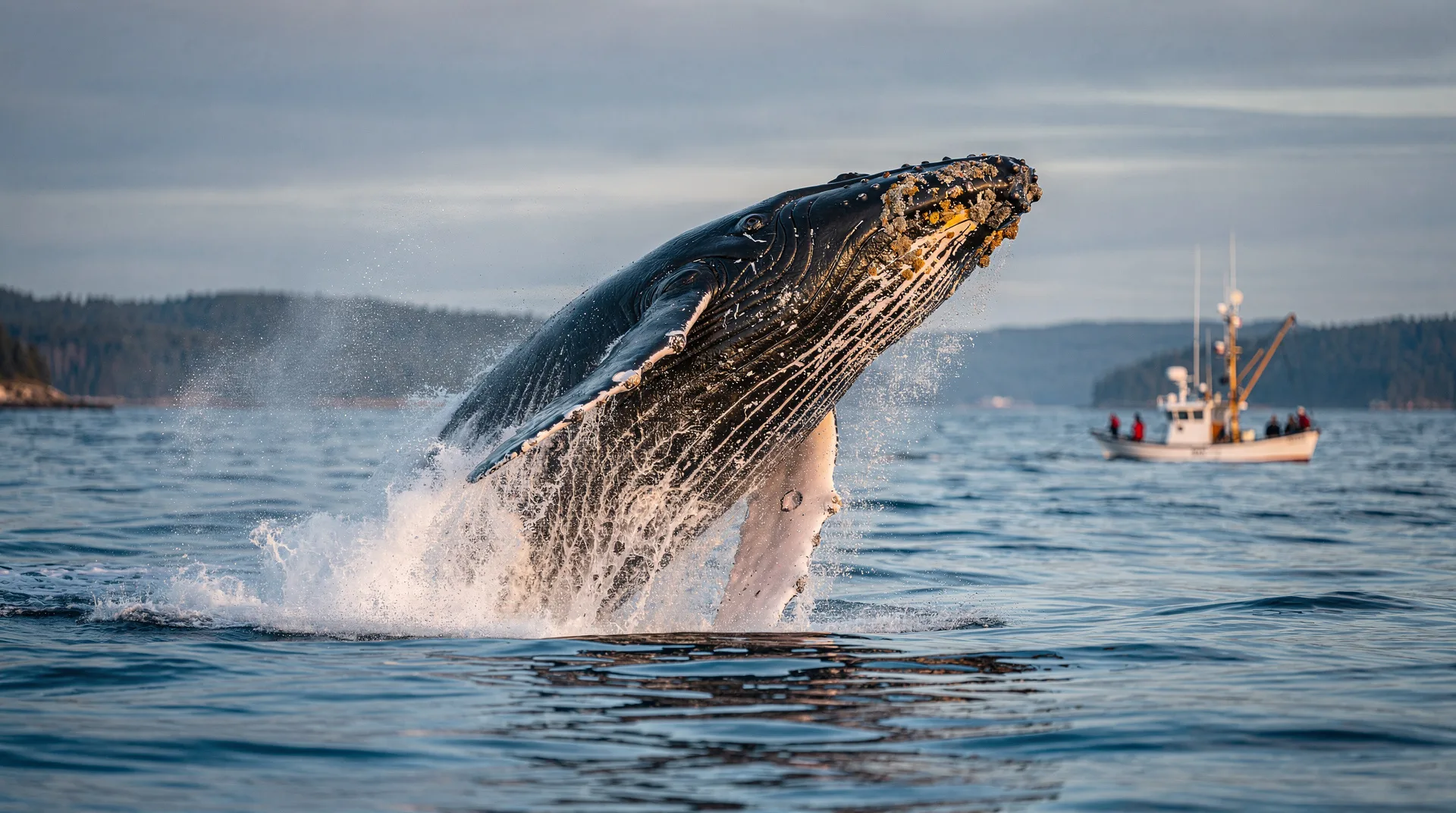
Whale watching in Canada: best places and seasons
Where is the best place to watch whales in Canada?
Tadoussac in Quebec, where the St. Lawrence and Saguenay rivers meet, is arguably the best. Blue, fin, beluga and minke whales gather here from May to October. The Bay of Fundy (New Brunswick/Nova Scotia) and Tofino (BC) are equally impressive, each offering different species and scenery.
Canada has more coastline than any other country on earth — roughly 202,080 kilometres of it — and the whales know this well. From the St. Lawrence Estuary in Quebec to the kelp forests of British Columbia, from the tidal extremes of the Bay of Fundy to the Arctic shallows of Hudson Bay, Canadian waters host an extraordinary diversity of cetaceans. Blue whales, the largest animals ever to have lived on this planet, feed in the Gulf of St. Lawrence. Humpbacks breach dramatically off Vancouver Island. Orca pods patrol the straits of Georgia. And each summer, thousands of beluga whales turn the Churchill River a moving, breathing white.
This guide covers every major whale watching destination in Canada, the species you can expect to see at each, the best time to visit, and how to book a trip that is both unforgettable and responsible.
| At a glance | |
|---|---|
| Where | Tadoussac (QC), Bay of Fundy (NB/NS), Tofino & Victoria (BC), Churchill (MB) |
| Cost | Around $55-$250 CAD per tour depending on region and boat type |
| Time needed | 2-4 hours per tour; a dedicated trip usually justifies 2-4 days on site |
| Getting there | Tadoussac by car/bus from Quebec City; Victoria/Tofino by ferry or flight from Vancouver; Churchill by air or the Via Rail Winnipeg train |
| Best time | Roughly May-October on both coasts, peaking July-September; grey whales pass BC in March-April |
Why Canada is a world-class whale watching destination
The productivity of Canadian waters comes down to oceanography. Cold, nutrient-rich currents upwell along both coasts, feeding massive blooms of krill and small fish that in turn support some of the densest concentrations of large marine mammals anywhere in the world. The St. Lawrence, fed by the Great Lakes watershed, creates a deep, cold mixing zone where freshwater meets salt — an environment so rich it supports fin whales, blue whales, and belugas simultaneously within sight of a single boat.
On the Pacific side, the collision of the Alaska Current with the continent’s edge produces upwelling that supports enormous populations of salmon, herring, and krill. These in turn support resident orca pods with territories that have been studied for decades, humpbacks that have returned in force since hunting ended, and the occasional blue or sperm whale offshore.
What makes Canada particularly special is scale. You are not watching whales through binoculars from a cliff. You are typically within 50 to 100 metres on a zodiac, in silence broken only by the animal’s exhalation — a sound, felt as much as heard, that tends to reorder your sense of priorities permanently.
Tadoussac and the Saguenay–St. Lawrence Marine Park
Tadoussac is the oldest continuously inhabited European settlement in Canada (founded 1600) and the epicentre of St. Lawrence whale watching. The village sits at the mouth of the Saguenay Fjord, where cold, deep Saguenay water flows into the St. Lawrence and creates an upwelling that concentrates krill and small fish in astonishing quantities. The result is one of the most accessible whale watching environments in the world — on many summer days, you can see whales from the shore without boarding a boat.
The marine park protects 1,245 square kilometres of estuary and supports the world’s most studied population of St. Lawrence belugas (roughly 900 individuals), along with minke, fin, humpback, and — in good years — blue whales. The blue whale is the largest animal on earth, reaching 30 metres in length, and seeing one surface alongside a small zodiac is a perspective-altering experience. The St. Lawrence population of blues is considered endangered; their presence here is both a conservation success story and a reminder of how much work remains.
Most whale watching in Tadoussac runs from mid-May through mid-October. June and July are excellent for a range of species. August and September are peak months for blue and fin whales, with sightings remarkably reliable. Zodiac tours get you closer; larger inflatable pontoon boats offer more stability for those prone to seasickness. Local operators include Croisières AML, Zodiac Fjord Aventures, and Famille Dufour Croisières — all operating under strict wildlife-watching guidelines that prohibit approaching whales closer than 400 metres for motorised craft (200 metres for zodiacs under “passive observation” protocols).
Beyond Tadoussac, the Mingan Archipelago on the north shore of the Gulf of St. Lawrence is famous for blue whale encounters. The archipelago’s monolithic limestone formations are surreal even before you factor in the world’s largest animals surfacing nearby.
Browse whale watching and wildlife tours across CanadaBay of Fundy: right whales and the world’s highest tides
The Bay of Fundy, shared between New Brunswick and Nova Scotia, is famous primarily for its tides — the highest in the world, reaching 16 metres in the upper bay at Hopewell Rocks. But the tidal mixing that creates this phenomenon also makes the Bay of Fundy one of the best whale watching locations in the Atlantic world. The tides pull enormous quantities of zooplankton, particularly copepods, into the surface waters, and critically endangered North Atlantic right whales come specifically to feed here in summer.
Right whales are among the most endangered large animals on the planet, with a population estimated at around 360 individuals. The Bay of Fundy’s Grand Manan Basin is one of their primary summer feeding grounds, making a boat trip out of Grand Manan, Digby, or St. Andrews a genuine wildlife conservation experience. Seeing a right whale — a massive, slow-moving animal that feeds at the surface with its mouth open, filtering tonnes of water — is an encounter loaded with meaning given their precarious status.
Humpbacks are numerous and acrobatic in the Bay of Fundy. Fin whales, the second-largest animal species, are common. Minkes are abundant. Harbour porpoises are so ubiquitous they are often ignored in favour of larger quarry, which feels both wasteful and appropriate.
The best whale watching in the Bay of Fundy runs from July through September, with August being peak season for right whale sightings. Operators in Digby, Brier Island, and Grand Manan offer tours of two to six hours. Brier Island, a 45-minute ferry ride from Digby Neck, is particularly beloved — a tiny island at the mouth of the bay with excellent whale watching records and a appealingly remote feel.
Tofino and Vancouver Island: orcas, humpbacks and grey whales
Vancouver Island’s Pacific coast offers some of the most dramatic whale watching in Canada, combining reliable orca sightings with a coastal wilderness landscape that is itself jaw-dropping. The waters around Victoria at Vancouver Island’s southern tip are the territory of resident orca pods — the most studied killer whales in the world, with individual animals named and their family trees documented over decades of research. The southern resident community consists of three pods (J, K, and L) with a total population that has declined to around 75 individuals, making each sighting precious.
Transient (Bigg’s) orcas, which hunt marine mammals rather than fish, range more widely along the coast and are often seen in smaller, quieter groups. They have recovered well and encounters are increasingly common throughout the Salish Sea.
From Tofino on the island’s west coast, grey whale watching is the main event in spring. Grey whales migrate from their Mexican breeding lagoons to Arctic feeding grounds each year, and approximately 20,000 of them pass within sight of the Vancouver Island coast in March and April. Some individuals stop to feed in the shallow bays around Tofino all summer. Humpbacks have returned in large numbers after being essentially absent from BC coastal waters for decades following commercial whaling; they are now frequently seen in summer from both Tofino and Victoria.
Book a whale watching and dolphin tour from VancouverChurchill, Manitoba: beluga whales in the Arctic
Churchill in northern Manitoba is famous worldwide for polar bear viewing, but its summer attraction is equally extraordinary: the annual gathering of beluga whales in the Churchill River estuary and Hudson Bay. Between July and mid-August, an estimated 3,000 to 5,000 belugas congregate in the warm, shallow waters of the estuary to calve, nurse, moult, and socialise. The density of animals is astonishing — standing on the riverbank, you see white shapes everywhere, constant movement, and hear a constant chorus of clicks, whistles and chirps that carries clearly above the water’s surface.
Belugas are exceptionally curious and social animals. Kayaking or snorkelling with belugas is the signature Churchill summer experience — the whales actively approach humans, surfacing to investigate, maintaining eye contact, and occasionally vocalising at close range. This is not observation; it is a two-way encounter. Operators offer guided zodiac tours, kayak experiences, and snorkelling trips under strict guidelines developed with Parks Canada and local First Nations communities.
Churchill is accessible only by air or the Via Rail service from Winnipeg (two nights on the train). Most visitors combine a July beluga trip with the June polar bear cubs, or a late-October/November polar bear viewing trip. See our polar bears in Churchill guide for more detail on the bear-watching season.
BC’s Great Bear Rainforest: humpbacks and coastal wolves
The Great Bear Rainforest, the temperate coastal rainforest stretching from northern Vancouver Island to the Alaska border, offers an immersive wilderness experience that combines whale watching with some of the most spectacular coastal scenery on earth. Humpback whales are now abundant throughout this stretch of coast, frequently seen breaching, lunge-feeding, and tail-lobbing in the narrow channels between island-covered fjords. Orcas patrol these same channels. Dolphins — Pacific white-sided and Dall’s porpoise — often bow-ride ahead of wildlife tour vessels.
The region is accessible primarily by small ship expedition from Prince Rupert or Bella Bella, or via guided lodge-based operations out of Telegraph Cove or Port Hardy. These multi-day journeys also offer the chance to see grizzly bears on the beaches, coastal wolves, and the rare spirit (Kermode) bear — a white-coated subspecies of black bear found only here. If budget allows, a multi-day Great Bear Rainforest expedition is among the most complete wildlife experiences available anywhere.
Best time of year for whale watching in Canada
May–June: First good month for the St. Lawrence (belugas, minkes, first fins). Grey whale feeding season in Tofino. Humpbacks returning to BC coast.
July: Peak beluga season in Churchill. Good all-round whale watching in the St. Lawrence. Bay of Fundy season beginning. BC orcas most reliably active.
August: Prime month almost everywhere. Blue and fin whales reliable in the St. Lawrence. Bay of Fundy right whales at peak. Churchill belugas still present until mid-month.
September: Excellent St. Lawrence season continues. Bay of Fundy humpbacks. BC season still good. Fewer crowds than August.
October: St. Lawrence season ending. Some BC operators run into October for humpbacks and transient orcas.
March–April: Grey whale migration past Vancouver Island. Otherwise the shoulder season for most whale watching.
How to choose a whale watching operator
Look for operators that are members of their regional whale watching association (Whale Watching Operators Association of BC on the Pacific coast; the Association québécoise de l’industrie touristique in Quebec). Members commit to minimum approach distances, engine-off protocols, and time limits near cetaceans.
Smaller boats, particularly zodiacs, get closer and offer better photography — but they are wetter and less comfortable in choppy conditions. Larger vessels provide stability and shelter but typically maintain greater distances. If you are prone to seasickness, choose larger vessels and take medication the night before.
Ask about certification of naturalist guides. The best operators employ marine biologists or wildlife biologists who can contextualise what you’re seeing. The difference between a good and mediocre whale watching tour is largely about the quality of interpretation.
Costs (in CAD)
| Location | Typical tour | Price range |
|---|---|---|
| Tadoussac | 3-hour zodiac | $75–$110 |
| Tadoussac | 3-hour pontoon | $55–$80 |
| Bay of Fundy | 3–4 hour boat | $65–$95 |
| Victoria, BC | 3-hour zodiac | $110–$140 |
| Tofino | 3-hour inflatable | $100–$130 |
| Churchill (beluga kayak) | 2–3 hours | $175–$250 |
| Churchill (zodiac) | 2 hours | $120–$165 |
Most tours charge separately for children under 12 (typically 25–40% discount). Booking online in advance usually saves 5–15%.
What to bring
On any whale watching boat:
- Waterproof jacket (even in summer; spray and wind are guaranteed on a zodiac)
- Warm mid-layer (it is always colder on the water than on shore)
- Non-slip shoes with grip (boat decks get wet)
- Sunscreen and sunglasses (glare on water is intense)
- Motion sickness medication if susceptible
- Binoculars (8×42 is ideal for scanning)
- Camera with a zoom of at least 200mm equivalent
For Churchill beluga snorkelling:
- Wetsuit is typically provided
- Bring a towel and dry clothes for after
- Waterproof camera or phone case
Where to stay near each destination
Tadoussac: Le Moulin à Baude (charming heritage inn), Hôtel Tadoussac (historic, views over the bay), or camping at the provincial park.
Bay of Fundy — Grand Manan: Marathon Inn (historic Victorian property). Limited options; book well ahead.
Bay of Fundy — Brier Island: Brier Island Lodge (basic but perfectly located for whale watching).
Victoria, BC: Wide range from budget hostels to the iconic Fairmont Empress. The Oswego Hotel and Magnolia Hotel are excellent mid-range options.
Tofino: Middle Beach Lodge (adults-only, forest and beach setting), Wickaninnish Inn (luxury, directly on the ocean). Book months ahead for summer.
Churchill: Lazy Bear Lodge (ecolodge with excellent wildlife programming), Churchill Wild (luxury fly-in lodges outside town).
Pairing whale watching with the rest of a trip
Tadoussac fits naturally into a wider Charlevoix or Saguenay-Lac-Saint-Jean loop out of Quebec City; the Quebec 7 days itinerary can be extended by 2 days to add Tadoussac without rushing. On the Atlantic side, a Bay of Fundy whale watching day slots well into the Fundy loop 7 days or a wider Atlantic Canada 10 days trip, with Hopewell Rocks as a natural add-on for the same tides that feed the whales.
In BC, combine a Victoria orca tour with a stop at Tofino for grey whales, or build both into a Vancouver Island 7 days route. Churchill belugas pair most often with the polar bears in Churchill guide trip in autumn, or with the Churchill polar bear 5 day itinerary if you want both bears and belugas timed around the shoulder season.
Frequently asked questions about Whale watching in Canada: best places and seasons
Is whale watching in Canada guaranteed?
Nothing in wildlife watching is guaranteed, but the major Canadian destinations have very high sighting rates in season — Tadoussac and Churchill in particular routinely achieve 95%+ sighting success during peak months. Most operators offer a second trip free if no cetaceans are seen.
Which is better: zodiac or larger boat?
Zodiacs get lower to the water, closer to animals, and provide more exciting photography opportunities. They are wetter, less stable, and not suitable for people with back problems, pregnancy, or severe motion sickness. Large pontoon or cruiser vessels are more comfortable and accessible. For first-time visitors, especially families, a larger vessel is usually better.
Can children go whale watching?
Yes, and whale watching is frequently one of the highlights of a family trip to Canada. Most zodiac operators have a minimum age of around 6 years; some set it at 10. Larger vessels typically have no minimum age. Check with your specific operator.
Is whale watching ethical?
Responsible whale watching, under current Canadian regulations and best-practice guidelines, is considered by marine biologists to have minimal impact on cetaceans and to generate significant conservation benefits through public engagement and operator fees that partly fund research. Choose operators that follow Transport Canada’s small vessel regulations and voluntary whale-watch guidelines.
What species can I see in the St. Lawrence?
The St. Lawrence marine park hosts beluga (year-round, but best July–August), minke (May–October), fin (July–October), humpback (July–October), blue (August–September, variable), and occasionally sperm, sei, and pilot whales. Harbour porpoises are common throughout.
Can I see orcas in eastern Canada?
Orcas are rare but not unheard of in Atlantic Canada, occasionally appearing in the Gulf of St. Lawrence. For reliable orca sightings, the Pacific coast — Victoria, Campbell River, or Telegraph Cove — is the correct destination.
How do I get to Tadoussac?
From Quebec City (about 210 km), drive Highway 138 east to Baie-Sainte-Catherine and take the free ferry across the Saguenay. The crossing takes 10 minutes. Alternatively, Intercar runs buses from Quebec City. The Saguenay-Lac-Saint-Jean region has no direct rail service.
Is Churchill worth visiting just for belugas?
Absolutely. The beluga experience in Churchill is one of the most unusual wildlife encounters in the world. The snorkelling with belugas, the sheer density of animals in the river, and the remote Arctic setting combine to create something genuinely difficult to replicate elsewhere. Most visitors also see polar bears, Arctic foxes, and tundra birds on a summer Churchill trip.
What should I do if I only have one day for whale watching in Canada?
Pick the destination closest to your existing route rather than making a special trip. From Vancouver or Victoria, a single Victoria orca tour needs no extra travel day; from Quebec City, a Tadoussac day trip (about 210 km each way) is doable, though an overnight makes it far less rushed. Trying to combine two whale watching regions in one trip usually means one of them gets a compromised, weather-dependent single shot.
Do I need to book a whale watching tour in advance?
In July and August, yes — book at least a few days ahead for Tadoussac, Victoria and Tofino, and months ahead for Churchill given its very limited lodge capacity. Shoulder months (May, June, September, October) usually allow booking a day or two out, though weekends still fill up.