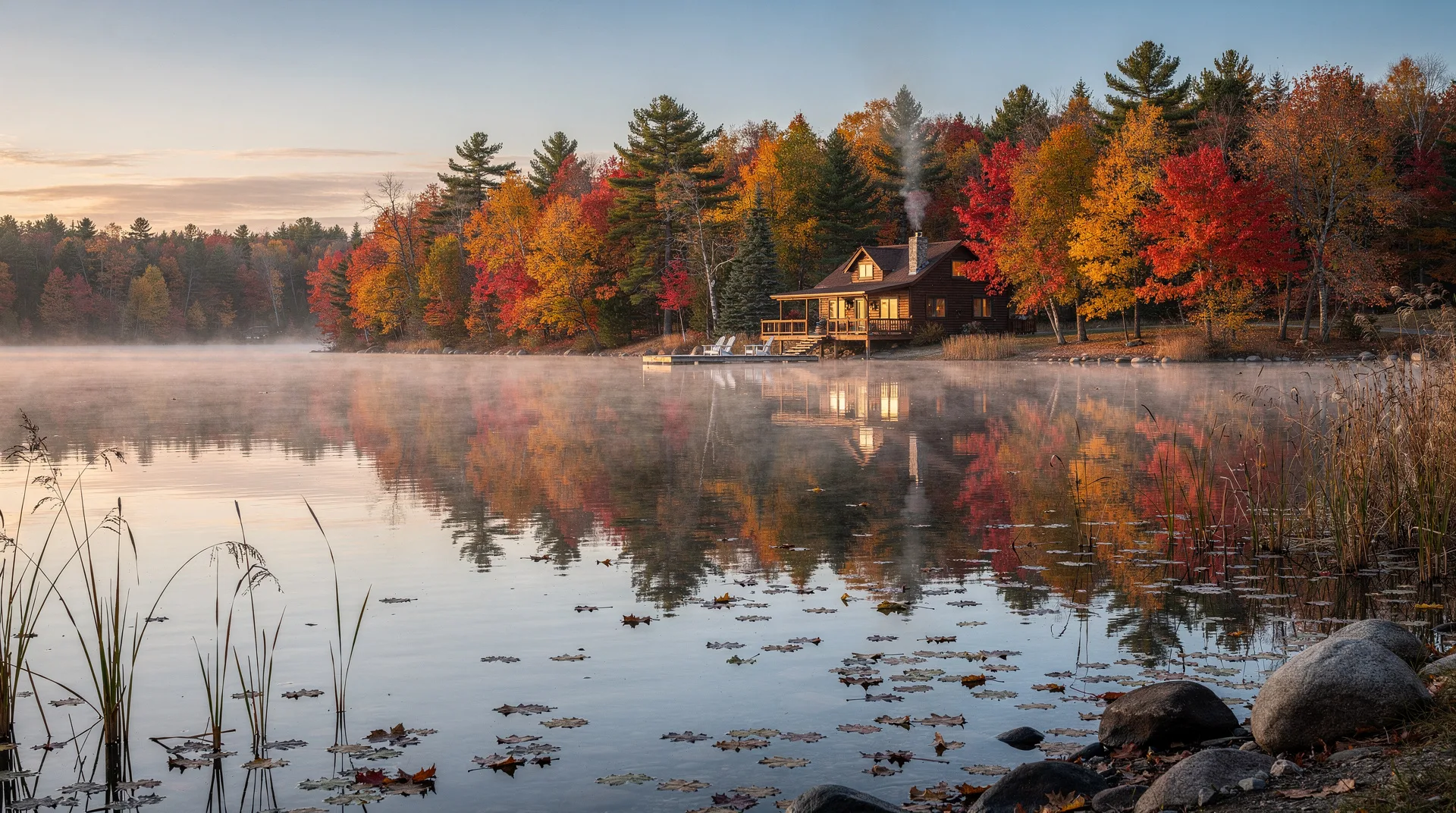
Ontario Cottage Country: Muskoka, Kawarthas & Haliburton Guide
What is Ontario cottage country and where is it?
Ontario cottage country refers to the lake-rich region north of Toronto extending from Muskoka in the west through the Kawarthas to Haliburton in the east — hundreds of lakes on the Canadian Shield where generations of Ontarians have summered. It lies roughly 1.5 to 3 hours from Toronto by car.
The phrase “going to the cottage” carries enormous weight in Ontario. It is not merely a description of a vacation plan — it is a cultural statement, a declaration of belonging to a summer ritual that has defined central Canadian leisure for over 150 years. Ontario cottage country is the collective name for the lake-rich region north of Toronto where granite, forest, and water meet in a landscape that has become inseparable from the province’s self-image.
Three regions compose the core of this territory. Muskoka is the prestige address — the Big Three lakes, the heritage resorts, the most valuable cottage real estate in Canada. The Kawarthas offer a different experience: a network of lakes and rivers connected by the historic Trent-Severn Waterway, warmer water, more accessible terrain, and a less stratified social atmosphere. Haliburton sits between them in geography and character — quieter and less developed than Muskoka, with forest and lakes that attract those seeking a slower pace.
This guide covers all three regions with enough detail to help visitors decide where to go and what to expect from each.
| At a glance | |
|---|---|
| Where | North of Toronto: Muskoka (west), Kawarthas (centre/south), Haliburton (east) |
| Cost | Cottage rentals from a few hundred to several thousand CAD per week; provincial park camping is far cheaper |
| Time needed | A long weekend for one region, a week to see all three at a relaxed pace |
| Getting there | Car only — 1.5 to 3 hours from Toronto depending on region; no meaningful public transit |
| Best time | July-August for full lake and resort season, June or late September for fewer crowds and lower prices |
Muskoka: the classic cottage country
Muskoka is where Ontario cottage country began and where it reaches its most concentrated expression. The region centres on three large lakes — Lake Muskoka, Lake Rosseau, and Lake Joseph — set in ancient Canadian Shield granite about 200 kilometres north of Toronto. The landscape is immediately recognizable: pink granite outcrops at the waterline, white pine and birch meeting the rock, clear lake water reflecting the summer sky.
The towns of Gravenhurst, Bracebridge, and Huntsville are the service hubs. Gravenhurst, at the south end, has the Muskoka Wharf heritage district and the historic steamship RMS Segwun. Bracebridge has the highest concentration of restaurants and cafés. Huntsville, the largest and northernmost, is the gateway to Algonquin Provincial Park and has a lively independent downtown.
For visitors without their own cottage, the options include resort stays (Windermere House on Lake Rosseau, Deerhurst Resort north of Huntsville, JW Marriott The Rosseau Muskoka), vacation rental cottages through VRBO and Airbnb, and public camping at Arrowhead Provincial Park near Huntsville and several smaller conservation areas.
The lakes are the focus of most Muskoka activity: swimming from granite point beaches, canoeing and kayaking, motorboat cruises, paddleboarding, and the quintessential Muskoka experience of doing nothing particularly productive on a dock in the afternoon sun. The Muskoka Lakes cruise operates historic steamships from the Muskoka Wharf for those who want the lake experience without private boat access. If you would rather have a guide handle the logistics, you can browse guided tours in Ontario before you go.
Fall colour in Muskoka (late September through mid-October) is spectacular — the mixed hardwood and pine forest against the granite lake shores produces the defining Ontario autumn image. This is also the time when accommodation is more available and the crowds are thinner than in summer.
See the dedicated Muskoka travel guide for full details on accommodation, restaurants, and activities.
The Kawarthas: canals, warm lakes, and waterways
The Kawarthas are not the Muskoka alternative that people choose when they cannot afford Muskoka — they are a genuinely different lake district with their own distinct character and appeal. The region sits about 150 kilometres northeast of Toronto, centred on the city of Peterborough and extending through the lakes of Chemong, Katchewanooka, Clear, Stoney, Lovesick, and Balsam.
What distinguishes the Kawarthas from Muskoka is the Trent-Severn Waterway — a 386-kilometre canal system built between 1833 and 1920 that connects the Bay of Quinte on Lake Ontario to Georgian Bay via a chain of lakes and rivers, lifted and lowered by 44 locks. The waterway is navigable by pleasure craft from spring through autumn, and the experience of travelling through it — passing through historic lock stations, tying up in small waterway towns, watching the water level rise and fall in the lock chambers — is one of the most distinctive freshwater travel experiences in Canada.
The Kawarthas’ water is warmer than Muskoka’s — the lakes here are shallower, on less rocky terrain, and heat up faster in summer. Swimming tends to start earlier in the season and the sandy-bottom lake beaches are more common. The terrain is also flatter and less dramatic, which some visitors prefer.
Peterborough is the regional hub — a city of 90,000 with a university, a decent arts scene, and the Peterborough Lift Lock, the highest hydraulic lift lock in the world (it raises and lowers boats 20 metres between the upper and lower sections of the Trent-Severn). The lock is a National Historic Site and the view from the upper level — looking down on the boat that has risen with you — is an unexpectedly dramatic engineering experience.
Bobcaygeon is the most popular of the smaller Kawartha towns — a cottage community that sits where Pigeon Lake meets Sturgeon Lake, with a working lock, a busy main street in summer, and a reputation for being the friendliest and most relaxed of the Kawartha villages. It is also the setting of the Tragically Hip’s song “Bobcaygeon,” which has given it a specific cultural resonance among a generation of Canadians.
Fenelon Falls has a working lock, a handsome town centre, and Fenelon Falls itself — a dramatic drop on the Burnt River accessible from the town park. Lindsay is the largest city in the region and has more accommodation options than the smaller villages.
For cottage rentals in the Kawarthas, the supply is larger and generally more affordable than Muskoka. Waterfront properties on the smaller Kawartha lakes cost substantially less than equivalent Muskoka properties, making the region accessible to families who want the cottage experience without the Muskoka price tag.
See the Kawarthas travel guide for specific lake, town, and activity details.
Haliburton: the quieter forest country
Haliburton occupies a different position in the cottage country spectrum — less crowded than Muskoka, less canal-focused than the Kawarthas, and more oriented toward forest recreation and artistic culture. The region sits on the Canadian Shield about 200 kilometres north of Toronto (accessible via Highway 35 from Lindsay or from Huntsville).
The village of Haliburton is the commercial centre — small (population around 1,700), with enough restaurants and shops to service the surrounding cottage community and a growing arts presence centred on the Haliburton School of Art and Design, part of Fleming College, which brings artists and students to the region and supports a network of galleries and studios.
The lakes in Haliburton are numerous, smaller on average than Muskoka’s Big Three, and set in denser forest with less of the open granite character that defines Muskoka. The Haliburton Forest and Wild Life Reserve covers 80,000 acres of managed forest north of the village — a private operation offering guided wolf howls, canopy walks through the forest canopy, and ATV and snowmobile access in season. The wolf howl programs, where staff howl into the forest and the pack’s response is broadcast to visitors, are a distinctive and genuinely memorable experience.
Algonquin Provincial Park lies on Haliburton’s northern boundary and is accessible from the region via Highway 60 from Huntsville (the south gate) or from the smaller east gates. The Algonquin Park guide covers canoe routes, camping, wildlife, and day hiking in detail.
Haliburton has a significant Nordic skiing and snowshoeing community in winter, centred on the Haliburton Nordic trails and the Haliburton Forest’s winter operations. The region is one of the few cottage country areas where winter use is nearly as developed as summer.
Comparing the three regions
For classic cottage experience and prestige: Muskoka, by a considerable margin. The lakes are deeper, cleaner, and more dramatically set in granite, and the cultural gravity of the “Muskoka cottage” name carries real meaning. The resorts and restaurants are the best in cottage country. It is also the most expensive and the most crowded.
For families on a budget or canal travel: The Kawarthas offer the most value for waterfront access, and the Trent-Severn Waterway is uniquely interesting for families with children. Boat rentals, lock watching, and sandy beaches make the Kawarthas strong for multi-generational family vacations.
For arts, forest, and quiet: Haliburton. The smaller scale, the forest arts culture, and the less commercialized atmosphere make it the choice for visitors who find the social intensity of Muskoka summer season exhausting.
Getting to cottage country from Toronto
All three regions are accessible by car from Toronto. Muskoka is the most direct — Highway 400 north to Highway 11, approximately 2 hours to Gravenhurst. The Kawarthas require Highway 115 or 35 north from the 401 east, approximately 90 minutes to Peterborough. Haliburton is reached via Highway 35 north from Lindsay or Highway 118 east from Bracebridge, typically 2.5 to 3 hours.
There is no meaningful regular public transit to any of the three regions. GO Transit operates to Barrie (for Muskoka connections) but from Barrie north, car rental or taxi is required. Rental cottages in all three regions implicitly assume car access.
Friday traffic warning: The summer Friday exodus from Toronto to cottage country is one of the more reliably unpleasant driving experiences in Ontario. The Highway 400 north corridor particularly backs up from mid-afternoon through 9 or 10 pm on summer Fridays. Departing Thursday evening or Saturday morning eliminates this entirely.
Best time to visit Ontario cottage country
July and August are peak season across all three regions. The lakes are warm, the resorts are fully operational, and the outdoor activities are at maximum availability. Book accommodation months in advance for popular weekends.
June is an excellent compromise — the black flies (a genuine annoyance in late May) have usually subsided by mid-June, temperatures are comfortable, the lakes are still cool for swimming but pleasant for kayaking, and the crowds are notably thinner.
Late September to mid-October is fall colour season, particularly spectacular in Muskoka and Haliburton. Weekday visits during this period combine beautiful scenery with manageable crowds and available accommodation.
Winter is increasingly active in all three regions, particularly for snowmobiling (extensive trail networks connect all three areas), cross-country skiing, and ice fishing. Arrowhead Provincial Park’s forest skating trail near Huntsville is one of the finest winter activities in Ontario.
Practical tips for cottage country visitors
Cottage rentals: VRBO, Airbnb, and regional property managers all list cottage country properties. The best waterfront cottages in all three regions book out early — for July and August peak weeks, January or February booking is not excessive for popular lakes. Off-peak weeks (June, early September, Thanksgiving) are significantly more available.
Provincial parks: Arrowhead (near Huntsville) and Algonquin Park offer camping across all budgets — from basic tent camping to yurt and cabin rentals. Reservations through Ontario Parks fill quickly for summer weekends; book six months in advance when reservations open.
Grocery and supplies: Stock up in the larger gateway towns (Gravenhurst, Bracebridge, Huntsville for Muskoka; Peterborough, Lindsay for the Kawarthas; Haliburton village for Haliburton) rather than relying on small-village stores that are limited in selection and expensive.
Wildlife: Black bears, moose, and loons are all present throughout Ontario cottage country. Food storage at campsites should follow bear-aware protocols. Loon calls at night are one of the defining experiences of any cottage country visit — and a reliable indicator that the lake is sufficiently clean and undisturbed to support breeding pairs.
Algonquin Provincial Park: the crown of cottage country
Algonquin Provincial Park sits at the northern edge of cottage country — adjacent to both Muskoka (via the Huntsville south gate) and Haliburton (via the east side access points) — and operates at a scale that dwarfs all three cottage country regions. At 7,630 square kilometres, it is larger than Prince Edward Island and contains more than 1,500 lakes, 1,000 kilometres of canoe routes, and a wildlife population (moose, wolf, beaver, loon, bear, white-tailed deer) that functions as the benchmark for what Ontario’s boreal-and-mixed-forest ecosystem looks like without significant human pressure.
The park’s Highway 60 corridor is accessible as a day trip or overnight camping experience from Muskoka (45 minutes from Huntsville) or Haliburton. The full interior — a wilderness of canoe lakes connected by portages, with no road access and no permanent infrastructure beyond the canoe routes and camping sites — requires a different level of commitment and experience.
The Algonquin Provincial Park guide covers the park in full detail. For cottage country visitors, the key points are:
- Day hikes along the Highway 60 corridor (Lookout Trail, Track and Tower Trail, Beaver Pond Trail) are accessible to any fitness level
- The Algonquin Visitor Centre and its museum of natural history is excellent and free with park admission
- Canoe rentals and guided canoe trips are available at Portage Store on Canoe Lake for visitors without backcountry experience. Travellers combining cottage country with other regions can also check Canada tours and activities for extra options
- The fall colour in Algonquin (peak late September) is among the finest in eastern Canada
The cottage rental economy
Ontario cottage country has developed a substantial cottage rental industry around the fundamental reality that most Ontarians who visit these regions do not own a cottage. The rental market ranges from basic 1950s-era lakefront cabins available for a few hundred dollars per night to luxury architect-designed properties with private docks, hot tubs, and full kitchen equipment renting for several thousand dollars per week.
Finding a cottage rental:
- VRBO (Vacation Rentals By Owner) and Airbnb both list cottage country properties in large numbers. VRBO tends to have more of the traditional week-by-week waterfront cottage rentals; Airbnb has a broader range including shorter stays.
- Cottage Life magazine’s rental listings connect visitors to regional property managers and directly to owners.
- Muskoka-specific agencies (including Cottage Vacations and Kawartha Cottage Rentals) specialize in their regions and offer curated inventories with local knowledge.
Booking timing: The standard cottage country rental week is Saturday to Saturday (in Muskoka) or Saturday to Saturday (in the Kawarthas). Summer peak weeks (the July 4 week, the August civic holiday week, and the August long weekend) book out for the following year before the current season ends. For popular lakefront properties, January booking for the same summer week is realistic for premium properties.
Environmental responsibility in cottage country
Ontario cottage country’s most significant challenge is the accumulated pressure of 150 years of cottage development on the lake ecosystems that define the region. Shoreline development, phosphorus runoff from septic systems, invasive species (particularly Phragmites australis, an aggressive marsh grass that displaces native vegetation), and the direct impacts of heavy recreational boat traffic have degraded several lakes that were pristine in the early cottage era.
Responsible cottage country visitors can reduce their impact by:
Cleaning watercraft between lakes: Invasive species like zebra mussels, milfoil, and round goby spread between lake systems on boat hulls and trailers. The Ontario Ministry of Natural Resources requires that all watercraft be cleaned, drained, and dried between water bodies. The regulation is enforceable; more importantly, it reflects a real need.
Using phosphorus-free products: Phosphorus-containing soaps, detergents, and sunscreens contribute to algal bloom development in lake systems. Phosphorus-free alternatives are widely available and are now required in Ontario for products used near water.
Respecting loon nesting areas: Common loons nest on quiet lake shores and are sensitive to disturbance during the May–July nesting period. Canoeists and paddleboarders who observe loons should maintain at least 50 metres of distance.
Related guides
- Muskoka: things to do in Ontario’s cottage country
- The Kawarthas: lakes, canals & cottage getaway guide
- Muskoka destinations guide
- Algonquin Provincial Park
- Ontario travel overview
- Canoeing Algonquin — for cottage-country visitors wanting to add a canoe trip
- Ontario provincial parks guide — camping options beyond Algonquin and Arrowhead
Frequently asked questions about Ontario Cottage Country
Which is better for families: Muskoka or the Kawarthas?
The Kawarthas generally suit families better — warmer, shallower water for swimming, sandy beaches, and lower-cost rentals, plus the novelty of the Trent-Severn Waterway locks. Muskoka has excellent family resorts too, but at a higher price point.
Do I need a car to visit Ontario cottage country?
Yes, effectively. GO Transit reaches Barrie, which helps for Muskoka connections, but from there — and for the Kawarthas and Haliburton entirely — a car or taxi/rental is necessary. There is no meaningful regular public transit into any of the three regions.
Ontario cottage country is one of the great summer experiences available anywhere in eastern North America — a landscape of extraordinary natural quality within a few hours of one of Canada’s largest urban centres. Whether you arrive by car with a week’s groceries for a rented cottage or by boat through a Trent-Severn lock, the lakes, forest, and long summer light of this region deliver the particular kind of restoration that urban Ontario has been seeking here for 150 years.