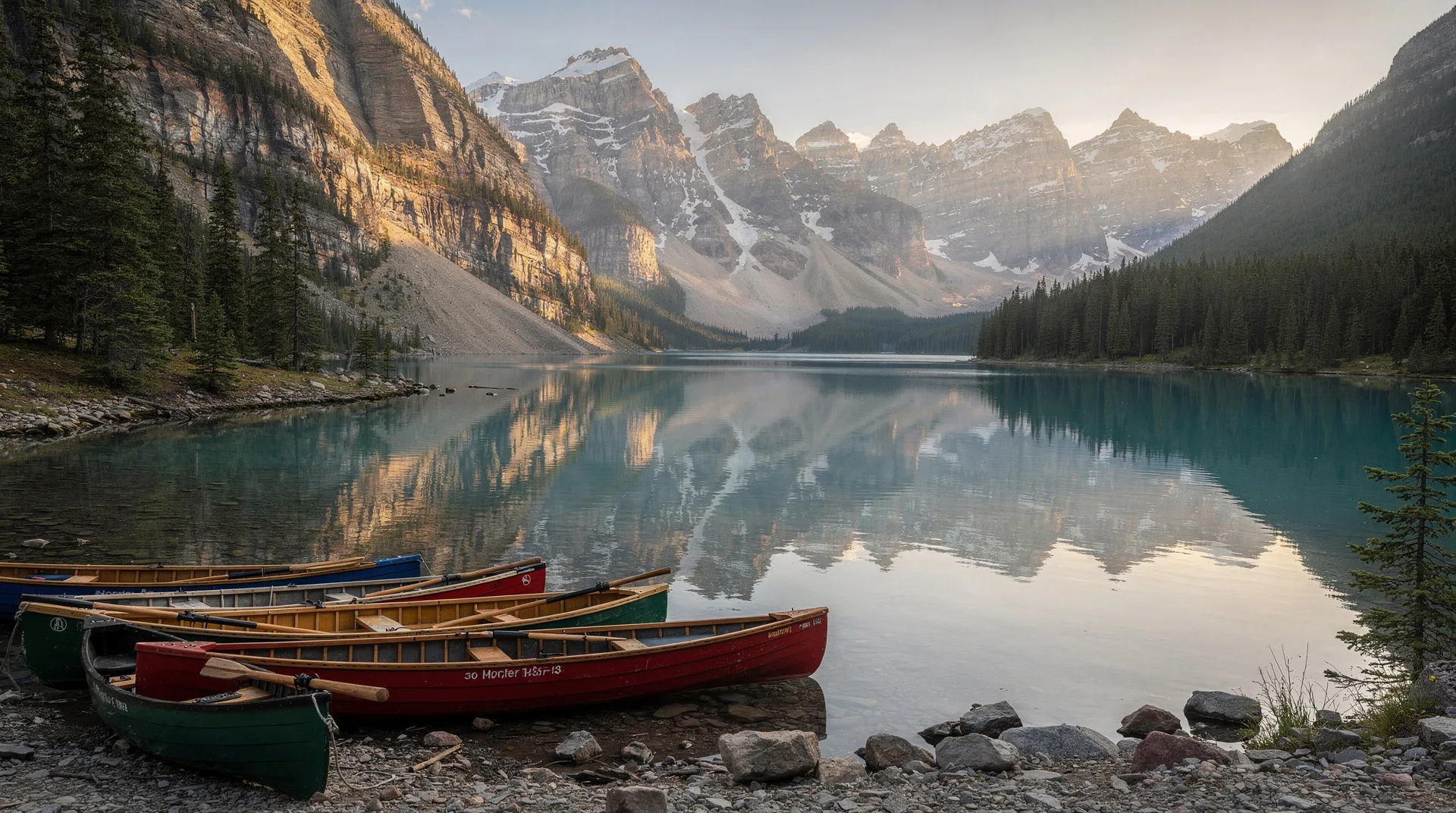
Moraine Lake: the complete visitor guide
How do I get to Moraine Lake in 2026?
Private vehicles are restricted from Moraine Lake Road during peak season (late June to mid-October). You must arrive by Parks Canada shuttle (book at reservation.pc.gc.ca), commercial tour, or on foot/by bike. Book shuttle spots 3+ months ahead — they sell out. Taxis are no longer permitted on the road.
There is a moment, every morning from late June through early October, when the first visitors of the day arrive at the Rockpile Trail viewpoint above Moraine Lake and the Valley of the Ten Peaks comes into full view. Even among people who have seen every photograph, memorised every description, and prepared themselves for something extraordinary — the reality stops them cold. The lake is more turquoise than the pictures suggest. The valley is wider. The ten peaks of the Wenkchemna range stretch across the horizon in a jagged, snow-dusted panorama of implausible grandeur. The sound of calving ice from the glaciers above is the only noise.
Moraine Lake was once on the back of the Canadian twenty-dollar bill. It is arguably the most photographed landscape in Canada. And it is, consistently, worth every logistical complication involved in reaching it.
At a glance
| Where | Moraine Lake Road, Banff National Park, 14 km from Lake Louise village |
| Cost | Around CAD 8 shuttle return, plus a Parks Canada park pass (day pass or Discovery Pass) |
| Time needed | Around 2-3 hours for the Rockpile viewpoint, lakeshore and a coffee stop; a half-day or more with a hike |
| Getting there | Parks Canada shuttle (reservation required), guided tour, or bike/on foot from Lake Louise village |
| Best time | Sunrise, June through September; larch season in late September for the golden trees |
Why Moraine Lake looks the way it does
The lake’s extraordinary colour — ranging from electric turquoise to deep emerald depending on light conditions and time of year — is caused by glacial rock flour suspended in the meltwater that feeds it. Rock flour is finely ground mineral particles produced by glaciers grinding against the bedrock below. These particles are so fine (between 0.001 and 0.1 mm) that they remain suspended in water and scatter light at the blue-green end of the spectrum, absorbing red wavelengths and reflecting the blues and greens that give glacial lakes their signature colour.
The colour is most intense in June and July, when snowmelt brings maximum rock flour concentrations. By late September, as runoff decreases, the colour may shift slightly toward greener or clearer tones — still beautiful, but different.
Moraine Lake itself was formed not by a glacier, as its name might suggest, but by a massive rockfall from the Tower of Babel peak on the lake’s eastern shore. The dam of rock debris (the “Rockpile”) is the natural feature you climb to reach the classic viewpoint. The name is technically a misnomer; the feature is talus debris rather than glacial moraine — a mistake by the first European surveyor to describe the lake, Samuel Allen, who named it in 1894.
The Valley of the Ten Peaks
The backdrop to Moraine Lake is one of the most dramatic mountain panoramas in North America. Ten named peaks — all above 3,000 metres — form the southern wall of the Wenkchemna cirque. The Stoney Nakoda name “Wenkchemna” means “ten” in their language; the ten peaks carry both Stoney Nakoda names and numbers (Wenkchemna Peak, also known as Peak 10) assigned by Samuel Allen.
The peaks from left to right as seen from the Rockpile are: Fay, Little, Bowlen, Tonsa, Allen, Tuzo, Deltaform, Neptuak, Wenkchemna, and Temple. Mount Temple (3,543 metres) is the highest of the group and one of the most frequently climbed high peaks in the Canadian Rockies. The combination of the peaks, the glaciers hanging between them, and the turquoise lake in the foreground creates the composition that made Moraine Lake iconic.
Getting to Moraine Lake: the access situation in detail
Access to Moraine Lake is the most complex logistics question in the Canadian Rockies, and it changes from season to season as Parks Canada refines its approach to managing visitor volumes.
The core issue: The Moraine Lake Road (11 km from Lake Louise village) cannot accommodate the volume of private vehicles that would arrive without restriction. Peak season demand exceeds road capacity by early morning. As a result, private vehicles are prohibited during peak season (typically late June through mid-October, with exact dates confirmed annually by Parks Canada).
How to get there:
Parks Canada shuttle: The official and recommended method. Shuttles depart from the Park and Ride facility at Lake Louise Ski Resort (signed from Lake Louise village). Tickets are sold through the Parks Canada reservation system (reservation.pc.gc.ca) opening in April. In 2025, shuttle tickets sold out within hours of opening for many summer dates. Book as early as possible — 3 months ahead minimum for peak dates.
Commercial tours: Tour operators have separate vehicle access allocations. Booking a guided Moraine Lake tour from Banff, Lake Louise, or Calgary provides guaranteed access when Parks Canada shuttles are sold out. This is the best backup option. See the GYG link below.
Walking or cycling: The Moraine Lake Road is open to cyclists and hikers. From Lake Louise village it is approximately 11 km on a paved road with significant elevation gain. Not trivial but achievable for fit walkers and cyclists.
Early and late season access: Before the road restrictions begin (typically before late June) and after they end (typically mid-October), private vehicles can drive to Moraine Lake directly. Early June visits (when the lake may still be ice-covered) or mid-October visits (with potential snow and larches at peak gold) are possible by private vehicle and significantly less crowded.
Browse guided Moraine Lake tours with guaranteed accessThe Rockpile viewpoint
The Rockpile is the defining viewpoint at Moraine Lake — a 20-metre scramble up the talus debris dam at the lake’s eastern end, reached by a 0.8-km trail (30 metres elevation gain) from the main parking area. The trail is well-maintained and takes about 10 minutes at a moderate pace.
The view from the top is the one from the twenty-dollar bill: the lake’s full turquoise expanse in the foreground, the Valley of the Ten Peaks filling the horizon behind. Several platforms at different heights on the Rockpile provide different angles; the highest point is not necessarily the best for photography.
Sunrise at the Rockpile is the single most sought-after photography opportunity in the Canadian Rockies. The first light hits the peaks from the east, gradually illuminating them from their summits downward, while the lake below is still in shade. When the sun finally clears the ridge and reaches the water, the reflection of the peaks in the lake — on calm mornings — produces an image of extraordinary symmetry. For sunrise photography, arrive 45–60 minutes before sunrise. In peak summer, the Rockpile at dawn may still have 30–50 people present.
Hikes from Moraine Lake
Larch Valley and Sentinel Pass (11.5 km return, 720 m elevation gain)
The most celebrated hike from Moraine Lake. The trail climbs through Larch Valley — a bowl of alpine larch trees that turn brilliant gold in late September and early October — to Sentinel Pass at 2,611 metres, the highest maintained trail pass in the Canadian Rockies. The pass rewards with views in both directions: the Valley of the Ten Peaks behind, Paradise Valley stretching ahead.
In late September, the larch colour display transforms the hike. The combination of gold larches, grey limestone peaks, and the possibility of early snow makes this a pilgrimage-worthy autumn experience. Arrive very early; the Larch Valley hike is extremely popular during colour season.
See our best hikes in Canada guide for more detail.
Consolation Lakes (5.8 km return, 65 m elevation gain)
A gentler option from Moraine Lake, climbing through boulder fields and forest to Lower and Upper Consolation Lakes — quieter turquoise lakes in a hanging valley above the main lake. The contrast with Moraine Lake’s iconic setting is restful; the Consolation Lakes have a more intimate, enclosed character. Good option for families or those wanting less elevation gain. The boulder field en route is fun for children.
Wenkchemna Pass (18.6 km return, 730 m elevation gain)
The full valley traverse, continuing past the lake to the head of the Wenkchemna cirque and the pass at the valley’s end. Full-day hike; the effort rewards with the most complete experience of the Ten Peaks environment, with views extending into Kootenay National Park from the pass.
If you want to see how these trails compare with the other classic walks around the village, the Lake Louise hikes overview lays them out side by side, and the Larch Valley and Sentinel Pass guide goes deeper on the route described above. Hikers who like a tea-house stop on the way can look at the Lake Agnes Tea House hike as a complement on a second day. Always read the wildlife safety guide before heading onto any trail in bear country.
Photography guide for Moraine Lake
Sunrise: The most consistent and celebrated time. Arrive 45–60 minutes early. Dawn light on the peaks with the lake in shade, followed by the first sunlight reaching the water, is the classic sequence. Arrive mid-June to late September for the best combination of sunrise timing and weather probability.
Blue hour: In the 30–45 minutes before sunrise, the peaks reflect in the lake with deep blue-purple tones that are distinct and beautiful. Long exposure and a tripod are needed.
Afternoon light: The Valley of the Ten Peaks faces southeast; morning light on the peaks is better than afternoon (when they fall into shade). The lake colour itself is best in midday light.
Autumn larch season (late September to mid-October): The combination of gold larches on the slopes above the lake and the turquoise water below creates colour contrast that is arguably more photogenic than the summer landscape. The road restrictions typically end by mid-October, allowing private vehicle access during the peak larch period.
Lens recommendations: Wide angle (14–24mm equivalent) for the Rockpile panorama. 50–100mm for detail shots of the peaks and their glaciers. A polarising filter reduces surface glare on the lake and intensifies the colour on sunny days.
Book a guided Lake Louise, Moraine Lake and Banff Gondola day tourCosts (in CAD)
| Item | Cost |
|---|---|
| Parks Canada shuttle (return) | $8 per person |
| Guided day tour including Moraine Lake | $80–$150 per person |
| Parks Canada Discovery Pass (annual) | $83.50 adult |
| Daily park entry (per adult) | $12.25 |
| Moraine Lake Lodge per night | $800–$1,500+ |
| Canoe rental on Moraine Lake | $130 per hour |
Where to stay near Moraine Lake
Moraine Lake Lodge: The only accommodation directly at Moraine Lake — a collection of historic wooden cabins on the lakeshore. The location is incomparable; the price reflects it (typically $800–$1,500+ per night). Guests have early morning access to the lake before shuttles begin. Books out months in advance; often the only way to guarantee perfect sunrise conditions without competing with shuttle crowds.
Deer Lodge (Lake Louise): 2 km from Lake Louise village. Heritage property, excellent dining, shuttle to Moraine Lake departing from nearby. Good mid-range option.
Fairmont Chateau Lake Louise: The iconic heritage hotel on Lake Louise. Expensive; guests can combine Lake Louise and Moraine Lake visits via shuttle. The most celebrated hotel base in the Rockies. See our Banff National Park guide for full accommodation options.
Lake Louise campgrounds: Parks Canada campgrounds at Lake Louise provide affordable access. Reservation required; book through reservation.pc.gc.ca.
Seasonal overview
Late May to early June: Ice may still cover part of the lake. Road restrictions not yet in effect — private vehicle access possible. Far fewer visitors. The lake without ice reveals gradually; dramatic in its own right.
Mid-June to August: Peak summer. Maximum rock flour concentration means most intense turquoise colour. Shuttle required. Warm temperatures and excellent hiking conditions. Crowded.
September: Excellent month. Crowds beginning to thin after Labour Day. Larches not yet turning in early September; by late September colour season beginning. Cooler temperatures.
October: Larch season peak in the first two weeks. Road restrictions may end mid-month, allowing private vehicle access for colour season. Best time for combined lake and larch photography. Some risk of snow and ice on trails.
November to late June: Lake often frozen November through May. Road may be accessible by private vehicle but check Parks Canada for current restrictions and conditions. Exceptional winter photography with snow and ice, but short daylight and cold temperatures.
Planning the rest of your trip around Moraine Lake
Moraine Lake rarely stands alone in an itinerary. The Moraine Lake shuttle guide covers the reservation process step by step, and the Parks Canada Discovery Pass guide helps you decide between a day pass and an annual one. If you are building a longer Rockies trip, the Banff 3-day itinerary and the Canadian Rockies 10-day itinerary both fit a Moraine Lake morning into a realistic schedule. Travellers basing themselves in town can read about Banff and Lake Louise as bases, and anyone planning a big day out should check the best time to visit Banff before locking in dates. If you would rather avoid the driving, the Roam transit guide for Banff explains the public bus options in the valley, and the blog guide to Moraine Lake offers a more personal take on the visit.
Combining Moraine Lake with Lake Louise
Most visitors combine both lakes in a single day. The Parks Canada shuttle links both from the Lake Louise Ski Resort base. Both are worth substantial time; allow a minimum of 3 hours at each for a meaningful visit, more if hiking. Starting with Moraine Lake at sunrise and moving to Lake Louise for mid-morning is the classic sequence.
See our Banff National Park guide for the full Lake Louise and Plain of Six Glaciers experience. For a full side-by-side breakdown of scenery, access and hiking, see our Moraine Lake vs Lake Louise comparison.
Moraine Lake versus other Rockies lakes
Moraine Lake is often mentioned alongside Peyto Lake and Lake Louise as the three defining turquoise lakes of the Icefields Parkway corridor. Peyto Lake, seen from a short walk off the Icefields Parkway, has a similarly saturated colour but a wolf-shaped outline visible from its viewpoint and no shuttle restriction — a useful alternative on a day when Moraine Lake shuttles are sold out. See the Icefields Parkway stops guide for the full corridor, including Peyto Lake, Bow Lake and the Columbia Icefield. Compared with both, Moraine Lake’s advantage is the concentrated drama of the Ten Peaks wall directly behind the water, visible from a single short walk rather than a roadside pullout.
Frequently asked questions about Moraine Lake: the complete visitor guide
Can I still drive to Moraine Lake in 2026?
During peak season (typically late June through mid-October), private vehicles are prohibited on Moraine Lake Road. Access is by Parks Canada shuttle, commercial tour, or on foot/bicycle. Check Parks Canada’s website annually for exact dates, as the restriction period is confirmed each spring.
How far in advance must I book the shuttle?
For July and August dates, booking 3–4 months ahead is the realistic minimum for popular dates. Shoulder season (early July, September) may be available with less lead time. Tickets go on sale in mid-April; high-demand dates sell out quickly.
What if all shuttle tickets are sold out?
Book a commercial guided tour from Banff or Lake Louise — operators have their own vehicle access allocations. These tours combine Moraine Lake with other Rockies highlights and are an excellent option even for independent travellers. Alternatively, plan for early June or mid-October when road restrictions may not be in effect.
Is the lake actually that colour in real life?
Yes, and arguably more so. The colour appears edited in photographs; it is actually that intense in person, particularly in June and July. The effect is greatest in direct sunlight; the lake appears duller on overcast days.
What is the best time of day to visit?
Sunrise for photography (especially in summer). Mid-morning offers good light and the lake is fully accessible. Midday in high summer is crowded but still beautiful. The blue hour before sunrise for long-exposure photography is exceptional on calm mornings.
How cold does it get at Moraine Lake?
Summer temperatures are comfortable during the day (15–25°C). Mornings can be cold (5–10°C at dawn in July). September mornings are cold (0–8°C); bring a warm layer for sunrise visits. October visits can see sub-zero temperatures and light snow.
Is canoe rental available at Moraine Lake?
Yes, canoe rentals are available from the Moraine Lake Lodge dock when the lake is ice-free (typically late June through early October). At approximately $130/hour, a dawn or early morning canoe paddle on the lake is among the finest experiences available in the Canadian Rockies.
Should I visit Moraine Lake or Peyto Lake if I only have time for one?
If you have a confirmed Moraine Lake shuttle booking, take it — the Ten Peaks backdrop is more immersive than Peyto Lake’s roadside view. If you don’t have a shuttle reservation and don’t want to gamble on cycling or a tour, Peyto Lake on the Icefields Parkway requires no reservation and delivers comparably vivid colour with a short, easy walk from the parking area.
Can I skip the shuttle by staying at Moraine Lake Lodge?
Yes — Moraine Lake Lodge guests drive in on a separate access arrangement and can reach the Rockpile before the first public shuttle arrives, which is the single best way to get the viewpoint with minimal crowds. It is also the most expensive way to solve the access problem, at roughly CAD 800-1,500+ per night.