Lake Louise vs Moraine Lake: which to visit?
Should I visit Lake Louise or Moraine Lake?
Lake Louise is larger, more accessible, and surrounded by year-round infrastructure including the Fairmont hotel. Moraine Lake is smaller, more dramatically framed by the Ten Peaks, and considered by many photographers the more stunning of the two. Both are must-sees in Banff — if you only have time for one, Moraine Lake's compact grandeur makes it the more visceral experience.
Within Banff National Park’s extraordinary collection of glacial lakes, two dominate every shortlist and every photograph: Lake Louise and Moraine Lake. They sit 14 km apart in the same valley system. Both are fed by glacial meltwater. Both are the same shade of impossible turquoise. Both are surrounded by mountains and frequently jammed with visitors from May to October.
Yet they are not the same experience. Lake Louise is larger, more established, and the site of one of Canada’s most famous hotels. Moraine Lake is compressed, intimate, and framed by ten peaks that give the lake a theatrical quality unlike anything else in the Rockies. Photographers consistently cite Moraine Lake as the more spectacular of the two. Most visitors who see both typically want to go back to Moraine.
This guide covers both lakes in detail — the access logistics, the best viewpoints, the hiking options, the photography tips, and the honest comparison of which lake delivers more.
| At a glance | |
|---|---|
| Where | Banff National Park, Alberta — Banff, 14 km apart from each other |
| Cost | Both lakeshores are free to visit; a Parks Canada park pass (around CAD $12.25/adult/day) is required to enter Banff National Park |
| Time needed | Half a day for one lake, a full day to see both properly |
| Getting there | Lake Louise by car year-round; Moraine Lake by Parks Canada shuttle, commercial shuttle, bike or on foot (private cars barred in season) |
| Best time | Late May to early July for the most intense turquoise colour; late September for larches above Moraine Lake |
The basics
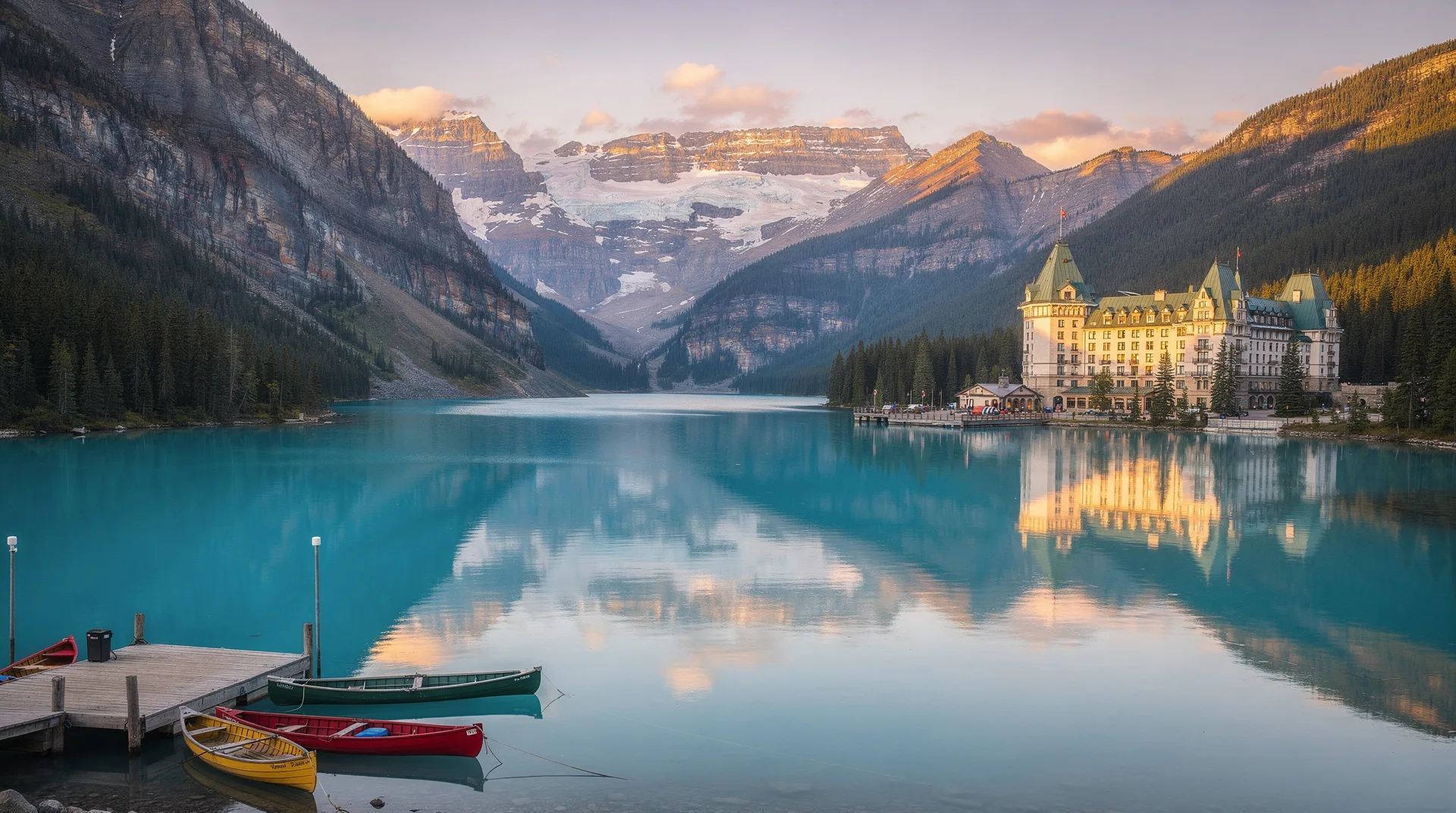
Lake Louise: 2.4 km long, approximately 500 m wide, maximum depth 90 m. Elevation 1,731 m. Access road open year-round, though congested in summer. The Fairmont Chateau Lake Louise stands on the lakeshore. Year-round visitor infrastructure including restaurants, bars, the lake canoe rental, and lift access to the ski resort above.
Moraine Lake: 600 m long, 300 m wide, maximum depth 14 m. Elevation 1,885 m. Access road open late May to mid-October (closed in winter). No hotels at the lake — the Moraine Lake Lodge is the only accommodation, and it is expensive and booked months ahead. A small café and canoe rental are the extent of services.
| Lake Louise | Moraine Lake | |
|---|---|---|
| Size | 2.4 km × 500 m | 600 m × 300 m |
| Elevation | 1,731 m | 1,885 m |
| Year-round access | Yes | No (late May–mid-Oct) |
| Accommodation on site | Fairmont Chateau Lake Louise | Moraine Lake Lodge (small, expensive) |
| Road closure | Never (summer congestion) | Seasonal (Oct to late May) |
| Featured on | Postcards, national tourism campaigns | Former Canadian $20 bill |
Getting there
Lake Louise
Lake Louise village is 57 km northwest of Banff town on the Trans-Canada Highway. A spur road leads 4 km from the village to the lake parking area. In peak summer (late June to Labour Day), the main parking lot at Lake Louise fills by 7am on most days. Parks Canada operates a mandatory shuttle from the Lake Louise ski resort parking area (a 20-minute bus ride) when the main lot is full.
Arriving before sunrise — 5–6am — is the most reliable way to park at the lake itself and avoid the shuttle. The morning light is also superior for photography of the Chateau against the lake.
Moraine Lake
Moraine Lake is 14 km from Lake Louise village on a dead-end road. Parks Canada restricts private vehicle access to Moraine Lake Road from late May to mid-October — the road has been closed to private vehicles since 2023. Access is by Parks Canada shuttle (book at reservation.pc.gc.ca, often sold out weeks ahead), on foot (14 km one way from Lake Louise village, strenuous), or by bicycle.
The shuttle reservation system opens in mid-January and peak summer dates sell out within hours. If you have not reserved a shuttle, your options are:
- Hike from Lake Louise village: 14 km one way, gaining 154 m elevation, taking 3–4 hours each way. Very few visitors do this.
- Commercial shuttle: Several Banff operators run private shuttles to Moraine Lake, typically CAD $50–$70 per person.
- Book a tour: The Banff Lake Louise and Moraine Lake gondola and hot springs combination includes Moraine Lake access as part of a guided itinerary.
- Stay at Moraine Lake Lodge: The only way to be at the lake at sunrise without shuttle logistics.
The shuttle and access restrictions are Parks Canada’s response to severe overcrowding. Before restrictions, the parking lot at Moraine Lake filled before 5am on summer days, with cars parked along the road for kilometres.
The water colour
Both lakes are the same source phenomenon: glacial flour — fine rock particles ground by glacial action — suspended in meltwater. The particles scatter blue and green wavelengths of light, creating the turquoise-to-jade appearance that makes these lakes look altered in photographs when they are not.
The colour is most intense from late May to early July, when snowmelt provides maximum glacial flour input. By August the colour begins to fade slightly. By October, before the road closes, the lakes have lost some of their peak intensity but remain impressive.
Moraine Lake’s colour: Most visitors describe Moraine Lake’s colour as more vivid and concentrated than Lake Louise — partly because the lake is smaller and the water shallower, intensifying the turquoise effect. The surrounding rock walls also create a different reflection quality.
The best viewpoints
Lake Louise viewpoints
The Lakeshore: The classic view is from the public path along the southern lakeshore, with the Victoria Glacier as backdrop and the Fairmont Chateau on the right. Best in morning light (late afternoon puts the glacier in shadow).
The Fairmont terrace: The hotel’s lakeside terrace is accessible to non-guests during the day. Morning coffee on the terrace with the lake view is a legitimate Lake Louise experience.
Mirror Image: With very still air (usually before 8am), the lake surface reflects the mountains with minimal ripple. Arrive before sunrise for the mirror surface window.
Upper lake hike: The Plain of Six Glaciers trail continues beyond the lakeshore viewpoint to the teahouse (4.9 km from the lake) and higher viewpoints looking back down the lake — a completely different and dramatic perspective.
Moraine Lake viewpoints
The Rockpile: The most famous viewpoint — a short scramble (200 m) on boulders deposited by a rockslide at the lake’s northern end. This is the image on the old $20 bill. The Rockpile is 2–3 minutes from the parking area and requires minimal effort. Arrive before the shuttles start for a view without other visitors.
Canoe: Paddling on Moraine Lake from a low water perspective, with the Ten Peaks surrounding you, is considered the best way to experience the lake’s scale. Canoe rental is available at the lake (CAD $45/hour, cash only typically). Book when you arrive — the rental dock queue fills quickly.
Larch Valley trail viewpoints: The Larch Valley trail (5.8 km to Sentinel Pass) ascends from the Moraine Lake valley, with increasingly dramatic retrospective views of the lake and the Ten Peaks as you climb. The first major viewpoint comes at about 2 km; the best is at the top of the larch zone.
Hiking
Lake Louise hikes
Plain of Six Glaciers (14.4 km return, 365 m elevation gain, moderate): From the lakeshore, following the lake’s north shore, ascending to the Six Glaciers teahouse and beyond to the Plain itself for glacier and mountain views. One of the classic Rocky Mountain hikes.
Lake Agnes and Big Beehive (14.4 km return with Big Beehive, 525 m gain, moderate-strenuous): Climbs through forest to Lake Agnes (a smaller lake above Lake Louise), the Lake Agnes teahouse, and the Big Beehive summit lookout. One of the best views in the area from the Big Beehive.
Fairview Mountain (8.2 km return, 1,016 m gain, strenuous): A full-day climb to the summit at 2,744 m — one of the higher objectives accessible from Lake Louise without technical equipment.
Moraine Lake hikes
Larch Valley and Sentinel Pass (11.6 km return to the pass, 725 m gain, strenuous): The signature hike from Moraine Lake — through the larch forest (spectacular in September), up to Larch Valley meadows, and over Sentinel Pass at 2,611 m. One of the top day hikes in the Canadian Rockies. In late September, the larches are golden.
Consolation Lakes (5.8 km return, 65 m gain, easy): A relatively flat walk from Moraine Lake to a pair of quiet lakes below the Consolation Valley — an easy option when the main Moraine Lake area is crowded.
Eiffel Lake (12.6 km return, 430 m gain, moderate): An extension of the Larch Valley trail, branching off to Eiffel Lake with views of the Ten Peaks from a different angle. Less-travelled than the main Sentinel Pass route.
Photography guide
Both lakes reward serious photographers, but require different strategies.
Lake Louise photography tips:
- Arrive before sunrise for mirror reflections and golden hour on the Chateau
- Morning light (before 9am) is optimal — afternoon puts Victoria Glacier in shadow
- Use a polarizing filter to cut surface reflections and deepen the water colour
- The Chateau as a compositional element is either the shot or the obstacle — decide which
Moraine Lake photography tips:
- The Rockpile is best at sunrise before the first shuttle arrives (~7am) — arrive earlier
- The golden hour light on the Ten Peaks is exceptional in early morning (July–September)
- September and early October: if larches are turning, combine the foreground colour with the turquoise lake
- Canoe-level photography gives a completely different perspective that most visitors miss
Accommodation at each lake
At Lake Louise
The Fairmont Chateau Lake Louise is the iconic property — one of Canada’s most famous hotels. Rates range from CAD $600 to $1,500+/night for a standard lake-facing room. Non-lake-facing rooms and off-peak dates can be found from CAD $350. The Chateau has multiple restaurants, a spa, and is a destination in itself.
More affordable alternatives exist in Lake Louise village (Post Hotel, Deer Lodge, several budget options) ranging from CAD $150 to $350/night.
At Moraine Lake
The Moraine Lake Lodge is the only accommodation at the lake. It has roughly 30 rooms and 3 cabins, operating seasonally from late May to mid-October. Rates: CAD $600–$1,200+/night including breakfast. Typically booked 6–12 months in advance. Staying here is the only way to experience Moraine Lake at sunrise without shuttle logistics.
The Banff Lake Louise and Moraine Lake sightseeing gondola tour and the Moraine Lake tours from Banff provide access to the lake without overnight stays.
Cost comparison
| Activity | Lake Louise | Moraine Lake |
|---|---|---|
| Lake access | Free | Free (shuttle required in season) |
| Parks Canada shuttle | CAD $10–$12/person | CAD $10–$12/person |
| Canoe rental | CAD $45–$55/hour | CAD $45/hour |
| Accommodation | CAD $150–$1,500+/night | CAD $600–$1,200/night (Lodge only) |
| Tea at the teahouse | CAD $8–$15 | N/A (no teahouse at lake) |
Wildlife and safety at both lakes
Both valleys see regular black bear and occasional grizzly activity, particularly in berry season (July–September). Bear spray is recommended for any hike beyond the immediate lakeshore, including the short Rockpile scramble at Moraine Lake during quiet early-morning hours. Pikas and hoary marmots are common on the talus slopes above both lakes; keep dogs leashed and food secured at parking areas, where ravens and chipmunks are persistent.
Cold water is the other hazard worth naming: both lakes sit at 4–8°C even at the height of summer, and neither has lifeguards. Wading for photos is fine; swimming is not advisable.
Park pass and entry requirements
Both lakes sit inside Banff National Park, so a valid Parks Canada park pass is required regardless of which lake you visit — see our Banff park pass guide for day-pass versus Discovery Pass pricing. The pass is checked at the park gates on the Trans-Canada Highway, not at either lake individually, so buy it before you arrive rather than at the lakeshore.
If you are building a longer stay around the two lakes, our Lake Louise hikes overview and best tours from Lake Louise cover options beyond what is listed here, and a 5-day Banff itinerary shows how to fit both lakes into a wider Rockies trip without rushing either.
Which is worth the effort?
The access restrictions at Moraine Lake introduce genuine friction into the visit — shuttle reservations that sell out in January, commercial shuttle costs, or the hiking option. Worth it? Consistently yes, among visitors who make the effort. The lake’s compact scale and the dramatic enclosure of the Ten Peaks create an immediate, overwhelming response that Lake Louise — larger and more spread out — does not quite replicate.
Lake Louise is the more versatile destination: year-round access, more hiking options, accommodation range, the Chateau experience. If you are visiting in winter or at awkward access times, Lake Louise is the reliable choice.
Moraine Lake rewards those who plan for it — early shuttle reservation, early morning arrival, or the Lodge stay. The payoff is a view that most visitors consider the most striking single image in the Canadian Rockies.
Our verdict
Visit both. They are 14 km apart and the trip to see one without seeing the other leaves something undone.
If you must choose one: Moraine Lake, for the more immediate visual impact. The Rockpile view is the closer encounter with the landscape you came for.
For logistics: Book the Moraine Lake Parks Canada shuttle the moment reservations open in January if visiting in July or August. If you miss shuttle availability, the commercial shuttles and organised tours are the reliable alternative.
See also: Banff National Park guide, Banff vs Jasper, Banff NP vs Jasper NP, Best time to visit Canada, Lake Louise destination guide, Moraine Lake in detail.
Frequently asked questions about Lake Louise vs Moraine Lake: which to visit?
Is Moraine Lake better than Lake Louise?
For visual impact: most visitors and photographers rate Moraine Lake slightly higher, citing the compact drama of the Ten Peaks and the intense water colour. For versatility and ease of access: Lake Louise is superior. Both are outstanding — the comparison is between two of the most beautiful lakes in the world.
Why is Moraine Lake road closed to private vehicles?
Parks Canada closed the Moraine Lake Road to private vehicles from late May to mid-October starting in 2023, addressing extreme overcrowding that had made the lake unsafe. Before restrictions, the parking lot filled before 5am, with traffic backed up for kilometres on the highway. The shuttle and access reservation system manages visitor numbers while keeping the lake accessible.
What time should I arrive at Lake Louise in summer?
Arrive before 7am if you want to park at the lake itself. After 7am in peak summer (late June to Labour Day), the parking lot is typically full and the mandatory shuttle begins operating. Sunrise visits (4:30–5:30am) offer empty paths, mirror reflections, and the best light.
What colour is Moraine Lake compared to Lake Louise?
Both are glacial turquoise, but most visitors describe Moraine Lake as having a slightly more vivid, intense colour — possibly due to the lake’s shallower depth and the reflection from the surrounding rock walls. Both lakes are most intensely coloured from late May through July when glacial meltwater is at its peak volume.
Can I swim in Lake Louise or Moraine Lake?
Both lakes are cold year-round — typically 4–8°C even in August, fed directly by glacier meltwater. Swimming is technically permitted but extremely uncomfortable for most visitors. Wading ankle-deep for photographs is common; full swimming is not recommended due to the cold.
Do I need a park pass to visit Lake Louise or Moraine Lake?
Yes. Both lakes are inside Banff National Park, so a Parks Canada park pass (day pass or annual Discovery Pass) is required regardless of which lake, or both, you visit. See our Banff park pass guide for current pricing and where to buy one before you arrive.
When is Larch Valley best for photography?
Late September (typically September 20–October 5, depending on the year) when the subalpine larch trees turn golden. The combination of golden larches in the foreground, turquoise Moraine Lake below, and snow-dusted Ten Peaks in the background creates one of the most sought-after landscape photographs in Canada. Moraine Lake shuttle access remains open through mid-October, but September weekends during larch season should be booked as early as January.