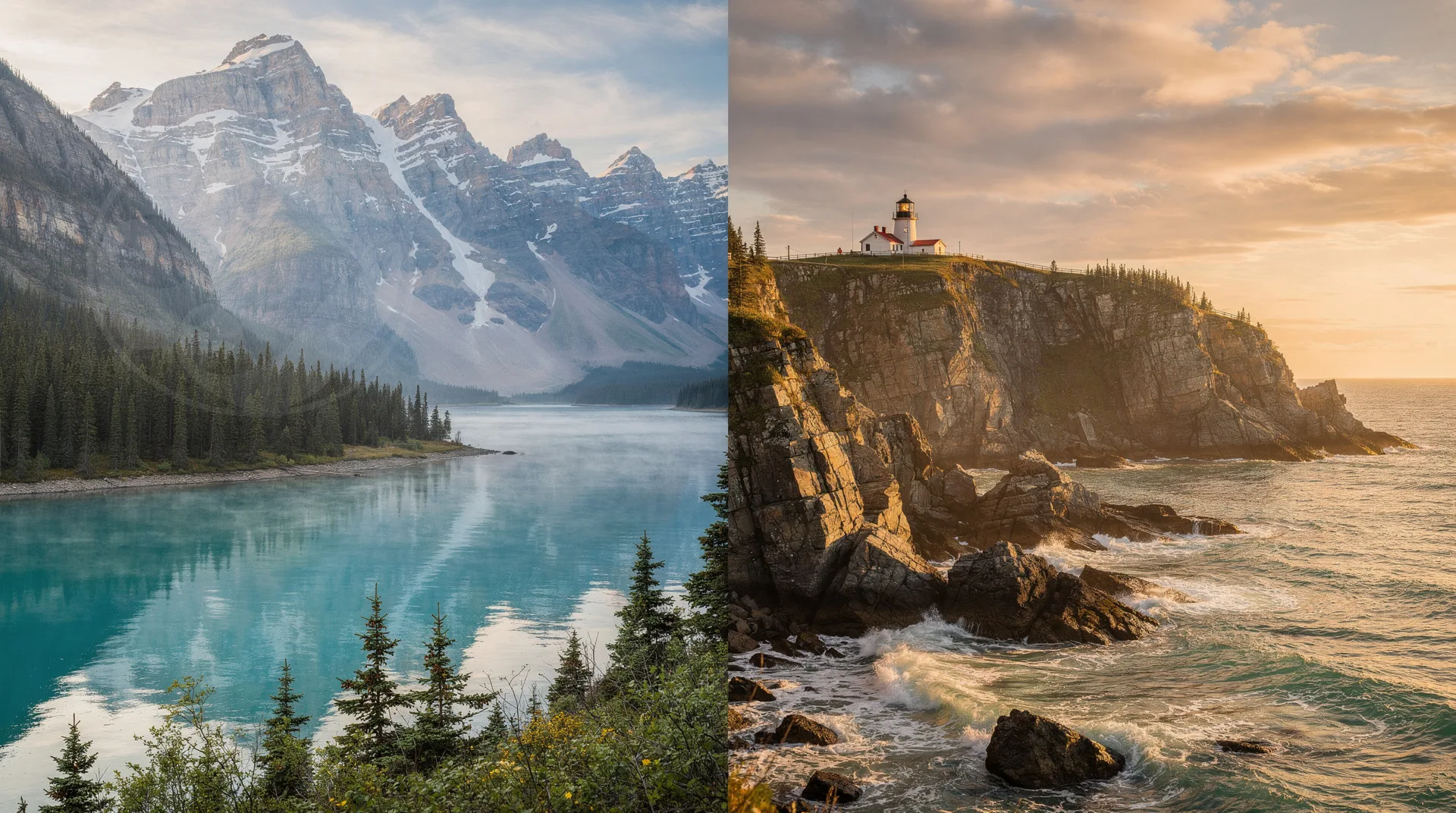
Banff National Park vs Jasper National Park comparison
Is Banff National Park or Jasper National Park better?
Banff National Park offers more infrastructure, iconic lakes, and easier access from Calgary. Jasper National Park is larger, quieter, and delivers a wilder Rocky Mountain experience including the Columbia Icefield and Maligne Lake. For most first-time visitors, Banff is the better single choice — but the Icefields Parkway connecting them is itself a reason to do both.
Banff and Jasper are Canada’s two most celebrated national parks. Together they form the core of the Canadian Rocky Mountain Parks UNESCO World Heritage Site — the largest World Heritage site in the Canadian Rockies, covering over 20,000 km² of protected mountain wilderness.
| At a glance | |
|---|---|
| Where | Alberta, along the Icefields Parkway (Highway 93), roughly 4-5 hours’ drive apart |
| Cost | Parks Canada day pass around CAD $11.70/adult, needed for either park |
| Time needed | 3+ days per park for the highlights; 7+ days to do both properly |
| Getting there | Fly into Calgary for Banff, Edmonton for Jasper, or drive/train between the two |
| Best time | July-August for full access; late September for larch colour with fewer crowds |
Both parks occupy the spine of the Rocky Mountains in Alberta. Both have turquoise glacial lakes, abundant wildlife, dramatic peaks, hot springs, and visitor infrastructure that ranges from first-class hotels to backcountry wilderness camping. Both receive millions of visitors per year and are managed by Parks Canada under the same fee and permit structure.
Yet they are not interchangeable. The differences — in size, character, crowd levels, wildlife, and the type of experience they deliver — are meaningful enough to warrant a detailed comparison.
The parks at a glance
Banff National Park is Canada’s oldest national park, established in 1885 around the discovery of hot springs at the base of Sulphur Mountain. It covers 6,641 km² and contains the town of Banff (population ~8,000), the Bow Valley corridor, and the southern stretch of the Icefields Parkway to the boundary with Jasper.
Jasper National Park is Canada’s largest Rocky Mountain park at 10,878 km² — almost 65% larger than Banff. It is less developed, more remote in character despite having the town of Jasper at its centre, and home to the northern half of the Icefields Parkway including the Columbia Icefield itself.
They share a boundary at the Saskatchewan River Crossing / Sunwapta Pass area, connected by the Icefields Parkway (Highway 93). Driving from the Banff townsite to Jasper townsite via the Icefields Parkway takes approximately 4–5 hours with stops — or up to 8–9 hours if you stop seriously at every viewpoint.
| Banff NP | Jasper NP | |
|---|---|---|
| Established | 1885 (first Canadian park) | 1907 |
| Size | 6,641 km² | 10,878 km² |
| Town | Banff (8,000 residents) | Jasper (5,000 residents) |
| Annual visitors | ~4–5 million | ~2–2.5 million |
| Park entry | CAD $11.70/adult/day | CAD $11.70/adult/day |
| Nearest major airport | Calgary (128 km) | Edmonton (370 km) |
Getting there
Banff
Calgary International Airport (YYC) is the gateway — one of Canada’s busiest airports with direct international connections. The park is 128 km west on the Trans-Canada Highway, roughly 90 minutes by car. Shuttles from Calgary airport to Banff run multiple times daily (CAD $50–$70 one way). There is no direct train service to Banff, though the Rocky Mountaineer runs seasonal service to Banff via the Bow Valley route.
Jasper
Edmonton International Airport (YEG) is 370 km east — about 4 hours by car. Calgary is 362 km south — about 4.5 hours via Highway 93 (the Icefields Parkway). VIA Rail operates seasonal service to Jasper on the transcontinental Canadian route (Vancouver–Toronto), making Jasper one of the few national park towns in Canada accessible by train.
Most visitors reach Jasper by driving from Calgary or Edmonton, by driving the Icefields Parkway from Banff, or as part of a Rocky Mountaineer or VIA Rail journey. A Banff and Jasper multi-day tour from Calgary handles the logistics of both parks efficiently.
Iconic lakes
Banff lakes
Lake Louise is the most photographed lake in Canada: jade-green glacial water backed by the Victoria Glacier, with the Fairmont Chateau Lake Louise on its south shore. The walk along the lake to the Plain of Six Glaciers teahouse is one of the most rewarding moderate hikes in the Rockies. Summer crowds are significant — arrive before 8am or use the Parks Canada shuttle.
Moraine Lake is in the Valley of the Ten Peaks, 14 km from Lake Louise. The view from the Rockpile is one of the most reproduced images in Canada — it appeared on the old $20 bill. Summer access is restricted: Parks Canada closes the road to private vehicles from late May to mid-October, with shuttle access from Lake Louise. Moraine Lake is as spectacular as Lake Louise and slightly less congested once you are there.
Peyto Lake sits just inside Banff’s northern section on the Icefields Parkway. The viewpoint from Bow Summit (2,069 m) offers one of the most dramatic lake overlooks in the Rockies — the wolf’s-head shaped lake glowing turquoise against the surrounding forest.
Jasper lakes
Maligne Lake is the crown jewel of Jasper: 22 km long, the largest natural lake in the Canadian Rockies, and home to Spirit Island — a tiny wooded island surrounded by reflecting mountain peaks that has become one of Canada’s most iconic images. The Spirit Island boat cruise operates June to mid-October (CAD $75–$85/person). The lake is also excellent for kayaking and stand-up paddleboarding.
Medicine Lake is geologically unusual — a lake that partially drains underground through a karst system each autumn, leaving mudflats in late summer before refilling in spring. The changing water levels create dramatically different views through the seasons.
Pyramid Lake and Patricia Lake are close to Jasper town (7 km) and offer calm water activities — kayaking, canoeing, and swimming — with easy access and less crowding than Maligne.
| Banff NP | Jasper NP | |
|---|---|---|
| Most iconic lake | Lake Louise | Maligne Lake |
| Second lake | Moraine Lake | Medicine Lake |
| Most accessible | Peyto Lake (Icefields Pkwy) | Pyramid Lake (7 km from town) |
Hiking
Banff hiking highlights
Plain of Six Glaciers (14.4 km return, moderate): From Lake Louise along the lakeshore, ascending to a historic teahouse with glacier views. One of the most rewarding moderate hikes in the Rockies.
Larch Valley (11.8 km return, moderate): Accessed from Moraine Lake, spectacular in late September when the larch trees turn golden. One of the most photographed autumn hikes in Canada.
Johnston Canyon (5.4 km return to upper falls, easy): A canyon walk through narrow limestone gorge to impressive waterfalls. Very accessible and crowded in summer; early morning is recommended.
Sentinel Pass (11.6 km return, strenuous): From Moraine Lake to the high pass at 2,611 m — stunning panoramic views but a demanding ascent.
Jasper hiking highlights
Skyline Trail (44 km, 2–3 days, strenuous): One of the great multi-day hikes in Canada — above the treeline for most of its length with views across the Jasper wilderness. Requires backcountry permits (book well in advance through Parks Canada).
Valley of the Five Lakes (4.5 km return, easy): A short loop through forest to a series of jade and blue lakes — one of the most accessible scenic hikes in Jasper.
Bald Hills (10.4 km return, moderate): Above Maligne Lake with panoramic views over the lake and surrounding peaks. Larch trees make this exceptional in late September.
Path of the Glacier (1.6 km return, easy): Short trail to the toe of the Athabasca Glacier — walk to where the ice was 100 years ago, as marked by historical signs showing the glacier’s retreat.
Wildlife
Both parks are excellent for wildlife viewing, but Jasper has a slight edge in terms of frequency and variety of encounters.
Banff wildlife: Elk are frequently seen in and around the town of Banff, particularly in fall when they come into town during rutting season. Bears (black and grizzly) appear along the Bow Valley Parkway in spring and fall. Bighorn sheep are reliably spotted near the road at Sheep Mountain and along the Trans-Canada.
Jasper wildlife: The Icefields Parkway north of the Columbia Icefield is considered one of the best wildlife corridors in the Canadian Rockies. Elk, moose, mountain goat, grizzly and black bears, bighorn sheep, and wolves are all regularly reported. Maligne Valley Road is particularly productive for moose. The Athabasca Valley has one of the densest elk populations in the Rockies.
Jasper’s greater size, lower visitor numbers, and the length of the Icefields Parkway through its territory all contribute to more frequent wildlife encounters.
The Columbia Icefield
The Columbia Icefield straddles the Banff-Jasper boundary and is the largest icefield in the Canadian Rockies — the hydrographic apex of North America, draining water to the Pacific, Atlantic, and Arctic oceans simultaneously.
The main visitor experience is on the Jasper side: the Athabasca Glacier, a lobe of the icefield that reaches close to the Icefields Parkway. The Columbia Icefield Skywalk (a glass-floored walkway over a canyon) and the Columbia Icefield Adventure (snowcoach tours onto the glacier) are both on Highway 93 within Jasper National Park.
The Banff, Lake Louise, and Moraine Lake gondola and hot springs tour covers Banff’s major highlights. A 2-day Banff and Jasper tour covers the Icefields Parkway and both parks in a structured format.
Hot springs
Banff Upper Hot Springs (Sulphur Mountain): Open year-round, at 1,585 m elevation. Water temperature approximately 37–40°C. Historic building, well-maintained facilities, and easy access from town. One of Canada’s most visited hot spring sites.
Miette Hot Springs (Jasper): Canada’s hottest natural hot springs at source (54°C), cooled to bathing temperature (40°C). More remote location (60 km from Jasper town) means significantly fewer visitors. Many regulars consider Miette the better experience specifically because of the lower crowds and the mountain setting.
Accessibility and crowds
Banff is significantly more crowded than Jasper. July and August see near-continuous pressure on parking, trails, and key viewpoints. Parks Canada’s mandatory shuttle systems for Lake Louise and Moraine Lake address the worst of the congestion, but the park as a whole is busy in peak season.
Jasper’s lower visitor numbers — in a larger park — means trails are quieter, parking is more available, and the backcountry feels genuinely remote. The town of Jasper has a smaller service offering than Banff but rarely feels over-run.
Note: Parts of Jasper town and nearby areas were affected by the 2024 wildfire. Most park attractions and trails have since reopened, though some facilities remain under repair. Check Parks Canada’s current status before visiting specific areas.
Cost comparison
| Expense | Banff NP | Jasper NP |
|---|---|---|
| Park entry (adult/day) | CAD $11.70 | CAD $11.70 |
| Discovery Pass (annual) | CAD $75.25 | Covers both parks |
| Mid-range hotel | CAD $200–$400/night | CAD $150–$300/night |
| Spirit Island boat cruise | N/A | CAD $75–$85/person |
| Banff Gondola | CAD $62–$75/adult | N/A |
| Jasper SkyTram | N/A | CAD $45–$60/adult |
| Hot springs entry | CAD $16/adult | CAD $16/adult |
Best for…
Choose Banff if you:
- Are flying into Calgary and have 3–4 days in the Rockies
- Want maximum infrastructure and dining options
- Are visiting Lake Louise and Moraine Lake as priorities
- Want to combine the national park with skiing (Lake Louise, Sunshine Village)
- Are travelling without a car (shuttle infrastructure is better)
Choose Jasper if you:
- Value fewer crowds and a wilder experience
- Want the Columbia Icefield and Athabasca Glacier as highlights
- Are interested in Maligne Lake and Spirit Island boat cruises
- Are arriving by VIA Rail train
- Want to attend the Dark Sky Festival (late September)
- Are visiting for wildlife photography
Do both if you:
- Have 7+ days in the Rockies
- Want to drive the Icefields Parkway properly (a mandatory experience)
- Are visiting Canada for the first time and want the complete picture
Our verdict
For a single-park visit: Banff for first-time visitors who need the most efficient introduction to the Rockies. Jasper for those prioritizing fewer crowds, Maligne Lake, and a wilder atmosphere.
For the complete experience: both parks plus the Icefields Parkway. This is, without qualification, one of the great travel routes in the world. The 232 km drive between the two parks is the experience that connects everything — and you cannot fully understand either park without making the journey between them.
See also: Banff vs Jasper guide, Lake Louise vs Moraine Lake, Banff National Park guide, Jasper National Park guide.
Where to stay if you’re doing both
Basing in the town of Banff or Canmore works well if you have 3-4 days and want to day-trip along the Icefields Parkway without fully relocating. For a longer trip, splitting nights — a few in Banff, a couple in Lake Louise village, then 2-3 in the town of Jasper — avoids the fatigue of driving the full 232 km parkway twice in one day. Booking accommodation in Jasper ahead of time matters more than in Banff, since the town has a smaller room count and July-August fills early. See our best time to visit Banff and best time to visit Jasper guides for month-by-month detail, and Banff vs Canmore if you’re deciding where to base yourself.
Booking logistics for both parks
The Parks Canada reservation system governs Moraine Lake shuttle bookings, some campgrounds, and popular backcountry permits — these open months ahead and sell out fast for July-August. If you don’t have a car, ROAM Transit covers local routes around Banff and Lake Louise, though Jasper has more limited local transit and a car or tour is more useful there. The Parks Canada Discovery Pass is worth buying if you’re crossing between the two parks, since it covers both without needing a second daily pass.
Frequently asked questions about Banff National Park vs Jasper National Park comparison
Do Banff and Jasper share a park entry pass?
Yes. A single Parks Canada daily pass (CAD $11.70/adult) covers both parks if you enter them on the same day or drive continuously through. The Discovery Pass (CAD $75.25/adult/year) covers both parks and all Parks Canada sites across Canada for 12 months — excellent value for any visit of 7+ days.
Which park has the better hiking?
Banff has more accessible day hikes with famous views (Larch Valley, Plain of Six Glaciers). Jasper has more wilderness and better multi-day backpacking (Skyline Trail). For a single day hike, the Rockpile at Moraine Lake (Banff) or Valley of the Five Lakes (Jasper) both rank among the best short hikes in the Rockies.
Is the Icefields Parkway in Banff or Jasper?
Both. The Icefields Parkway (Highway 93) runs from Lake Louise in Banff National Park to Jasper town in Jasper National Park — 232 km in total. The Columbia Icefield, the parkway’s centrepiece, sits on the boundary of the two parks. Most of the icefield’s visitor infrastructure (Athabasca Glacier, Skywalk) is on the Jasper side.
How many days do I need for Banff National Park?
Minimum 3 days for the major highlights: Lake Louise, Moraine Lake, Banff Gondola, Johnston Canyon, and the town of Banff. Five days allows more hiking, the Bow Valley Parkway, and Peyto Lake. Seven days is comfortable for a comprehensive visit including day trips along the Icefields Parkway toward Jasper.
What is Jasper’s Dark Sky Preserve?
Jasper National Park is the second-largest dark sky preserve in the world. The annual Jasper Dark Sky Festival (mid to late October) brings astronomers, photographers, and visitors for telescope viewing events, constellation talks, and aurora borealis opportunities. Outside the festival, the park’s remote location and limited light pollution make it one of the best places in Canada for star gazing year-round.
Are both parks accessible in winter?
Banff is a major winter destination — the ski resorts (Lake Louise, Sunshine Village, Mt Norquay) operate December through April, the hot springs are open year-round, and the town is full-service. Jasper is less oriented toward winter tourism but the Icefields Parkway is typically open (check road conditions), and the dark sky and aurora opportunities make it worth visiting November through March.