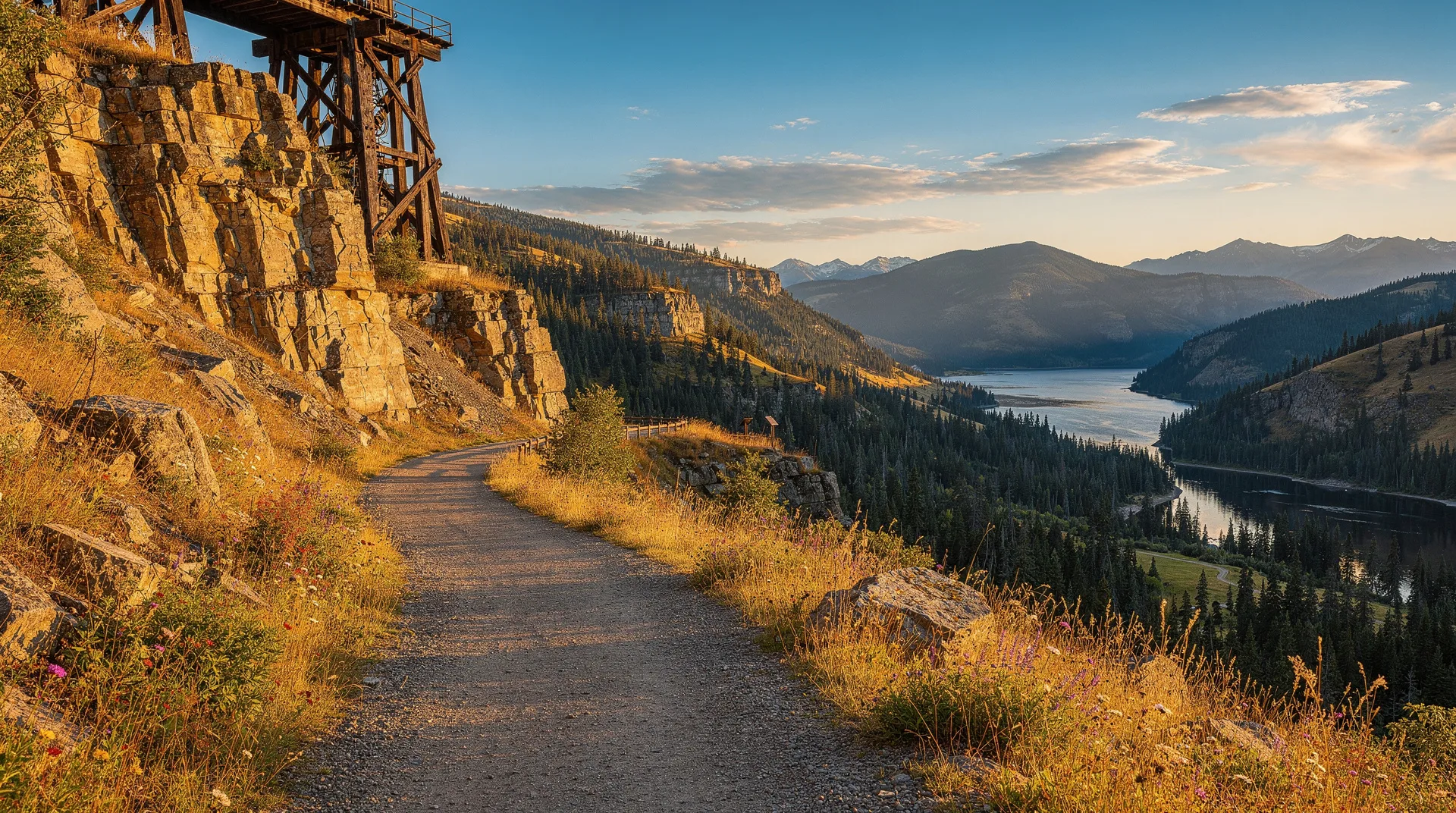
Kettle Valley Rail Trail: cycling through wine country
How long is the Kettle Valley Rail Trail?
The full Kettle Valley Rail Trail runs 600+ km from Hope to Midway, though most travellers focus on specific sections. The iconic Myra Canyon trestles section (24 km return from Ruth Station) and the Penticton-to-Summerland wine-country section (about 35 km) are the most popular day and multi-day rides.
The Kettle Valley Rail Trail (KVR) is one of the most spectacular rail-to-trail conversions in North America.
| At a glance | |
|---|---|
| Where | Okanagan Valley, BC — main sections near Kelowna, Penticton and Naramata |
| Cost | Trail access is free; guided shuttles and tours run around CAD 40-200 per person |
| Time needed | Half a day for Myra Canyon; 3-4 days for a multi-stop wine-country tour |
| Getting there | Self-drive from Kelowna or Penticton; most riders base themselves in the Okanagan Valley |
| Best time | May-June and September-October for cooler riding; July-August for full wineries but hotter conditions |
The trail’s signature is the Myra Canyon section above Kelowna — 18 restored wooden trestles spanning dramatic gorges on a single 12-km stretch, carved through one of the most challenging railway engineering environments in Canadian history. But the full KVR offers extraordinary diversity: desert scenery through the South Okanagan, rolling wine country between Penticton and Summerland, the alpine Coquihalla summit, and thick interior forest west toward Hope.
This guide covers the main cycling sections, logistics, and how to plan rides from a few hours to a full multi-day tour.
The three headline sections
Myra Canyon (above Kelowna)
The single most photographed section of the KVR. Eighteen wooden trestles and two tunnels cross a deeply dissected canyon on the hillside above Kelowna. Many of the original trestles were destroyed by wildfires in 2003; they were meticulously rebuilt and reopened in 2008.
Typical ride: Ruth Station trailhead to Myra Station and back — 24 km return, mostly flat with slight rail grade. 3-4 hours including stops.
Surface: Compacted gravel; suitable for mountain bikes, hybrids, and even road-touring bikes with slightly wider tires.
Access: Drive from Kelowna up June Springs Road to Little White Mountain Road (gravel) to the Ruth Station parking. Approximately 45 minutes from downtown Kelowna.
Best season: May through October. The high elevation (1,200 m+) means snow is possible into late May and can return by late October.
Rentals: Kelowna bike shops rent hybrid and mountain bikes. Some operators also offer shuttle service from Kelowna to the trailhead.
Penticton to Summerland — Wine Country
The most accessible KVR section for casual cyclists is the 35 km of trail between Penticton and Summerland along the western shore of Okanagan Lake. The trail passes through orchards, vineyards, small communities, and exceptional lake-and-mountain scenery.
Highlights:
- Poplar Grove and Arterra Wines near Penticton
- Kettle Valley Steam Railway — a section of the original rail line that still operates heritage steam trains from Prairie Valley Station, Summerland (summer only)
- Giants Head Mountain viewpoint
- Multiple wineries with tasting rooms accessible from the trail
Typical ride: Full Penticton-to-Summerland return is about 70 km — easily a full day with wine stops. Many cyclists do a one-way ride with a shuttle pickup.
Surface: Compacted gravel with some paved sections through Summerland.
Chute Lake to Penticton (Naramata Bench descent)
A 30-km descent through the Naramata Bench wine region from Chute Lake to Penticton — one of the most celebrated winery-focused bike rides in BC. Riders descend from alpine terrain through dozens of vineyards and wineries, with frequent tasting-room stops and exceptional lake views.
Operation: Typically done as a shuttle-supported one-way — several companies drive riders up to Chute Lake and they cycle back to Penticton.
Shorter accessible sections
Brookmere to Coldwater — the KVR’s western slope section near Merritt. Flat, scenic, rarely busy.
Bankhead to Penticton — a shorter urban-accessible ride from the Bankhead trail access point into central Penticton, approximately 10 km.
Hope to Othello Tunnels — the westernmost section includes the famous Othello Tunnels (a series of five tunnels and bridges through the Coquihalla River gorge, built for the KVR). The tunnels are a 3.5-km flat walk from Hope — suitable for short rides or easy hikes.
Longer tours and multi-day rides
Hope to Kelowna (6-8 days): The classic long KVR tour, covering approximately 350 km through several mountain passes and the south Okanagan. Camping-heavy (many sections are remote). Requires gravel touring bikes, full camping gear, and good logistics planning.
Myra to Naramata (3-4 days): A more civilised trip — you stay in accommodation (B&Bs, wineries, small hotels) nightly. Start with Myra Canyon, descend to Kelowna, cycle south through the wineries to Penticton, possibly connecting to Naramata Bench.
Full KVR (600+ km, 10-14 days): Completing the full original line from Hope to Midway requires serious commitment, gravel touring experience, and camping. Not a beginner tour.
What to bring
Bike: Hybrid or mountain bike with tires at least 35mm wide. Gravel bikes work well. Road bikes are not suitable for most sections.
Helmet: Required by law in BC.
Water: Carry 2+ litres for multi-hour rides. Few water sources along the trail.
Food: Sandwiches, snacks, fruit. Limited food stops on remote sections.
Sun protection: Hat, sunscreen, lip balm.
Tools: Spare tube, pump, multi-tool. Tire punctures from sharp gravel are the most common problem.
Insect repellent: Mosquitoes in forested sections, particularly May-June.
Layered clothing: Weather changes quickly in alpine sections.
Tours and guided rides
Several Penticton and Kelowna operators run guided day rides and shuttle services. Typical offerings include:
- Myra Canyon shuttles and guided tours (CAD $75-150 per person)
- Penticton-to-Summerland one-way shuttles (CAD $40-60 per person)
- Naramata Bench wine-country rides (CAD $100-200 with wine tasting stops)
See the Okanagan wine guide for broader wine region planning. If you would rather not organise shuttles yourself, you can compare guided tours around Kelowna and book ahead in summer.
Combining KVR cycling with other BC activities
The KVR is a natural complement to any Okanagan trip. Natural combinations include:
- Wine tasting — particularly on the Penticton-Summerland and Naramata sections
- Okanagan Lake activities — swimming, SUP, sailing
- Hiking — combine KVR sections with nearby trails (Giants Head in Summerland, Mount Campbell near Oliver)
- Kelowna city activities — a morning on Myra Canyon, afternoon in downtown Kelowna
When to ride
May-June: Cool and pleasant. Wildflowers in full bloom. Watch for lingering snow at high elevations (Myra Canyon).
July-August: Peak season. Warmest weather. Wineries fully operational. Can be hot (30+°C) on exposed sections.
September-October: Excellent weather, harvest activity at wineries, fall colours. Arguably the best month for the wine-country sections.
Winter (November-April): High-elevation sections are snow-covered. Some lower sections (Hope to Othello, Penticton waterfront) remain accessible year-round.
Safety and practical notes
- Wildlife: Bears, cougars, and rattlesnakes (South Okanagan desert sections) are present. Make noise, carry bear spray on remote sections.
- Mobile coverage: Spotty on remote sections, good near towns.
- Surface quality: Ranges from smooth packed gravel (Myra Canyon) to rough, rocky rubble (some Coquihalla sections). Research the specific section before committing.
- Heat in summer: The South Okanagan is hot. Ride early morning or evening. Always carry extra water.
Planning a wider Okanagan trip around the KVR
The KVR works best as one element of a longer Okanagan stay rather than a standalone destination. Our Okanagan wine 5-day itinerary is a useful framework for slotting a Myra Canyon morning or a Naramata Bench descent in alongside tasting-room visits, and the complete Okanagan wine guide covers which wineries are worth prioritising if cycling time is limited. If you are driving in from elsewhere in BC, check the BC driving distances guide to gauge how the Okanagan fits with a Rockies or Vancouver Island leg of the same trip.
Cyclists looking for a different kind of BC riding after the KVR often head to Whistler for lift-served mountain biking — a much more technical, gravity-focused experience than the KVR’s gentle rail grade — or to the wider best hikes in British Columbia guide for foot-based alternatives on rest days.
Frequently asked questions about Kettle Valley Rail Trail: cycling through wine country
What kind of bike do I need for the Kettle Valley Rail Trail?
A hybrid or mountain bike with tires at least 35mm wide is ideal. Gravel bikes work well. Road bikes with narrow tires are not recommended — the gravel surface punctures them quickly.
How long does it take to cycle Myra Canyon?
The classic Ruth-to-Myra return loop (24 km) takes most riders 3-4 hours with stops. Faster riders can complete it in 2 hours; slower family groups with young children 5-6 hours.
Is Myra Canyon safe for children?
Yes. The trail is flat (gentle rail grade), wide, and on a predictable surface. The trestles have solid handrails. Children aged 7+ can typically ride the full section; younger children may fit in a trailer.
Can you walk the Kettle Valley Rail Trail?
Yes. The trail is multi-use. Myra Canyon is spectacular as a walk as well as a ride — a one-way walk and shuttle pickup is a popular option. Allow 4-6 hours for the 12 km.
Are there winery stops on the Kettle Valley Rail Trail?
Extensively in the Penticton-Summerland and Naramata sections. Many wineries have tasting rooms directly on or immediately adjacent to the trail. Plan carefully if tasting — and consider using a shuttle service rather than cycling between wineries carrying wine.
Where does the Kettle Valley Rail Trail start and end?
The full original railway line ran from Hope in the Fraser Canyon to Midway on the US-Canada border. The trail today covers most of this alignment with some interrupted sections. The most popular cycling sections are concentrated in the Okanagan (Myra Canyon, Penticton-Summerland, Naramata).
Do I need to book Myra Canyon shuttles in advance?
In July and August, yes — book at least a few days ahead, since shuttle vans have limited capacity and the trailhead parking at Ruth Station fills early on weekends. In shoulder season (May-June, September), booking a day or two ahead is usually enough.
Is the KVR suitable for e-bikes?
Yes, and e-bikes are increasingly common on the longer sections, particularly the Chute Lake to Penticton descent and full-day Penticton-Summerland rides. Check with rental shops in Kelowna or Penticton, as not all stock e-bikes in peak summer.