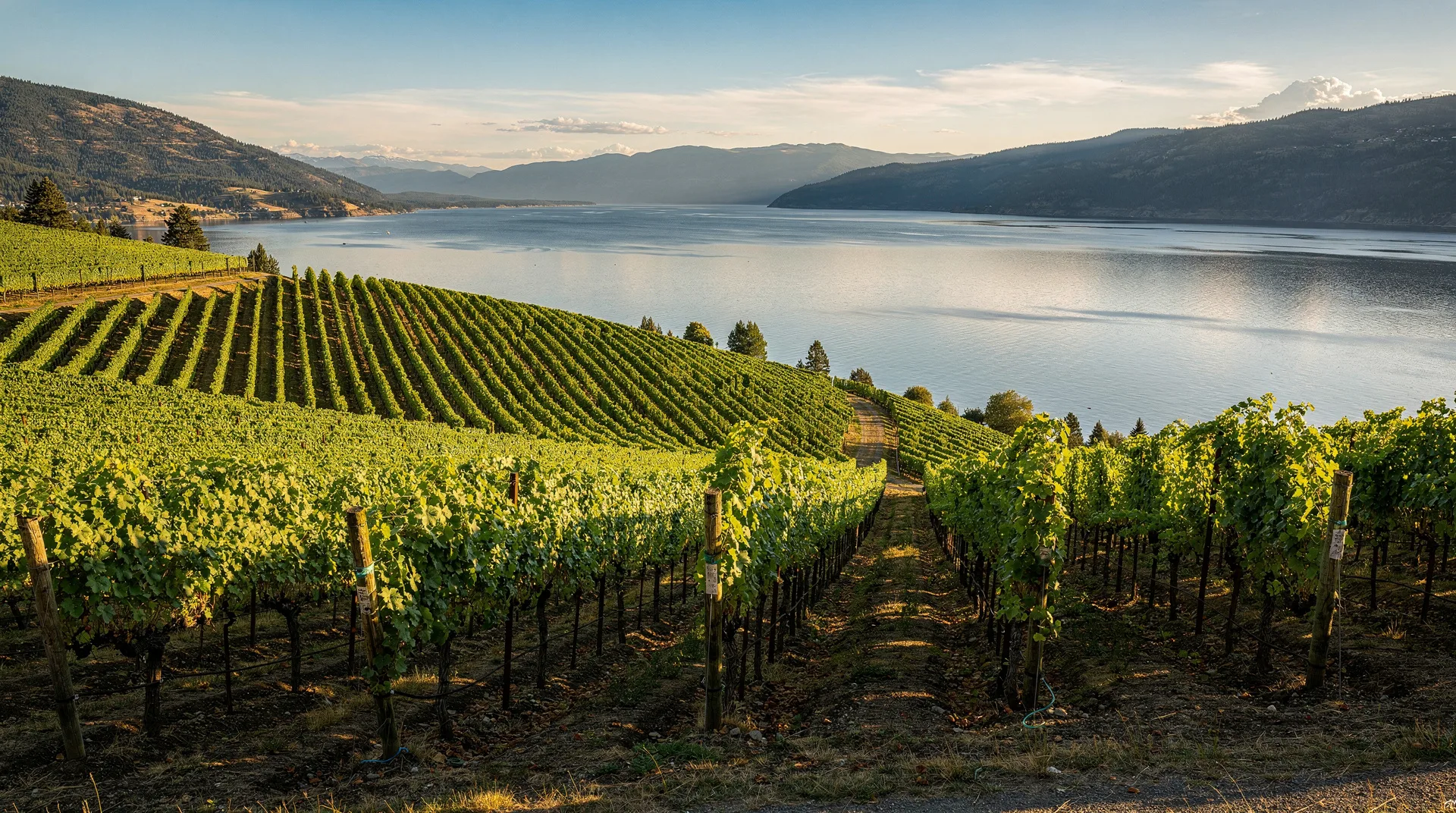
Okanagan wine guide: 200+ wineries and how to taste them
What wine is the Okanagan known for?
The Okanagan is known for Pinot Noir, Chardonnay, Riesling, and Pinot Gris in the cooler north, and Cabernet Sauvignon, Merlot, Syrah, and red blends in the warmer south (Osoyoos and Oliver). Icewine is produced throughout the valley and is a BC speciality of international reputation.
The Okanagan Valley runs 200 kilometres from Osoyoos at the US border north to Vernon, a narrow glacial trough flanked by steep semi-arid slopes above a chain of long, deep lakes. It is Canada’s most important wine region and, increasingly, one of North America’s most significant. More than 230 wineries operate in the valley, ranging from celebrated international producers with tasting rooms that rival Napa Valley for architectural ambition to tiny family operations where you taste from a kitchen table while the proprietor’s dog snoozes nearby.
The climate is the story. Osoyoos, at the valley’s southern tip, is the northern extension of the Sonoran Desert ecosystem — Canada’s only true desert — with summer temperatures reaching 40°C and extended sun hours that ripen red grapes to full phenolic maturity. Northern Kelowna is significantly cooler, better suited to aromatic whites and Pinot Noir. Between them, the valley offers an extraordinary range of terroir across a relatively short drive.
BC wine has reached a level of quality that surprises visitors who come expecting a pleasant regional novelty and leave having experienced genuinely world-class wine. The region’s top Pinot Noirs, Rieslings, and Bordeaux-blend reds now compete seriously on international palates.
At a glance
| Where | Okanagan Valley, British Columbia, from Osoyoos north to Vernon |
| Getting there | Fly into Kelowna (YLW, direct from Vancouver, Calgary, Toronto) or drive around 4.5-5 hours from Vancouver |
| Time needed | Around 2 days for a focused south or Naramata circuit; 3+ days for the full valley |
| Cost | Tasting fees roughly CAD 10-25 per person; mid-range to upscale for winery restaurants and accommodation |
| Best time | June-July for warm weather and light crowds; September-October for harvest atmosphere |
Understanding the Okanagan’s wine subregions
Osoyoos and Oliver (the South Okanagan)
The southern Okanagan around Osoyoos and Oliver is the hottest and driest subregion — the Canada-US border is 5 km south of Osoyoos, and the climate is almost continuous with Washington State’s Okanogan Valley. This is prime territory for bold reds: Cabernet Sauvignon, Merlot, Cabernet Franc, Syrah, Malbec, and blends of these varieties.
Oliver calls itself the “Wine Capital of Canada” with some justification — the 30 km stretch of Highway 97 between Osoyoos and Oliver has one of the highest winery densities in the country. The Golden Mile Bench, a designated sub-appellation on the west slope above Oliver, produces particularly structured Bordeaux-variety wines from calcium-rich soils with exceptional sun exposure.
Notable producers (south): Burrowing Owl Estate Winery (tasting room with outstanding valley views), Black Hills Estate Winery (Nota Bene, a Bordeaux blend with a cult following), Tinhorn Creek Vineyards, Road 13 Vineyards.
Naramata Bench and Penticton
The Naramata Bench, a narrow terraced slope above the east side of Okanagan Lake north of Penticton, is the most aesthetically appealing wine touring area in the valley — a country road winding through vineyards and orchards with the blue lake visible below and the mountains rising behind. The bench’s climate is moderated by the lake and produces Pinot Noir, Merlot, Syrah, and aromatic whites of exceptional quality.
Penticton, at the south end of Okanagan Lake, is the logistics base for Naramata Bench touring — a compact, bikeable city with a good downtown restaurant scene and accommodation for wine tourists.
Notable producers (Naramata Bench): Poplar Grove Winery, Kettle Valley Winery, Hillside Winery, Laughing Stock Vineyards, Monster Vineyards.
Okanagan Falls: South of Penticton, Okanagan Falls has a concentration of quality producers in a slightly different microclimate. Blue Mountain Vineyard is the benchmark here — one of BC’s most consistent producers of Pinot Noir and sparkling wine.
Kelowna and the Central Okanagan
The Kelowna area is the most populous part of the Okanagan and has both urban convenience and significant wine production. The Kelowna wine district spreads across multiple bench areas above the city and the east side of Okanagan Lake (the Lakeshore area toward Summerland).
Mission Hill Family Estate: One of BC’s flagship wineries, with a mission-style winery building, outdoor amphitheatre, and restaurant. A polished visitor experience with serious wine quality — the Quatrefoil reserve red is consistently excellent. Worth visiting for the physical space as much as the wine.
Cedar Creek Estate Winery: Recently redesigned by Bernardo Bader Architects, Cedar Creek has become an architectural destination alongside a serious wine producer. The Platinum Block series wines are among BC’s finest.
Quails’ Gate Winery: West Kelowna, on the slopes above Okanagan Lake. Beautiful setting, consistently reliable Pinot Noir and Chardonnay. The Old Vines Restaurant is excellent.
The North Okanagan (Vernon, Enderby)
The northern Okanagan is the coolest subregion, better suited to early-ripening varieties and aromatic whites — Riesling, Pinot Gris, Gewurztraminer, and Pinot Noir. The area has fewer wineries than the south but genuine quality producers.
Intrigue Wines and O’Rourke’s Peak Cellars (above Lake Country) represent the cooler north well. Sparkling wine production in this area is increasingly sophisticated.
Browse Okanagan wine tours and food experiences on GetYourGuidePlanning a wine touring route
Two-day itinerary: south-focused
Day 1 (Oliver and the Golden Mile Bench):
- Morning: Arrive Osoyoos via Kelowna (1.5 hours) or Vancouver (5 hours).
- 10 am: Nk’Mip Cellars — Canada’s first Indigenous-owned winery, operated by the Osoyoos Indian Band. Excellent Merlot and Syrah, compelling cultural context.
- 11:30 am: Road 13 Vineyards — organic-leaning, innovative, exceptional value.
- Lunch: Watermark Beach Resort restaurant, Osoyoos.
- 2 pm: Burrowing Owl Estate Winery — tasting plus viewpoint on the valley.
- 4 pm: Black Hills Estate Winery — Nota Bene is the flagship.
- Overnight: Oliver or Osoyoos.
Day 2 (Naramata Bench and Penticton):
- 10 am: Hillside Winery, Naramata Bench.
- 11:30 am: Poplar Grove Winery — valley views, strong reds.
- Lunch: Penticton lakefront or picnic at a winery.
- 2 pm: Blue Mountain Vineyard, Okanagan Falls — the Pinot Noir benchmark.
- 4 pm: Return to Penticton or continue north to Kelowna.
Three-day itinerary: full valley
Extend the above with a Kelowna day covering Mission Hill, Cedar Creek, and Quails’ Gate. An hour drive north from Penticton, the Kelowna wine district fills a full day comfortably.
How tasting rooms work
Most Okanagan winery tasting rooms charge a tasting fee of CAD 10–25 per person for 5–8 wines. This fee is often refunded or credited against a wine purchase. Reservations are required at many popular wineries during summer and on weekends — check each winery’s website and book in advance, particularly for July–August.
Tasting room etiquette:
- You are not obligated to buy. Tasting fees cover the cost of the pour.
- Do spit — especially if you are driving. Spittoons are provided for a reason. Professional tasters spit.
- Ask questions. Winery staff at small producers often include the winemaker or a family member — the conversation enriches the experience.
- If you find wines you love, buy them. Okanagan wines are difficult to find outside BC (limited export), so the tasting room is often your best opportunity.
Icewine
BC’s icewine production is internationally recognised. Icewine (eiswein) is made from grapes that have frozen naturally on the vine in temperatures of -8°C or below — the freezing concentrates the sugars in the remaining juice, producing an intensely sweet and complex dessert wine.
The Okanagan’s autumn temperatures reliably drop to icewine-producing levels from November onward. Most wineries that produce icewine make it in small quantities; bottles are expensive (CAD 50–100 for a 375 ml half-bottle) but represent a genuinely distinctive BC product.
Late harvest wines are more accessible alternatives — made from overripe or partially dried grapes, they share some of the concentrated sweetness profile at a lower price point.
Wine and food pairing in the Okanagan
The Okanagan’s restaurant scene has evolved dramatically alongside its wine industry. Several winery restaurants operate at a level that would be noteworthy in Vancouver:
Old Vines Restaurant (Quails’ Gate): Best in class for winery restaurants in BC. The menu works with BC produce and local proteins; the wine pairing options are thoughtful.
Sonora Room (Burrowing Owl): The guest house and restaurant at Burrowing Owl have a serious kitchen. Booking required well in advance.
The Kitchen (Black Hills area): Oliver’s restaurant scene has grown around wine tourism; the Kitchen is consistently recommended for regional cooking.
General local pairing guidance:
- South Okanagan reds (Cab Sauv, Merlot, Syrah) pair with lamb (the Similkameen Valley raises excellent lamb), venison, and robust grilled preparations.
- Pinot Noir (central/north) pairs with BC salmon, mushrooms, duck.
- Riesling and Pinot Gris with the Okanagan’s stone fruit desserts, fresh chèvre, and lighter fish.
- Icewine with blue cheese or desserts — particularly anything involving local fruit (peaches, apricots, cherries).
Best time to visit
June–July: Vines leafing out, tasting rooms fully open. Weather is excellent (25–32°C). Fewer crowds than August.
August: Peak tourism season. The busiest tasting rooms require advance booking. Fruit stands are full of Okanagan peaches, cherries, and apricots — the food culture alongside the wine makes August the most complete sensory experience.
September–October: Harvest season. The most dramatic time to visit — you can often witness (or participate in) harvest activity at smaller wineries. Temperatures cool but remain pleasant. Okanagan Fall Wine Festival (October) draws significant visitor numbers.
November–April: Most wineries operate reduced hours or by appointment only. Osoyoos and Oliver are driveable and some producers offer winter tasting. The ski resorts (Big White, Silver Star) are in operation — a ski + wine combination is possible.
Book Okanagan wine tours from Vancouver on GetYourGuideGetting there
From Vancouver: Drive via Highway 1 to the Coquihalla Highway (Highway 5) to Merritt, then Highway 97C to Kelowna — approximately 4.5–5 hours. Or take Highway 3 (Hope-Princeton Highway) through the Similkameen Valley for a more scenic but longer route (5.5–6 hours).
Fly: Kelowna International Airport has direct flights from Vancouver (1 hour), Calgary, Edmonton, Toronto, and other cities. Several car rental companies operate from YLW.
Designated driver or wine tour: Given the drinking involved in serious wine touring, a designated driver arrangement or a guided winery tour bus (several operate from Kelowna and Penticton) is the responsible option.
Where to stay
Penticton: Central base for Naramata Bench and south Okanagan touring. Penticton Lakeside Resort, Sault Hotel (boutique), and numerous motels.
Oliver: Most convenient for the Golden Mile and Osoyoos. Spirit Ridge Resort (four-star, on Nk’Mip Cellars property) is the standout.
Kelowna: Full range of urban accommodation. Hotel Zed and the Delta Hotels Grand Okanagan are reliable.
Winery accommodation: Burrowing Owl has a guest house; Cedar Creek has a farmhouse rental; several Naramata Bench properties offer vacation rentals adjacent to the vines.
Combining wine touring with the rest of the Okanagan
Wine is the anchor of an Okanagan trip, but the valley offers more than tasting rooms. Okanagan Lake itself is warm enough for swimming through summer, and beach afternoons pair naturally with a lighter tasting schedule. Cyclists can combine a Naramata Bench wine day with the flatter sections of the Kettle Valley Rail Trail, which runs above several of the bench’s best-known wineries. In winter, the region’s ski resorts — see the Big White ski resort guide — let visitors combine skiing with icewine season, since both run on the same winter calendar.
Building the wider trip around your tasting days
A wine route works best when the rest of the trip is planned around it. If you would rather follow a ready-made sequence of stops, the Okanagan wine itinerary lays out a slower pace with room for lakeside afternoons. For a broader sense of the area beyond the vineyards, the Okanagan Valley destination page covers the towns along the lake, while the pages on Naramata and Penticton are useful if you plan to base yourself near the bench.
Most visitors will want a car for the valley, since tasting rooms sit on country roads rather than in town centres. Our guides to renting a car in Canada and car rental in British Columbia explain what to think about before you pick one up, and the BC driving distances guide helps you judge how much time to leave between the coast and the interior. Because a day of tasting and driving do not mix, build in a taxi, a tour or a non-drinking driver from the start.
Timing matters as much as routing. The best time to visit British Columbia page puts the valley’s seasons in context with the rest of the province, which is handy if you are combining wine country with the coast. If you enjoy discovering regional drinks and food beyond wine, the food tours in Canada guide and the craft beer in Canada guide show how a tasting-focused trip can broaden into other local producers. And if icewine has caught your interest, the Ontario icewine guide offers a useful comparison with how the style is made on the other side of the country.
Related guides
- Hot springs in BC guide — Nakusp and Ainsworth hot springs are within driving range of the northern Okanagan
- Big White ski resort guide — ski + wine tourism combination in the Kelowna area
- Kettle Valley Rail Trail guide — cycling above the Naramata Bench wineries
- British Columbia destinations guide
- Kelowna travel guide
Frequently asked questions about Okanagan wine guide: 200+ wineries and how to taste them
How many wineries are in the Okanagan?
The Okanagan and the adjacent Similkameen Valley have over 230 licensed wineries as of 2026. The number grows each year. You cannot visit them all in any reasonable amount of time — plan a focused route rather than trying to maximise numbers.
Is Okanagan wine expensive?
Relative to European wine at similar quality levels, Okanagan wine is moderately priced. A quality BC Pinot Noir retails for CAD 30–60; an entry-level table wine CAD 18–25. Compared to Napa Valley or Burgundy wines at comparable quality, BC wines offer genuine value. Tasting fees (CAD 10–25 per person) are a modest cost for a morning or afternoon of engagement.
Can I buy Okanagan wine to take home?
Yes — purchase at tasting rooms (no quantity limit for personal consumption). Shipping wine interprovincially and internationally is complicated by liquor laws; the tasting room can advise on current regulations for your destination.
What is the Okanagan Fall Wine Festival?
The BC Wine Institute’s Okanagan Fall Wine Festival runs in early October. It is Canada’s largest wine festival, with 160+ events across the valley over 10 days — winery dinners, tasting events, harvest activities, and seminars. Accommodation books out months in advance for the peak weekend.
Do I need to book winery visits in advance?
For the larger, well-known estates (Mission Hill, Burrowing Owl, Nk’Mip Cellars) and for winery restaurants, reservations are strongly recommended in July and August and for the October wine festival weekends. Many small Naramata Bench and Similkameen producers welcome walk-ins outside peak weekends, but calling ahead avoids disappointment, especially if you have a specific wine or experience in mind.