Inside Passage BC Ferry: the ultimate coastal voyage
How long is the BC Ferries Inside Passage sailing?
The main Port Hardy to Prince Rupert sailing takes 15 hours when operated in daylight hours (a daytime summer schedule). Winter sailings operate overnight (15-16 hours). The sailing covers roughly 500 km through protected coastal waters.
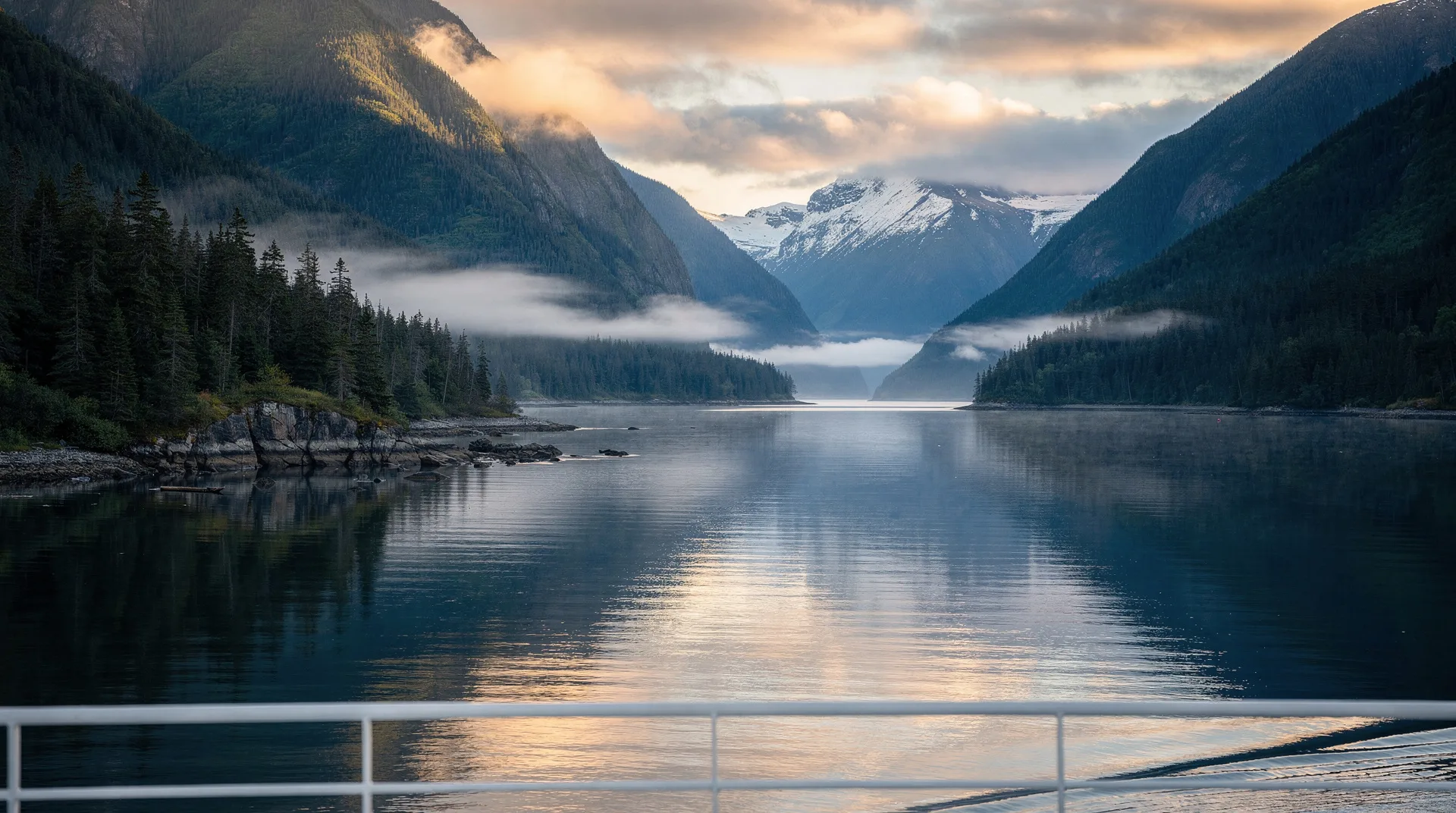
The Inside Passage sailing on BC Ferries is one of the great scenic voyages in North America — a 15-hour daylight passage through a protected coastal waterway that rivals any commercial Alaska cruise at a fraction of the price. The route threads between Vancouver Island and the BC mainland, past the Great Bear Rainforest, through Fiordland Recreation Area, and finally up the Inland Passage to the northern BC coast. Glaciers tumble to the water’s edge. Humpback whales surface alongside the ship. Bald eagles perch on navigational markers. Dall’s porpoises ride the bow wave.
For travellers making their way up the BC coast — whether heading to Alaska, ferrying up for the Cassiar Highway return loop, or building a Yellowhead Highway road trip — the Inside Passage is both essential transport and a genuine destination in its own right.
At a glance
| Where | Port Hardy (north Vancouver Island) to Prince Rupert, BC mainland |
| Cost | Around CAD $250-300 per foot passenger one-way; CAD $600-700 with a vehicle |
| Time needed | Around 15 hours in summer daylight; 15-16 hours overnight in winter |
| Getting there | Drive or fly to Port Hardy; the ferry terminal is a short drive from the airstrip |
| Best time | May to September for the daytime scenic sailing |
The route
The main Inside Passage sailing operates between Port Hardy (northern Vancouver Island) and Prince Rupert (northern BC mainland). The vessel currently assigned is the Northern Expedition, a modern 150-metre ferry built specifically for this route, with cabins, restaurants, a lounge with panoramic windows, and enclosed observation decks.
In summer (May through September), the ferry runs a daytime schedule: depart Port Hardy around 7:30 am, arrive Prince Rupert around 10:30 pm. The entire sailing takes place in daylight. This is the signature experience.
In winter (October through April), the ferry runs overnight in both directions. Cabins are included in the standard fare for winter sailings. The scenery is missed in darkness, but for travellers needing transport rather than sightseeing, winter fares and schedules are functional.
The route covers approximately 500 km through some of the most protected and scenic water in Canada.
What you see along the way
The early hours sail north from Port Hardy across Queen Charlotte Strait and into Milbanke Sound — often the roughest section of the sailing, though still well-sheltered compared to open Pacific waters. Wildlife sightings begin immediately: Dall’s porpoises and Pacific white-sided dolphins frequently ride the bow wave.
Mid-morning through early afternoon the ferry enters Finlayson Channel and Princess Royal Channel — tight, fjord-like passages through the Great Bear Rainforest. Humpback whales are common here from June to September. Steep granite walls rise directly from the water, draped with waterfalls. The community of Klemtu (Kitasoo/Xai’xais Nation) may be visible on the port side.
Early afternoon the ship crosses Wright Sound — an open water section with views to the Coast Mountains. Dall’s porpoises and occasional orca pods are sighted here.
Late afternoon the ferry passes through Grenville Channel — the narrowest and most visually striking section of the route, with the channel narrowing to 500 metres in places and forested slopes rising 1,500 metres on either side. This is arguably the most spectacular 90 minutes of the entire voyage.
Evening brings arrival into Prince Rupert Harbour around dusk, often with alpenglow on the Coast Mountains.
Booking the Inside Passage
Reservations are essential — sailings run twice weekly in peak season and sell out months in advance for July and August. Book through BC Ferries directly (bcferries.com) as early as possible for your preferred date.
Fares (typical summer 2026 range):
- Adult foot passenger: CAD $250-300 (includes seat, access to all public areas)
- Vehicle up to 20 ft: CAD $600-700
- Cabin (optional, recommended for long sailings): CAD $100-200 extra
Cabins are not required for the daytime summer sailing but provide a private space for families, a place to nap, and en-suite facilities. For longer groups or families with children, a cabin transforms the experience. Cabins book out earliest — reserve as soon as schedules open.
Meal packages can be added at booking. The ship has a full-service restaurant and cafeteria; meals can also be purchased onboard without a package.
See the BC Ferries guide for broader BC Ferries planning context.
Combining the Inside Passage with onward travel
Most travellers ride the Inside Passage as part of a larger coastal journey. Popular combinations include:
Port Hardy to Prince Rupert, then Yellowhead Highway (Hwy 16) to Prince George and beyond — this forms a classic BC road loop. From Prince Rupert, drive south-east through Terrace and Smithers to Prince George (780 km), then continue to Jasper in Alberta or return to Vancouver via the Cariboo.
Port Hardy to Prince Rupert, then Discovery Coast Connector to Bella Coola — a seasonal service (May-September) that extends the Inside Passage experience with a mid-route stop in the remote Great Bear Rainforest.
Prince Rupert to Haida Gwaii — a 6-hour separate ferry from Prince Rupert to Skidegate on Haida Gwaii. Combining the Inside Passage with Haida Gwaii makes for an epic one-way coastal journey.
Prince Rupert to Ketchikan, Alaska — the Alaska Marine Highway operates connecting service from Prince Rupert north to Ketchikan, Sitka, Juneau, and beyond, allowing a continuous ferry journey up the entire Northwest Coast.
What to pack
- Layered clothing — coastal weather is unpredictable; mornings on the outer deck may require a warm jacket even in July
- Waterproof jacket — showers are common
- Binoculars — transformational for wildlife viewing
- Camera with telephoto lens — whale and bear sightings can be far
- Refillable water bottle — onboard water stations are available
- Book or download content — while scenery dominates, there are slower stretches
- Motion sickness remedy — the open-water sections (Queen Charlotte Strait, Milbanke Sound, Wright Sound) can have chop in windy conditions
Where to stay at either end
Port Hardy is small and has limited accommodation. Kwa’lilas Hotel (Indigenous-owned, opened 2016) is the standout option. Glen Lyon Inn and Airport Inn offer reliable mid-range stays. Book early for the night before a morning sailing.
Prince Rupert has a broader range. Crest Hotel, Inn on the Harbour, and Coast Prince Rupert Hotel all offer harbour views. See the Prince Rupert destination page for more detail. If you have a spare day on the coast, guided tours in British Columbia can fill it with wildlife and sightseeing outings.
Inside Passage versus Alaska cruise
This comparison comes up often. An Alaska cruise offers larger ships, more onboard amenities, multi-day sailing, and organised shore excursions. A BC Ferries Inside Passage sailing offers:
- Lower cost — often under CAD $300 per person one-way versus CAD $1,500-3,000 for a basic Alaska cruise week
- Better wildlife sightings — smaller vessel, lower decks close to water, slower passage through tight channels
- Direct local experience — working ferry serving BC coastal communities, not tourist-oriented
- One-way flexibility — easily combines with rental car or onward ferry service
For travellers who want the scenery without the cruise-industry trappings, the Inside Passage is the superior choice.
| Inside Passage (BC Ferries) | Alaska cruise | |
|---|---|---|
| Typical cost | Around CAD $250-300 one-way, foot passenger | Around CAD $1,500-3,000 for a week |
| Duration | Around 15 hours, one sailing | 7+ days, multiple ports |
| Vessel | Working ferry, around 150 m | Large cruise ship, onboard amenities |
| Wildlife viewing | Close to the water, slower channels | Higher decks, larger ship |
| Flexibility | Easy to combine with a rental car or onward ferry | Fixed itinerary |
Connecting onward by rail and road
Travellers landing in Prince Rupert or continuing from Port Hardy often build the Inside Passage into a longer loop that eventually reaches the Rockies. From Prince George, the Yellowhead Highway continues east toward Jasper National Park and the Icefields Parkway — a natural extension for anyone combining coastal BC with the mountains.
For travellers preferring rail over driving, VIA Rail’s Canadian runs the transcontinental route and can be booked as a one-way leg; see the VIA Rail booking guide for how reservations work. Those weighing rail options against the pricier scenic train should also read Rocky Mountaineer versus VIA Rail before committing to a route.
Browse BC ferry-connected tours and experiencesFrequently asked questions about Inside Passage BC Ferry: the ultimate coastal voyage
How do I book the Inside Passage ferry?
Book through BC Ferries directly at bcferries.com. Reservations open approximately 12 months in advance for the summer season. July and August sailings routinely sell out by March — book as early as possible for peak dates.
Can I bring a vehicle on the Inside Passage?
Yes. Vehicles up to 20 ft are standard; larger RVs and trailers require a special rate and size measurement. Vehicle reservations are highly recommended for summer sailings.
Is the Inside Passage good for wildlife viewing?
Very good, particularly for humpback whales (June-September), Dall’s porpoises, Pacific white-sided dolphins, bald eagles, and sea lions. Orca sightings occur but are less predictable. Bears are occasionally visible on shore in protected channels. Bring binoculars.
Does the Inside Passage ferry run in winter?
Yes, but on overnight schedules in both directions, meaning most scenery is missed. Winter fares include cabins. For scenic purposes, plan a summer daylight sailing.
How rough is the sailing?
Most of the route is very sheltered — sailing through channels protected by islands. The exceptions are Queen Charlotte Strait (near Port Hardy), Milbanke Sound, and Wright Sound, which are open-water crossings that can have moderate chop in windy conditions. Motion sickness is unusual but possible; bring a remedy if sensitive.
Is the Inside Passage suitable for children?
Yes. The ship has a small play area, quiet lounges, and restaurants. A cabin is recommended for families to provide a retreat during a long day. Children often love spotting whales and eagles from the observation decks.
Can I combine the Inside Passage with a Jasper or Rockies trip?
Yes. From Prince Rupert, the Yellowhead Highway runs east through Prince George toward Jasper National Park, making the ferry a scenic opening leg of a longer coast-to-mountains road trip.
Is the Inside Passage cheaper than the Rocky Mountaineer?
Yes, considerably. The Inside Passage runs a few hundred dollars per person one-way, while the Rocky Mountaineer is a premium daytime-only rail product costing several times more per day of travel — the two serve different routes and budgets rather than being direct substitutes.