Indigenous culture in Canada: First Nations, Inuit and Métis experiences by region
How can I respectfully experience Indigenous culture in Canada?
Choose Indigenous-owned and operated tourism experiences — cultural centres, guided tours, art galleries, and restaurants run by First Nations, Inuit, or Métis operators ensure your visit benefits communities directly. Avoid generic 'Native' experiences at mainstream tourist attractions. Research the specific nations whose territory you are visiting.
At a glance
| Where | Coast-to-coast; strongest concentrations in British Columbia, the Prairies, Quebec’s Wendake and Atlantic Mi’kmaq territory |
| Cost | Cultural centre admission typically CAD 10-25; many powwows and land walks are free or by donation |
| Time needed | 2-3 hours for a single cultural centre; a full day for Wanuskewin, Wendake or Ksan |
| Getting there | Self-drive or guided tour to most sites; Haida Gwaii and Arctic communities require flights |
| Best time | Year-round for museums; summer for powwows and outdoor cultural events |
Encountering Canada’s first peoples
Canada’s Indigenous peoples — comprising First Nations, Inuit, and Métis nations — have inhabited this land for at least 15,000 years. Their cultures, languages, and knowledge systems represent one of humanity’s most diverse and sophisticated bodies of wisdom, shaped by intimate relationship with environments ranging from Pacific temperate rainforest to Arctic tundra.
For visitors, encountering Indigenous Canada is one of the country’s most meaningful travel experiences — and one that requires thoughtful, respectful engagement. The legacy of colonisation, residential schools, and systemic dispossession means that context and careful operator selection matter greatly. This guide points toward authentic, community-driven experiences that benefit Indigenous peoples directly and present culture with dignity and depth.
Canada’s Truth and Reconciliation Commission calls for increased knowledge of Indigenous history and culture among all Canadians and visitors. Tourism is increasingly recognised as a vehicle for economic reconciliation — when you book an Indigenous-owned tour, stay at an Indigenous lodge, or buy art from an Indigenous gallery, you are participating in something meaningful.
British Columbia: totem poles, potlatches and coastal nations
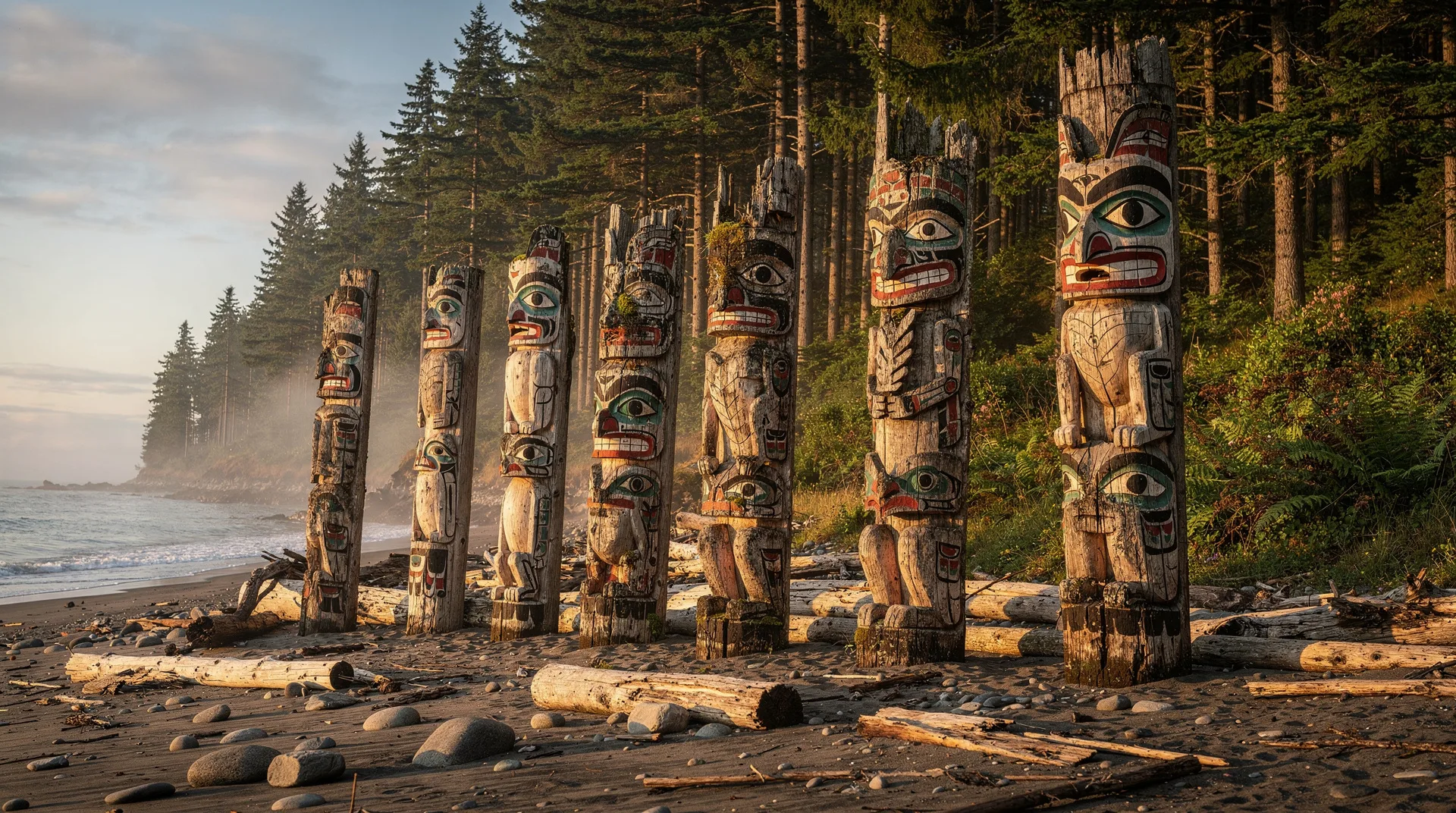
BC’s First Nations cultures are among the most visually distinctive in the world. The Northwest Coast art tradition — characterised by formline design, stylised animal imagery (raven, eagle, orca, bear, salmon), totem poles, and carved cedar work — is one of the most sophisticated art traditions in the Americas.
U’mista Cultural Centre in Alert Bay (Cormorant Island, accessible by ferry from Port McNeill) is one of the most important First Nations cultural institutions in Canada. It was founded specifically to house potlatch regalia seized by the Canadian government in 1922 — confiscated during the illegal period when potlatch ceremonies (a fundamental cultural institution of coastal peoples) were banned. The collection’s return to the Kwakwaka’wakw people who owned it was a landmark in cultural repatriation. The centre offers tours, cultural demonstrations, and contemporary programming.
Museum of Anthropology at UBC (Vancouver) houses one of the world’s finest collections of Northwest Coast Indigenous art, including a spectacular Great Hall with full-scale totem poles and canoes. The Multiversity Galleries display thousands of additional artifacts in open storage. The museum opened its doors in 1976 in a building designed by Arthur Erickson, itself inspired by post-and-beam Coast Salish architecture.
Haida Gwaii (Queen Charlotte Islands) is the homeland of the Haida Nation — one of the most culturally and artistically influential peoples of the Northwest Coast. The Haida are famous worldwide for their totem poles, argillite carvings, and sophisticated governance systems. SGang Gwaay (Anthony Island) is a UNESCO World Heritage Site containing the world’s largest collection of standing totem poles in their original setting. Visiting requires permits and a Haida guide. Haida Heritage Centre at Kay Llnagaay in Skidegate provides excellent cultural context.
Squamish Lil’wat Cultural Centre in Whistler is operated jointly by the Squamish and Lil’wat Nations and offers guided tours, cultural demonstrations (including traditional food preparation and weaving), and an excellent permanent collection. A strong example of urban Indigenous tourism done right.
Browse Indigenous culture and nature experiences in BC on GetYourGuideThe Prairies: Métis heritage and Plains nations
The Prairies were shaped by the cultures of Cree, Blackfoot, Assiniboine, Lakota, and Ojibwe nations, and by the Métis — the people who emerged from the mixing of European (primarily French) and Indigenous (primarily Cree and Ojibwe) ancestry in the fur trade era.
Wanuskewin Heritage Park near Saskatoon, Saskatchewan, is one of Canada’s most important Indigenous heritage sites and tourism destinations. Located on a river valley that has been a gathering place for Plains peoples for 6,400 years, Wanuskewin has undergone major renewal to become a world-class cultural centre. Activities include guided archaeological tours, tipi camps, Indigenous food experiences, and powwow attendance. The park has recently reintroduced bison — central to Plains Indigenous cultures — to the site.
Head-Smashed-In Buffalo Jump near Fort Macleod, Alberta, is a UNESCO World Heritage Site and one of the world’s oldest and best-preserved buffalo jumps — a cliff where Plains peoples stampeded bison herds for over 6,000 years. The interpretive centre, designed with input from Blackfoot Elders, is built into the hillside and provides extraordinary context on Plains Indigenous hunting culture and cosmology. Blackfoot guides lead the tours.
Batoche National Historic Site in Saskatchewan is the site of the 1885 North-West Resistance — the last stand of the Métis people under Louis Riel against Canadian federal expansion. The site has been managed and interpreted by Parks Canada with increasing Indigenous input. The annual Back to Batoche festival draws Métis from across the country for cultural celebration.
Métis Cultural Village events and Gabriel Dumont Institute programming in Saskatoon offer insights into Métis culture — fiddle music, the Red River cart, distinct Métis art forms, and a cuisine that fuses Indigenous and French-Canadian traditions.
Ontario: Six Nations and Anishinaabe territory
Ontario contains the largest Indigenous population of any province and extraordinary diversity of nations.
Six Nations of the Grand River (near Brantford) is the most populous First Nations reserve in Canada and home to Haudenosaunee (Iroquois Confederacy) peoples — Mohawk, Onondaga, Cayuga, Oneida, Seneca, and Tuscarora nations. The Woodland Cultural Centre maintains significant collections of Haudenosaunee and Anishinaabe cultural heritage and is working on major new programming. The annual Six Nations Powwow is open to visitors.
Manitoulin Island is the world’s largest freshwater island and the spiritual homeland of the Anishinaabe (Ojibwe/Chippewa) peoples. Several First Nations on the island offer cultural tourism — guided tours of significant sites, art studios, and cultural events. The Ojibwe Cultural Foundation in M’Chigeeng provides arts and cultural programming.
Curve Lake First Nation near Peterborough operates cultural tours focusing on Anishinaabe traditions, birchbark canoe craft, and traditional plant knowledge.
Bannock restaurant in Toronto, operated by chef Shawn Adler with Indigenous food culture at its heart, and Pow Wow Café in Kensington Market represent Indigenous food culture in urban Ontario.
Quebec: Innu, Huron-Wendat and Mohawk nations
Wendake (Huron-Wendat Nation) near Quebec City is one of the most accessible and well-developed Indigenous cultural tourism destinations in Canada. The Huron-Wendat Nation offers tours of the Huron-Wendat Museum, traditional longhouse visits, and accommodation at the acclaimed Hôtel-Musée Premières Nations — where guests sleep in contemporary rooms with traditional architectural references and eat at a restaurant serving Wendat cuisine incorporating game, corn, and traditional ingredients. This is one of the best-executed Indigenous tourism experiences in the country.
Kahnawake Mohawk Territory, south of Montreal, is one of the oldest Haudenosaunee communities in Canada. The Mohawk-owned businesses here, including cultural centres and powwow events, provide access to Haudenosaunee culture.
Atlantic Canada: Mi’kmaq territory
The Mi’kmaq (Mi’kmaw) Nation has inhabited Atlantic Canada for at least 13,000 years, with territory extending across Nova Scotia, PEI, New Brunswick, Newfoundland, and eastern Quebec.
Membertou Heritage Park in Sydney, Cape Breton, offers cultural tours of the Membertou First Nation community with storytelling, traditional music, and food experiences. Membertou is remarkable for its success in economic development while maintaining cultural identity.
Eskasoni Cultural Journeys at Eskasoni on Cape Breton offers boat tours on Bras d’Or Lake with Mi’kmaq cultural interpretation — a beautiful setting for learning about the Mi’kmaq relationship with these waters.
Chapel Island National Historic Site on Bras d’Or Lake is a sacred Mi’kmaq gathering place, the site of an annual celebration in late July (St. Anne’s Mission) that has been held for centuries and remains an important cultural event.
Find Indigenous cultural experiences on Vancouver IslandThe Arctic and Subarctic: Inuit culture
The Inuit are the Indigenous peoples of Canada’s Arctic — Nunavut, Nunavik (northern Quebec), Nunatsiavut (northern Labrador), and the Inuvialuit Settlement Region in the Northwest Territories. Their culture is shaped by the extreme demands of Arctic life: ingenious technologies for hunting, travel, and shelter; a profound relationship with sea ice, caribou, and marine mammals; and an artistic tradition (particularly in stone carving, printmaking, and textile art) that has gained global recognition.
Iqaluit, Nunavut is the most accessible point of entry into Inuit territory. Local tour operators offer guided cultural experiences, guided excursions on the land, and art workshops. The Nunatta Sunakkutaangit Museum in Iqaluit has an excellent collection of Inuit artifacts and contemporary art.
Cape Dorset (Kinngait) on Baffin Island is one of the most celebrated Inuit art communities in the world. The Kinngait Studios — formerly West Baffin Eskimo Co-operative — produces prints, drawings, and sculptures by artists whose work appears in galleries from New York to Tokyo. Visiting Cape Dorset and seeing the studios in person is a remarkable experience.
Rankin Inlet, Nunavut has a strong ceramics tradition alongside printmaking and carving.
Inuit art galleries in southern Canadian cities provide access to Arctic art without the journey. Feheley Fine Arts in Toronto and Inuit Art Quarterly online are good resources for understanding this tradition.
How to find responsible Indigenous tourism operators
Indigenous Tourism Association of Canada (ITAC): The national organisation representing Indigenous tourism operators. Their website (indigenoustourism.ca) lists verified Indigenous-owned and operated experiences across the country.
Indigenous Tourism BC (ITBC): BC-specific organisation with a comprehensive guide to Indigenous tourism in the province.
Spirit of a Nation Travel: A consortium of Indigenous-owned tour operators across the Prairies.
Questions to ask when evaluating an operator:
- Is this operator Indigenous-owned?
- Are guides Indigenous community members?
- Does revenue flow back to the community?
- Is this experience co-developed with community Elders?
Respectful engagement: a practical guide
On acknowledgement of territory: When visiting any location in Canada, it is increasingly standard practice to acknowledge the traditional territory of the Indigenous peoples on whose land you are standing. Many Canadian institutions and events open with land acknowledgements. This practice is meaningful — take the time to learn whose territory you are in.
Photography: Always ask before photographing people. At ceremonies and cultural events, follow posted rules. Some ceremonies are closed to photography entirely; honour those restrictions.
Art purchasing: Buy art directly from Indigenous artists, from Indigenous-owned galleries, or from artist cooperatives. Avoid mass-produced “Native” souvenirs, which are often not made by Indigenous people.
Listening over speaking: The deepest exchanges with Indigenous knowledge-holders come from listening. Resist the impulse to draw parallels or offer comparisons; simply listen and ask respectful questions.
For context on specific regions, see the Acadian heritage guide for a parallel story of cultural resilience in Atlantic Canada, and the Cabot Trail guide for Mi’kmaq cultural sites along Cape Breton’s famous route. For BC specifically, the dedicated Indigenous experiences in BC guide goes deeper on totem pole sites and First Nations-led tours, and pairs well with a trip through Haida Gwaii or the Great Bear Rainforest.
Building a trip around Indigenous experiences
Indigenous tourism works best when it is the thread of a trip rather than a single stop squeezed between other sights. A few pairings make that easy without extra planning.
On the Prairies, a visit to Wanuskewin combines naturally with Batoche for the Métis story, and with the Head-Smashed-In Buffalo Jump guide if you are continuing west toward Alberta. Leave time to talk with the guides rather than rushing between sites; the stories are the point.
In Ontario, Manitoulin Island rewards a slow pace, and it fits well into the wider northern Ontario guide for travellers who want lakes, forest and cultural visits in the same journey.
If your dates line up with a summer gathering, the powwow experiences guide explains what to expect, how to behave in the arena and how to be a good guest. For Quebec, the Quebec First Nations guide and the Indigenous tourism in Quebec guide add detail on Wendake and neighbouring communities.
For a broader national overview of operators and how Indigenous-led tourism is organised, the Indigenous tourism in Canada guide is a useful companion to this page. In the far north, Iqaluit is the natural starting point for Inuit culture, and the Nunavut destination page helps you plan the logistics around it.
Regional experiences at a glance
| Region | Signature experience | Best for |
|---|---|---|
| British Columbia | U’mista Cultural Centre, Haida Gwaii | Totem poles, potlatch history |
| Prairies | Wanuskewin, Head-Smashed-In Buffalo Jump | Plains and Métis heritage |
| Ontario | Six Nations, Manitoulin Island | Haudenosaunee and Anishinaabe culture |
| Quebec | Wendake, Hôtel-Musée Premières Nations | Huron-Wendat culture, overnight stays |
| Atlantic | Membertou Heritage Park, Eskasoni | Mi’kmaq culture and Bras d’Or Lake |
| Arctic | Iqaluit, Cape Dorset | Inuit art and land-based culture |
Frequently asked questions about Indigenous culture in Canada: First Nations, Inuit and Métis experiences by region
What is the difference between First Nations, Inuit, and Métis?
These are three constitutionally recognised categories of Indigenous peoples in Canada. “First Nations” refers to the hundreds of distinct Indigenous nations across the country (formerly called “Indians” under the Indian Act — a term now largely abandoned). “Inuit” refers specifically to the Indigenous peoples of the Arctic regions. “Métis” refers to the people of mixed Indigenous and European ancestry who formed a distinct nation, primarily in the Prairie provinces. “Indigenous” is the inclusive term for all three groups.
Is it appropriate to attend a powwow as a non-Indigenous visitor?
Many powwows are open to the public and visitors are genuinely welcome. Follow the posted rules: respect the dance circle and ceremonial items, ask before photographing, dress modestly, and follow the guidance of the emcee. Attending as a respectful observer is appropriate; participating in sacred dances without invitation is not.
How can I support Indigenous artists when buying souvenirs?
Buy direct from Indigenous artists at markets and galleries rather than from non-Indigenous retailers selling mass-produced items. Look for artist names, nation affiliations, and authenticity markers. Ask vendors directly: “Was this made by Indigenous artists?” The Inuit Art Foundation’s certification mark and ITAC membership are useful trust signals.
Are there Indigenous experiences suitable for families with children?
Yes. Wanuskewin Heritage Park, the Squamish Lil’wat Cultural Centre, and many Indigenous cultural centres specifically design family programming with interactive elements — storytelling, traditional games, craft activities, and guided nature walks. These experiences can be powerful educational moments for children.
What is a residential school and why does it matter to Indigenous tourism?
Residential schools were government-funded, church-run boarding schools that forcibly separated Indigenous children from their families from the late 19th century until 1996. The system caused massive cultural, linguistic, and personal trauma across generations. Understanding this history is fundamental to understanding contemporary Indigenous Canada. The National Centre for Truth and Reconciliation in Winnipeg is dedicated to documenting and teaching this history.
Can I visit Indigenous communities without a formal tour?
Some communities welcome independent visitors; others prefer structured visits through cultural centres. Research specific community protocols before arriving. Booking through an Indigenous-run operator is the safest approach and ensures your visit is genuinely welcome.
Where can I learn more about Indigenous history before visiting?
The National Centre for Truth and Reconciliation website (nctr.ca) is comprehensive. Facing History and Ourselves has Canadian Indigenous curriculum resources. The CBC’s Reclaimed series provides accessible current reporting. Books: “21 Things You May Not Know About the Indian Act” by Bob Joseph is an excellent primer.
Which single destination gives the best Indigenous cultural experience in Canada?
There is no single answer, but Wendake (Huron-Wendat Nation) near Quebec City is often cited as the most accessible and well-executed, combining a museum, longhouse tours and an Indigenous-owned hotel and restaurant in one visit. For a wilder, more remote experience, Haida Gwaii in BC is unmatched.
Do Indigenous cultural centres operate year-round?
Most major institutions like the Museum of Anthropology, U’mista Cultural Centre and Wanuskewin Heritage Park operate year-round, though hours are reduced outside summer. Outdoor and land-based experiences, and most powwows, are concentrated in the summer months.