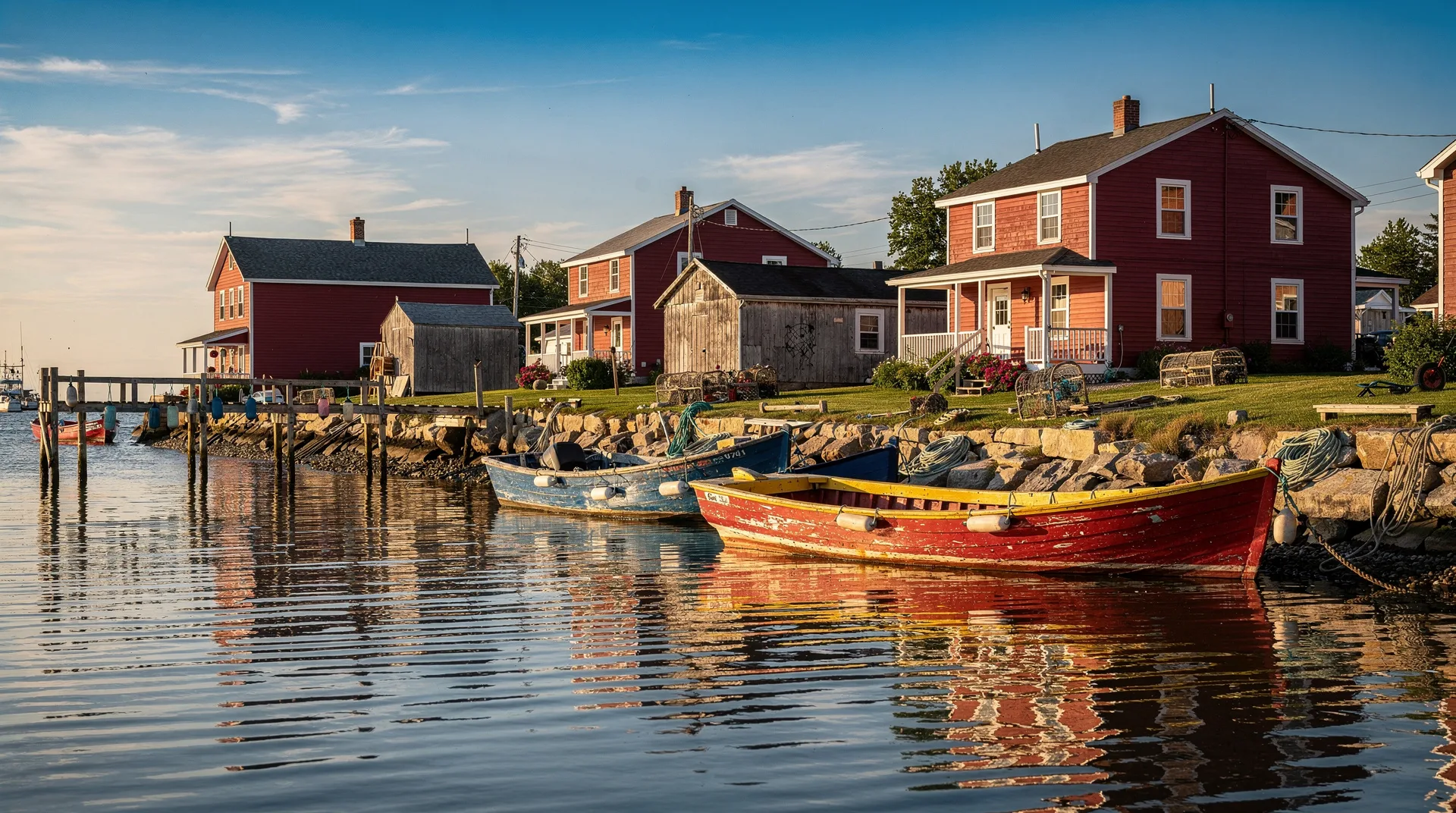
Acadian heritage: history, villages and festivals in Atlantic Canada
Who are the Acadians and where can I learn about their history?
The Acadians are the descendants of French settlers who arrived in Atlantic Canada in the early 1600s. Expelled by the British in 1755 in the Grand Dérangement (Great Expulsion), many survived and returned. Village Historique Acadien in New Brunswick and Grand-Pré National Historic Site in Nova Scotia are the premier heritage experiences.
| At a glance | |
|---|---|
| Where | New Brunswick, Nova Scotia and PEI (New Brunswick is Canada’s only officially bilingual province) |
| Cost | Village Historique Acadien around CAD 25-30 for adults; Grand-Pré is free (Parks Canada); Fortress of Louisbourg requires a separate ticket |
| Time needed | 3-4 days for a New Brunswick-focused circuit; add 2 days to include Grand-Pré and Nova Scotia sites |
| Getting there | A car is essential — the Acadian Peninsula and Clare District are not well served by public transport |
| Best time | August, for the Festival Acadien de Caraquet and National Acadian Day on the 15th; sites are open roughly late June to mid-October |
A people forged by exile and return
The Acadians have one of the most dramatic histories of any people in North America. They arrived in what is now Nova Scotia and New Brunswick as French colonists in the early 17th century, built prosperous farming communities on the dyked marshlands of the Bay of Fundy, developed a distinct culture and identity over 150 years — and then, in 1755, the British colonial authorities expelled them from their lands in a mass deportation known as the Grand Dérangement.
Between 1755 and 1763, an estimated 10,000 to 18,000 Acadians were forcibly removed from their homes and scattered to British colonies along the Atlantic Seaboard, to France, and to the Caribbean. Communities were destroyed, farms burned, families separated. Some found their way to Louisiana, where the Acadian diaspora eventually became the Cajun culture that persists today. Others survived in hiding in the forests and marshes of Atlantic Canada. Many perished during the deportations.
But the Acadians endured. By the late 18th century, those who remained and those who returned rebuilt communities across New Brunswick, Nova Scotia, and PEI. Today, approximately 500,000 Acadians live in Atlantic Canada — primarily in New Brunswick, which is Canada’s only officially bilingual province. Their survival, cultural revival, and ongoing identity constitute one of the most remarkable stories in Canadian history.
Understanding Acadian heritage enriches any trip to Atlantic Canada enormously, and the heritage sites, living history villages, and festivals dedicated to this culture are among the region’s finest travel experiences.
Village Historique Acadien: the masterpiece of living history
Village Historique Acadien near Caraquet, New Brunswick, is one of the finest living history museums in Canada and the premier destination for understanding Acadian culture. The village occupies 364 hectares of forested land near the Acadian Peninsula coast and recreates Acadian life from 1770 to 1949 using 40 historic buildings and a community of costumed interpreters.
Visitors step into a working historical community. The interpreter-residents speak both French and English (though the village is predominantly French in character — this is the heart of Acadian New Brunswick), cook in period kitchens, operate traditional crafts (cooperage, weaving, blacksmithing, farming), and engage visitors in genuine conversation about Acadian life. The attention to detail is exceptional: the food being prepared is authentic, the tools are functional originals, the animals in the fields are heritage breeds.
What to see: The village is divided into eras — an 18th-century settlement section, a Victorian-era bourgeois section, and an early 20th-century modernity section. The journey from the simple log cabin of 1770 to the prosperous farmstead of the 1880s to the mechanised farm of the 1940s is a physical walk through 180 years of Acadian resilience.
Practical: The village is open late June through mid-October. Allow a full day — there is genuinely too much to see in less time. Admission is approximately CAD $25–$30 for adults. The on-site restaurant serves traditional Acadian food.
Getting there: Village Historique Acadien is about 5 hours from Halifax by car via the Trans-Canada. The Acadian Peninsula requires a car; public transport does not serve the area adequately.
Find Atlantic Canada heritage tours and experiencesGrand-Pré National Historic Site: the heart of the Grand Dérangement
Grand-Pré National Historic Site in Nova Scotia’s Annapolis Valley is the most emotionally resonant Acadian heritage site in Canada. Grand-Pré (meaning “Great Meadow”) was the largest Acadian settlement in Nova Scotia before the 1755 expulsion, and it was from here that thousands of Acadians were loaded onto ships and deported to dispersal across the British Atlantic world.
The site is a UNESCO World Heritage Site and has been recognised as a landscape of memory and identity for the Acadian people. A memorial church (built 1922 as a symbol of Acadian renaissance), a statue of Évangéline (the fictional heroine of Longfellow’s epic poem about the deportation), and beautiful gardens mark the central commemorative area.
The Visitor Centre has been redesigned as a genuinely outstanding museum — telling the full story of Acadian settlement, the dyke-building technology that transformed Bay of Fundy marshes into farmland, the cultural vibrancy of pre-deportation Acadian society, the horror of 1755, and the slow return and rebuilding of Acadian identity.
Practical: Grand-Pré is about 80 km from Halifax, 1 hour by car. Open May through October. Admission is free (Parks Canada). Allow 2–3 hours.
Combination: Grand-Pré pairs perfectly with a visit to the Acadian Memorial in Wolfville and the charming college town itself, and with the Annapolis Valley wine region nearby. The Canadian cuisine guide covers the region’s food culture.
Caraquet and the Acadian Peninsula: the living heartland
Caraquet, New Brunswick, is the cultural capital of Acadian Canada — a town of 4,000 on the Baie des Chaleurs coast where French Acadian culture is not a heritage artifact but a living reality. The language on the street is Acadian French; the businesses are French-named; the culture is distinct and proud.
The Festival Acadien de Caraquet (late July through August 15) is one of Canada’s most joyous cultural celebrations — 17 days of Acadian music, theatre, art, and community celebration culminating on National Acadian Day (August 15). The tintamarre — a massive community parade where participants make as much noise as possible — on August 15 is exuberant and moving in equal measure.
The Acadian Museum of Caraquet has collections covering Acadian material culture, genealogy, and archives. For visitors with Acadian ancestry, the genealogical resources can be extraordinary.
La Sagouine is a theatrical-cultural institution in Bouctouche, NB — a performance venue and living heritage park based on the plays of celebrated Acadian author Antonine Maillet, whose work put Acadian vernacular on the world literary stage (she won the Prix Médicis in France for her novel La Sagouine in 1979).
Nova Scotia: the Acadian presence
Beyond Grand-Pré, Acadian presence is scattered across Nova Scotia in communities that survived or re-established after 1755.
Clare District on the Fundy shore of Nova Scotia (around Weymouth and Yarmouth) is the largest Acadian community in Nova Scotia, with a distinct cultural identity. The Centre acadien at Université Sainte-Anne in Church Point has an excellent regional museum.
Chéticamp, Cape Breton is a vibrant Acadian fishing and textile community on the Cabot Trail. The famous Chéticamp hooked rugs (tapis hookés) are a distinctly Acadian craft tradition, colourful and intricate. The Musée des Acadiens des Pubnicos and the cooperative crafts studios are worth visiting.
Ile Royale (Cape Breton Island) was a major French colonial territory and the location of the Fortress of Louisbourg — the most extensively restored 18th-century fortress in North America. Louisbourg was the most significant French fortification in North America before its capture by the British in 1758. Parks Canada operates the site as a living history museum with costumed interpreters, period food, and reconstruction of the entire fortress town. It is extraordinary. Allow a full day.
PEI: Acadian heartland on the island
Prince Edward Island has a significant Acadian minority concentrated primarily on the western portion of the island. The Acadian Museum of Prince Edward Island in Miscouche provides a comprehensive overview of PEI Acadian history. The Évangéline Trail driving route through western PEI links Acadian communities, heritage sites, and cultural institutions.
Mont-Carmel in western PEI has the Acadian Pioneer Village, a smaller-scale living history operation celebrating early Acadian life on the island.
The annual Festival Acadien de la région Évangéline in mid-August celebrates Acadian music, dance, and food in western PEI communities.
Explore PEI heritage and cultural experiencesAcadian cuisine: a distinct food culture
Acadian food culture is rooted in the landscape — salt cod, potato, root vegetables, wild game, and forest berries — with a French culinary sensibility shaped by 17th-century Norman and Poitevin cooking traditions.
Rappie pie (râpure) is the most distinctive Acadian dish: a potato casserole made by grating and squeezing potatoes to remove their starch, then mixing them with the cooking liquid from chicken or clam (the ratio of potato to liquid is critical), and baking until golden. The result is gelatinous, dense, and intensely savoury — utterly unlike anything else. Rappie pie is most associated with the Clare District of Nova Scotia and is still made in family kitchens throughout the region.
Fricot is an Acadian chicken stew with potatoes and dumplings — straightforward but deeply comforting.
Ployes are Acadian buckwheat pancakes made without eggs — thin, slightly spongy, with a distinctive buckwheat flavour. Served with maple syrup, molasses, or cretons (a pork spread). The Edmundston area of New Brunswick is the heartland of ploye culture, and the Festival des Ployes celebrates them annually in August.
Acadian poutine râpée (not the same as Quebec poutine) is a boiled potato dumpling with a pork filling — labour-intensive to make and a cherished family recipe passed between generations.
Practical planning for an Acadian heritage trip
Base cities: Moncton, NB (centrally located, bilingual, closest large city to the Acadian Peninsula) or Fredericton, NB are practical bases. Halifax, NS is better positioned for the Nova Scotia Acadian sites.
Driving: A dedicated Acadian heritage circuit in New Brunswick can cover Village Historique Acadien, Caraquet, Bouctouche, and Moncton in 3–4 days. Adding Grand-Pré adds 2 days minimum.
Language: Much of the Acadian heartland is French-speaking. Basic French is warmly appreciated. Most tourist-facing businesses and heritage sites are bilingual.
National Acadian Day: August 15 is celebrated throughout Atlantic Canada with the tintamarre. If you can be in Caraquet or any Acadian community on August 15, do not miss it.
For Atlantic Canada trip planning, the east coast lobster guide and Cabot Trail itinerary complement an Acadian heritage circuit beautifully.
Weaving Acadian heritage into a wider Atlantic Canada trip
Acadian sites are rarely a standalone trip — they work best layered into a broader Atlantic Canada itinerary. From Halifax, a natural sequence is Grand-Pré (1 hour), then on to Cape Breton and the Cabot Trail, where Chéticamp’s Acadian fishing community and hooked-rug tradition sit directly on the route. From Moncton or Fredericton, the New Brunswick circuit through Caraquet and Village Historique Acadien pairs naturally with a wider look at the Bay of Fundy coast, including Hopewell Rocks and the tides that shaped so much of Acadian farming history through the dyke systems.
For visitors tracing genealogy specifically, the Acadian Museum of Caraquet, the Centre acadien in Church Point, and the Acadian Museum of PEI in Miscouche each hold distinct regional archives — most families with Acadian roots find records split across more than one of these, so budget time at more than one museum rather than assuming a single stop will be comprehensive.
Where to stay and what to pair with the heritage sites
Choosing a base shapes the whole trip. Moncton and Fredericton work well for the New Brunswick circuit, while Halifax is the natural starting point for the Nova Scotia sites. If you are building a longer route, the Atlantic Canada 10-day itinerary and the Maritimes loop both leave room for Acadian stops without feeling rushed.
In Nova Scotia, the college town of Wolfville is the easiest place to sleep near Grand-Pré, and Annapolis Royal adds another layer of early French colonial history for travellers who want to understand how the settlements fit together. Further down the Fundy shore, Yarmouth is a practical gateway to the Clare District and its Acadian villages.
On Cape Breton, the French colonial story continues at Louisbourg, and the Fortress of Louisbourg tour guide explains how to spend the day there. Evenings in the Chéticamp area are a good moment to explore the island’s musical side, covered in the Celtic music guide.
For travellers who want the full picture of the region before they go, the driving Atlantic Canada guide and the Prince Edward Island destination page help link the New Brunswick, Nova Scotia and island stops into a single route. The Bay of Fundy page is worth reading too, since the tides explain why the Acadians built their dykes where they did.
Frequently asked questions about Acadian heritage: history, villages and festivals in Atlantic Canada
Are Acadians the same as Cajuns?
The Cajuns of Louisiana are direct descendants of Acadians deported from Nova Scotia and New Brunswick in 1755–1763 who eventually settled in the Louisiana bayous. The word “Cajun” is derived from “Acadien” in English pronunciation. Cajun and Acadian cultures have diverged significantly over 250 years — Louisiana’s subtropical environment, mixing with French Creole, African, and Native American cultures, produced a very different cuisine and music tradition — but the heritage connection is direct and powerful.
Where is the best single day visit for Acadian heritage?
Village Historique Acadien near Caraquet, NB, is the most comprehensive single-day Acadian experience. Grand-Pré in Nova Scotia is the most emotionally resonant if you are approaching from Halifax.
Is there a best time to visit for Acadian culture?
August is the peak cultural season — the Festival Acadien de Caraquet and National Acadian Day on August 15 are the highlights of the Acadian calendar. Village Historique Acadien is also at full operation in July and August.
Do I need to speak French to enjoy Acadian cultural sites?
No — all major heritage sites (Village Historique Acadien, Grand-Pré, Fortress of Louisbourg) offer full English interpretation. The living culture of Acadian communities is primarily French, but visitors are welcomed regardless of language.
What is the Grand Dérangement?
The Grand Dérangement (Great Expulsion) of 1755 was the forced deportation of the Acadian people from their settlements in present-day Nova Scotia, New Brunswick, and PEI by British colonial authorities. Approximately 10,000–18,000 Acadians were expelled and their settlements burned. The event is central to Acadian identity and memory. In 2003, the British Crown issued a Royal Proclamation acknowledging the deportation and expressing regret.
Is there Acadian heritage outside the Maritimes?
Yes. Louisiana’s Cajun culture is the most famous diaspora community. There are Acadian communities in Quebec (particularly the Magdalen Islands and Gaspé peninsula), in New England (Franco-American communities in cities like Lowell, Massachusetts), and scattered globally from France to the Falkland Islands. In Canada, the most concentrated Acadian populations are in New Brunswick, Nova Scotia, and PEI.
What is the Acadian flag?
The Acadian flag is the French tricolour with a gold star (the Star of the Virgin Mary) in the blue section. Adopted in 1884, it is flown throughout Acadian communities on National Acadian Day (August 15) and year-round in the Acadian heartland. It is a powerful symbol of Acadian cultural survival and pride.
How long should I spend on an Acadian heritage trip?
Three to four days covers a focused New Brunswick circuit (Village Historique Acadien, Caraquet, Bouctouche). Extending to five or six days allows a swing through Grand-Pré and the Nova Scotia Acadian communities, or combining the trip with the Cabot Trail or Bay of Fundy highlights for a fuller Atlantic Canada itinerary.
Can I do Acadian heritage sites as day trips from Halifax?
Grand-Pré, about an hour from Halifax, works well as a half-day trip. Village Historique Acadien and Caraquet, roughly five hours from Halifax, are not realistic as day trips — plan to base in Moncton or Fredericton for the New Brunswick sites instead.