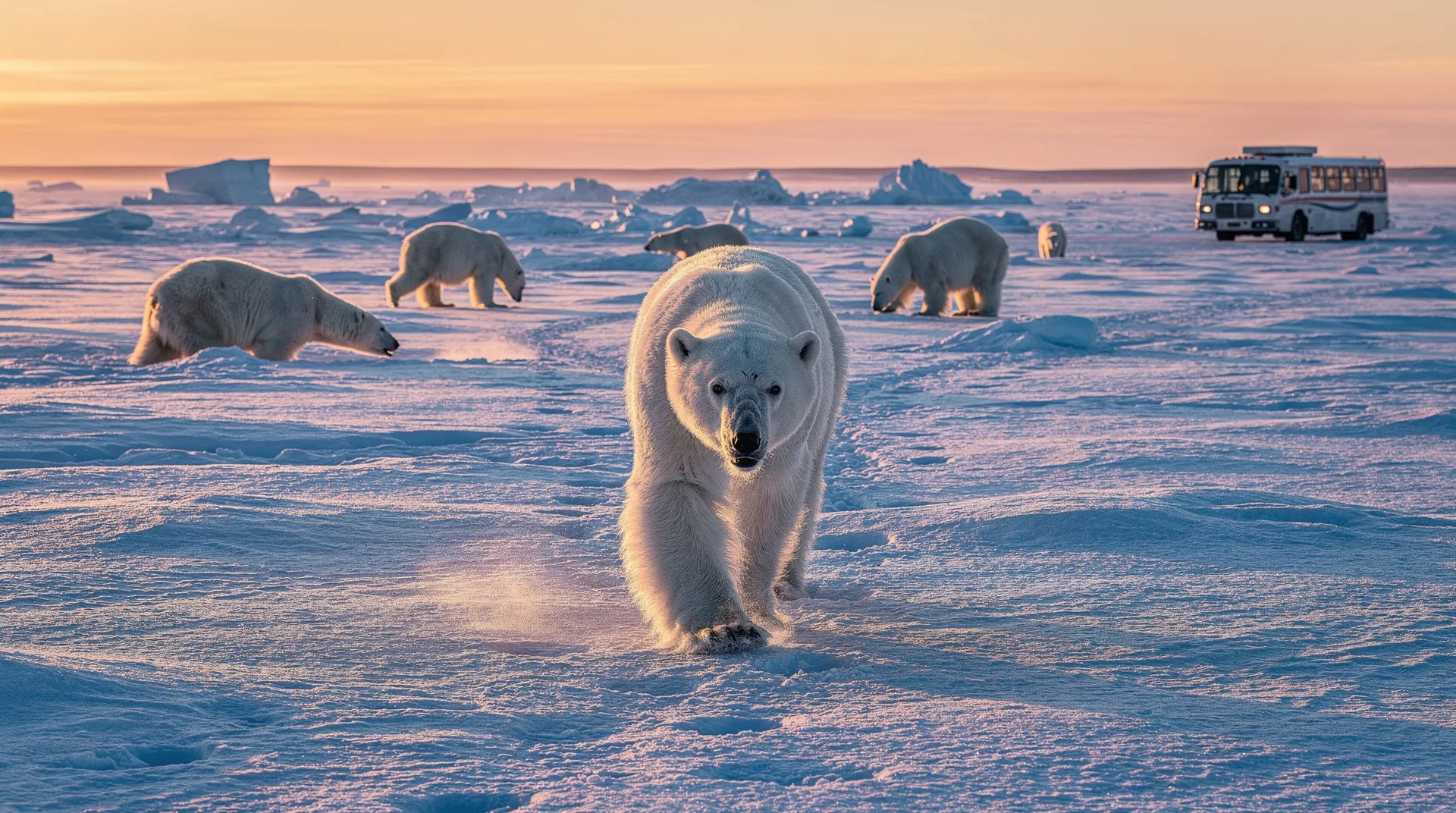
Churchill tundra buggy safari: the vehicles, the experience, the photography
What is a tundra buggy and how do the Churchill polar bear tours work?
A tundra buggy is a large elevated vehicle built for the subarctic — high ground clearance, heated cabin, outdoor observation platform. Churchill operators run full-day buggy tours and multi-day tundra lodges between mid-October and late November, from Churchill itself.
At a glance
| Where | Churchill Wildlife Management Area, out from the Tundra Buggy Departure Centre near Churchill |
| Cost | Around $650-950 per person per day for a standalone buggy day; more within full packages |
| Time needed | A full day (around 9-10 hours) per buggy outing; 3-4 days recommended |
| Getting there | Bus transfer from Churchill hotels to the launch point, then buggy |
| Best time | First two weeks of November for the best light and bear density combined |
The yellow tundra buggy is the single image most travellers associate with Churchill: a lumbering, elevated vehicle rolling across frozen muskeg with polar bears in the foreground. The buggies are not a gimmick; they are the reason this kind of safari is possible at all, and their design — refined over four decades of Hudson Bay operation — shapes what the trip feels like and what you can photograph.
This guide is the practical companion to the Churchill polar bears season guide. That piece covers when to go, how much it costs, and how to get to town. This piece covers the buggies themselves: how they work, what a day on board is actually like, the difference between day tours and tundra lodges, and the photography reality once you are out there.
What a tundra buggy actually is
A Churchill tundra buggy is a purpose-built, road-illegal vehicle designed for soft, uneven, frozen tundra. The defining features:
- High ground clearance — typically around 1.5 m between tyre and chassis, enough to clear willow hummocks, small boulders, and partially frozen ponds
- Enormous low-pressure tyres — roughly 160 cm in diameter, run at very low pressure to spread vehicle weight across the fragile tundra and minimise ground damage
- Heated, insulated passenger cabin — usually with rows of bench seats, large windows designed to open wide enough for a lens but not for a person
- Rear outdoor observation platform — the grated metal deck over the rear axle, open to the weather, with a waist-high safety rail. This is where almost all serious photography happens.
- Wash-room aboard — basic, important on a 9–10 hour day
- Driver-guide-naturalist team — professional crew, often with decades of bear experience
- Diesel power with substantial range — enough to operate out to the furthest Wildlife Management Area sectors and back in a single day
Passenger capacity varies by operator and vintage but sits typically between 18 and 40 per vehicle. Newer fleets tend towards larger vehicles with better windows; some older, smaller models are preferred by photographers for more manoeuvrability and fewer people competing for deck space.
Critically, buggies are not allowed to drive off-track. Operators travel on a defined network of legacy trails across the Churchill Wildlife Management Area, managed under permit. Vehicles cannot freestyle across untouched tundra — which protects the ecosystem and also sets a baseline for the kind of terrain you see from the windows.
A day on a tundra buggy
A typical full-day Churchill buggy tour runs something like this:
| Time | What happens |
|---|---|
| 06:00 | Hotel wake-up, breakfast, layering gear |
| 07:00 | Bus transfer from Churchill hotels to the buggy launch (the Tundra Buggy Departure Centre, about 20 km out of town) |
| 07:45 | Board buggy, safety briefing, depart |
| 08:15 | Reach the first potential bear areas; slow-driving and stopping begins |
| 10:00 | Morning hot drinks break, first photography session on rear platform |
| 12:30 | Hot lunch on board (soup, sandwiches, chili) |
| 13:00–15:30 | Afternoon sessions — golden light starts mid-afternoon in peak season |
| 16:00 | Blue hour / last light, often some of the best photography of the day |
| 16:30 | Return drive |
| 17:30 | Bus back to hotel |
A day on the buggy is long, cold when you are on the deck, and punctuated by long periods of stillness between very active wildlife encounters. Accept this rhythm — the times when nothing seems to be happening are often when a bear appears half a kilometre away, and the driver’s decision whether to move or wait is the single most important wildlife choice of the day.
Expect the buggy to stop and sit for 20–90 minutes at a time when a bear is close. You do not chase bears; the bears come to you or they don’t.
Day buggy vs tundra lodge
Two quite different products use the same basic vehicles.
Day tundra buggy
You sleep each night in a Churchill hotel and travel out and back to town each day by bus + buggy. This is the bulk of Churchill polar bear tourism.
Pros:
- Warmer, more comfortable evenings in a proper hotel
- Access to Churchill restaurants, the museum, the town
- Flexibility around add-ons like aurora tours, dog sledding, cultural visits
- Lower cost per night than the lodges
Cons:
- 2–3 hours per day lost to transit (bus, boarding, return)
- Daylight portion of the day on the buggy is shorter
- No dawn or dusk bear activity visible from the buggy (you’re in transit or back in town)
Tundra lodge
A tundra lodge is a linked train of purpose-built buggies, connected into a single structure that sits in the Wildlife Management Area for the full season. You sleep on the lodge, eat on the lodge, and start each day already in bear country.
Pros:
- Dawn and dusk bear activity visible right from the windows
- Bears routinely approach the lodge overnight and in low light — often the single best photography context of the trip
- No daily commute means more effective field time
- Tight, small-group experience (typically 32 beds or fewer)
Cons:
- Bunk-style sleeping, shared bathrooms, no private hotel room
- Significantly more expensive per night
- No access to Churchill town until the turnaround day
- Books out 12–18 months ahead
For most visitors, a 3–4 day buggy programme from a Churchill hotel is more than enough to see extensive bear activity. For serious photographers or anyone who wants the immersive version, the tundra lodge is the right answer and worth the cost premium. If you want extra activities around the trip, guided tours in Manitoba are easy to add before or after your Churchill days.
Comparing the main operator categories
Without naming every provider, these are the main categories on the market for 2026:
- Large-scale day-buggy operators — Frontiers North Adventures is the best known, running the classic yellow fleet and a tundra lodge variant. Most widely available, most reliable for first-time visitors, strong guides.
- Specialist photography operators — smaller outfits that run photo-focused buggies with fewer passengers, pro-level coaching, longer field days. Usually sold as fixed-date departures under a specialist photo brand.
- Remote fly-in lodge operators — Churchill Wild and similar run lodges on the Seal River coast with walking-based encounters rather than buggies. Not technically tundra buggies, but they compete for the same traveller and it is worth knowing they exist.
- Multi-activity small operators — town-based outfits that combine buggy days, dog sledding, aurora, and cultural visits into shorter integrated packages.
All of the above are accessible only by booking direct with the operator or through a specialist travel agent. Marketplaces like GetYourGuide carry very little Churchill polar bear inventory — this is a specialist-channel trip.
What is included
A typical full-day buggy ticket or package includes:
- Hotel pickup and drop-off
- Buggy ride and onboard facilities
- Hot lunch and drinks throughout the day
- Professional bear guide and naturalist
- Access to the Wildlife Management Area (a permit-controlled zone)
- Basic loaner cold-weather gear on some operators
Not usually included:
- Alcohol (some operators sell beer/wine on board, some do not)
- Serious cold-weather kit — expect to bring or rent your own parka and insulated boots rated to -30°C
- Tripods on the deck — some operators discourage full tripods for space reasons; most allow compact tripods or monopods
Best dates for a buggy trip
The season window is roughly 10 October – 25 November, same as the broader polar bear season. Within that:
- Mid-October: fewer bears, lower prices, foliage still hanging on, daylight longer
- Late October to mid-November: peak — highest bear density on the coast, excellent light quality, all operators running full schedules
- Mid to late November: colder, lower sun angle, most dramatic atmospheric conditions. Bears start moving to the ice around the 20 November mark in a typical year, and this window can produce exceptional activity right up to the day the ice reforms.
Serious photographers tend to prefer the first two weeks of November, when angle-of-light is lower and more flattering, wind chill is manageable, and bear density is still at peak.
Photography tips
Bear photography from a tundra buggy has its own specific craft. A few things that separate a trip’s worth of keepers from a card full of distant bear-specks.
Lens choice. The single most useful lens on the buggy is a 70–200mm f/2.8 on a full-frame body, or an 80–400mm / 100–500mm zoom for extra reach. Bears often come close enough to fill the frame at 200mm; a second body with a wider lens (24–70mm) is useful for environmental shots when a bear is at the buggy. A 600mm prime is overkill on a moving platform in the cold — zooms are much easier to work with.
Shoot from the rear platform, not through the window. The heated interior is comfortable but the glass is never clean enough for a good image, and the angle from the window is downward onto the bear. Every serious frame of the trip will be from the open rear deck.
Dress for standing still. You will spend long periods stationary in open air. Parka rated to -30°C or below, insulated bib or ski pants, two pairs of gloves (liner + mitten with flip-top), insulated boots, balaclava. Hand warmers inside mittens are worth packing.
Battery management. Lithium batteries lose capacity sharply below -10°C. Pack 3–4 spare bodies-worth of batteries, keep them in an interior pocket against your body, and rotate as they cool. Expect roughly half normal capacity on the coldest days.
Lens fogging. When you move from the heated cabin to the deck, lenses fog. Do the transition deliberately — put the camera in a sealed bag before moving to warm air, let it equalise for 20–30 minutes before opening. The reverse direction (cold to warm) is the problem; cold to cold is fine.
Settings starting point. For active bears in mid-November daylight: 1/1000 sec, f/5.6–f/8, ISO 400–1600 depending on cloud cover. For low-light blue hour bears at close range: 1/250 sec, f/4, ISO 3200. Always shoot raw.
Composition. A bear’s environment is as important as the bear. A bear walking against willow and frozen pond, with visible Hudson Bay behind, is a better image than a 100% fill-the-frame face shot without context. Let some of the landscape into your frames.
Behaviour sequences. Sparring, mother-cub interactions, a bear standing on hind legs to sniff the vehicle — these are the sequences that make a portfolio. Be patient, keep the buffer clear, and anticipate rather than react.
Booking logic
Buggy inventory for peak dates sells out 12–18 months ahead. Serious photographers who want a specific departure with a specific operator book even earlier. Shoulder dates (early October, late November) are usually available at 6–9 months out. Last-minute bookings under three months are occasionally possible on cancellations at full or premium price.
Book direct with the operator or through a specialist travel agent with long-standing Churchill relationships. Do not expect major online marketplaces to carry full package inventory for peak dates.
Browse Manitoba and Winnipeg tours on GetYourGuideAs a practical note, most visitors fly into Winnipeg the day before their Churchill flight and spend a night in the city. Use that time for a meal at one of Winnipeg’s serious restaurants, a visit to the Canadian Museum for Human Rights, or — if your dates align — a Jets game. The GYG Manitoba page above is the cleanest way to pick up anything Winnipeg-side; the Churchill package itself should still be booked direct with your buggy operator.
Deciding between a buggy day and a full lodge stay
If you are weighing cost against experience, the honest shortcut is time-of-day. Day buggies miss the dawn and dusk windows, when bears are often most active and light is best for photography, because you are in transit or back in town. Tundra lodges solve that but cost significantly more per night and book out 12-18 months ahead. For the full season calendar, pricing tiers and how the three operator categories differ, see the Churchill polar bears season guide; for how November specifically compares to October in bear density and weather, see the Churchill in November guide.
Frequently asked questions about Churchill tundra buggy safari
How cold does it actually get on the buggy’s outdoor deck? The cabin is heated, but the rear observation deck is open to the weather, and wind chill in peak season regularly pushes the effective temperature well below -20°C. Dress as though you will be standing still outdoors for long periods, because you will be.
Is a tundra lodge worth the extra cost over a day buggy? For most first-time visitors, no — a 3-4 day buggy programme from a Churchill hotel already delivers extensive bear activity. The lodge is worth it specifically for photographers chasing dawn and dusk light or anyone who wants the fully immersive experience and can afford the premium.
Related reading
- Churchill polar bears: season, operators, costs
- Aurora viewing in Churchill
- Beluga kayaking in Churchill (summer season)
- Churchill how-to-get-there: train, flight and tour options
- Churchill cost guide
- Churchill in November: peak season guide
- Churchill destination overview
- Manitoba destination overview
A tundra buggy is not a zoo vehicle and Churchill is not a zoo. The bears come when they come, the light shifts by the minute, and the cold punishes anyone who underdresses. What you get in exchange is one of the most intimate wild encounters still possible with a large apex predator — and hours on a heated buggy between those encounters to work out how you want to photograph it when it arrives.