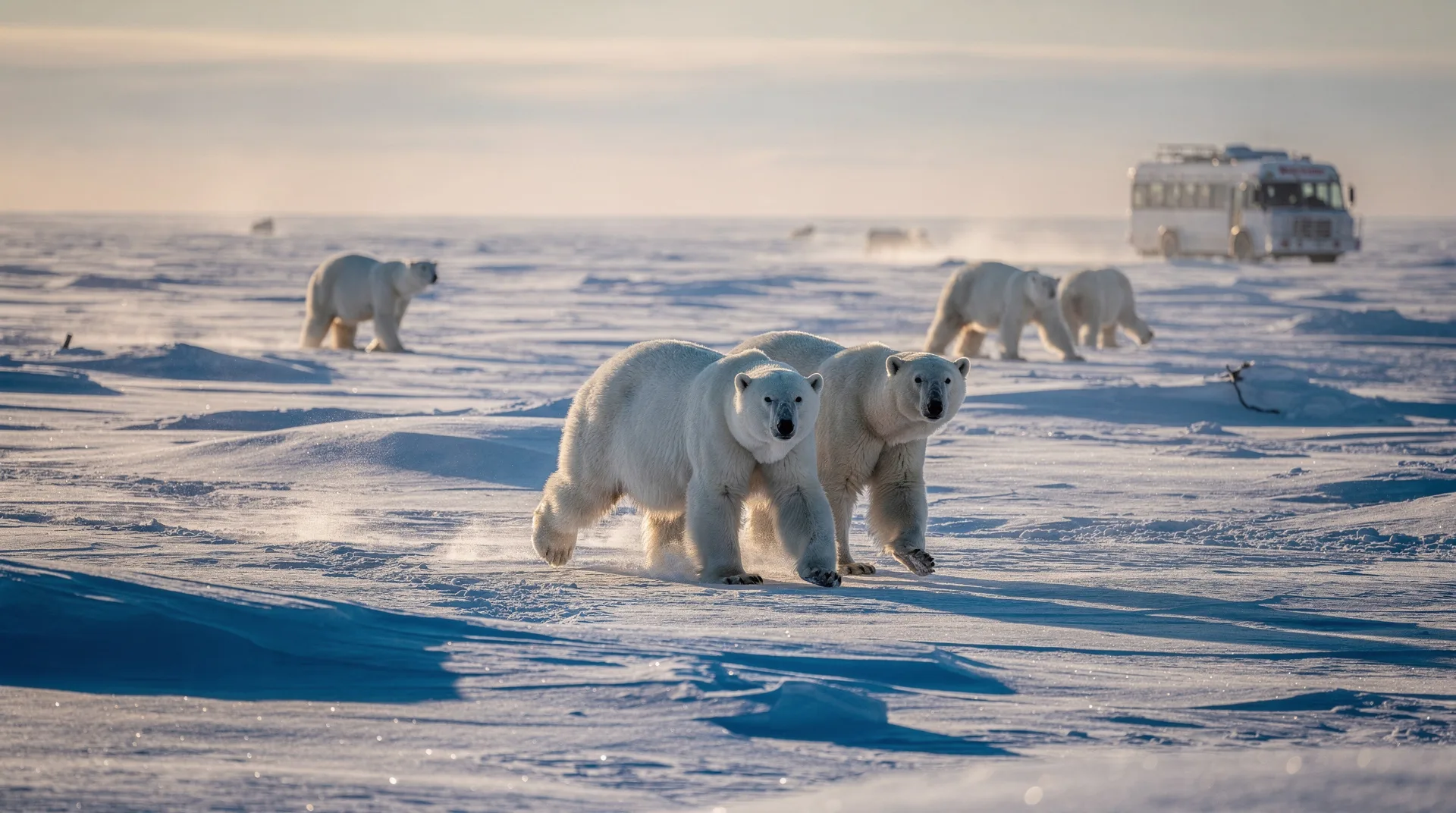
Churchill polar bears: the October–November season in Manitoba
When is polar bear season in Churchill, Manitoba?
The main polar bear viewing season in Churchill runs from mid-October to late November — roughly six weeks while bears gather on the Hudson Bay coast waiting for the sea ice to reform. Late October to mid-November is peak. Access is fly-in only from Winnipeg.
At a glance
| Where | Churchill, Manitoba, on the Hudson Bay coast; fly-in only from Winnipeg |
| Cost | Around C$6,500-16,000 per person depending on operator category |
| Time needed | 5-7 nights, giving 3-4 buggy days |
| Getting there | Calm Air flight from Winnipeg (around 2h45) or the VIA Rail Hudson Bay train (45-50 hours) |
| Best time | Late October to mid-November for peak bear concentration |
Churchill, Manitoba is the only place in the world where you can reasonably expect to see wild polar bears from a vehicle, on a scheduled trip, inside a six-week window every autumn. Roughly 900 bears of the western Hudson Bay population gather on the coast near the town each October and November, waiting for Hudson Bay to freeze so they can return to the ice and hunt seals. It is one of the great wildlife concentrations on the planet, and — for reasons both geographic and economic — one of the hardest wildlife trips in Canada to book casually.
This guide covers the season itself, what the trip actually involves, the main categories of operator, realistic costs, and how to get there. A companion guide, Churchill tundra buggy safari, covers the vehicles and the day-by-day experience in more detail.
Why the bears are there
Western Hudson Bay polar bears spend most of the year on the sea ice, where they hunt ringed and bearded seals. As the bay thaws in July, the ice breaks up and the bears are forced ashore. They spend July through October fasting — living off fat reserves built up over the winter hunt — on the tundra of the Hudson Bay coast, roughly between the Nelson River and the Seal River in Manitoba and northern Ontario.
Churchill sits at the point of this coastline where bears naturally concentrate in autumn, drawn to the area where sea ice historically forms first. As the water temperature drops through October and November, the bears move out towards the coast in increasing numbers, waiting for freeze-up. Once the ice reforms — usually sometime between the third week of November and early December — the bears walk offshore and the season ends.
Climate change has made freeze-up steadily later over the last three decades, extending the fast and putting the population under measurable stress. The bears are still there; the ice just arrives later than it used to. The scientific monitoring of this population (based at the Churchill Northern Studies Centre and Wapusk National Park) is some of the most important climate-change wildlife data in the Arctic.
The season in detail
| Period | What’s happening | Considerations |
|---|---|---|
| Early October | Bears present, fewer concentrations near town | Cheaper departures, fewer sightings guaranteed |
| Mid-October | Numbers build through the month | Shoulder pricing, good options |
| Late October to mid-November | Peak — bears highly concentrated on coast | Highest prices, best availability to book early |
| Mid to late November | Still excellent, sometimes exceptional activity as freeze-up approaches | Cold, low light, dramatic conditions |
| Late November | Ice reforms, bears leave | Season effectively ends |
Most operators run their first departures around the 7–10 October mark and their last around the 20–25 November mark. A six-week operating window is the reality; some years it is five, occasionally seven.
Weather during the season
October averages range from about 0°C to -8°C; November from -6°C to -18°C, colder with wind chill on the bay. Wind chill on a tundra buggy deck in late November can take the effective temperature below -30°C. Operators provide parkas and boots on request or as part of the package; bring insulated layers, serious mittens, a neck gaiter, and warm headwear regardless.
Daylight shortens aggressively across the season. Mid-October gives you roughly 10 hours of usable daylight; mid-November roughly 8, with lower sun angle and long golden/blue hours that photographers tend to love.
How the viewing works — operator categories
Most Churchill polar bear tourism falls into three broad categories. Operators are named generically here; specifics change year to year and booking should always be done directly with the operator.
Day-trip tundra buggy operators
The largest-scale category, anchored by Frontiers North Adventures and similar. These operators run fleets of the classic yellow elevated tundra vehicles out from Churchill each morning, into the Churchill Wildlife Management Area (an exclusive tundra zone with restricted vehicle access), and return to town each evening. You sleep in Churchill hotels and travel out daily by buggy.
- Typical length: 5–7 nights in Churchill, 3–4 full days on the buggy
- Price range (2026): roughly C$6,500–11,000 per person for a full package including flights from Winnipeg, hotel, meals, buggy days, and guiding
- Character: highest density of guaranteed sightings, social atmosphere on the buggy, least logistically demanding
Tundra lodge operators
A smaller number of operators run elevated, connected tundra lodges — essentially a chain of buggies parked on the Wildlife Management Area, serving as mobile hotels. Guests sleep at the lodge rather than returning to town each night.
- Typical length: 5–6 nights at the lodge
- Price range (2026): roughly C$9,500–13,000 per person for a full package
- Character: immersive, bears can approach the lodge overnight, extended dawn and dusk viewing — often the choice for serious photographers
Remote wilderness lodges
Several lodges sit outside the Churchill area entirely, most notably along the Seal River coast north of Churchill (the Churchill Wild category of operator) and other fly-in properties. These trade the guaranteed buggy-style concentrations for walking tours, longer bear-observation sessions, and a more wilderness experience. Walking with bears is a fundamentally different trip — it is permitted only with specific Parks Canada and Manitoba licences, in specific locations, with highly experienced guides.
- Typical length: 5–7 nights
- Price range (2026): roughly C$10,000–16,000 per person for a full package, including charter flights
- Character: more remote, smaller groups, walking experiences, higher cost, different ethical posture around bear encounters
All three categories produce excellent bear viewing. The question is what kind of experience you want — convenient and social, dedicated and immersive, or remote and wilderness-focused — and what you are prepared to spend.
What you will actually see
Realistic expectations for a well-run 3–4 day tundra buggy trip in peak season:
- Between 10 and 40 bear sightings across the trip, often involving the same individuals returning
- Close approaches — bears regularly come to buggies out of curiosity, sometimes standing on hind legs at the vehicle
- Mothers with cubs-of-the-year in certain years and locations
- Sparring between young males is common in late October and November — one of the iconic Churchill experiences
- Arctic foxes, ptarmigan, snowy owls (some years), Arctic hare
- Aurora on some evenings — Churchill is within the auroral oval
What you will not see reliably: bears hunting seals (this happens on the ice, not on land), dens with cubs (denning is in late winter, in Wapusk National Park, behind a closed access regime).
Costs — what is actually included
When comparing packages, watch the line items:
- Winnipeg–Churchill flights: usually included in full packages; if you book separately, expect C$1,100–1,800 return per person on Calm Air. VIA Rail’s Winnipeg–Churchill train is cheaper (around C$350–500 return in a seat) but takes 45+ hours each way and is frequently delayed.
- Hotels: Churchill has a limited hotel inventory. Peak season rooms are near-fully booked months ahead and run C$230–360 per night.
- Meals: included in most packages; standalone meals in Churchill restaurants run C$25–55 per person for dinner.
- Buggy days: the single biggest line item — typical buggy day tickets (when sold standalone) run C$650–950 per person per day.
- Permits and conservation fees: built into the package price.
- Cold-weather gear rental: sometimes included, sometimes add-on (C$80–140 for a trip).
A genuinely all-inclusive 6–7 night package from Winnipeg, with 3–4 buggy days and reasonable hotel, sits comfortably in the C$7,000–10,000 per person range for 2026. Lower than C$6,000 usually means fewer buggy days or non-peak dates. Higher than C$11,000 usually means a lodge product, a remote operator, or specialist photography coaching included.
How to get to Churchill
There is no road to Churchill. Access is by air or rail only.
- Air: Calm Air operates scheduled flights from Winnipeg to Churchill (YWG–YYQ), typically daily in peak season. Flight time around 2h45. Most polar bear packages charter or block-book these flights.
- Rail: VIA Rail’s Winnipeg–Churchill service (the Hudson Bay) runs twice a week, taking 45–50 hours. The line is spectacular (prairie, boreal forest, tundra) and the train is comfortable, but schedule reliability has historically been variable and the return timing rarely suits a short package. A handful of tour operators combine rail-in with flight-out as a specialist product.
Do not plan to drive. The rail line is the only ground link, and you cannot drive a vehicle to Churchill in any season.
Book the full package — flights, accommodation, buggy days — as a single product through a specialist operator. Piecing the trip together independently is technically possible but rarely cheaper, and capacity is almost always held by the tour operators in peak season.
Browse Manitoba tours on GetYourGuideA practical note on bookings: most Churchill polar bear trips are booked direct with the specialist operator, not through broad booking platforms. GetYourGuide and similar marketplaces have limited Churchill inventory compared with operators who have held their own buggy fleet for decades. Use the link above for Winnipeg and Manitoba touring, but book the polar bear package itself directly.
When to book
Peak-season dates (roughly 20 October – 15 November) sell out 12–18 months ahead for the best operators. Shoulder dates (early October, late November) are usually available at 6–9 months. A very late booking (under 3 months) is occasionally possible at higher prices as cancellations free up.
For a 2026 peak-season trip, realistic booking windows:
- Ideal: book between April and October 2025
- Normal: book between October 2025 and April 2026
- Late: May–August 2026, possible with flexibility on operator and dates
- Very late: September 2026 onwards, only on cancellations
Ethics and impact
The western Hudson Bay polar bear population has declined roughly 30% over three decades and is formally classified as a species of Special Concern in Canada. Responsible operators in Churchill follow strict codes — maintained distances, no baiting, Wildlife Management Area access governed by provincial permit, mandatory bear-guide qualifications, careful minimisation of human–bear habituation.
As a visitor:
- Do not encourage the guide to approach bears closer than the operator’s standard
- Stay quiet on the upper deck of a buggy; bears do react to noise
- Do not throw anything down to bears (this has been a documented problem with social-media-driven visitors in the past)
- Understand that cancellations and weather delays are part of Arctic tourism — pad the trip with at least one flex day
Combining with other Churchill wildlife
The autumn bear season is largely standalone — belugas have left, and you are there primarily for bears. However, add-ons are possible:
- Aurora viewing on clear nights — see the Churchill aurora guide
- Dog-sledding — several local operators run kennels year-round
- Cultural and historic tours — Parks Canada’s Prince of Wales Fort and the Itsanitaq Museum in town
For the summer beluga whale season (July–August), which uses different logistics and a different category of operator, see the Churchill beluga kayaking guide.
Choosing between the three operator categories
If you are still deciding, this is the practical shortcut: day-trip buggies from a Churchill hotel suit most first-time visitors and cost the least; tundra lodges suit serious photographers who want dawn and dusk light without a daily commute; remote wilderness lodges suit travellers who want a wilder, walking-based encounter and can afford the premium. Whichever you choose, the mechanics of the vehicles themselves and a full day-by-day breakdown are in the Churchill tundra buggy safari guide.
If you want to add activities around the trip, you can also check guided tours in Manitoba for options in Winnipeg before or after your flight north. Bring layered, genuinely cold-rated gear regardless of category — see the Churchill in November seasonal guide for a full packing list and week-by-week weather breakdown. If your dates fall in November specifically rather than October, the bear behaviour, daylight and pricing shift enough that it is worth reading that guide alongside this one.
Frequently asked questions about Churchill polar bears
Do I need a visa to visit Churchill? If you are flying in from outside Canada, most visa-exempt travellers need an eTA (Electronic Travel Authorization) rather than a full visa. Apply well before your trip — see our Canada eTA and visa guide for the details.
Is Churchill worth it if I can only spend 2-3 nights? It is possible but not ideal. With only 1-2 buggy days your odds of a strong sighting drop noticeably compared with the 3-4 days most operators recommend. If your schedule is tight, prioritise the peak late-October to mid-November window to maximise the odds in a short trip.
Related reading
- Churchill tundra buggy safari: how the buggies work and what to expect
- Aurora viewing in Churchill
- Beluga kayaking in Churchill (summer season)
- Churchill how-to-get-there: train, flight and tour options
- Churchill cost guide
- Best tours in Churchill
- Churchill in November: peak season guide
- Churchill destination overview
- Manitoba destination overview
A Churchill polar bear trip is expensive, logistically involved, and weather-exposed. It is also, for the people who make it, almost uniformly the wildlife trip of a lifetime — a day watching a mother and cub cross the frozen muskeg two hundred metres from the buggy, or two young males sparring into the blue hour of a November afternoon, is not the sort of sight you forget. If that is what you want, plan it 12–18 months ahead, book a real operator, and treat the trip with the seriousness the Arctic deserves.