Berg Lake Trail: hiking to the foot of Mount Robson
How long is the Berg Lake Trail?
The Berg Lake Trail is 44 km return (22 km each way) from the trailhead near Mount Robson Provincial Park visitor centre to Berg Lake. Most hikers complete it as a 3-4 day backpacking trip with overnight camps at Marmot Campground or Berg Lake Campground. Day hikes to Kinney Lake (8 km return) are also popular.
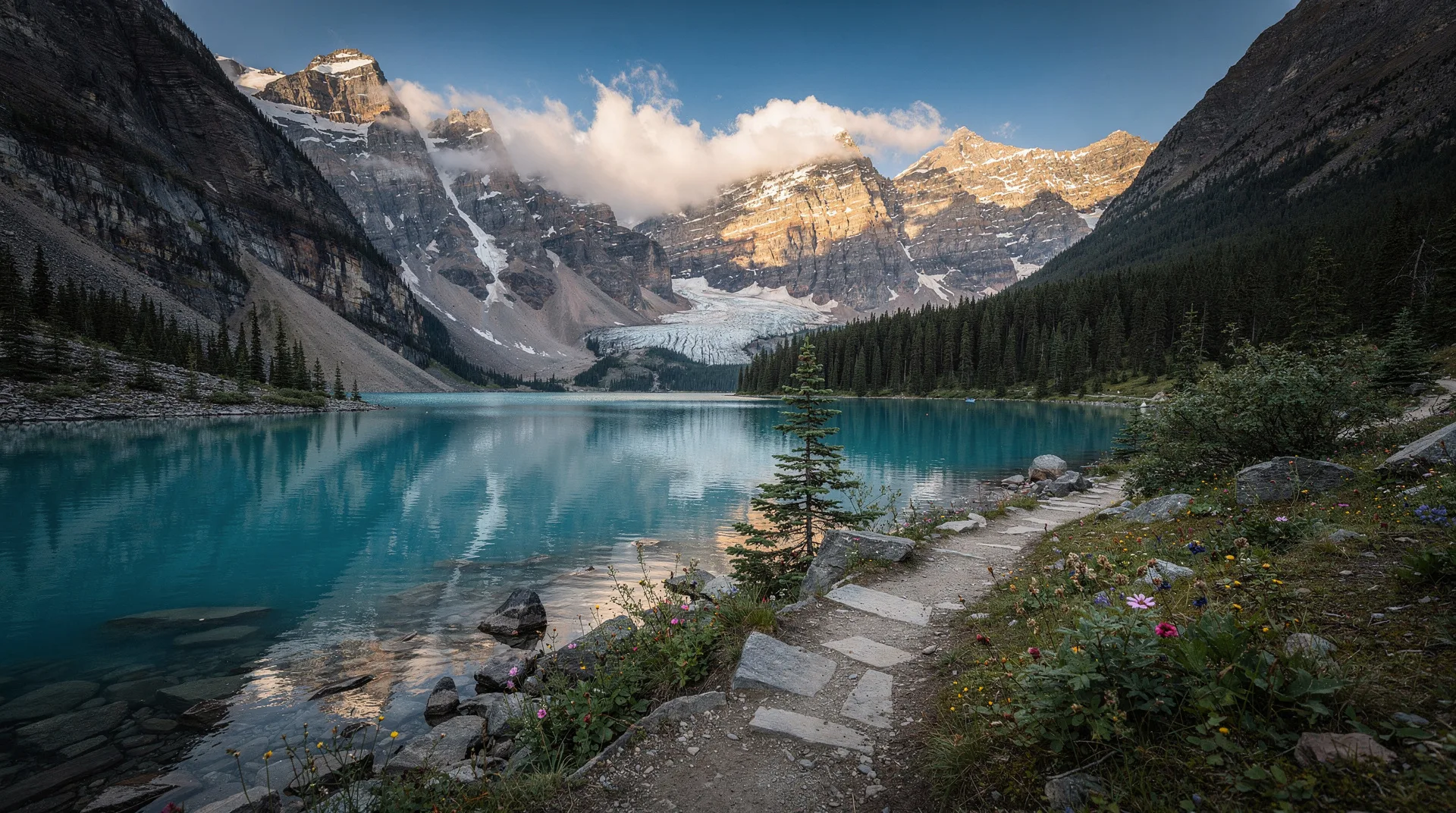
The Berg Lake Trail leads to arguably the most spectacular alpine lake in the Canadian Rockies. Tucked at the foot of Mount Robson — the highest peak in the Canadian Rockies at 3,954 metres — Berg Lake is a turquoise expanse fed directly by the Berg Glacier, which still calves small icebergs into the water during warm summer days. The mountain rises 2,500 metres above the lake in a near-vertical wall of rock, ice, and hanging glaciers. Few views in Canada compare.
Reaching Berg Lake requires a 22-km backcountry hike (44 km return) through Mount Robson Provincial Park in eastern BC. The trail ascends through rainforest, crosses white-water rivers, passes under glacier-fed waterfalls, and ultimately arrives at a protected campground on the lake’s southern shore. It is one of Canada’s great multi-day hikes — and also, for day-hikers, one of Canada’s great out-and-back day objectives to the lake’s lower approaches. If you would rather see the region without a backcountry permit, guided tours in British Columbia cover the wider Rockies.
| At a glance | Details |
|---|---|
| Where | Mount Robson Provincial Park, BC, 90 km west of Jasper on Highway 16 |
| Cost | Around CAD 10/person/night for backcountry camping, plus a reservation fee; day hiking is free |
| Time needed | 3-4 days typical for the full trail; a half-day for the Kinney Lake day-hike option |
| Getting there | Self-drive via Highway 16, roughly 90 km from Jasper or a longer drive from Prince George |
| Best time | July and August for cleared trail and long days; early September for colour with fewer bugs |
Trail overview
Trailhead: Berg Lake Trailhead parking area, 2 km east of Mount Robson Provincial Park Visitor Centre on Highway 16, 90 km west of Jasper
Total distance (full trail to Berg Lake): 44 km return (22 km one way)
Elevation gain: 795 metres (trailhead 838 m, Berg Lake 1,633 m)
Difficulty: Moderate to moderately difficult. Steady ascent with some steep sections.
Duration: 3-5 days typical (backpacking). Strong hikers do it in 2-3 days.
High point: Hargreaves Lake viewpoint / Berg Lake area (~1,650 m)
Season: Typically accessible June through September. Snow at Berg Lake persists into late June; early snowstorms possible in September.
The route in stages
Kilometres 0 to 4 — Robson River to Kinney Lake
The trail begins gently alongside the Robson River through a corridor of ancient western red cedar, Douglas fir, and western hemlock. This is inland temperate rainforest — unusual for the Rockies and a direct product of the massive snowfall and runoff from Mount Robson’s glaciers. The path is well-graded and easy, popular with day hikers and families.
At 4 km you reach Kinney Lake, a stunning turquoise lake with views of the summit of Mount Robson at its far end. Many hikers make Kinney Lake their day-hike destination — out-and-back from the trailhead is 8 km round-trip and can be done in 3-4 hours.
Kilometres 4 to 7 — Kinney Lake to Whitehorn Camp
The trail follows Kinney Lake’s eastern shore before turning inland and ascending moderately to the head of the lake. At km 7, the Whitehorn Campground offers 16 tent sites and serves as the first overnight option for slower hikers.
Kilometres 7 to 11 — The Valley of a Thousand Falls
This is arguably the most dramatic section of the trail. The valley ahead narrows into a steep box canyon. The trail climbs alongside the Robson River as it thunders through the canyon. Three major waterfalls punctuate the climb:
- White Falls (km 9)
- Falls of the Pool (km 10.5)
- Emperor Falls (km 11) — a thunderous 35-metre cascade, often shrouded in spray
Climb pace here is serious — about 500 metres of elevation gain over 4 km. Sections of the trail are built into the canyon walls. The views looking back down the canyon to the Robson River and Kinney Lake are extraordinary.
Kilometres 11 to 15 — Emperor Falls to Marmot Camp
Above Emperor Falls the valley opens dramatically. You emerge from the forest into a subalpine landscape of meadows, stream crossings, and open views of the Mount Robson massif. Mount Robson’s vast east face becomes visible. Marmot Campground at km 15 offers 14 sites in a setting that is already jaw-dropping — many hikers choose Marmot as their overnight rather than pushing on to Berg Lake.
Kilometres 15 to 22 — Marmot to Berg Lake
The final 7 km climbs gradually through alpine meadow and along the Robson River as it threads between towering walls. Glaciers become visible on either side. You pass:
- Rearguard Campground (km 19)
- Berg Lake Campground (km 22) — 30 sites, the principal overnight for Berg Lake visitors
- Berg Lake itself — the turquoise glacial lake with Mount Robson rising directly above
From Berg Lake Campground, day-hike options abound: the Toboggan Falls trail, the Hargreaves Glacier viewpoint, and the Snowbird Pass (a challenging full-day side trip) all radiate from the campground.
Permits and reservations
Berg Lake Trail camping is regulated by BC Parks and requires advance reservation via the BC Parks reservation system (bcparks.ca). Permits typically open in late fall for the following summer season and the popular July-August dates sell out within hours.
Permit cost: Approximately CAD $10/person/night plus a reservation fee. Prices subject to change.
Day hiking is permit-free but parking at the trailhead is managed during peak season — arrive early.
Reservation strategy: Set a calendar reminder for when reservations open (typically October or November for the following summer). Be online and ready at the exact opening time. Have preferred dates and alternate dates ready. Berg Lake Campground is the most competitive; Marmot and Whitehorn Campgrounds are slightly easier to reserve.
Trail status update
Important context: the Berg Lake Trail was severely damaged by flooding in summer 2021, and access above Kinney Lake was closed for extended periods during 2022-2024 for bridge replacement and trail repair. The upper trail reopened in stages. Before planning a trip, check the current status at bcparks.ca for the latest conditions, trail closures, and any temporary restrictions.
Gear checklist
Essential for the multi-day trip:
- Backpack (50-65 L recommended for 3-4 day trip)
- Tent — free-standing preferred (campgrounds have tent pads)
- Sleeping bag rated to -5°C (nights can be cold even in July at altitude)
- Sleeping mat
- Stove and fuel (wood fires prohibited; cooking must be on stove)
- Bear-resistant food canister OR bear lockers are provided at campgrounds — check current policy
- Water filter — streams are abundant but silty in places
- Rain gear — rain is common even in summer
- Layers — temperatures range 30°C+ (sunny valley sections) to near freezing (nights at altitude)
- Trekking poles — highly recommended for the Valley of a Thousand Falls ascent
- Sturdy hiking boots — trails are rough, wet, and rocky in places
- First aid kit
- Bear spray
- Maps and/or GPS — mobile coverage is nonexistent above Kinney Lake
Wildlife on the trail
Bears — Both black bears and grizzlies inhabit Mount Robson Provincial Park. Food must be properly stored at all times. Make noise while hiking (bear bells, conversation). Carry bear spray and know how to use it.
Mountain goats — Often visible on cliffs around Emperor Falls and in the alpine meadows near Berg Lake.
Moose and elk — Lower valley meadows, particularly at dawn and dusk.
Marmots — The namesake rock-dwelling rodents are common at Marmot Campground and throughout the alpine sections.
Day-hike alternative: Kinney Lake
If you cannot commit to the full multi-day trip, the day hike to Kinney Lake is outstanding:
- 8 km round trip from the trailhead
- 150 metres elevation gain
- 3-4 hours return
- Views of Mount Robson above the lake
- Easy terrain suitable for families with older children
Best times to hike Berg Lake
July — prime conditions. Snow has cleared the upper trail, wildflowers bloom, days are long.
August — excellent weather. Wildflower season continues at higher elevations. Bugs (mosquitoes) can be persistent in meadows.
Early September — brilliant autumn colours in the meadows, fewer bugs, but cold nights and shortening daylight. Possible early snow.
Late June — Kinney Lake is accessible but higher trail sections may still have snow patches. Waterfalls are at peak flow.
Combining Berg Lake with wider travel
Berg Lake sits in Mount Robson Provincial Park on Highway 16, between Jasper and Prince George. Natural combinations include:
- Jasper (Alberta) to Mount Robson + Berg Lake — Jasper is 90 km east; Berg Lake makes a superb add-on to any Icefields Parkway trip
- Yellowhead road trip — continuing west from Berg Lake via Prince George to Prince Rupert and the coast
- BC Rockies loop — combining with Yoho, Kootenay, and Glacier National Parks in BC (see the BC vs Alberta Rockies comparison)
Fitness and pacing tips
Most parties split the 22 km approach across two days, camping at Whitehorn or Marmot on the way in and Berg Lake Campground for one or two nights before retracing the route. The steepest sustained climbing is concentrated in the Valley of a Thousand Falls (km 7-11), where roughly 500 m of elevation gain happens over 4 km — pace this section conservatively rather than trying to match your speed on the gentler lower trail.
Fitness needed is moderate rather than extreme: regular hikers who can comfortably carry a loaded overnight pack for 15-20 km a day will manage it without difficulty. Trekking poles help noticeably on the canyon climb and on the descent, which is harder on the knees than most hikers expect.
For travellers deciding between this and other Rockies multi-day objectives, Berg Lake sits at the more demanding end — longer and with more sustained elevation gain than most day hikes in Banff National Park, but shorter and better-served with campgrounds than true wilderness backpacking routes.
Getting oriented: Jasper as a base
Most visitors approach Berg Lake via Jasper, using the town as a supply stop and, often, an overnight before or after the hike. The Jasper National Park guide and the Jasper hikes overview are useful for planning the rest of a Jasper-based trip around the Berg Lake days, and the driving Banff to Jasper guide is relevant if arriving via the Icefields Parkway.
Other hikes and trips to pair with Berg Lake
If the permit lottery goes your way, Berg Lake works well as the centrepiece of a longer Rockies trip. Hikers who enjoy it often want a second objective closer to the road. The best hikes in Canada roundup and the BC best hikes guide place this trail in context, while the Canadian Rockies overview helps with the bigger picture.
For a gentler warm-up or a rest-day walk, the Maligne Lake boat tour and the trails around Jasper offer scenery without the weight of a full pack. If your appetite is for another big alpine day, the Sulphur Skyline trail is a good test of fitness before committing to the backcountry.
Travellers building a full itinerary can slot the trail into the Banff and Jasper 7-day itinerary or the Canadian Rockies 10-day itinerary. Anyone planning around bears should also read the Canada wildlife safety guide, and the packing list is a useful cross-check for clothing and sleep gear before you leave.
Browse Mount Robson and BC Rockies adventure toursFrequently asked questions about Berg Lake Trail: hiking to the foot of Mount Robson
Is Berg Lake the best hike in Canada?
A reasonable claim. It combines scale (Mount Robson is the highest peak in the Canadian Rockies), colour (the lake is a deep turquoise from glacial flour), scenery variety (rainforest, canyon, meadow, alpine), and infrastructure (reserved campsites, maintained trail). Very few hikes in Canada match it for cumulative impact.
Can I day-hike to Berg Lake from the trailhead?
At 44 km round-trip with 795 m elevation gain, Berg Lake is too far for a realistic day-hike for most people. Very fit ultra-runners complete it in a single day; mortals should plan for 2-4 nights.
Do I need a permit for the Berg Lake Trail?
Day hiking is permit-free. Overnight camping requires a BC Parks reservation and permit. Reserve well in advance — peak dates sell out in minutes when reservations open.
Is the trail dangerous?
The trail itself is well-maintained but has objective risks: bears, river crossings, rockfall in the canyon, hypothermia if caught in unexpected weather. Come prepared. It is not a trail for complete backpacking novices.
What is the best campground for the best views?
Berg Lake Campground has the signature view of Mount Robson above the lake. Marmot Campground has one of the finest mid-trail views. Most hikers divide nights between multiple camps.
Are there outhouses or pit toilets?
Yes, all campgrounds on the trail have pit toilets. No other facilities — no potable water at camps, no garbage collection (pack out all waste).