Quick facts
- Location
- Riding Mountain National Park, Manitoba
- Best time
- June–September
- Days needed
- 2–4 days
- Entry
- Parks Canada Discovery Pass required
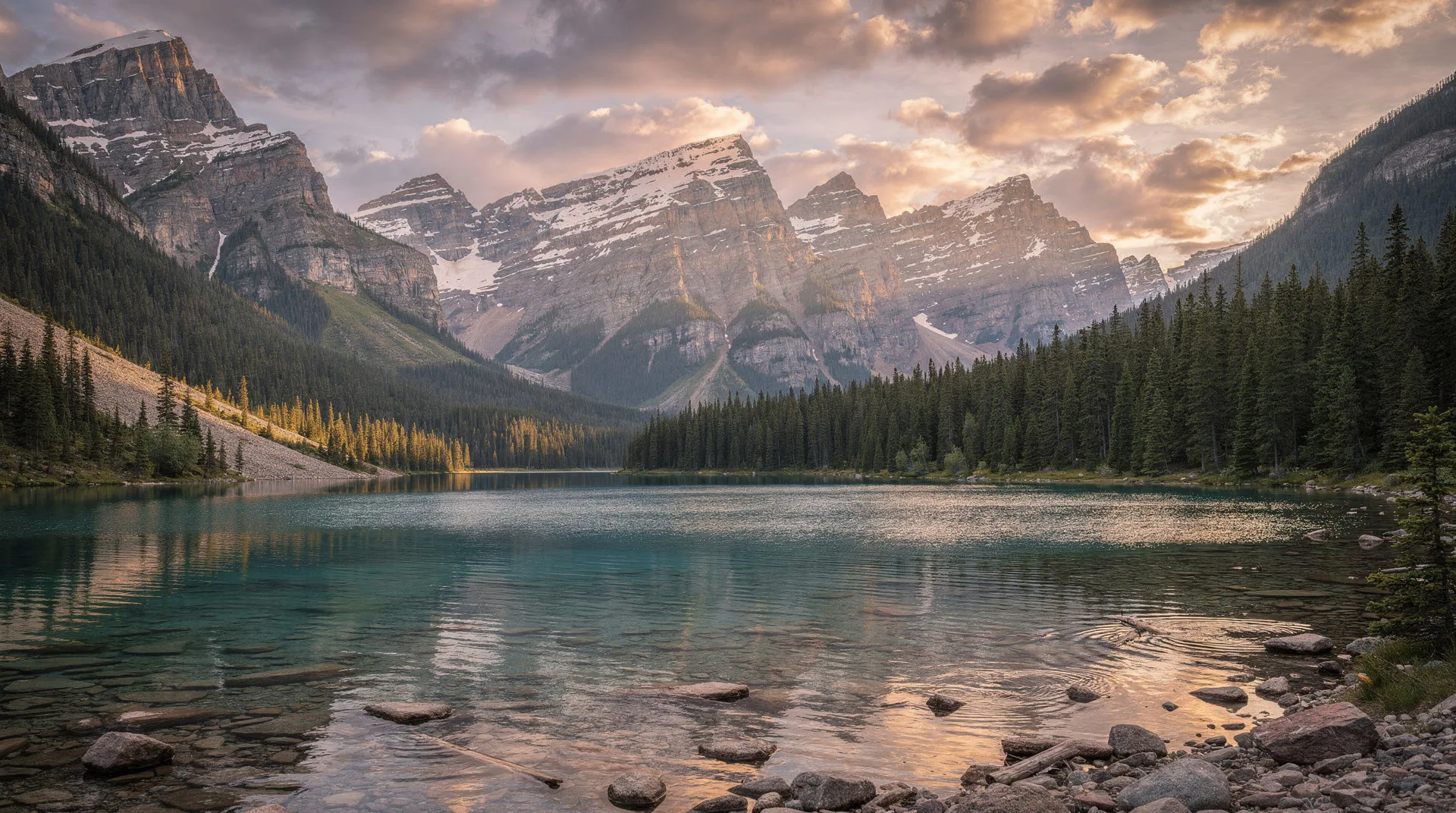
Wasagaming sits inside a protected highland wilderness, yet it feels like a small resort town from another era. The townsite — the only one inside Riding Mountain National Park — lines the southern shore of Clear Lake, with its 1930s log-and-stone architecture, a boat dock, a tennis court, and summer ice cream shops that have barely changed since they first opened. The surrounding park is a convergence point for three distinct ecosystems: boreal forest, eastern deciduous forest, and aspen parkland, which creates an unusually rich wildlife habitat rising dramatically from the flat Manitoba plain below.
For many Manitobans, Wasagaming and Riding Mountain are the default summer destination — the place families return to decade after decade. For visitors unfamiliar with the prairies, the park often comes as a genuine surprise: a forested plateau rising 500 metres above the surrounding farmland, with bison on the grasslands, moose in the marshes, elk in the meadows, and black bears working through the berry patches in late summer.
| At a glance | |
|---|---|
| Where | Riding Mountain National Park, Manitoba, around 250 km northwest of Winnipeg |
| Cost | Parks Canada Discovery Pass or day pass required; free-roaming to walk the townsite itself |
| Time needed | Around 2-4 days |
| Getting there | Around 2.5 hours by car from Winnipeg via Highway 10; no public bus service |
| Best time | June to September, July-August for full amenities |
Clear Lake and the townsite
Clear Lake is Wasagaming’s centrepiece — a glacially scoured lake with clean, reasonably warm water by Manitoba summer standards and a supervised beach that fills with families from mid-July through August. The Wasagaming beach is one of the finest freshwater swimming spots in western Canada: sandy, shallow-entry, and backed by the historic log pavilion that Parks Canada maintains as a community gathering space.
The townsite itself is small enough to explore on foot in an hour. The main commercial strip along Wasagaming Drive has a handful of restaurants, a general store, a bowling alley that opened in 1938, a movie theatre operating seasonally, and souvenir shops. What could feel kitsch instead feels genuinely charming — the wooden architecture is protected, and the scale is resolutely small. There are no chains, no big box amenities, no highways cutting through.
The Parks Canada visitor centre at the park gate, and the additional interpretive centre in town, both provide excellent orientation to the park’s natural and cultural history. Staff there can advise on current wildlife sightings, trail conditions, and any closures.
Hiking in Riding Mountain National Park
The park’s trail network covers more than 400 kilometres, ranging from a 30-minute lakeside loop suitable for families with strollers to multi-day backcountry routes requiring permits and solid navigation skills.
The Gorge Creek Trail (11 kilometres return) is among the most rewarding day hikes, dropping into a forested gorge with a small creek and excellent spring wildflowers. The trailhead is a short drive from Wasagaming.
Ominnik Marsh Trail (3 kilometres) is a flat boardwalk and path through wetland habitat — ideal for birding. Great blue herons, American bitterns, and various duck species are reliable. This is also good moose territory; early morning visits are recommended.
Bead Lakes Trail is a longer option (18 kilometres return) through interior boreal forest, reaching a chain of small lakes. The trail passes through classic moose and bear habitat; travel in groups and carry bear spray.
Baldy Mountain — the highest point in Manitoba at 831 metres above sea level — is accessible via a moderate 7-kilometre return trail from a trailhead north of Wasagaming. The summit offers broad views over the park’s forested plateau and, on clear days, the farmland stretching south.
Backcountry camping permits are available from the visitor centre for those wanting to spend nights on the trail. The park’s remote interior sees very few people mid-week, which is unusual for a national park of Riding Mountain’s accessibility.
Wildlife watching
Riding Mountain is one of the best places in Manitoba to observe large mammals in the wild, and the park’s protected status has allowed populations to stabilise at impressive levels.
Bison — the iconic prairie animal largely absent from the surrounding landscape — have been maintained in Riding Mountain since 1933. The Lake Audy Bison Enclosure, roughly 45 minutes’ drive from Wasagaming, holds a free-roaming herd of around 30–50 animals within a large fenced area. A viewing platform and accessible trail allow close approaches. This is not a zoo — the bison are genuinely wild and behave as such.
Elk are perhaps the most reliably visible large mammal near town. In autumn (September–October), bulls can be heard bugling from meadows near the townsite, and rutting behaviour is visible from the roads. Early morning drives along the park roads almost always produce elk sightings.
Moose are present year-round, particularly in the marshy areas along the Ochre River corridor and near the northern lakes. They are most active around dawn and dusk.
Black bears are common throughout the park and frequently visible in summer, particularly where berry crops are heavy. The park asks visitors not to approach bears or habituate them to human presence — follow posted bear protocol and carry bear spray on all trails.
Wolves inhabit the park in small numbers and are occasionally heard, less often seen. Their presence reflects the overall health of the ecosystem.
Birdlife is exceptional in the park’s diverse habitats: whip-poor-wills call from boreal edges at dusk, broad-winged hawks nest in the deciduous zones, and the wetlands support breeding populations of species scarce elsewhere on the prairies. If you would rather have a guide spot the wildlife for you, compare guided tours in Manitoba before you go.
Canoeing and water activities
Clear Lake supports rentals of canoes, kayaks, and paddleboards from the Wasagaming boathouse, operated seasonally from June through August. Paddling out from the beach in the early morning, with the boreal shoreline reflecting in calm water, is among the more meditative Wasagaming experiences.
Fishing is permitted on Clear Lake and many backcountry lakes (Parks Canada licence required). Lake trout, northern pike, and walleye are present. Ice fishing is popular on Clear Lake in winter — a very different Wasagaming experience, with ice huts dotting the frozen surface and warming huts available near the beach.
The Ochre River, which flows through the park, offers easier flatwater paddling. Canoeists willing to carry over a few beaver dams can paddle for several kilometres through prime wildlife habitat.
Cycling
The park has a paved multi-use trail connecting Wasagaming with several key trailheads, and cycling is permitted on many of the wider dirt trails. Bikes can be rented in town. A popular cycling loop follows park roads through the Whirlpool Lake and Moon Lake area — approximately 30 kilometres with minimal traffic on weekdays.
Mountain bikers use the Grosse Isle Trail system on the park’s eastern edge, which offers rougher terrain through mixed forest.
Autumn and winter
Wasagaming’s tourism season is firmly summer, but the park rewards visits in other seasons. Autumn brings dramatic foliage (peak colours typically mid-September), rutting elk, and far fewer people. Many of the commercial facilities in town close after Labour Day weekend, but the park remains open and the campgrounds reduce their capacity rather than closing entirely.
Winter offers cross-country skiing on groomed trails, snowshoeing, and the ice fishing on Clear Lake. A small number of year-round rental properties in the area allow winter stays, and Parks Canada maintains winter-accessible facilities at selected trailheads.
Practical information
Getting there: Wasagaming is approximately 250 kilometres northwest of Winnipeg via Highway 10. The drive takes roughly 2.5 hours. There is no public bus service to the townsite — a vehicle is required.
Accommodation: The park has two large campgrounds near Wasagaming — Wasagaming Campground (the largest, with electrical and services sites) and Moon Lake Campground for a quieter experience. Cabin and bungalow rentals exist in the townsite and just outside the park boundary. Book well ahead for July and August weekends; reservations open through Parks Canada’s online reservation system in April.
Entry fees: A Parks Canada Discovery Pass covers unlimited entry to all national parks for a year and is cost-effective for any visit of more than a couple of days. Day passes are available at the gate.
Bear safety: Carry bear spray and know how to use it. Store food in vehicle or provided food lockers — never in tents. The park’s bear population is well managed but encounters are genuinely possible.
Browse Manitoba and prairies tours on GetYourGuidePlanning a first visit
Most visitors underestimate how much there is to do beyond the beach and end up cramming Baldy Mountain, the bison enclosure, and a paddle into a single rushed day. Splitting a 2-4 day stay into a wildlife-focused day (Lake Audy bison, an early drive for elk), a hiking day (Gorge Creek or Baldy Mountain), and a lake day (paddling, beach, boathouse) makes better use of the park than trying to do everything at once. Campsite and cabin bookings for July and August weekends should go in as soon as the Parks Canada reservation system opens in April — the Wasagaming Campground’s serviced sites are the first to go.
Fuel up before heading deep into the park roads toward Lake Audy or Whirlpool Lake — services are limited to the townsite itself, and cell coverage drops away quickly once away from Wasagaming.
Pairing Wasagaming with other prairie stops
Riding Mountain works best as one chapter of a longer prairie journey rather than a stand-alone trip. Many travellers start in Winnipeg or at The Forks, then head northwest to the park before continuing west. If you are building a longer route, the Canada road trip itinerary and the guide to getting around Canada show how the prairies connect to the rest of the country.
Travellers who enjoy the quiet, wooded feel of Wasagaming often like Whiteshell Provincial Park on the other side of Manitoba, or the lakes and forest of Prince Albert National Park in Saskatchewan. Those who want more of the open prairie landscape can look at Grasslands National Park. For a broader view of the region, the prairies overview is a useful starting point.
Because the park is a wildlife destination, it is worth reading the Canada wildlife safety guide before you go, and the packing list helps with layers and insect protection for the boreal forest.
How Wasagaming compares with the Rockies parks
Visitors weighing Riding Mountain against Canada’s marquee mountain parks are comparing two very different kinds of national park experience. The Canadian Rockies offer bigger scenery and busier crowds; Riding Mountain offers gentler terrain, far fewer visitors, and arguably more reliable wildlife sightings at close range.
| Wasagaming / Riding Mountain | Banff / Jasper (Rockies) | |
|---|---|---|
| Scenery | Forested plateau, lakes, prairie edge | Dramatic peaks, glaciers, alpine lakes |
| Crowds | Modest even in peak summer | Very busy July-August |
| Wildlife reliability | High (bison, elk, moose, bears) | Good but more dispersed |
| Drive from nearest major city | Around 2.5 hrs from Winnipeg | Around 1.5-4+ hrs depending on gateway |
Frequently asked questions about Wasagaming
Do I need a park pass to visit Wasagaming? Yes. Wasagaming sits inside Riding Mountain National Park, so a Parks Canada Discovery Pass (annual) or a day pass, purchased at the gate or online, is required for entry.
Is Riding Mountain worth visiting if I have already been to Banff or Jasper? Yes, for a different reason — Riding Mountain trades dramatic peaks for gentler terrain, far smaller crowds, and some of the most reliable large-mammal wildlife watching (bison, elk, moose, bears) anywhere in western Canada.
Related reading
- Prairies road trip: Winnipeg, Saskatoon and Regina
- Prince Albert National Park: Grey Owl and Saskatchewan wilderness
- Cypress Hills Interprovincial Park: prairie oasis and dark sky
- Winnipeg weekend itinerary
- VIA Rail Canadian: the prairie crossing experience
Riding Mountain National Park and Wasagaming reward visitors who have been conditioned by the Rocky Mountain national parks to expect dramatic vertical scenery. The landscape here is gentler, the scale more intimate, and the wildlife encounters often more reliable. It is a distinctly Manitoban kind of national park experience — unhurried, genuinely wild, and enormously underrated.