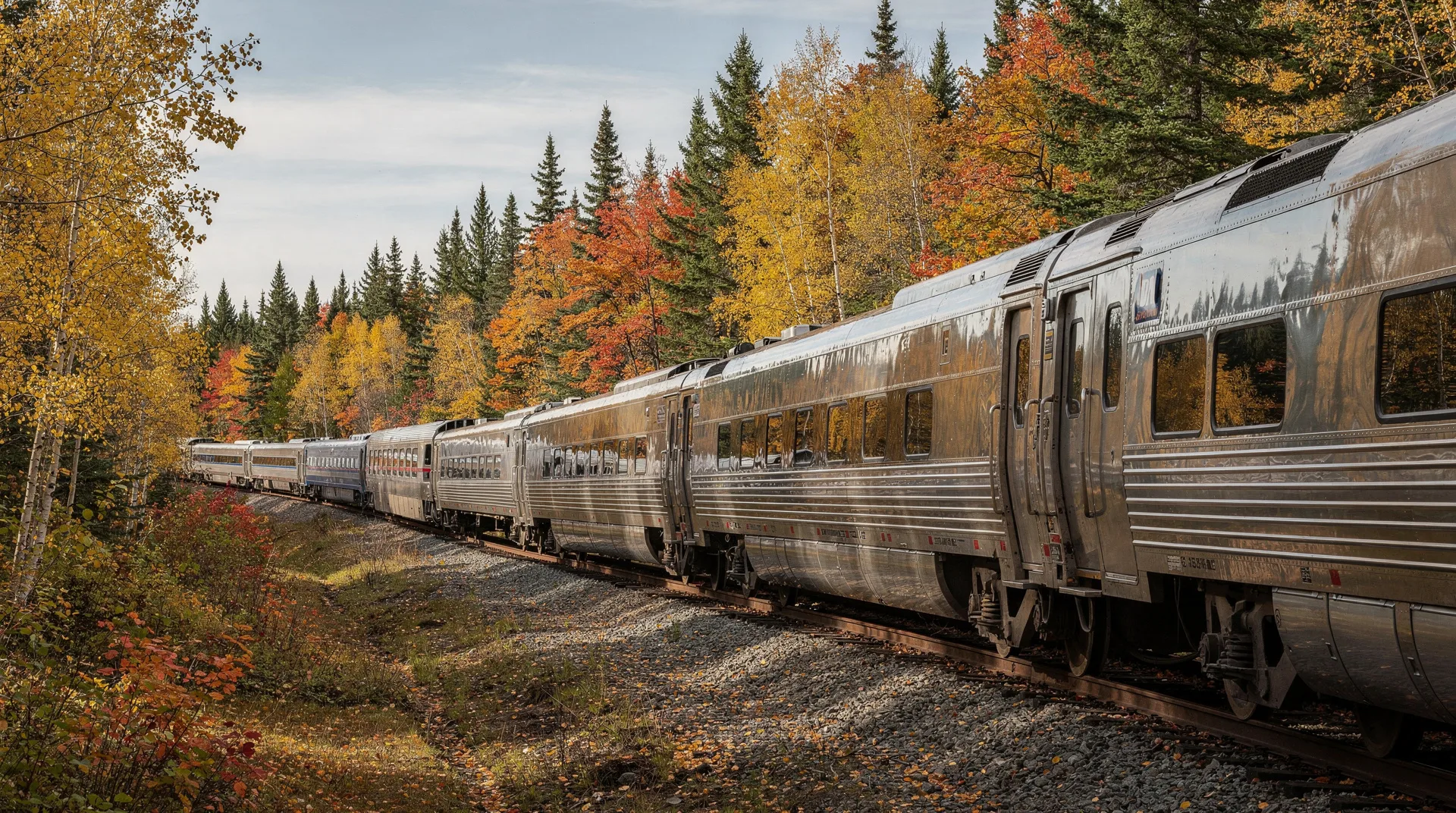
VIA Rail Canadian: The Prairie Crossing Experience
How long does the VIA Rail Canadian take to cross the prairies?
The Canadian takes approximately 18–22 hours to travel between Winnipeg and Saskatoon (or 24–28 hours to Edmonton). The exact time varies significantly depending on freight train priority, which often causes delays. Treat the timetable as an approximation.
There is no better way to understand the prairies than from the window of the VIA Rail Canadian. The train — one of the great transcontinental railway journeys in the world — crosses the prairie provinces for roughly 1,400 kilometres between Winnipeg and Saskatoon, then continues northwest through Edmonton and into the Rockies. This prairie crossing, often dismissed by travellers in a hurry as merely the flat part between more interesting things, is in fact one of the journey’s most meditative and revealing segments.
The scale of the landscape is only intelligible from a moving train. In a car, the highway cuts through individual fields and towns. On the Canadian, the full breadth of the prairie becomes visible: grain elevators on the horizon growing gradually closer then receding; canola fields turning yellow in summer for kilometres in every direction; the enormous sky, unobstructed by anything, extending from ground level in all four directions to the full dome of blue overhead. The word “infinite” is overused in prairie travel writing, but from the Canadian’s dome car windows it earns its use.
| At a glance | |
|---|---|
| Where | Winnipeg to Saskatoon (around 1,400 km), continuing to Edmonton |
| Cost | Included in your Toronto-Vancouver fare, or book the segment alone from around CAD $99-299 economy |
| Time needed | Around 18-22 hours Winnipeg-Saskatoon; 24-28 hours to Edmonton |
| Getting there | Board at Winnipeg station; see the VIA Rail booking guide for fares |
| Best time | July for canola bloom; check the timetable so the crossing falls in daylight |
The route across the prairies
The Canadian departs Winnipeg and heads northwest across Manitoba’s agricultural interior. The landscape here is flat, farmed, and characteristic: section-line roads dividing rectangular fields, grain elevators at every rail siding (fewer now than a generation ago, as the industry consolidates, but still the defining vertical element on the horizon), and small towns that exist because of the railway and may eventually not exist because the railway no longer stops.
The Manitoba-Saskatchewan border is invisible from the train — the landscape continues without perceptible change. Saskatchewan’s prairie is, if anything, even more expansive than Manitoba’s: the fields are larger, the horizon more distant, and the population more sparse.
Portage la Prairie (Manitoba) is an early stop, in the flat Red River valley. The town’s grain handling infrastructure is visible from the train.
Brandon (Manitoba) is the province’s second city, with a more substantial presence on the skyline. The Assiniboine River valley provides brief visual relief from the flatness near Brandon.
The Saskatchewan border comes without fanfare. Regina is visible in the distance — the provincial capital sits on a genuinely flat site and the approaches are visible from a long distance.
Regina is a major stop, with a layover of 15–30 minutes typically. The station is old and handsome. From Regina, the Canadian continues northwest through the Qu’Appelle Valley vicinity and toward Saskatoon.
Saskatoon is reached after approximately 18–22 hours from Winnipeg (though delays make this variable). The South Saskatchewan River crossing on approach to the city is a pleasant landmark — the city’s famous bridges visible in sequence.
Beyond Saskatoon: The train continues to Wainwright, Edmonton, Jasper, Kamloops, and Vancouver — the full transcontinental journey covering 4,466 kilometres over 3–4 days.
What to see from the dome car
The Canadian’s dome car is the essential prairie viewing platform. The glass roof and upper-level seating provide 360-degree views, and the elevation — even the modest height of a dome car above the rail — adds significantly to the perceived horizon distance.
Grain elevators: The surviving prairie grain elevators are increasingly rare. The classic wooden elevator, painted in company colours, was the prairie skyline for a century. Many have been demolished; those remaining are worth noting and photographing.
Sloughs and wetlands: Between the cultivated fields, Manitoba and Saskatchewan preserve countless small wetland areas — sloughs that serve as waterfowl breeding habitat. In spring and early summer, these hold ducks, geese, and shorebirds visible from the dome car.
Canola: In July, the canola fields turn brilliant yellow simultaneously across large areas. From the dome car, the effect — yellow to the horizon on both sides of the train, blue sky above — is one of the most vivid colour experiences available in Canadian travel.
Sunsets: Prairie sunsets on the Canadian are legendary. With no obstructions, the full arc of the western sky lights up during the transition from day to night. In the right season, this sunset coincides with the Saskatchewan portion of the journey.
Deer, coyotes, and occasional moose are visible from the train windows, particularly at dawn and dusk. The train moves slowly enough (freight delays are common; the Canadian yields right-of-way to freight) that wildlife spotting is often leisurely.
Doing the prairie crossing as a standalone segment
You do not have to ride the full Toronto-Vancouver Canadian to experience this section. VIA Rail sells Winnipeg-Saskatoon (and Winnipeg-Edmonton) as standalone segments, which is a practical option for travellers based in the Prairies road trip circuit who want one leg by train rather than by car. Economy Escape fares on this segment are frequently the cheapest per-kilometre fares anywhere on the VIA Rail network, since demand is lower than on the mountain or corridor sections. Combine it with a stopover in Winnipeg or a look at what to do in Saskatoon at the other end.
Sleeping on the Canadian across the prairies
The Canadian offers three accommodation classes, and the overnight prairie crossing is the main consideration for booking:
Economy class: Coach seats, reclined but not fully flat. Fine for a day crossing; manageable for an overnight with travel pillow and neck support. The cheapest option by far.
Sleeper Plus: The most popular option for the prairie crossing. Bedrooms and roomettes (shared or single) that fold down to proper beds. All meals included. The sleeper class observation lounge and dining car are accessible, providing a social aspect to the journey that economy travellers can access in the dome car and lounge car.
Prestige class: Larger suites, larger windows, premium dining. The additional cost over Sleeper Plus is significant; the experience is proportionally better.
For the prairie crossing specifically, Sleeper Plus provides the right balance: a real bed for the overnight hours, meal service in the dining car, and access to the dome car for daytime viewing. Economy is viable for budget travellers or for a daytime-only segment (Saskatoon to Winnipeg or similar, in daylight).
Find train tours and scenic rail experiences across Canada on GetYourGuideHow to spend the hours on board
A prairie crossing rewards a slower rhythm. Settle into a routine: a morning in the dome car with a hot drink, a long stretch of reading or journaling in your seat, a walk through the cars to see how the light changes the view from each side of the train. Bring binoculars if you have them; a pair makes the sloughs, hawks perched on fence posts and distant farmsteads far more rewarding. A paper map or a downloaded offline map helps you follow the towns as they pass, since mobile coverage is patchy.
Photographers should treat the dome car like a hide. Reflections on the glass are the main enemy, so shoot close to the window with a dark jacket held around the lens, and expect the best frames in the low light after sunrise and before sunset. If you are building a wider photo trip, the best photography spots article gives ideas for what to chase once you step off the train.
Where the prairie fits in a bigger trip
Many travellers treat the prairie crossing as the connecting thread of a longer journey. If you are riding the whole route, the full Canadian route guide explains how each stretch differs, and the VIA Rail Canadian itinerary shows how to pace stopovers. Comparing options? The Rocky Mountaineer versus VIA Rail guide lays out the differences, and the overview of scenic train routes in Canada places the Canadian alongside the alternatives. For a different kind of rail journey in the same region, the Hudson Bay train guide covers the northern line out of Manitoba.
At either end of the segment there is plenty to extend the stay, and you can reserve guided tours across Canada to fill the days before or after boarding. Winnipeg rewards a day or two before boarding, with The Forks a natural first stop. At the other end, Saskatoon makes an easy place to recover after a night on the rails, and Regina is worth a look if you want to turn the quick platform stretch into a proper visit. The wider Prairies region page is a good place to plan what comes before or after the train.
If you want a sense of the scale of the whole country, the train versus drive comparison and the Canada Rail Pass guide help you decide whether the train should be the backbone of your trip or a single memorable chapter. Planning around weather and daylight? The best time to visit Canada page explains how the seasons change what you will see from the window, and the packing list covers layers for a train car that can run cool in the evening.
Etiquette and comfort in the shared cars
The dome car and lounge are shared spaces, and a few habits make the journey better for everyone. Keep conversations at a friendly volume, avoid claiming a window seat for hours with bags, and rotate out so that other passengers get their turn at the best views. Photograph freely, but be mindful of other travellers who may be in the frame. Staff on board are used to questions about the route and local history, and a short chat often turns up details about the towns you are passing that no guidebook mentions.
Dress in layers: train cars can feel warm in the sun and cool at night. Comfortable shoes help for walking between cars, and a small bag with snacks, a refillable bottle, a charger and a book keeps you independent of the schedule. Travellers sensitive to motion generally find the prairie stretch gentle, with long, straight track and little swaying compared with the mountain sections.
Timing your journey for the prairies
The Canadian runs twice weekly in each direction. The schedule means that the daylight hours on the prairie segment depend on which departure day you choose — check the timetable carefully to ensure the main prairie crossing occurs in daylight.
Westbound departures from Winnipeg in summer typically reach the middle of Saskatchewan in late afternoon and evening — good for canola viewing and sunset watching.
Eastbound departures from Saskatoon reach Manitoba in the morning — pleasant for the softer morning light over the prairie.
Practical notes
Delays: The Canadian shares track with freight railways and must yield right-of-way. Delays of 1–6 hours are common; delays of 10+ hours occur occasionally. Build flexibility into your itinerary at both ends of the journey, particularly in winter. The train is the only scheduled passenger service on most of this route, so there are no alternative trains if you miss a connection.
Food and drink: Dining car meals are included with Sleeper Plus and Prestige class tickets. The dining car operates set meal times; consult the on-board schedule. The snack bar/lounge car serves lighter fare and drinks for economy passengers.
Connectivity: Wi-Fi is available on the Canadian but coverage is variable across the prairies. Use the journey as an opportunity to disconnect.
Luggage: Checked baggage is available at major stops. Carry-on luggage must fit in the overhead racks or under the seat in economy; sleeper passengers have more storage options.
Related reading
- VIA Rail Canadian: how to book, class options and cost
- Winnipeg weekend itinerary: 3 days in Manitoba’s capital
- Prairies road trip: 7 days
- Saskatoon: things to do
- How to get to Churchill: train, flight and tour options
- VIA Rail Canadian: the full Toronto-Vancouver route
Frequently asked questions about VIA Rail Canadian
Is the prairie crossing worth doing if I only have time for part of the Canadian?
Yes, for travellers curious about a side of Canada most visitors skip. It’s a good standalone segment (Winnipeg-Saskatoon or Winnipeg-Edmonton) if you can’t do the full Toronto-Vancouver journey.
Do I need Sleeper Plus for just the prairie segment?
Not necessarily. For a single daytime crossing, economy is perfectly workable. Sleeper Plus matters more if your segment includes an overnight and you want a real bed.
The prairie crossing on the Canadian is not a dramatic segment. There are no mountains, no canyons, no spectacular natural formations to photograph. What it offers instead is time — time to sit with the landscape, to watch the horizon through the dome car glass, and to understand, gradually and viscerally, why the early settlers who crossed this sea of grass on foot or horseback were either awed or broken by it. From a comfortable train seat, the latter is not a risk. The former is very possible.