Quick facts
- Closest trip
- Saint-Sauveur (1h)
- Furthest easy trip
- Quebec City (2.5h)
- Best transport
- Car recommended
- Best seasons
- All year, varies by destination
Montreal sits at a geographic crossroads that makes it one of the best-positioned cities in Canada for day trips. The Laurentians rise to the north within an hour. The Eastern Townships and their wine country spread east and south toward the Vermont border. Quebec City is 2.5 hours east along the St. Lawrence. Mauricie lies directly north between the two cities. And across the river, the Montérégie apple orchards and historic sites offer easy escapes that most visitors never discover.
A car gives you the most flexibility — many of the best destinations are served by highways from Montreal but have limited public transit connections. That said, several destinations (Quebec City, Mont-Tremblant) have bus and train links that make car-free trips feasible.
| At a glance | |
|---|---|
| Closest option | Saint-Sauveur, around 1 hour by car |
| Cost | Free to drive/explore; individual attractions (wineries, park entry, ski passes) add on top |
| Time needed | A full day each; Mont-Tremblant and Quebec City reward an overnight if you can spare it |
| Getting there | Car recommended; VIA Rail and bus operators cover Quebec City, Trois-Rivières and some Laurentian towns |
| Best time | Varies by destination — see the seasonal breakdown below |
Choosing a day trip by season
With so many options in different directions, the fastest way to choose is by season rather than distance. The table below compares the main regions at a glance; details on each follow further down the page.
| Region | Best season | Distance | Standout for |
|---|---|---|---|
| Laurentians | Winter (skiing), summer (lakes/hiking) | 1-2 hours | Mountains, ski hills, Mont-Tremblant village |
| Eastern Townships | Fall (foliage), summer (wine) | 1-2 hours | Wine country, lakeside towns, boutique skiing |
| Quebec City | Any season, best with an overnight | 2.5 hours | Old-world atmosphere, history |
| Mauricie | Summer (paddling), fall (foliage) | 1.5-2 hours | Boreal wilderness, canoe camping |
| Chaudière-Appalaches | Spring (maple season) | 1.5-2 hours | Maple sugar shacks, quiet history |
The Laurentians: mountains and ski hills (1–2 hours north)
The Laurentians are Montreal’s backyard mountain range — low, rounded, ancient Pre-Cambrian mountains covered in boreal and mixed forest, dotted with lakes, and developed into one of the best recreational regions in eastern Canada. In winter, they offer the closest serious skiing to Montreal. In summer, the same hills attract hikers, cyclists, lake swimmers, and anyone seeking cooler temperatures than the city.
Saint-Sauveur (60 km, 1 hour) is the closest Laurentian resort town, with ski hills in winter and discount outlet shopping year-round. For a day trip, it works well as a quick ski fix rather than a destination in itself.
Val-David (90 km, 1.25 hours) is more interesting — a village of artists, rock climbers, and potters with a pedestrian-friendly main street and the famous P’tit Train du Nord cycling trail running through the centre.
Mont-Tremblant (145 km, 1.75 hours) is the Laurentians’ main event — Quebec’s best ski resort in winter and a four-season resort village with gondola rides, lake kayaking, and the dramatic Tremblant pedestrian village. It’s doable as a day trip but deserves at least one overnight if you can manage it.
Mont-Tremblant National Park (adjacent to the resort) offers wilderness hiking, lake swimming, and canoe camping in a protected setting. The park entrance is about 2 hours from Montreal.
Eastern Townships: wine, lakes and villages (1–2 hours east)
The Eastern Townships (Cantons-de-l’Est) offer a completely different character from the Laurentians — gently rolling hills, Victorian architecture in English-heritage villages, Lac Memphrémagog, and Quebec’s wine country along the Route des Vins Brome-Missisquoi.
Magog (130 km, 1.5 hours) is the main hub — a pleasant lakeside town at the northern tip of Lac Memphrémagog with beaches, restaurants, and easy access to Mont-Orford’s hiking trails.
Sutton (110 km, 1.25 hours) is a boutique ski town with the most European character in Quebec — excellent restaurants, independent shops, and skiing that rewards skilled skiers over beginners.
Route des Vins (80–120 km, 1–1.5 hours) — a driving circuit through the wine villages of Dunham, Frelighsburg, and Stanbridge-East, with around 25 wineries and cideries open for tastings along the route. Ice cider — a Quebec invention made from frozen apple juice — is the regional specialty.
Bromont (85 km, 1 hour) has the largest lit night ski area in Canada and a chocolate factory that makes for a genuinely unusual pairing of activities.
Book a guided day trip from Montreal on GetYourGuideQuebec City: the Old Capital (2.5 hours east)
Quebec City at 250 km is at the outer edge of a comfortable day trip — you would arrive around noon after a 2.5-hour drive, have 5–6 hours in the city, and return by 10pm. For most visitors, this underserves the city, which deserves at least one overnight.
That said, the drive itself is attractive — Highway 20 along the south shore of the St. Lawrence passes through Chaudière-Appalaches farmland, or Highway 40 on the north shore runs closer to the river. VIA Rail connects the two cities in 3–3.5 hours with several daily departures, making the train an excellent alternative — you can leave Montreal at 7am, have a full day in the Old City, and return on a 6pm or 8pm train.
For a focused day trip, the Château Frontenac, Plains of Abraham, and Quartier Petit-Champlain cover the essential experience. If you would rather not drive, you can book Quebec City day tours in advance.
Mauricie: wilderness between two cities (1.5–2 hours northeast)
Mauricie occupies the boreal country between Montreal and Quebec City and is chronically undervisited because most travellers drive straight between the two cities without stopping. The region’s crown is La Mauricie National Park — 536 km² of lakes, rivers, and boreal forest with paddling routes, hiking trails, and one of the best canoe camping networks in eastern Canada.
Trois-Rivières (145 km, 1.5 hours) is the third-oldest city in North America, with a compact historic district, craft brewery culture, and the Forges du Saint-Maurice National Historic Site where iron was produced from the 1730s. It’s an excellent half-day stop en route to the park.
La Mauricie National Park (230 km, 2 hours) offers day use for hiking and swimming, with Lac Édouard and Lac Wapizagonke being the most popular destinations. Canoe rentals allow you to explore the lake system without overnight camping gear.
Chaudière-Appalaches: the south shore across the river (1.5–2 hours)
Often overlooked in favour of the north shore destinations, the south shore between Montreal and Quebec City has its own attractions for day-trippers with specific interests.
Grosse-Île National Historic Site is accessible by ferry from Berthier-sur-Mer and tells the devastating story of the quarantine station where 5,000 Irish immigrants died during the 1847 typhus epidemic. It is one of the most moving National Historic Sites in Canada.
La Beauce (2 hours south of Montreal, closer to Quebec City) is the maple syrup capital of the world — a river valley of dairy farms and maple bush that produces more syrup than any other region on earth. During maple season (late March to April), the cabanes à sucre are extraordinary.
Kamouraska (on the south shore near Rivière-du-Loup, 3 hours) is technically beyond a comfortable day trip but its claim to have the most beautiful sunsets in the world, combined with the eel harvest culture and heritage architecture, makes it worth mentioning as an extended day trip.
Getting there: car vs. public transport
By car: Most day trips require or strongly benefit from a car. The provincial highway system from Montreal is excellent — Autoroute 15 north to the Laurentians, Autoroute 10 east to the Eastern Townships, Autoroute 40 east to Quebec City and Mauricie. Car rentals are available at Montreal-Trudeau Airport and numerous city locations.
By bus: Orléans Express serves Quebec City, Trois-Rivières, and some Laurentians destinations from the Berri-UQAM bus terminal. Galland provides services to some Laurentian ski resorts in winter.
By train: VIA Rail’s Montreal–Quebec City service is excellent. Montreal–Ottawa service covers the western corridor if you’re considering Ottawa as a day trip.
By tour: Organized day trips to the Laurentians, Eastern Townships, and Quebec City operate from Montreal through various operators — a practical option if you prefer not to drive.
Seasonal considerations
Winter: Ski trips to Saint-Sauveur, Mont-Tremblant, or Bromont. The Eastern Townships ice cider route is beautiful in the snow. Quebec City’s Winter Carnival in February rewards the extra effort.
Spring (March–April): Sugar shack season — every direction from Montreal has cabanes à sucre open for maple meals and syrup experiences.
Summer: Lake swimming and hiking in the Laurentians and Eastern Townships. Festival season in Quebec City. Whale watching in Tadoussac (3 hours north) — this is more of an overnight trip.
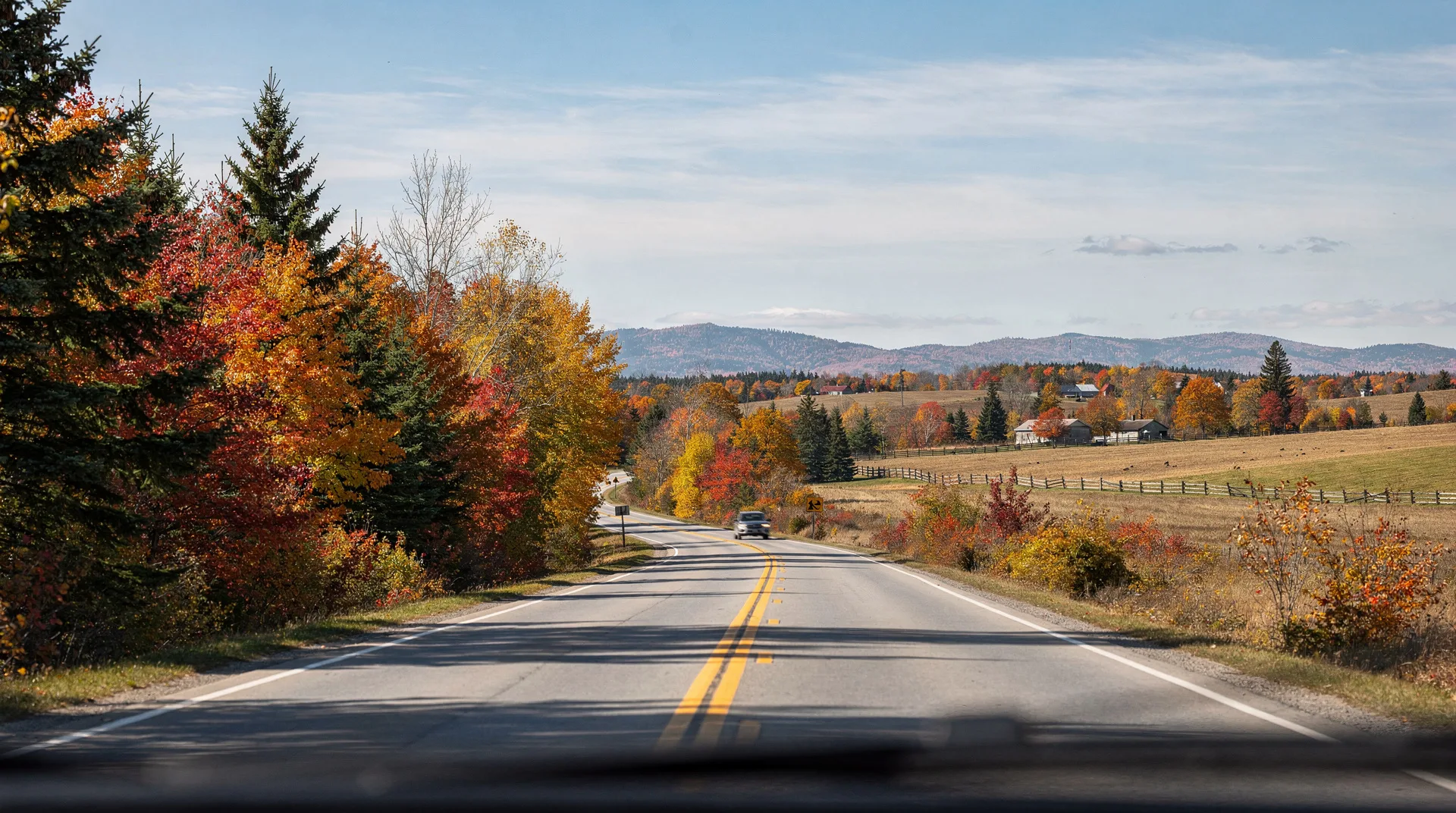
Fall: The Laurentians and Eastern Townships offer exceptional fall foliage, peaking in late September to early October. This is the most popular time for day trips and accommodation should be booked weeks in advance.
Frequently asked questions about Best day trips from Montreal
What’s the single best day trip from Montreal if you only have time for one?
For most first-time visitors, Mont-Tremblant or the Eastern Townships wine route give the best return on a single day — accessible, scenic, and with a clear activity to anchor the trip. If history and atmosphere matter more than nature, take the train to Quebec City instead.
Do you need a car for all of these day trips?
No, but it helps a lot. Quebec City and Trois-Rivières are well served by VIA Rail and Orléans Express buses, and some Laurentian ski resorts run winter shuttle services — but the Eastern Townships wine route and most of Mauricie are far easier, and in some cases only practical, with a car.