Quick facts
- Located in
- Mauricie, Quebec
- Best time
- Jun–Oct (fishing/canoeing) or Jan–Mar (winter activities)
- Getting there
- 200 km NE of Montreal via Hwy 40 and Hwy 55, then forest road
- Days needed
- 2-4 days
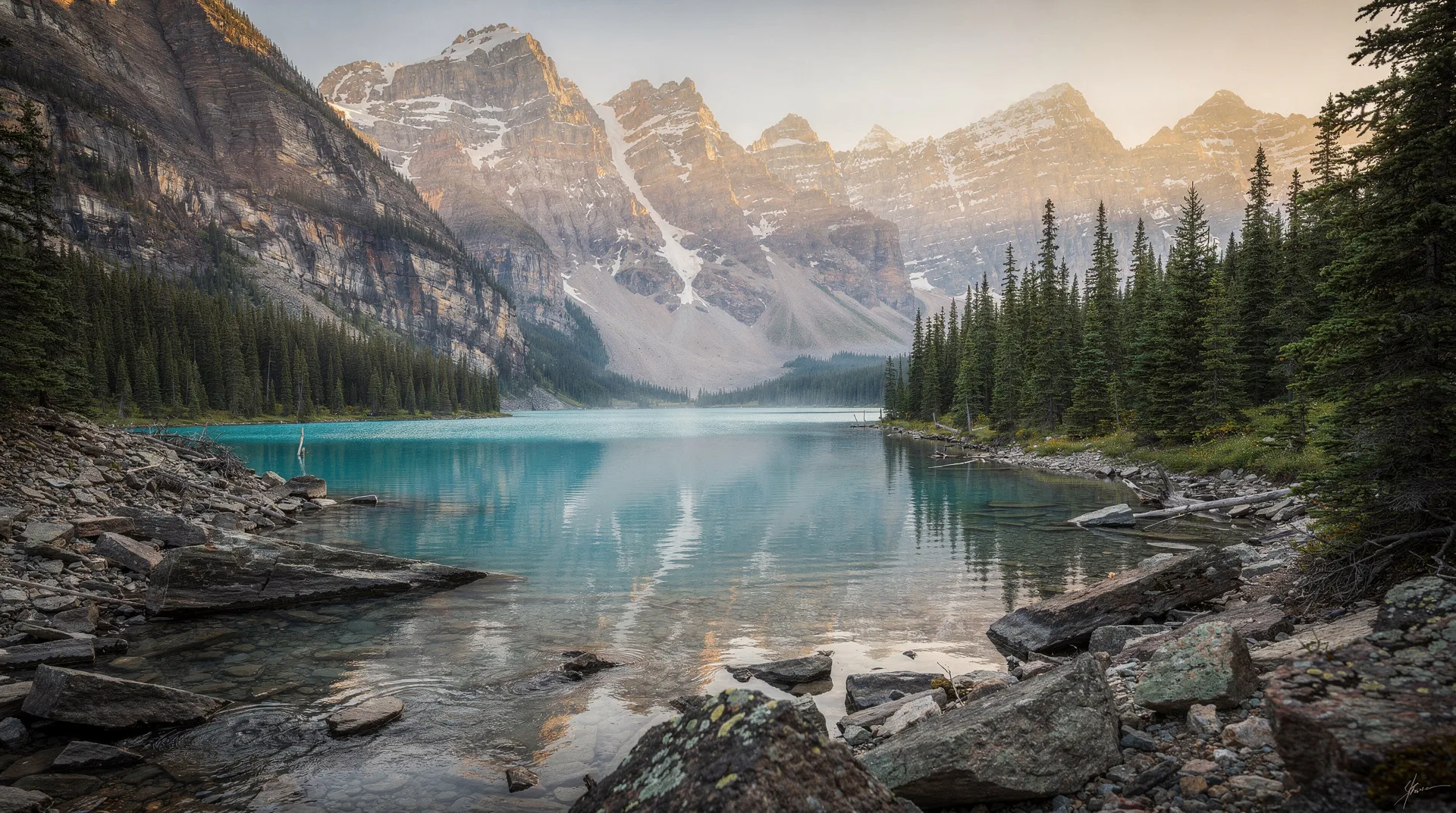
There is a moment on the road to Lac Sacacomie where the asphalt ends and the gravel begins, and the forest closes in on both sides of a track that shows no signs of commercial civilisation. For about 30 kilometres, the boreal forest of the Mauricie hinterland simply continues — spruce, fir, birch, the occasional beaver pond, and the silence that accumulates in managed forest when human activity is absent. Then the lake appears through the trees: long, dark, cold, and apparently bottomless in its depth of colour, with the Hôtel Sacacomie on its north shore as the only structure visible.
Lac Sacacomie is a 14-kilometre-long lake in the upper Saint-Maurice River watershed, north of Parc National de la Mauricie and well beyond the settled zone of the Mauricie region. The lake’s depth — over 100 metres in sections — gives it the thermal stability and water quality that support exceptional lake trout and walleye populations. The surrounding forest, in a state of semi-wilderness that is more natural than the heavily managed commercial forest further south, creates a landscape that urban Quebecers and international visitors find genuinely remote in a way that is increasingly rare within a few hours of a major city.
The Hôtel Sacacomie has been here since 1985, growing from a fishing camp into a full-service wilderness lodge that has developed an international reputation for combining genuine remoteness with serious hospitality. It is one of Quebec’s most celebrated resort experiences — not because of its luxury amenities (which are real but not opulent) but because of what it manages to provide simultaneously: authentic boreal wilderness accessible from Montreal without a plane flight, and the kind of accommodation and food that makes extended wilderness stays comfortable for guests who would not ordinarily consider backcountry camping.
| At a glance | |
|---|---|
| Where | Upper Saint-Maurice watershed, north of Parc National de la Mauricie, Mauricie, Quebec |
| Cost | Hôtel Sacacomie rooms typically run from around CAD 200-300+/night depending on season and room type; day access without a stay is limited |
| Time needed | 2-4 days to make the drive worthwhile |
| Getting there | Around 200 km / roughly 2.5-3 hours from Montreal via Hwy 40, Hwy 55, then forest road |
| Best time | June-September for fishing, canoeing and lake life; late September-October for fall colour; January-March for ice fishing and skiing |
The Lake Experience
Lac Sacacomie’s primary appeal is simply the lake itself — a body of water large enough to feel genuinely expansive from a canoe or a paddleboard but small enough to know personally after two or three days of exploration. The lake’s 14-kilometre length can be paddled in its entirety in a day, but there is little incentive to do so at speed — the forested shoreline, the coves and rocky points, the beaver lodges and the waterfowl activity in the shallower bays all reward slow progress.
The water temperature at the lake’s surface varies through the season. In June, it is cold enough to be bracing for swimming; by late July and August, the surface layer warms sufficiently for comfortable lake swimming, while the thermal stratification keeps the deeper water cold and well-oxygenated. The water clarity is remarkable — visibility in the shallower sections extends several metres below the surface, and the lake bottom’s character — varied between sandy, rocky, and weedy zones — is visible from a canoe in calm conditions.
Morning on Lac Sacacomie is one of the Mauricie region’s defining experiences. Before the wind comes up — usually by mid-morning — the lake surface is completely flat, reflecting the forest and the sky with mirror precision. The loon calls that start before dawn and continue through the early morning hours carry across the entire lake surface. If moose are using the lake’s northern shore, they can sometimes be heard entering the water before they are visible — the splash and snort of a large animal that has not yet registered the presence of observers from the far shore.
Fishing: Lake Trout and Walleye
Lac Sacacomie has built its fishing reputation specifically on lake trout and walleye, two species that require the combination of cold, deep, well-oxygenated water and stable food chains that the lake’s depth and remoteness provide. The fish are well-maintained here — not stocked, but naturally reproducing in populations that have not been depleted by the pressure that more accessible lakes typically experience.
Lake trout fishing at Sacacomie is typically done from a motorboat with jigging or trolling techniques on the deeper sections of the lake. The fish inhabit depths of 15–40 metres through the summer as the surface waters warm, and locating them requires depth-sounder equipment and knowledge of the lake’s underwater topography. The Hôtel Sacacomie’s guide service provides both equipment and expertise for guests who want to fish without the preparation burden.
Walleye fishing is more accessible — the fish are found in the lake’s shallower sections and near the weedy points and rocky structures that provide their preferred habitat. Evening and early morning walleye fishing on Lac Sacacomie, working the rocky points with jigs in the fading light, is one of the quieter pleasures of a stay at the lake.
Quebec fishing licences are required for all anglers and are available at the hotel or from sporting goods retailers in the region. Catch-and-release fishing for lake trout is encouraged and in some periods required by provincial regulation to protect the population.
Book Quebec wilderness and nature experiences on GetYourGuideCanoeing and Paddling
The lake’s scale and the calmness of its protected coves make Lac Sacacomie excellent paddling territory. Canoes and kayaks are available for rental at the hotel, and the lake’s geography rewards exploration in either direction from the central point of the lodge — northward toward the narrower lake sections and their more intimate forest character, or southward toward the open central basin where the scale of the water becomes more apparent.
The smaller lakes and ponds accessible by short portage from Lac Sacacomie’s shores provide additional paddling options for guests who want to extend beyond the main lake. These smaller water bodies have distinct ecological characters — slower, warmer, with denser aquatic vegetation and different wildlife — that complement the main lake’s deep-water qualities.
For serious canoe campers, the Sacacomie area is adjacent to the broader Saint-Maurice River watershed’s canoe camping network. The region north of the national park and around Lac Sacacomie has a network of canoe routes that experienced paddlers can use to design multi-day wilderness itineraries extending north toward La Tuque. This territory is genuine backcountry — no developed infrastructure, requiring full self-sufficiency — and should only be attempted by experienced canoeists with proper navigation equipment and wilderness preparation.
Wildlife Watching
The boreal forest around Lac Sacacomie supports a wildlife community that feels less managed than the national park’s — partly because the area lacks the park’s visitor infrastructure, partly because the forest extends without interruption in all directions and supports larger home ranges for the area’s predators and large herbivores.
Moose are the most visible large mammal. The lake shore and the shallow bays at each end of the lake are productive moose viewing areas, particularly in the morning and evening hours when the animals feed in the water. Black bears are present in the surrounding forest and are occasionally seen along the forest edge at the lake shore, particularly in blueberry season (August).
The bird life is extensive. Common loons are present on the lake through the summer in numbers comparable to the national park — the lake’s fish productivity supports them. Ospreys nest near the lake and are regularly observed fishing. The forest along the lake shore supports the full boreal forest bird community: three-toed woodpecker, boreal chickadee, various thrush species, and the warblers that pass through in spring and fall migration.
Fall Colour at Sacacomie
The boreal forest around Lac Sacacomie changes character dramatically in fall. The deciduous component — yellow birch, trembling aspen, and the occasional sugar maple at the forest edge — turns yellow and gold in late September through mid-October, while the evergreen spruce and fir provide the dark green backdrop that makes the colour contrast particularly sharp in this northern forest type.
The fall colour at Sacacomie is different from the red-and-orange spectacle of the national park’s southern hardwood forest — the boreal palette runs to yellows and golds rather than reds, and the proportion of evergreen in the forest means the colour is more subtly distributed. But the combination of the golden forest reflected in the cold lake water, under the sharper autumn light of the northern latitudes, produces a visual quality that many visitors find more atmospheric than the more celebrated colour of the Laurentians.
The Hôtel Sacacomie
The Hôtel Sacacomie is the reason most guests choose this particular lake over the region’s many other remote lake options. The lodge has 113 rooms and suites ranging from standard rooms in the main building to lakefront chalets with private decks over the water. The construction is solidly in the Quebecois hunting-lodge tradition — heavy timber, stone fireplaces, wood-panelled interiors — adapted for the expectations of a more sophisticated contemporary clientele.
The restaurant at the hotel uses regional produce and game — venison, wild boar, locally caught fish — to create menus that are genuinely reflective of the surrounding landscape rather than the standard hotel food that would be offered at a comparable suburban property. The wine list is adequate and the beer selection includes Quebec craft options. Dining on the lakefront terrace on a clear summer evening, with the lake reflecting the sunset and the loons calling in the distance, is the lake’s most social moment.
The spa facilities at the hotel include an outdoor thermal bath area accessible year-round — the contrast bathing sequence of hot pool, cold lake plunge, and rest in the heated lounge is particularly intense when the lake temperature in October is approaching 8°C. The outdoor sauna with direct lake access provides the same contrast experience in a more traditional format.
Winter at Sacacomie
Lac Sacacomie in winter is a different environment: the lake frozen solid by January, the forest silent and deep in snow, the thermal bath at the hotel producing steam clouds against the cold air. Ice fishing through the lake ice for lake trout and walleye is possible once the ice has reached safe thickness — typically January through mid-March — and the hotel organises ice fishing packages that include equipment, guide service, and the heated shelter that makes extended sessions on the ice comfortable.
Cross-country skiing and snowshoeing on trails in the surrounding forest provide winter activity beyond the ice. The landscape’s remoteness and the quality of the snow — undisturbed by the grooming machines and trail markers of the resort parks — give the winter outdoor experience at Sacacomie a character that is harder to find in the more developed winter destinations.
Getting There
Lac Sacacomie is reached by taking Highway 40 east from Montreal to Trois-Rivières, then Highway 55 north through Shawinigan toward Saint-Tite and Saint-Alexis-des-Monts, then following forest roads north toward the lake. The final approach road is unpaved but well-maintained for vehicle traffic. The total distance from Montreal is approximately 200 kilometres, taking 2.5–3 hours in normal conditions.
The remoteness of the approach is part of the experience — the transition from highway to forest road to lake arrival is a physical decompression that prepares visitors for the environment they are entering. A GPS or downloaded offline maps are recommended for the final approach, as cell coverage on the forest roads is unreliable.
Discover Canada’s wilderness lodge experiences on GetYourGuideSacacomie vs the National Park: Which Fits Your Trip
| Lac Sacacomie | Parc National de la Mauricie | |
|---|---|---|
| Accommodation | Full-service lodge with restaurant and spa | Tent camping, oTENTik units, backcountry canoe sites |
| Comfort level | High — beds, dining, thermal baths | Basic — self-sufficiency required beyond the frontcountry campground |
| Best for | Couples, comfort-seekers, serious lake trout anglers | Canoe campers, hikers, budget travellers |
| Cost | Higher — lodge rates plus meals | Lower — park entry fee plus camping/canoe rental |
| Wildlife feel | Remote and boreal, less visitor infrastructure | Similarly wild, more visitor services and trail signage |
For a driving-time framing, the Montreal to Mauricie guide covers how to combine Sacacomie with the rest of the region on one trip, and the Mauricie fall foliage guide is useful for timing an autumn visit to the lake.
Frequently asked questions about Lac Sacacomie
Is Lac Sacacomie open to day visitors, or only hotel guests? The Hôtel Sacacomie is the primary access point and the lake’s facilities (canoe rental, dining, spa) are oriented around guests; day access without a stay is limited, so this is best planned as an overnight or multi-night trip.
Do I need my own canoe or fishing gear? No — canoes, kayaks and fishing equipment, along with guide services for lake trout, are all available to rent through the hotel.
For the full Mauricie context — combining Lac Sacacomie with Trois-Rivières, Parc National de la Mauricie, and Shawinigan — the Mauricie region guide provides the complete picture.