Quick facts
- Main cheese area
- Baie-Saint-Paul to La Malbaie
- Best time to visit
- Year-round; summer has most producers open
- Featured cheeses
- Migneron, Ciel de Charlevoix, Hercule
- Part of
- Route des Saveurs de Charlevoix
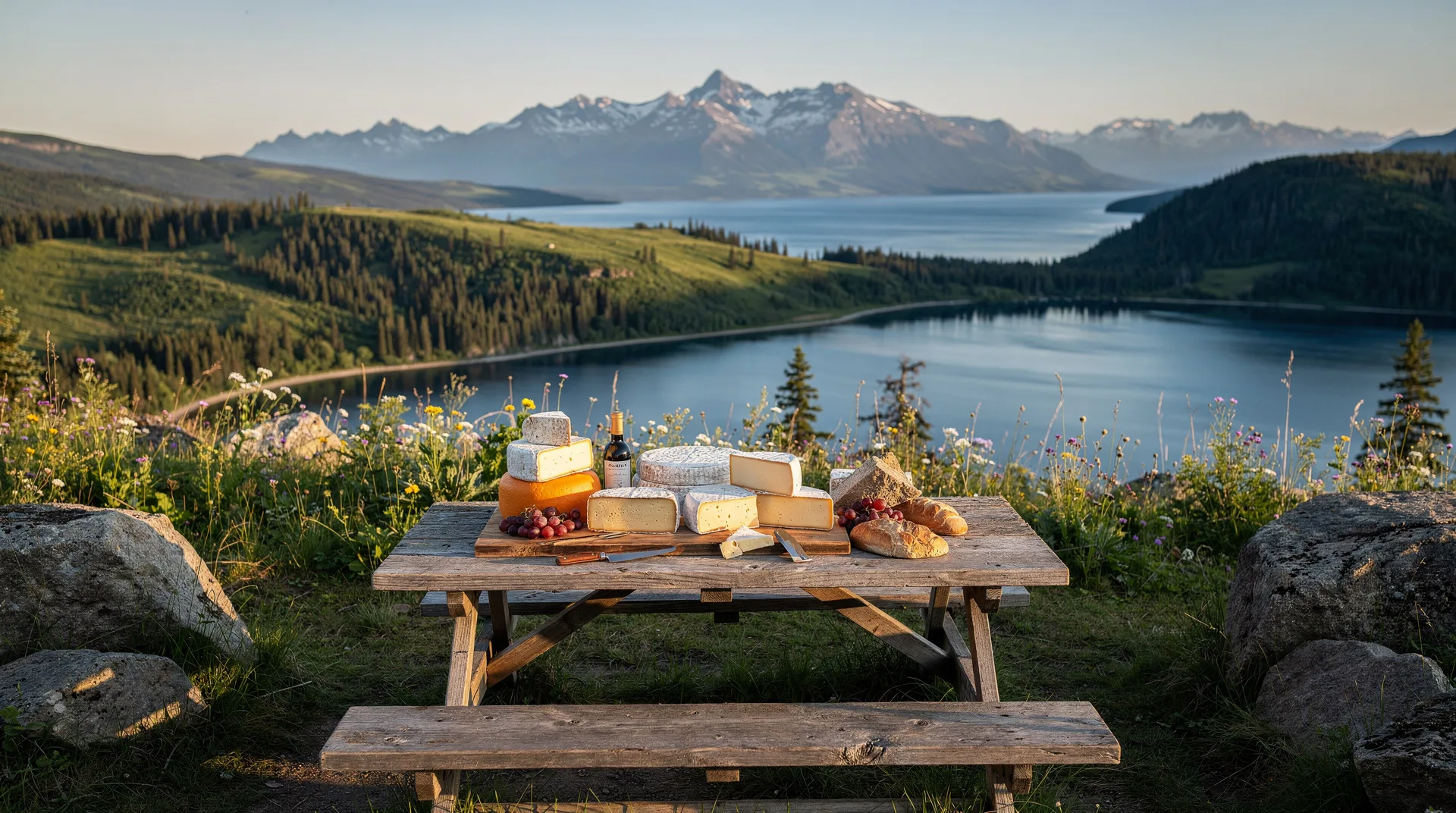
Charlevoix has developed one of the most distinctive artisan cheese cultures in North America, built on exceptional milk from cattle raised on the region’s rolling pasturelands above the St. Lawrence River. The combination of glacial geology (Charlevoix sits within one of the world’s largest meteorite impact craters, the Astroblème de Charlevoix, which produced distinctive soil mineralogy), the damp maritime climate off the St. Lawrence, and a generation of committed cheesemakers has produced cheeses that compete with the finest artisan production in Quebec — and, for several varieties, in all of Canada.
| At a glance | |
|---|---|
| Where | Baie-Saint-Paul to La Malbaie, along the Route des Saveurs |
| Cost | Fromagerie shops are free to browse; tastings/cheese boards typically around CAD 10-25; a Charlevoix food tour from Quebec City runs several hours and is priced per person |
| Time needed | Half a day for the two main Baie-Saint-Paul fromageries; a full day to work the whole cheese circuit |
| Getting there | Car required — roughly 1.5 hours from Quebec City to Baie-Saint-Paul |
| Best time | June-October, when tasting rooms and full production schedules are running |
Unlike the industrialized dairy production that dominates most of Quebec’s agricultural output, Charlevoix’s cheese production is fundamentally artisanal — small volumes, raw or minimally pasteurized milk in many cases, and flavour profiles that are tied to specific farms, herds, and seasons. For food-focused travellers, a day or two tracing the cheese producers of the Route des Saveurs is among the most rewarding culinary tourism experiences in eastern Canada.
The cheeses to know
Migneron de Charlevoix
Migneron is the cheese that put Charlevoix on the map internationally. Produced by Laiterie Charlevoix in Baie-Saint-Paul, it is a semi-soft washed-rind cow’s milk cheese with a characteristic pale orange rind (washed in brine during aging) and an interior that ranges from supple and yielding at 60 days to more complex and assertive at 90+ days. The flavour has the characteristic “washed rind” notes (earthy, slightly funky) balanced by the richness of the high-fat Charlevoix milk.
Migneron won best cheese in its category at the American Cheese Society competition, bringing international attention to Charlevoix production. It is widely available in Quebec specialty cheese shops but is best purchased at Laiterie Charlevoix’s shop in Baie-Saint-Paul, where it is fresher and the full age range is often available.
Ciel de Charlevoix
Also from Laiterie Charlevoix, Ciel de Charlevoix (“Sky of Charlevoix”) is a bloomy-rind soft cheese in the Brie/Camembert tradition but distinctly Québécois in character — produced with local milk, aged for 4 weeks, with a mushroomy white rind and a creamy interior that softens to almost liquidity when perfectly ripe. The flavour is more complex and less industrial than mass-produced Brie: earthy, slightly tangy, with a richness that reflects the quality of the source milk.
Hercule de Charlevoix
A harder, longer-aged cheese in the Alpine tradition, Hercule is produced at the Maison d’affinage Maurice Dufour in Baie-Saint-Paul. Aged 6–18 months, the cheese develops a natural rind and a dense, slightly granular interior with concentrated flavour — buttery, slightly nutty, with the complexity that extended aging produces. Hercule is the Charlevoix cheese that works best on a cheese board alongside wines, and it travels better than the softer varieties.
Lait de Vache
A fresh cheese from the same Maison Dufour, Lait de Vache is the versatile young cheese from the region — used in cooking, spread on bread, or served with local honey and fruit. Its mildness makes it the most approachable of the Charlevoix cheeses for visitors unfamiliar with stronger styles.
Le Cru de Charlevoix
One of the more unusual offerings — a raw milk cheese from a smaller producer that showcases the direct flavour influence of Charlevoix pasture milk. The “cru” (raw) designation means the milk is not heat-treated before cheesemaking, preserving the microbial complexity that pasteurization would destroy. Availability varies by season and producer.
Where to buy and taste
Laiterie Charlevoix (Baie-Saint-Paul)
The anchor institution of Charlevoix cheese production, Laiterie Charlevoix has operated in Baie-Saint-Paul since 1948. The family-owned operation has grown from a traditional local dairy into one of Quebec’s most celebrated artisan producers without losing its artisanal character. The retail shop in Baie-Saint-Paul sells the full range of their production (Migneron, Ciel de Charlevoix, and seasonal varieties) alongside local dairy products.
The fromagerie is not a formal tour destination — it is a working dairy — but the shop is excellent and the staff are knowledgeable. This is the first stop on any Charlevoix cheese itinerary.
Maison d’affinage Maurice Dufour (Baie-Saint-Paul)
The affinage operation run by the Dufour family is both a producer and a maturing cave for several Charlevoix cheeses. The Hercule and Lait de Vache brands originate here. The shop is adjacent to the maturing facilities and gives visitors a closer look at the aging process. Appointment-based visits to the caves are sometimes available — call ahead.
Fromagerie La Station de Compton (Eastern Townships)
While not in Charlevoix itself, this fromagerie is often mentioned in the same breath — its Alfred Le Fermier is one of Quebec’s best artisan hard cheeses and Charlevoix visitors often make the comparison between the two regions’ production styles.
Route des Saveurs fromagerie stops
The Route des Saveurs de Charlevoix includes multiple cheese producers among its 40+ members. A map and passport system allows visitors to collect stamps at each producer and receive recognition for completing various portions of the route. The cheese stops are concentrated between Baie-Saint-Paul and La Malbaie.
Book a Charlevoix food tour from Quebec City on GetYourGuidePairing Charlevoix cheese
The cheeses pair naturally with the other products of the Charlevoix culinary system:
Ice cider: The sweet-tart concentration of fermented frozen apple juice cuts through the richness of washed-rind cheeses like Migneron. Several Charlevoix cideries produce ice cider alongside the apple orchards that line the St. Lawrence hillsides.
Local charcuterie: Charlevoix producers make artisan duck confit, smoked meats, and terrines using local meat — the charcuterie boards at Route des Saveurs restaurants typically combine house-made charcuterie with local cheese.
Quebec wine: While Charlevoix itself does not produce wine (the climate is too cold), the Eastern Townships vineyards are a 4-hour drive, and Quebec sommelier culture at Charlevoix restaurants typically emphasizes interesting small-producer wines from Ontario and beyond.
Local bread: Several Baie-Saint-Paul boulangeries produce artisan bread using local wheat and traditional fermentation — the combination of fresh-baked sourdough and Ciel de Charlevoix at peak ripeness is one of the simplest and best food experiences in the region.
The broader Charlevoix terroir
Quebec’s cheese industry benefited from regulatory changes in the late 1990s that permitted small-batch raw milk cheese production — before this, industrial production standards effectively prohibited artisan cheesemaking. Charlevoix was among the first regions to develop significant artisan production after the regulatory change, partly because the region already had a culture of food artisanship (the Route des Saveurs was among Quebec’s first designated agritourism routes) and partly because the quality of Charlevoix milk gave local producers a raw-material advantage.
The Astroblème de Charlevoix (the meteorite impact crater, 350 million years old and 56 km in diameter) has long been credited with producing the mineral complexity in local soils that transfers to the milk and ultimately to the cheese. Whether this geological story fully explains the cheese’s character is uncertain — many factors contribute — but the narrative is compelling and the cheesemakers themselves embrace it.
Practical information for cheese tourism
Opening hours: Most fromagerie shops are open Tuesday–Sunday (some year-round, some summer only). Confirm hours before visiting — small artisan operations may close without notice.
Purchasing to travel: Charlevoix cheeses in vacuum-sealed packaging travel well for 7–10 days under refrigeration. Soft cheeses (Ciel de Charlevoix) require careful handling and are best consumed within 3–5 days. Hercule in its hard form travels well for weeks.
Getting there: Baie-Saint-Paul is 1.5 hours east of Quebec City on Route 138/362. A car is essential for the Route des Saveurs cheese circuit — the farms are spread across a 60 km corridor.
Building a cheese-focused half-day
A practical order for visitors with limited time: start at Laiterie Charlevoix in Baie-Saint-Paul for the widest range and freshest stock, then walk or drive the short distance to Maison d’affinage Maurice Dufour for Hercule and Lait de Vache and a look at the aging caves if a visit slot is available. Buy a wedge of each style you want to taste (washed-rind, bloomy-rind, hard, fresh) rather than a single large piece — Charlevoix cheese is best compared side by side, and the fromageries expect visitors to buy in small quantities for exactly this reason. Save the softest cheeses (Ciel de Charlevoix) for the same evening or next day, since they do not hold as well as Hercule.
Travellers who prefer a guided introduction rather than self-driving the circuit can combine the cheese stops with a broader Charlevoix food tour departing Quebec City — useful for visitors without a car or who want the tasting context explained rather than self-navigated.
Combining cheese with the rest of Charlevoix
A cheese day works well slotted into a broader Charlevoix trip rather than as a stand-alone visit — see the Charlevoix from Quebec City guide for how to fit a cheese stop into a day trip, weekend or longer road trip, or the 4-day itinerary for a full plan that pairs the Route des Saveurs with Charlevoix’s parks and villages. Base yourself in Baie-Saint-Paul, which puts both anchor fromageries within walking distance and keeps driving to a minimum.
Frequently asked questions
Is Charlevoix cheese available outside the region? Yes — Migneron and Ciel de Charlevoix are distributed to specialty cheese shops across Quebec and increasingly elsewhere in Canada, but selection and freshness are best bought directly from the producers in Baie-Saint-Paul.
Can I visit the fromageries without a car? Not practically — there’s no regular public transit along the Route des Saveurs, so a rental car or a guided food tour from Quebec City is necessary to reach the producers.