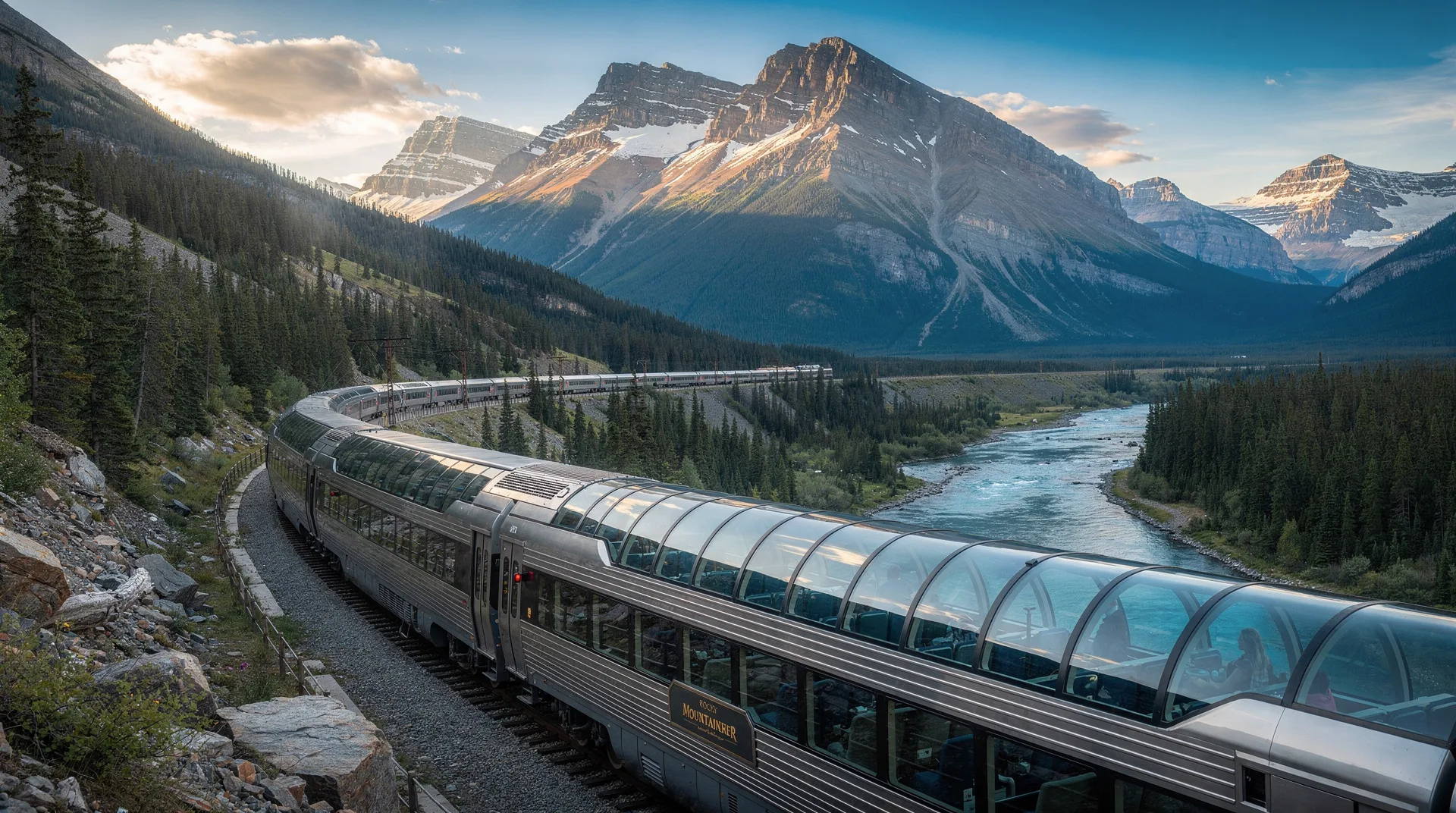
Rocky Mountaineer 2025: updates and deals
Rocky Mountaineer has been running since 1990 and has, in that time, become one of the world’s most recognised luxury rail experiences. The two-day Vancouver-to-Banff or Vancouver-to-Jasper journey through the Canadian Rockies — where the glass-dome coaches give panoramic views of peaks, glaciers, rivers, and wildlife — is the kind of trip that appears on people’s lists for years before they actually do it.
The 2025 season brings some meaningful updates to routes, pricing, and the booking experience. If you’ve been watching Rocky Mountaineer for a while and wondering whether this is the year to book, here’s what’s changed and what remains constant.
| Details | |
|---|---|
| Where | Vancouver, Whistler, or Banff to Banff, Jasper, or Denver |
| Cost | Around CAD $1,500-3,500+ per person for the train alone, depending on route and service level |
| Time needed | Minimum two days (First Passage, Journey Through the Clouds); three to four for the other routes |
| Getting there | Fly into Vancouver or Whistler; fly out from Calgary or Denver |
| Best time | June-September, with September offering early autumn colour and lower prices |
The 2025 route lineup
Rocky Mountaineer operates three main Canadian routes, each covering distinct terrain:
First Passage to the West (Vancouver to Banff): The flagship route. Two days from Vancouver through the Fraser Canyon, the Spiral Tunnels, and into Banff National Park. Night is spent in Kamloops, BC between the two travel days. This is the route most people mean when they talk about Rocky Mountaineer — the one with the Spiral Tunnels, the dramatic Thompson River gorge, and the arrival into Banff at the end of day two.
Journey Through the Clouds (Vancouver to Jasper): Follows the same first day as First Passage, then diverges north from Kamloops toward the Yellowhead Pass and Jasper National Park rather than south to Banff. The terrain on day two is more remote — the Albreda Glacier, the Fraser River headwaters, the long approach to Jasper through increasingly wild mountain country.
Rainforest to Gold Rush (Whistler to Jasper): The northernmost route, beginning in Whistler and heading north through the mountains of BC to Prince George, then east to Jasper over three days. This is Rocky Mountaineer’s most remote and least travelled route — the First Nations territories north of Whistler are spectacular and almost entirely unknown to international visitors.
Rockies to the Red Rocks (Banff to Denver, USA): The US expansion route, launched in 2021 and now firmly established. Four days from Banff through the Canadian Rockies, Glacier National Park in Montana, into Wyoming and Colorado. A genuine cross-border experience that requires a more significant time commitment but offers mountain terrain you won’t see otherwise.
What’s new for 2025
Refreshed menus: Rocky Mountaineer makes a genuine effort with its onboard food, and the 2025 season sees updated menu programming across both service levels. The GoldLeaf service (meals included in an upper-level glass dome with separate dining room below) has brought in regional Canadian sourcing partnerships with BC producers. The SilverLeaf service (meals included on a single-level dome car) has similarly updated its offering.
Early booking incentives: For 2025, Rocky Mountaineer is offering more structured early-booking discounts than in previous years. Departures booked more than six months in advance can access savings of 10–20% off standard fares, particularly on shoulder-season departures (May, September) that are less heavily subscribed than the peak July-August period.
Package combinations: Rocky Mountaineer has deepened partnerships with accommodation providers in Vancouver and in Banff/Jasper for 2025, making it easier to book a complete trip (pre-train accommodation, the train itself, and post-train accommodation) through a single channel. These combination packages often include transfers and occasional extras that reduce the logistical friction of planning both ends of the trip.
Shoulder season expansion: The 2025 season has been extended slightly in both directions, with May departures starting earlier and September departures running later than in recent years. The shoulder season argument for Rocky Mountaineer is compelling: prices are lower, the mountains are less crowded, and autumn colour in September gives day two of the Banff route a spectacular golden quality.
Service levels: GoldLeaf vs. SilverLeaf
The choice between Rocky Mountaineer’s two service levels involves a significant price difference and a meaningful experience difference.
GoldLeaf Service: The premium product. You travel in a bi-level glass-dome coach — seating is on the upper level with panoramic glass roof and windows; dining is on the lower level with table service. Meals, alcoholic beverages, and snacks are included. GoldLeaf is more expensive (roughly CAD $1,000-1,500+ per person per day, depending on season and route), and the experience is noticeably more special — the combination of the glass dome with white-tablecloth dining has been the gold standard for this journey for thirty years.
SilverLeaf Service: Single-level glass-dome coach with panoramic windows. Meals and non-alcoholic beverages are included; alcohol is additional. The physical views are similar — you’re in the same scenery — but the dining experience is a buffet-style rather than table service, and the sense of occasion is somewhat lower. Significantly less expensive than GoldLeaf; still a very good experience.
For most first-time riders, the honest recommendation is to budget for GoldLeaf if possible and go once than save money and feel uncertain about the comparison. But SilverLeaf is not a compromise version of the experience — it’s a genuine premium train journey, just with a slightly different atmosphere.
Rocky Mountaineer vs Via Rail
The comparison comes up constantly, and the honest answer is that they’re different products serving different budgets. Via Rail runs the same general corridors at a fraction of the price, without the glass dome, included multi-course meals, or overnight hotel stop — you travel in standard rail seating, often overnight in a sleeper if you choose that class. Rocky Mountaineer’s entire model is built around daylight-only travel and the panoramic dome experience; Via Rail’s is built around point-to-point transport with a scenic bonus. The Via Rail vs Rocky Mountaineer guide breaks down the differences route by route for travellers deciding between the two.
Pricing context for 2025
Rocky Mountaineer pricing for 2025 follows the patterns established over recent years, with some adjustment for operational costs. Approximate ranges (subject to departure date and availability):
First Passage to the West (Vancouver-Banff):
- SilverLeaf: CAD $1,500–2,200 per person
- GoldLeaf: CAD $2,500–3,500 per person
These prices cover the train journey and accommodation in Kamloops between travel days. They do not include getting to Vancouver, getting from Banff, accommodation at either end of the journey, or most excursions.
The total cost of a Rocky Mountaineer trip — including flights, pre/post accommodation, and the train — typically runs CAD $5,000–9,000+ per person for international visitors building a complete Canadian Rockies itinerary around it.
Early-booking discounts and package combinations can reduce this, particularly for shoulder-season departures. The Rocky Mountaineer website’s best fare calendar is worth monitoring if dates are flexible.
Combining Rocky Mountaineer with other experiences
The Rocky Mountaineer doesn’t operate in isolation — it’s typically one component of a Canadian Rockies itinerary. Common combinations:
Pre-train Vancouver: Two to three days in Vancouver before boarding. The city has enough to fill a short stay easily — Stanley Park, Granville Island, the food scene, a day trip to Whistler.
Post-train Banff/Jasper: The arrival in Banff or Jasper is the beginning, not the end, of the mountain experience. A minimum of three days in Banff National Park after the train allows for lake visits, hiking, and the Icefields Parkway. Guided experiences in Banff complement the train journey by taking you deeper into the park than you’d manage independently on a short visit.
Moraine Lake and Lake Louise: These can be reached from Banff townsite easily after arriving by train. Guided tours to Moraine Lake avoid the access complexity of the shuttle system and often include additional stops that maximise a limited day.
East to Calgary, west back to Vancouver: The classic circuit for First Passage travellers is to fly into Vancouver, ride the train east to Banff, spend time in the Rockies, and fly home from Calgary. This avoids backtracking and uses the train for the best portion of the journey.
What Rocky Mountaineer isn’t
A few honest notes to manage expectations:
Rocky Mountaineer does not run overnight — the train stops each night in Kamloops (or Prince George on the northern route) and passengers sleep in hotels. This is a deliberate design choice to ensure all mountain scenery is viewed in daylight, but it means the experience is nothing like a traditional sleeper train.
The train does not go to certain popular locations directly. There is no Rocky Mountaineer service to Jasper via the Icefields Parkway — you travel to Jasper or Banff, and the parkway between them requires a separate vehicle or tour.
Rocky Mountaineer is significantly more expensive than Via Rail, which runs the same corridors on a different schedule and at a fraction of the price. Via Rail’s Canadian and Jasper-Vancouver services are excellent in their own right and worth considering for budget-conscious travellers who want a train experience without the luxury price point.
Final thoughts
Rocky Mountaineer in 2025 is in a strong position: the routes are well established, the service is consistently high quality, and the early-booking incentives make the pricing somewhat more manageable than peak-season walk-up rates. If the Canadian Rockies are on your list and the budget allows, this remains one of the world’s genuinely outstanding train journeys.
The two things that make it special — the glass-dome design that maximises the mountain views, and the deliberate pacing that keeps you in the mountains all day — are unchanged from what made it famous. The 2025 updates are refinements, not reinventions.
Frequently asked questions about Rocky Mountaineer 2025: updates and deals
How far in advance should I book Rocky Mountaineer?
For peak season departures (July–August), six to twelve months in advance is advisable, particularly for GoldLeaf service which has limited capacity. Shoulder season (May, September) departures are somewhat easier to book closer to the date, but early-booking discounts make advance booking financially advantageous in any season.
Can I do Rocky Mountaineer as a day trip?
No. The shortest Rocky Mountaineer journey is two days, with a night in Kamloops between travel days. The train does not operate on a day-trip model. One-way journeys (Vancouver to Banff, for example, without returning) are common and can be combined with flying back from Calgary.
Is Rocky Mountaineer worth the price compared to driving?
They are different experiences rather than comparable ones. Driving the Trans-Canada or Icefields Parkway gives flexibility, stops, and a relationship with the landscape that the train doesn’t provide. Rocky Mountaineer provides unobstructed views from glass domes, service, meals, and a passive experience of the landscape that is genuinely moving. Many travellers do both on different trips.
What is the best season for Rocky Mountaineer?
June through September for the most reliable weather and greenest vegetation. September has the advantage of early autumn colour, particularly on the Banff and Jasper routes where aspen and larch begin to turn gold. July-August is peak season with the highest prices and fullest trains. May is often excellent with late snow on the mountains and spring flowers beginning.
Are children welcome on Rocky Mountaineer?
Yes. There is no minimum age. Children typically receive the same experience as adults in GoldLeaf or SilverLeaf service. The long days of sitting and looking out windows (roughly 8-10 hours each travel day) can challenge younger children’s patience — families with children under 8 should think realistically about whether the format works for them.
Does Rocky Mountaineer cost more than Via Rail?
Significantly more. Via Rail covers similar corridors at a fraction of the price without the glass-dome coaches, included multi-course dining, or mandatory overnight hotel stop built into the fare. The Rocky Mountaineer vs Via Rail guide compares the two in detail for travellers trying to decide which fits their trip and budget.