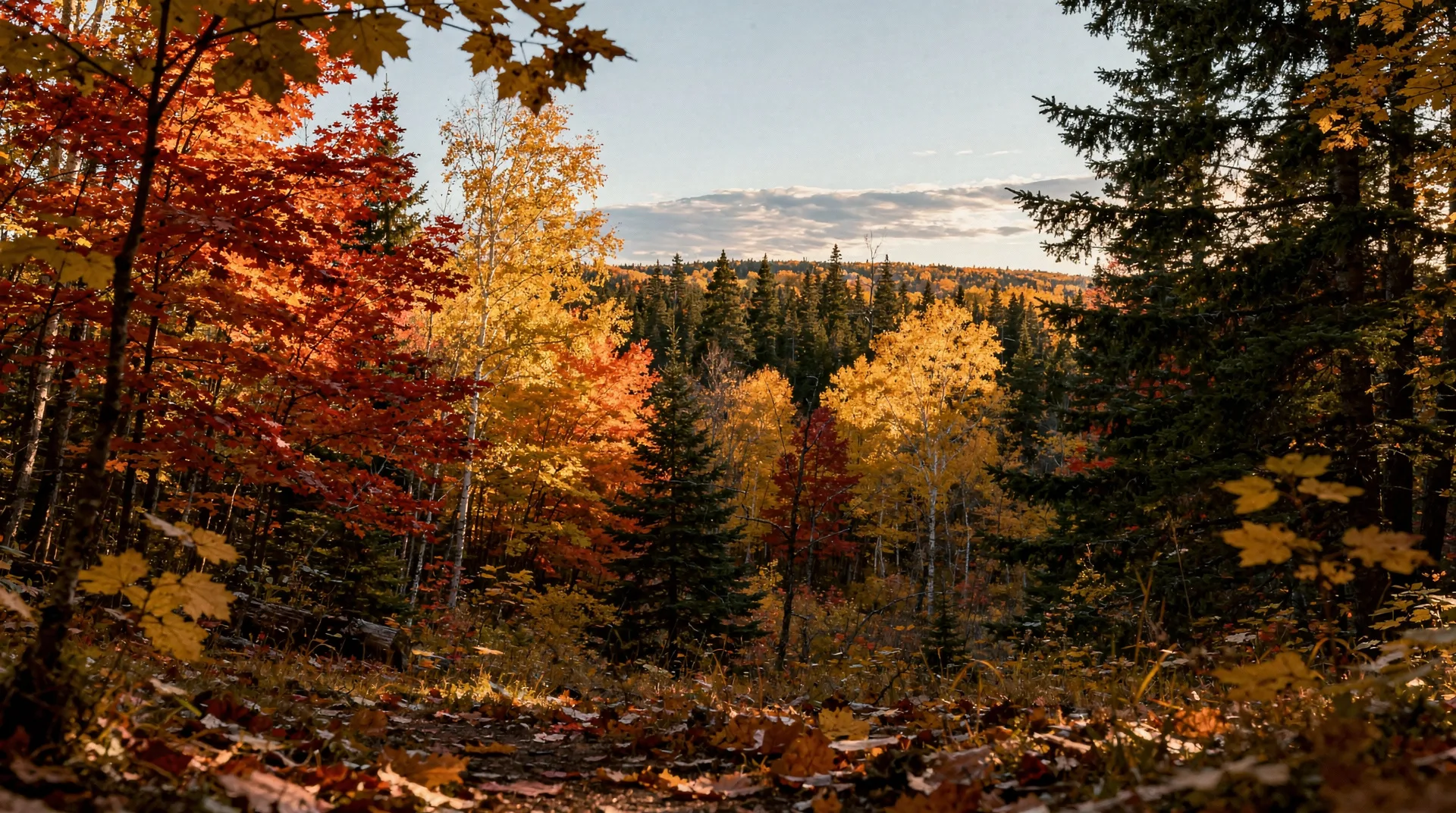
Canada's best fall colors: where and when
Canada’s autumn is one of the world’s great seasonal events — a continental-scale transformation of the landscape that runs roughly from late August in the north to late October in the south, covering terrain so varied that no single trip can capture it fully. The famous New England fall colour gets most of the international attention, but Canada’s equivalents are larger, less crowded, and in some cases more dramatic.
The diversity is what makes it compelling. Quebec’s maple forests produce the archetypal red-and-orange display. The Canadian Rockies offer something entirely different — golden larches against grey granite peaks and turquoise lakes, a combination of colour and landscape that looks genuinely impossible in photographs. Nova Scotia’s Cabot Trail runs through hill country with sea views. Ontario’s Algonquin Park is the most accessible and most consistently excellent fall experience in the country.
Planning is the variable. Canada’s fall colour season is brief at any given location — peak typically lasts ten to fourteen days — and the timing varies by year depending on summer temperatures and precipitation patterns. Getting to the right place at the right time requires some research and a degree of flexibility.
| At a glance | |
|---|---|
| Where | Nationwide — Quebec, Ontario, the Rockies, and Nova Scotia are the standout regions |
| Cost | Free to view in most spots; national and provincial park entry fees apply (around CAD 10-23/vehicle/day) where the best trails sit inside a park |
| Time needed | A dedicated fall trip works well as a long weekend per region, or 10-14 days to combine two or three |
| Getting there | Fly into Toronto, Montreal, Quebec City, or Calgary depending on region, then self-drive |
| Best time | Late September through mid-October for most of the country; late August for the far north |
Getting to the trailheads without a car
Not every fall colour destination requires a rental car. Toronto is the practical base for Algonquin and Muskoka day trips and seasonal bus tours; Montreal and Quebec City both sit within a short drive of the Laurentians, the Eastern Townships, and Charlevoix.
For the Rockies, Banff and Canmore are the logical bases for larch season hiking, both reachable from Calgary in under two hours. If you’d rather not drive at all, several operators run dedicated fall colour coach tours from these hubs — see the Banff tours guide for the Rockies option and the Cabot Trail guide for the Atlantic route.
What to pack for a fall colour trip
Layering matters more than any other single packing decision. Mornings in the Rockies and northern Ontario can sit close to freezing in late September even when afternoons are pleasant, and mountain weather changes fast at elevation. A shell jacket, a warm mid-layer, and sturdy waterproof footwear cover most scenarios; for the larch trails specifically, bear spray and a printed trail map are worth carrying since cell coverage disappears quickly above the treeline. If Algonquin’s interior is on the itinerary, budget an extra day for the drive from Toronto and check the Algonquin Provincial Park page for current trail conditions before setting out.
Algonquin Provincial Park: the classic Ontario experience
Algonquin Provincial Park, three hours north of Toronto in the Canadian Shield, is the most visited provincial park in Ontario and one of the finest fall colour destinations in North America. The park covers 7,700 square kilometres of mixed boreal and deciduous forest — maple, birch, aspen, and poplar — and the Highway 60 corridor that runs east-west through the southern park provides a concentrated display of colour visible from the road.
Peak colour at Algonquin typically runs from late September through the first week of October, though this varies by year. The park’s own website maintains a colour report during the season. The Algonquin Visitor Centre and the various pull-offs along Highway 60 provide easy roadside access; the interior canoe routes offer a more immersive experience for paddlers willing to plan a multi-day trip.
The Lookout Trail (2.1 km, 90-metre elevation) is the single best short investment for Algonquin fall colour — the ridge viewpoint gives a panorama over the forest canopy that captures the scale of the display. Do it at mid-morning light.
Quebec: maple forests and village-to-village routes
Quebec’s fall colour is built on maple trees — sugar maple specifically, the same tree that produces the sap for maple syrup. The sugar maple turns red. Not orange-red or burgundy — true scarlet, sometimes approaching crimson, with a saturation that registers differently from other deciduous colour. Combined with the orange of red maple, the yellow of birch, and the remaining green of conifers, a Quebec hillside in October looks like something that was colour-corrected by someone who didn’t know when to stop.
The Laurentians north of Montreal — the resort region that includes Mont-Tremblant and the villages of Saint-Sauveur, Sainte-Adèle, and Saint-Jovite — are the most accessible Quebec fall option from the city. The Route des Cantons-de-l’Est (Eastern Townships) south and east of Montreal is less well known internationally but produces comparable colour with a distinct agricultural and village character — covered bridges, fromageries, orchards, and winery harvest events alongside the leaf-peeping.
The Charlevoix region northeast of Quebec City combines significant elevation, the St. Lawrence River, and excellent maple forest to produce one of Quebec’s best fall drives. The route from Quebec City along the north shore of the St. Lawrence to Baie-Saint-Paul and La Malbaie runs through colour of a quality and quantity that rewards dedicated autumn travel.
Peak timing in southern Quebec (Laurentians, Eastern Townships) runs from late September through mid-October. The Charlevoix peaks slightly earlier.
The Canadian Rockies: larch season
The Rockies’ fall colour is dominated not by maples but by subalpine larch — a conifer that unusually drops its needles in autumn, turning gold before shedding. The larch forests are concentrated at high elevations (above the treeline proper, in the zone where the most cold-tolerant trees survive) and are accessible via hiking trails rather than roadside viewpoints.
The famous locations:
Larch Valley, Banff National Park: A 5.8 km trail from the Moraine Lake parking area that climbs through dramatic larch-studded terrain with views back toward the Valley of the Ten Peaks. Peak timing runs from mid to late September — the specific window varies by year and elevation. The trail is popular on weekends during peak larch season; going midweek or starting at first light significantly reduces crowds.
Sentinel Pass: Continuing beyond the larch meadows of Larch Valley, the trail reaches Sentinel Pass at 2,611 metres — the highest point accessible by trail in Banff National Park. The views of the larch-covered slopes below and the peaks above are among the best in the Rockies.
Sunshine Meadows: Accessible by gondola from the Banff Sunshine ski area, the high-altitude meadow system turns gold in September with a combination of larch and other alpine vegetation. Views toward Mount Assiniboine are exceptional.
The key thing to know about Rockies larch season is that it combines the fall colour with a very specific mountain landscape — the colour is not red or orange but gold, set against the dark grey limestone and the turquoise of the lakes still visible at lower elevations. It is aesthetically unlike any other autumn experience in Canada.
Guided Banff experiences in autumn often build in the larch season timing and can get you to the best viewpoints without the logistics of shuttle booking and early starts.
Nova Scotia: Cabot Trail and the Atlantic shore
The Cabot Trail on Cape Breton Island is Nova Scotia’s — and arguably Atlantic Canada’s — premier fall colour drive. The 300 km circuit around the northern tip of the island runs through Cape Breton Highlands National Park, which holds the region’s most dramatic combination of highland colour and sea views.
The highlands turn from late September through October. The combination of the Highland trees (maple, birch, beech) with the coastal views over the Gulf of St. Lawrence and the Atlantic Ocean creates a landscape that is different in character from Quebec or Ontario — the scale is smaller, the setting more maritime, and there is a specific quality to the Atlantic light in October that deserves its own adjective.
Guided tours of the Cabot Trail take the navigation out of the equation and allow full attention to the landscape. The trail’s winding coastal and highland sections require genuine attention to drive safely; a guide handles that while you look at the colour.
The broader Nova Scotia countryside — the Annapolis Valley, the South Shore, the Kejimkujik National Park inland area — provides fall colour that extends well beyond the Cabot Trail and rewards exploration.
Ontario’s fall beyond Algonquin
Algonquin is the most famous but not the only fall colour option in Ontario. The Muskoka region (south of Algonquin) is perhaps the most photographed — the cottage-country lakes, granite outcrops, and mixed forest produce a classic Ontario fall scene that appears on calendars and in real estate marketing for good reason.
The Bruce Peninsula (between Georgian Bay and Lake Huron) has excellent fall hiking in Bruce Peninsula National Park, with turquoise Georgian Bay water as a backdrop to the colour. The combination is unusual — the Caribbean-coloured water next to autumn-red forest looks implausible until you see it.
The Niagara Escarpment, running north from Niagara Falls through Hamilton, Orangeville, and the Blue Mountains, turns from mid-October and the Bruce Trail along its length offers hiking through the colour with excellent views of the Georgian Bay shore from the north end.
Practical timing guide
| Region | Peak window |
|---|---|
| Yukon and northern Canada | Late August - early September |
| Northern Ontario, northern Quebec | Mid - late September |
| Algonquin and Muskoka | Late September - early October |
| Quebec Laurentians, Eastern Townships | Late September - mid-October |
| Nova Scotia, Cape Breton | Late September - mid-October |
| Rockies larch season | Mid - late September |
| Southern Ontario | Early - mid October |
These are typical peak windows; specific years vary by several weeks depending on temperature and precipitation patterns during the preceding summer. Most provincial parks and several regional websites publish colour reports during the season.
Final thoughts
Canada’s fall colour is not a single event but a season-long progression across a continent. Chasing peak colour is one of Canada’s most satisfying seasonal pursuits — the combination of the landscape, the light quality of October, the temperature (cool but rarely cold in the prime window), and the absence of summer’s crowds makes autumn travel in Canada a genuinely underrated choice.
The mistake is thinking one trip captures it. Algonquin one year, the Quebec Eastern Townships the next, the Rockies in larch season the year after that — the country is large enough that a decade of autumn visits would still leave territory unexplored.
Frequently asked questions about Canada’s best fall colors: where and when
When exactly is peak fall colour in Canada?
Peak timing varies by region and year. Generally: northern Canada from late August; Algonquin and the Rockies (larch) from mid-September; Quebec and Nova Scotia from late September through early October; southern Ontario through mid-October. Check regional colour report websites in the week before your visit for current conditions.
Can I see fall colour from the Rocky Mountaineer train?
Yes — September departures of Rocky Mountaineer see aspen colour beginning in the Rockies, and the autumn light quality is excellent. The larch colour is at higher elevations than the train route reaches, but the valley-level aspens turn gold from mid-September and are visible from the train.
Is fall a good time to visit Quebec City?
Excellent. Quebec City in fall is one of Canada’s most attractive combinations of urban culture and seasonal colour. The Plains of Abraham and the surrounding parkland turn colour while the old city’s stone architecture takes on a particular warmth in autumn light. The crowds are dramatically smaller than summer. The food in October is at its best — harvest season produce, cider, mushrooms.
How crowded is Algonquin during peak colour?
The peak colour weekend at Algonquin is extremely busy — Highway 60 can see significant traffic and the main lookout trailheads fill up. Weekday visits during the peak window are much better. The interior of the park (accessible by canoe) is never crowded. Coming the week before or after the precise peak often still produces excellent colour with a fraction of the weekend peak congestion.
Are there guided fall colour tours in Canada?
Yes, extensively. Bus tours run from Toronto to Algonquin and Muskoka during peak season. Guided hiking tours operate in the Rockies during larch season. Self-drive itineraries with accommodation packages are available through most provincial tourism boards. The advantage of guided options is that operators know the peak timing and can adjust routing based on current colour reports.
Do I need a car for a fall colour trip?
Not always. Algonquin and Muskoka are reachable by bus tour from Toronto, and several operators run coach trips into the Rockies and along the Cabot Trail during peak season. A rental car gives far more flexibility to chase colour reports day to day, though, and is close to essential for the Quebec back roads and the Icefields Parkway.