Fall in Canada: why autumn is the best season
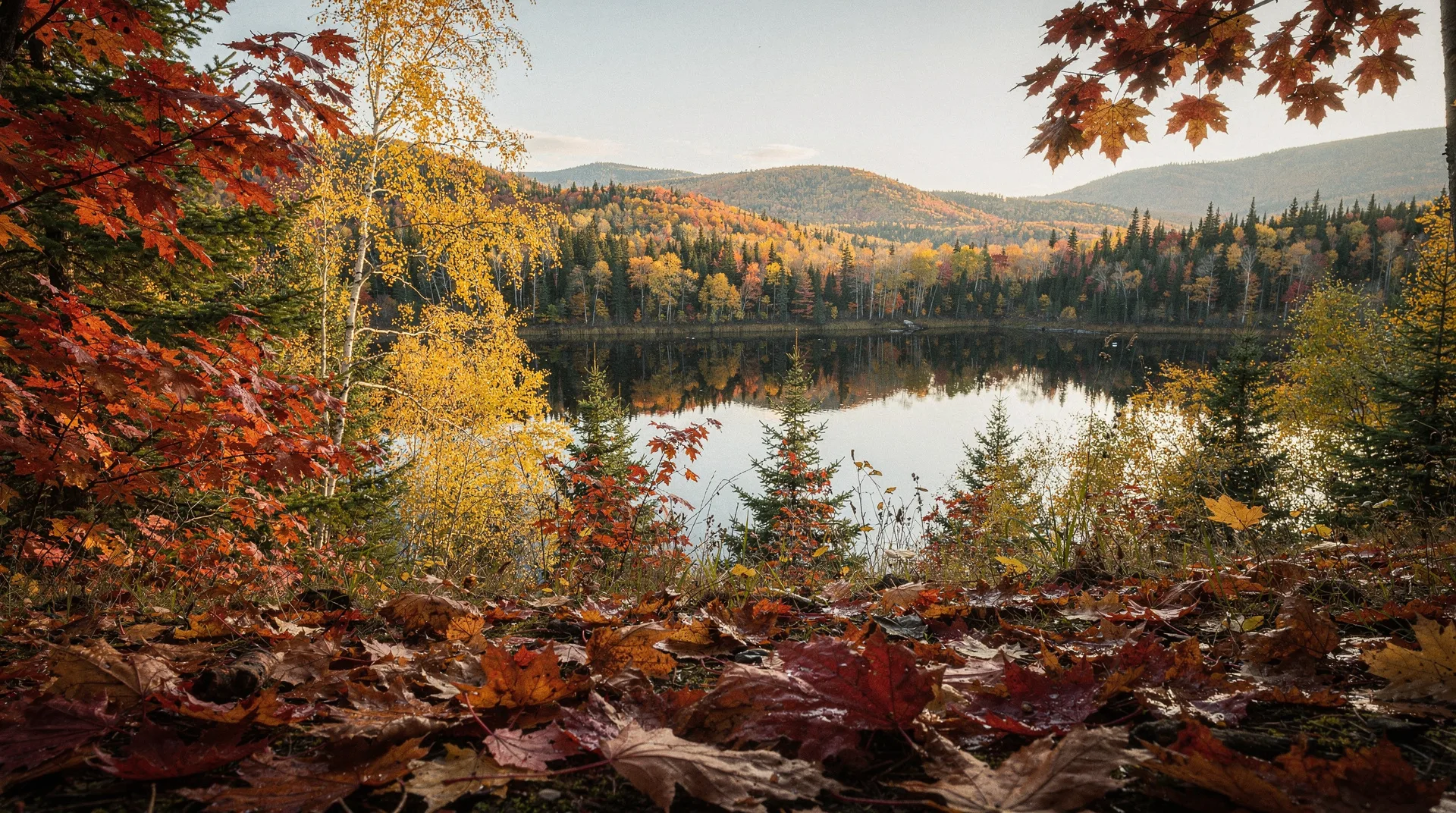
There is a specific morning in the Canadian autumn — usually in late September, somewhere between the first cold night and the peak of the colour — when the combination of light, temperature, and landscape coalesces into something you can’t photograph adequately and struggle to describe to people who weren’t there. The air is clean and cold. The maples are at their most vivid. The morning frost has melted from the grass but still lingers in the shadows. Everything is perfectly, almost aggressively alive in the way that things are just before they stop being so.
| At a glance | |
|---|---|
| Where | Nationwide — strongest in Quebec/Ontario (maple), the Rockies (larch), and the prairies (aspen) |
| Cost | Accommodation typically 20-30% cheaper than summer once September ends |
| Time needed | A weekend for a single region; 7-10 days for a Quebec-to-Rockies-style circuit |
| Getting there | Self-drive is the practical option for foliage routes; fly into Montreal, Quebec City or Calgary as anchors |
| Best time | Late September-early October for larches; early-mid October for eastern maple; varies by latitude |
I have been to Canada in summer, in winter, and in autumn. I go back in autumn.
This is not a minority opinion. Among travellers who have visited multiple times and in multiple seasons, autumn consistently produces the most affection. The reasons are practical — fewer crowds, lower prices, better weather in many ways — and aesthetic, because what happens to the Canadian landscape in September and October is genuinely one of the great natural spectacles available to travellers.
Why autumn changes everything
Canada’s autumn foliage reputation belongs primarily to the eastern provinces, but the phenomenon is national. What varies is the species composition and therefore the colour palette, the timing, and the landscape context.
In eastern Canada — Ontario, Quebec, New Brunswick, Nova Scotia, Prince Edward Island — the forest is dominated by sugar maple, red maple, yellow birch, and American beech. Sugar maple produces the most intense red, orange, and yellow of any deciduous tree. When a hillside covered in sugar maples turns in early October, the result is a colour intensity that photographs struggle to reproduce accurately — not because it looks filtered or processed, but because the saturation and the quality of October light combine in ways that cameras render flat.
In the Canadian Rockies, the relevant species is not maple but larch — the only conifer that loses its needles in autumn. The subalpine larch (Larix lyallii) turns from green to a vivid, particular gold in the second half of September, and the combination of that gold against the grey rock, the blue sky, and the dark green of the surrounding spruce creates a colour palette entirely unlike the eastern foliage.
In the prairies, the foliage is aspen: trembling aspen covers large areas of Manitoba, Saskatchewan, and Alberta, and in October the parkland region — the transition zone between boreal forest and prairie — turns a consistent pale gold that extends to every horizon under the enormous prairie sky.
Eastern Canada foliage: the classic experience
The traditional Canadian autumn colour experience follows a route through Quebec and Ontario that tourism departments have been promoting for decades, with good reason. The route from Montreal up the Laurentian Mountains (Laurentides) north to Mont Tremblant, then east through the Eastern Townships (Estrie) toward Quebec City, then further east along the St Lawrence to Charlevoix, constitutes one of the finest autumn drives in the world.
Mont Tremblant peaks around the first or second week of October. The ski resort base village, empty of summer visitors and not yet open for skiing, has an almost melancholy quality that suits the season. The mountain’s slopes are entirely visible from the village, which means watching the colour change over several days as the maples work their way down from the summit.
Quebec’s Charlevoix region — the area along the north shore of the St Lawrence between Quebec City and the Saguenay Fjord — peaks slightly later, usually mid-October. The combination of the elevated terrain, the agricultural landscape, and the river below produces compositions that look constructed. The towns of Baie-Saint-Paul and La Malbaie are beautiful at any time of year and extraordinary in October.
New Brunswick’s covered bridges and river valleys are underrated as an autumn destination. The Restigouche and Miramichi river valleys, lined with maple forest, produce excellent foliage and have the advantage of being almost entirely uncrowded — the tourists who throng Quebec and Ontario in October haven’t yet discovered that New Brunswick’s colour rivals theirs.
Montreal day tours and autumn experiences include colour season trips to the Laurentians and the Eastern Townships that take the logistics out of the peak foliage period.
The Rockies in larch season
The larch season in the Canadian Rockies runs roughly from the third week of September through mid-October, peaking usually around September 25th to October 5th. It is shorter and more weather-dependent than eastern foliage — a heavy early snowfall can end the season before peak, and a cold snap can accelerate it by a week. Checking current conditions from the Parks Canada website and social media monitoring of recent trail reports is worth doing in the week before your visit.
The best larch destinations in the Rockies are:
Larch Valley, Banff: The trail from Moraine Lake into Larch Valley (6 km return, 400 m elevation gain) leads through forest that becomes increasingly larch-dominated as you climb, with the valley floor surrounded by larches at their peak and the Ten Peaks visible above. This is the most accessible and photographed larch location in the Rockies.
Sentinel Pass, Banff: Continuing above Larch Valley to Sentinel Pass (11 km return from Moraine Lake, 725 m total elevation gain) puts you at the ridgeline between two drainages, with larch forests on both sides and the Valley of the Ten Peaks below. One of the finest views in the Rockies, accessible on a full day hike.
Arethusa Cirque, Kananaskis Country: Less crowded than the Moraine Lake routes, the cirque is accessed via a 7 km return trail from the Smith-Dorrien/Spray Trail south of Canmore. The larches here are often less busy than the national park equivalents and consistently excellent.
Chester Lake, Kananaskis: Another Kananaskis option that sees fewer visitors than Banff, with excellent larch coverage in a cirque setting.
Crowd dynamics in autumn vs summer
This is a practical argument as much as an aesthetic one. Summer in the Canadian Rockies means Moraine Lake access by shuttle (book weeks in advance), Lake Louise parking full by 8 am, trails crowded throughout daylight hours, and accommodation at premium prices booked out months ahead.
September in the Rockies means the shuttles are still running but easier to book. October means the shuttle season ends and you can drive directly to Moraine Lake again — often arriving at dawn to find a handful of other people. Accommodation prices drop 20–30% from September into October. Restaurants in Banff townsite have tables available on short notice.
The same dynamic applies in eastern Canada. Quebec City in July is excellent but busy. Quebec City in the first two weeks of October, with the Charlevoix turning colour visible from the city, is equally excellent and significantly less crowded. The Cabot Trail in summer is popular; in late September it is at its most beautiful and is visited by a fraction of the summer traffic.
Autumn activities beyond foliage
The colour season coincides with other natural events that make autumn in Canada particularly rich:
The elk rut: September in the Canadian Rockies is elk rutting season. Bulls bugle — a sound somewhere between a whistle and a roar — throughout the morning and evening hours. Elk gather in open valleys and meadows. In Jasper townsite and in the Bow Valley near Banff, the rut brings elk into town and produces some of the most dramatic wildlife viewing of the year. Keep your distance — bulls in rut are aggressive — but the spectacle from a safe remove is unforgettable.
The salmon run: Pacific salmon runs in British Columbia from late August through October draw bears, eagles, and herons to the rivers in concentrations that rival the Rockies for wildlife viewing. The Adams River sockeye salmon run (in dominant years — 2022 was a dominant year) is one of the largest salmon runs in the world and is accessible near Chase, BC. Viewing platforms above the river are set up during peak run weeks.
Mushroom season: Autumn is chanterelle and porcini season in the forests of British Columbia and the Maritime provinces. Foraging mushrooms is a genuine autumn activity that has attracted an enthusiastic community — guided foraging walks are available in several regions. To compare options across the country, browse autumn tours across Canada.
What to wear, what to expect
Autumn temperatures in Canada vary significantly by region. Southern Ontario and Quebec in early October is jacket weather — 10–15°C during the day, occasionally dropping to near zero at night. The Rockies in late September can include snow on the mountains and temperatures at altitude that require full winter gear for hikes above treeline. Cape Breton in September is mild and pleasant. Northern Quebec in October is cold.
Layer. Bring a waterproof outer shell regardless of the forecast — autumn weather in most of Canada is variable. The cold mornings that produce the best photography light also require warm layers that come off as the day warms.
Accommodation often fills in peak colour weeks in popular areas — particularly the Quebec Laurentians and Charlevoix, and the Rockies around the larch peak. Book ahead, and check cancellation policies so you can adjust if colour timing differs from your dates.
Turning it into a trip: two ways to structure autumn travel
The single-region weekend is the low-commitment option: pick one area — Banff for larches, Charlevoix for maple, or the Cabot Trail for coastal colour — and build 3-4 days around it without long transfers. The circuit approach is more ambitious: a route from Montreal through the Laurentians and Eastern Townships to Quebec City and Charlevoix covers the eastern classic in about a week, while a Rockies-focused version built around the Canadian Rockies 10-day itinerary timed for late September captures both larch season and the tail of the elk rut.
Because colour timing shifts year to year by up to two weeks depending on early frost or snowfall, building in a flexible 2-3 day window around your target dates, rather than locking a single date months out, meaningfully improves your odds of catching peak colour rather than the week before or after it.
Regional colour comparison
| Region | Peak window | Signature colour | Crowd level |
|---|---|---|---|
| Canadian Rockies (larch) | Late Sept-early Oct | Gold against grey rock and green spruce | Moderate, lower than summer |
| Quebec (Laurentians, Charlevoix) | Early-mid October | Intense red/orange sugar maple | High in peak weeks |
| Ontario (Algonquin, Muskoka) | Late Sept-early Oct | Red maple, yellow birch | High in peak weeks |
| Atlantic Canada (Cabot Trail, NB valleys) | Mid-October | Mixed maple, coastal backdrop | Low to moderate |
| Prairies (aspen parkland) | October | Pale gold across open horizons | Low |
| Yukon and northern Canada | Late August | Early aspen and tundra colour | Low |
Final thoughts
Summer is when Canada is most visited, and it delivers. But autumn is when the country shows a different face — quieter, more thoughtful, less curated. The landscapes are doing something extraordinary under their own power, independent of tourist seasons and visitor centres and Instagram schedules. Being there when the larches turn, or when the maples along the St Lawrence are at their peak, or when the elk begin to bugle in the Bow Valley at dawn — these are moments that align travel with something larger than the trip itself.
The seasonal travel guide has month-by-month detail across regions, and the itineraries section includes autumn-specific routes that build around the colour season.
Frequently asked questions about Fall in Canada: why autumn is the best season
When do the leaves change colour in Canada?
Peak colour timing varies by region and latitude. In Yukon and northern Canada, colour starts in late August. In the Rockies (larches), peak is typically September 25 to October 5. In Ontario and Quebec, peak varies from early October in the north to mid-October in the south. Nova Scotia and New Brunswick peak mid-October. Check regional tourism colour reports in the weeks before your trip.
Are the Canadian Rockies good in autumn?
Yes — arguably the best time. The larch season produces dramatic colour in the high-elevation areas, the crowds are smaller than in summer, wildlife viewing is excellent (elk rut, bears foraging before hibernation), and accommodation is easier to book and less expensive. The main risk is early snowfall, which can close high-elevation trails.
How does Canadian autumn compare to New England foliage?
Canadian autumn foliage, particularly in Quebec and Ontario, is comparable in intensity and often exceeds it in scale — the forest coverage in Canada is simply larger. Canadian destinations are also significantly less crowded than Vermont and New Hampshire peak foliage weekends. The Quebec foliage circuit is less well-known internationally than New England’s, which is partly why it remains manageable to visit.
What should I pack for autumn in Canada?
Layers are essential: a warm mid-layer (fleece or light down jacket), a waterproof outer shell, warm hat and gloves for early mornings. In the Rockies above treeline, full winter gear is appropriate even in late September. Good walking shoes or hiking boots for trails. The temperature range from dawn to midday can span 15 degrees.
Is it better to plan an eastern Canada or Rockies foliage trip first?
Neither is objectively better — they’re different experiences on different calendars. The Rockies larch window (late September-early October) is shorter and more weather-dependent; the eastern maple season (early-mid October, later toward the coast) is longer and more forgiving of a fixed travel date. First-timers with flexible dates often do best targeting the Rockies; those locked into set dates months out are safer with the eastern circuit.
Can I see both larch and maple colour on one trip?
It’s possible but tight, since the Rockies larch peak (late September-early October) and Quebec’s maple peak (early-mid October) only overlap by a few days and are a long flight or drive apart. Most travellers choose one region per trip rather than chasing both, using the seasonal travel guide to pick dates that maximize one over the other.