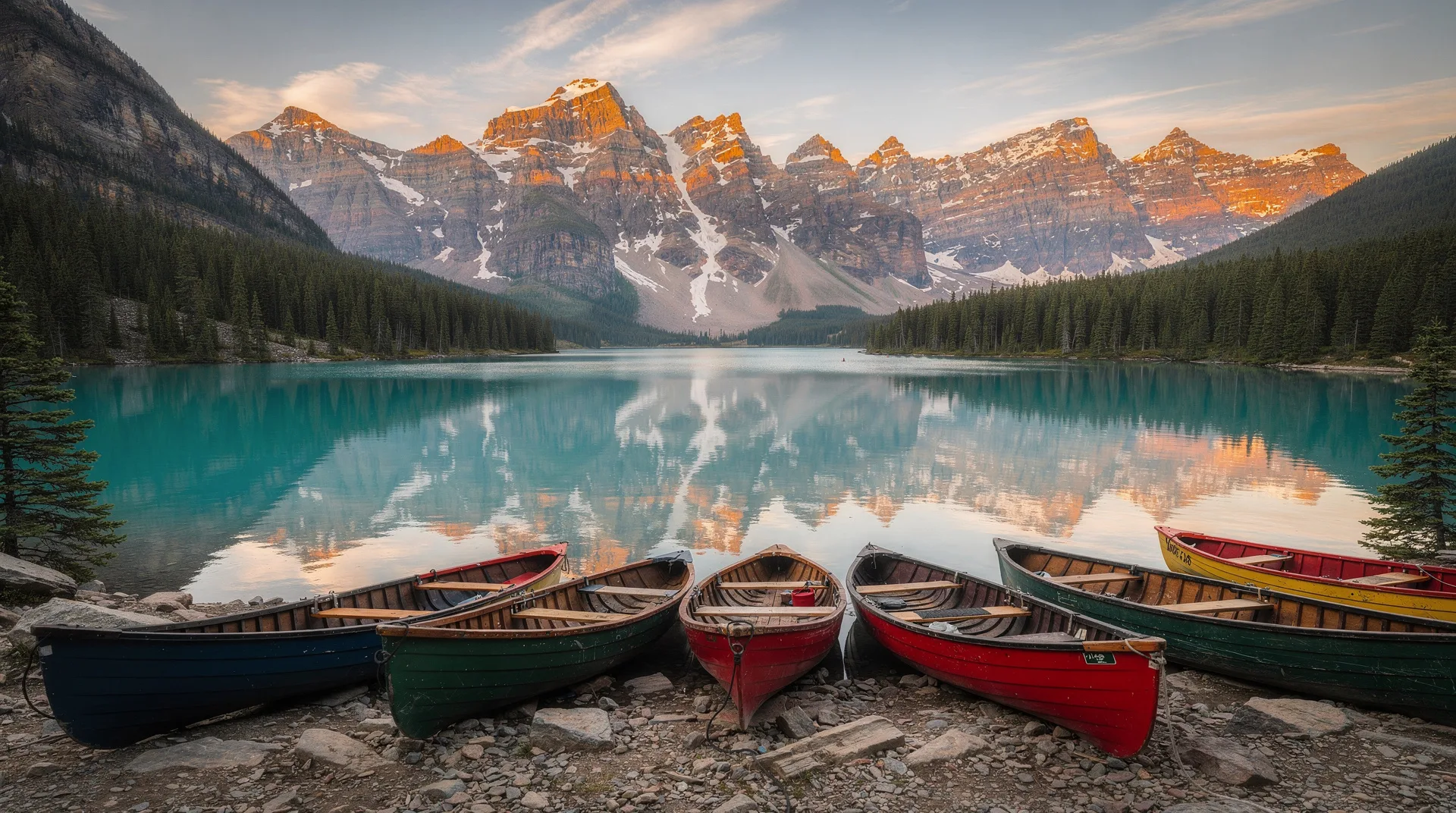
Moraine Lake: everything you need to know
Moraine Lake is, by some measures, the most beautiful body of water in Canada. The turquoise colour — caused by glacial rock flour suspended in the melt from the surrounding glaciers — is more intense than photographs suggest, the Valley of the Ten Peaks rises directly from the far shore, and the Rockpile above the lake’s eastern end delivers a view that genuinely earns the word iconic.
It is also one of the most logistically complex places in Banff National Park to visit, and the gap between knowing it’s extraordinary and actually managing a satisfying visit without frustration requires real planning. This guide covers the access system, timing, hiking options, and everything else you need for a visit that matches the photographs rather than the car park queue.
| Details | |
|---|---|
| Where | Banff National Park, 14 km from Lake Louise |
| Cost | Free to visit once inside the park; a Banff park pass is required for entry |
| Getting there | Parks Canada shuttle (book ahead), bicycle, on foot, or guided tour — private vehicles not permitted in peak season |
| Time needed | Around 2 hours minimum; a half or full day with a hike |
| Best time | June-July for peak colour, late September for larch season |
What makes Moraine Lake’s colour so intense
The turquoise colour of Moraine Lake is not unique but is among the most vivid examples of a phenomenon specific to glacially-fed lakes. Glaciers grind rock as they flow — physically pulverising it into particles smaller than flour — and this glacial silt, called rock flour, remains suspended in meltwater and gives glacially-fed lakes their blue-green colour by scattering sunlight at specific wavelengths.
The colour varies by season: it is most intense in June and July when meltwater input is highest and the suspended particles are most concentrated. By September, lower meltwater flow means slightly reduced colour intensity, though the lake is still extraordinary and the larch season compensates with a completely different kind of visual spectacle.
The colour is also affected by light angle and sky conditions. Early morning, when the sun is low and the surface reflects the blue sky, often produces the most vivid appearance. Overcast days mute the turquoise but create better photographic conditions by eliminating harsh shadows.
The access situation: shuttles, parks-and-ride, and timing
Moraine Lake Road became unmanageable for private vehicle access during peak season over the past decade — the road capacity and the Moraine Lake parking area simply cannot accommodate the number of visitors who want to arrive by car. Parks Canada’s response has been a mandatory access system during peak season (approximately mid-May through mid-October) that works as follows:
Parks-and-ride shuttle: The primary access method. Shuttles operate from the Lake Louise Ski Resort park-and-ride (the main hub) and from Banff townsite. The shuttle must be booked in advance through the Parks Canada reservation system. Shuttle passes sell out — sometimes weeks in advance during peak summer. Book as soon as your travel dates are confirmed.
Hiking and cycling: Access via the Moraine Lake Road on foot or bicycle is permitted and does not require a reservation. The road is 12 km from the Lake Louise Ski Resort junction and gains about 200 metres of elevation — a manageable bike ride of 45–60 minutes or a 2.5–3 hour walk. Cycling to Moraine Lake from Lake Louise village and hiking the trails is an increasingly popular approach that bypasses the shuttle queue.
Guided tours: The most stress-free option. Moraine Lake guided tours and day trips handle transport, timing, and access, often including Moraine Lake in combination with Lake Louise and other Rockies highlights.
For visitors who want the experience without the shuttle-booking anxiety, this is the pragmatic solution. Combined Banff area day tours including Moraine Lake also pair the lake with the gondola and hot springs for a full day.
Early season and late season: Before mid-May and after mid-October, private vehicle access to Moraine Lake Road may be possible depending on conditions and Parks Canada decisions in a given year. The road opening date varies annually with snow conditions. Check Parks Canada’s website for current year access information.
The Rockpile: the essential fifteen-minute walk
The Rockpile is the pile of boulders at the eastern end of the lake that provides the elevated vantage point for the canonical Moraine Lake photograph. The trail is 300 metres and gains about 30 metres of elevation. It takes fifteen minutes to reach the top viewpoint. It is not difficult.
The tradeoff is that every other visitor at Moraine Lake also walks the Rockpile. In peak season, the boulders at the top can be crowded enough to require waiting for a clear spot. Arriving at the first shuttle of the day, or hiking in by bicycle before the shuttle starts running, gives the best chance of the Rockpile with fewer people.
The view from the top is of the lake in its full context — the turquoise water, the shoreline trail, the lodge at the far end, and the Ten Peaks filling the skyline beyond. The ten peaks are Wenkchemna, Neptuak, Deltaform, Turbine, Perren, Allen, Tuzo, Bowlen, Fay, and Little — the names a mixture of Indigenous (Stoney Nakoda numbers for the first ten peaks counted), early climbers’ names, and mountaineering committee choices. The leftmost peak, Deltaform, is the highest at 3,424 metres.
Hiking from Moraine Lake
The lake is a trailhead for some of the best hiking in Banff National Park, and a full day at Moraine Lake should include at least one trail beyond the Rockpile.
Larch Valley Trail: 5.8 km return, 360 m elevation gain, classified moderate. Starts at the far end of the lake and climbs through forest that becomes increasingly larch-dominated as you gain altitude. The larch transition typically happens around 2,200 metres, and the valley above is surrounded by mature larches visible from several open areas on the trail. In September, the larches turn gold and the trail becomes one of the finest walks in the Rockies. Allow 2.5–3 hours return.
Sentinel Pass via Larch Valley: 11.6 km return, 725 m elevation gain from the lake, classified difficult. Continuing above Larch Valley to Sentinel Pass (2,611 m) delivers panoramic views of the Ten Peaks from above and a dramatic view down the Paradise Valley on the other side. This is a full day hike — 5–7 hours — requiring proper fitness, layered clothing, and early start. The most rewarding day hike in the area.
Consolation Lakes: 5.8 km return, 65 m elevation gain — essentially flat. An easy walk south of Moraine Lake to two smaller lakes in a cirque. Good option for families, less experienced hikers, or as a secondary walk after the Rockpile. The boulders of the Rockpile moraine pass beneath towering cliff faces and the lakes have their own specific character.
Eiffel Lake: 11 km return, 400 m elevation gain. A less-travelled trail that branches from the Larch Valley trail toward a small lake with excellent views of the Ten Peaks from a different angle. Less crowded than Larch Valley on the same day.
Lake Louise: the essential pairing
Most visits to Moraine Lake are paired with Lake Louise, 14 km away. The two lakes are often described as a set, and while each is complete in itself, seeing both in a day gives you the full context of what glacially-fed Rocky Mountain lakes can produce.
Lake Louise is larger, more developed (the Château Lake Louise hotel sits at one end), and slightly less dramatically framed than Moraine Lake, but the views of Victoria Glacier at the far end — particularly from the Plain of Six Glaciers teahouse trail (8 km return, 380 m elevation) — are among the finest in the park. The lakeshore walk takes 45 minutes one way at a casual pace.
The Parks Canada shuttle that serves Moraine Lake also connects to Lake Louise, making both accessible on a single shuttle pass on the same day.
Seasonal guide: when to visit
June: Peak colour intensity, maximum meltwater, potentially still some ice at the lake edge in early June. Access system in operation by mid-month. Weather can be cold and changeable. Quieter than July and August.
July–August: The peak season for crowds. Warmest and most reliable weather. All facilities open. Shuttle books out quickly. Access the lake early (first shuttle) or accept busy conditions.
September: The best month for many Rockies travellers. Larch season starts in the third week of September and peaks around September 25 to October 5. Crowds thin. Access is slightly easier. Cooler temperatures but often spectacular weather windows.
October: Larch season wind-down. Access system may still be in place or may transition back to vehicle access depending on snowfall. By mid-October, many facilities close for winter. Early October remains beautiful.
November–May: Moraine Lake Road is closed or access-restricted by snow. The lake is frozen. A snowshoe to the frozen lake through winter is possible for those equipped and experienced, but facilities are closed and conditions require significant preparation.
Pairing Moraine Lake with the rest of the park
Most visitors don’t stop at Moraine and Lake Louise alone. A Banff park pass covers entry across the whole park, and the Banff Gondola or Sulphur Mountain boardwalk makes a good lower-effort add-on for a day that’s already had a big hike. If timing allows, the Icefields Parkway north toward Jasper is one of the best scenic drives in Canada and connects naturally to a Moraine Lake and Lake Louise day if you have a rental car and a second day to spend. For travellers trying to avoid the worst of the crowds altogether, the avoiding crowds in the Rockies guide has strategies specific to this exact bottleneck.
Practical information
Facilities: A small lodge at the lake offers canoe rentals, a basic café, and washrooms. There is no full restaurant. Bring food and water for the day.
Cell service: Moraine Lake has limited and unreliable cell service. Download offline maps before you go.
Wildlife: Bears (both black bears and grizzlies) are active in the area. Carry bear spray accessible on your hip, not in your pack. Trail closures due to bear activity are possible on any given day — check Parks Canada current conditions before hiking.
Canoe rental: Canoes are available for rent from the lodge at approximately CAD $100/hour. Paddling on the lake, particularly toward the far end with the peaks above, is one of the most memorable experiences available at Moraine Lake and somewhat distinct from the walking trails experience.
Photography: The best light is morning (before 9 am in summer) and the golden hour before sunset. The Rockpile faces west, meaning the lake is lit from behind in the morning and the peaks are side-lit — this produces better landscape photography than midday direct light.
The Banff National Park guide has comprehensive coverage of all the park’s major experiences, and the Rockies itineraries section includes multi-day routes that incorporate Moraine Lake as part of a broader visit.
Final thoughts
Moraine Lake rewards the effort to get there — whether that means booking a shuttle weeks in advance, cycling the access road, or joining a guided tour that handles the logistics. The lake is one of those places where the gap between the photographs and the reality closes rather than opens — it looks, in person, exactly as extraordinary as the images suggest, and then slightly more so.
The access planning is real work, but it’s a single logistical problem with clear solutions. Solve it in advance, get there as early as you can on the day, and the rest takes care of itself.
Frequently asked questions about Moraine Lake: everything you need to know
Can I drive to Moraine Lake?
During peak season (approximately mid-May to mid-October), private vehicle access to Moraine Lake Road is restricted and generally not permitted. Access is by Parks Canada shuttle (book in advance), bicycle, or on foot. Outside peak season, vehicle access may be possible subject to road conditions. Check the Parks Canada website for current year access rules.
How early do I need to book the shuttle to Moraine Lake?
As early as possible once the reservation system opens for your travel dates. Shuttles can sell out weeks in advance in July and August. For September visits, demand is lower but still worth booking early. The Parks Canada reservation site opens several months before the season.
Is the hike to Larch Valley worth it if it’s not larch season?
Yes. The Larch Valley trail is a beautiful mountain hike with good views of the Ten Peaks regardless of season — the larches are a bonus that makes it extraordinary in late September. In summer, the wildflowers along the lower section and the views from the open slopes above are excellent. Sentinel Pass, if you continue, is worth the effort in any season with good visibility.
How long should I spend at Moraine Lake?
Minimum two hours for the Rockpile, lakeshore walk, and basic orientation. Add three hours for the Larch Valley trail return. Add a full day for the Sentinel Pass hike. Most visitors with shuttles have a fixed time window — make sure your shuttle return allows enough time for whatever hiking you plan. The Sentinel Pass route requires a minimum of five to six hours on the trail alone.
Is Moraine Lake better than Lake Louise?
They’re complementary rather than competing — Moraine Lake has the more dramatic Ten Peaks backdrop and fewer facilities, while Lake Louise is larger, more developed, and pairs with the Château and the Plain of Six Glaciers trail. Most visitors with a shuttle pass do both on the same day rather than choosing between them.