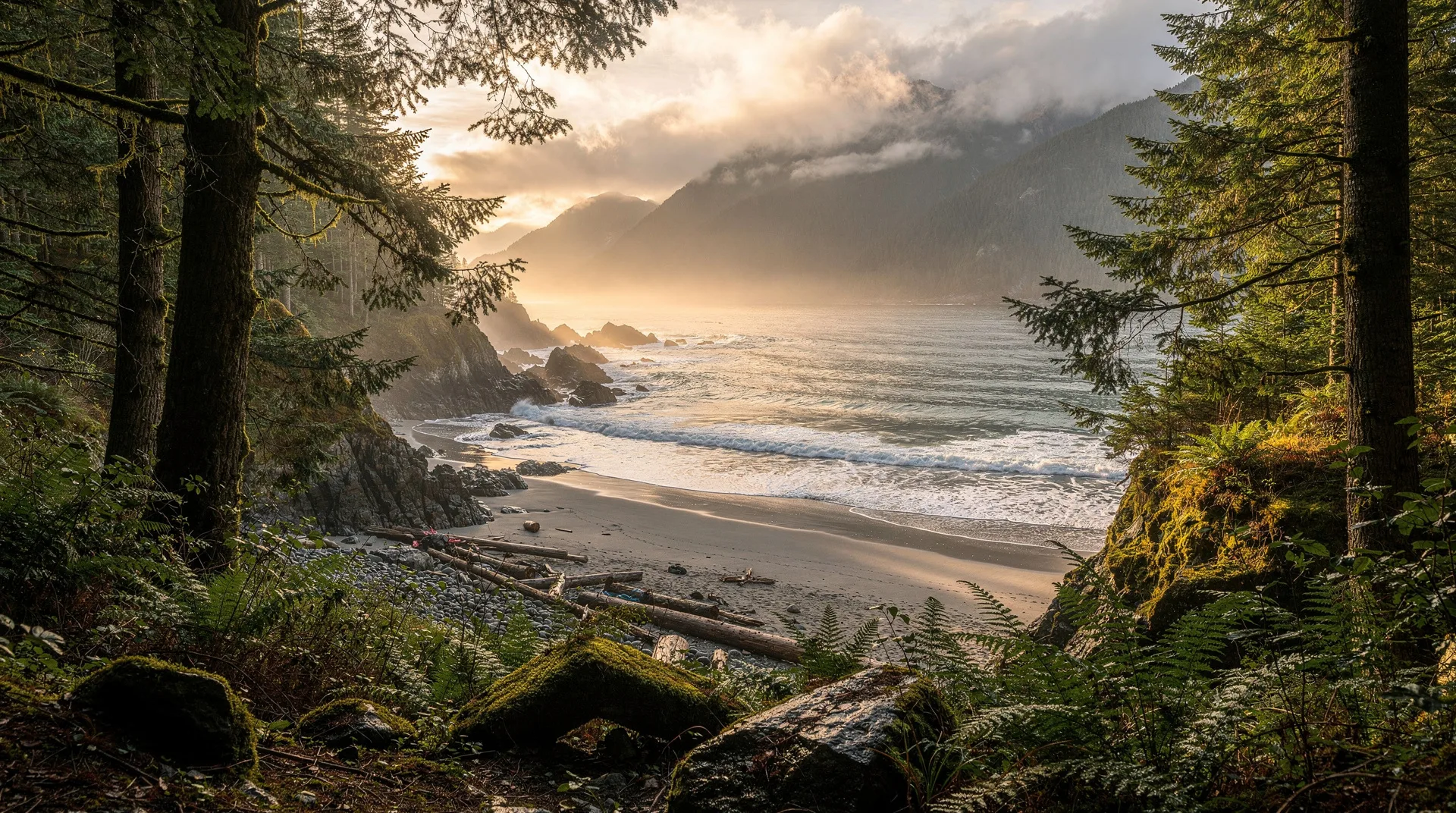
West Coast Canada in 10 days: Vancouver, Whistler, Victoria & Tofino
At a glance
| Route | Vancouver, Whistler, Victoria, Tofino loop, approximately 1,200 km |
| Cost | Around CAD 3,000-5,000 per person, comfort level, excluding international flights |
| Time needed | 10 days, car required from Day 3 onward |
| Getting there | Fly into Vancouver International Airport (YVR) |
| Best time | July-August for warmth and reliable ferries; Sept-Oct for storm season swell at Tofino with fewer crowds |
Overview
British Columbia’s southwest corner packs an improbable range of landscapes into a circuit that takes 10 days and covers approximately 1,200 kilometres. This itinerary begins in Vancouver — mountains, ocean, and world-class urban culture in one compact package — heads north along the Sea-to-Sky Highway to Whistler, crosses by ferry to Vancouver Island, explores Victoria’s gardens and heritage architecture, then drives north along the island’s west coast to Tofino on the Pacific Ocean. The return is either by ferry back to Vancouver (continuing the loop) or by flying from Tofino.
This is one of Canada’s most satisfying 10-day road trips: the distances are manageable, the scenery is continuously excellent, and each destination has a sufficiently different character that the variety sustains interest throughout.
| Days | Destination | Highlights |
|---|---|---|
| 1–2 | Vancouver | Stanley Park, Granville Island, MOA |
| 3 | Sea-to-Sky to Whistler | Shannon Falls, Peak 2 Peak Gondola |
| 4 | Whistler | Village, hiking, biking |
| 5 | Ferry to Victoria | Departure Bay, afternoon in Victoria |
| 6 | Victoria | Butchart Gardens, Fisherman’s Wharf |
| 7 | Victoria to Tofino | Pacific Rim National Park Reserve |
| 8–9 | Tofino | Surfing, beach walks, whale watching |
| 10 | Return to Vancouver | Nanaimo ferry or fly |
Days 1–2: Vancouver
Vancouver is the gateway and deserves two full days rather than one. The city’s three main physical features — the mountains directly north, the Pacific directly west, and the inland sea of Burrard Inlet — shape every neighbourhood and every view.
Day 1: The seawall around Stanley Park is the first obligation of any Vancouver visit. The 8.8-kilometre loop takes 2–3 hours on foot (less on a rented bike from the West End); the totem poles at Brockton Point, the view of the downtown skyline from Prospect Point, and the beaches at Third Beach make it excellent throughout. Cross the Burrard Bridge to Granville Island for lunch at the Public Market — the finest covered food market in western Canada.
Day 2: Drive or take transit to the University of British Columbia for the Museum of Anthropology. The Great Hall’s collection of Northwest Coast First Nations totem poles, carved boxes, bentwood chests, and ceremonial objects is one of the finest in the world — essential context for everything you will encounter in BC. Pick up your rental car this afternoon for tomorrow’s drive.
Book a 3-day Vancouver, Victoria and Whistler tourDay 3: Sea-to-Sky Highway to Whistler
Collect your rental car in the morning (or pick up from yesterday) and head north on Highway 99. The Sea-to-Sky Highway is BC’s most cinematic drive: the highway clings to cliffs above Howe Sound, with Coast Mountain peaks above and the flat water of the sound below. The ferry traffic creates a layered visual of boats, water, mountains, and road.
Stops: Shannon Falls (84-metre waterfall, 5-minute walk from the highway), Stawamus Chief viewpoint (the enormous granite face of the Chief is visible from the parking area; the full hike to one of three summits takes 3–5 hours), and Sea to Sky Gondola in Squamish (optional — offers summit views over Howe Sound and trail access at 885 metres).
Arrive in Whistler by early afternoon. Check into accommodation and spend the afternoon walking the pedestrian village.
Day 4: Whistler
Whistler is built around two mountains — Whistler Mountain and Blackcomb Mountain — and the gondola and lift infrastructure connects them. The summer experience is dominated by the Peak 2 Peak Gondola: a 4.4-kilometre crossing 436 metres above the valley floor, connecting the two mountain summits. The views from either summit take in the Coast Mountains in every direction.
Beyond the gondola, summer in Whistler offers: extensive hiking and mountain biking on the two mountains (the Whistler Mountain Bike Park is world-class), the Lost Lake Park trails and swimming area in the valley, and the contemporary arts programming at the Squamish Lil’wat Cultural Centre in the village — an exceptional First Nations cultural facility representing both the Squamish and Lil’wat Nations, on whose shared territory Whistler sits.
In winter, of course, the dynamic inverts: 200+ ski runs, three glaciers, and the largest ski resort in North America.
Dine at Araxi (fine dining, locally sourced, consistently excellent over many years) or browse the village’s restaurants for more casual options.
Day 5: Horseshoe Bay ferry to Victoria
Drive south from Whistler to Vancouver (1.5 hours), then continue west to Horseshoe Bay for the BC Ferries crossing to Nanaimo on Vancouver Island (1 hour 40 minutes, spectacular crossing through the islands of Howe Sound and Georgia Strait). Book ferry reservations well in advance in summer.
From Nanaimo, drive south on the Island Highway to Victoria (approximately 1.5 hours). Arrive in Victoria with enough afternoon remaining for a walk along the Inner Harbour — the Empress Hotel, the Parliament Buildings reflected in the water, the buskers performing on the causeway — and dinner in the Chinatown or the Old Town area.
Day 6: Victoria
Victoria is, in many ways, the most British city in Canada: afternoon tea, double-decker buses, the word “bloody” used in anger, and a temperate climate that allows the kind of exuberant garden culture impossible elsewhere in Canada. This is not a cliché — it is a genuine cultural residue of settlement history, and engaging with it rather than dismissing it is the key to enjoying Victoria.
Morning: Butchart Gardens, 22 kilometres north of the city centre, is the most famous garden in Canada — 55 acres of immaculately maintained formal gardens occupying a former limestone quarry. The Sunken Garden, the Japanese Garden, the Italian Garden, and the Rose Garden are all world-class; the sheer density of colour and horticultural ambition makes it one of the best gardens in North America. Go early to beat the largest crowds.
Afternoon: Back in the city centre. Fisherman’s Wharf near the harbour has floating homes and fresh fish and chips from the dock-side shacks that is not merely tourist food but genuinely excellent. The Royal BC Museum (the finest natural history and human history museum in British Columbia) is worth several hours; the First Peoples galleries are exceptional. Whale watching tours operate from the Inner Harbour — orca and humpback whale sightings are regular in the summer.
Day 7: Victoria to Tofino via Pacific Rim National Park Reserve
This is the longest driving day of the itinerary — approximately 4 hours from Victoria to Tofino via the Inland Island Highway and then Highway 4 west across the island. The scenery on Highway 4 through the MacMillan Provincial Park Cathedral Grove (a stand of 800-year-old Douglas firs that survived the logging era) makes the inland crossing worthwhile.
Just before Tofino, the road passes through the Pacific Rim National Park Reserve. Stop at Long Beach — 16 kilometres of sand exposed to the full Pacific Ocean. Even in summer, the surf rolls in with oceanic energy and the horizon is empty all the way to Japan. Walk the full length of accessible beach, and note the contrast with any Atlantic beach you have visited.
Check into accommodation in Tofino with time for an evening walk on the beach.
Days 8–9: Tofino
Tofino is one of Canada’s most appealing destinations precisely because of its specificity: it is a small town on the outer coast of Vancouver Island, surrounded by old-growth rainforest, facing the open Pacific, with surf, wildlife, and weather in approximately equal measure. There is no pretending this is anything other than what it is.
Surfing: Tofino is Canada’s surf capital. The beaches of Cox Bay, Chesterman Beach, and Long Beach receive consistent Pacific swells from September through to April, and in summer the water is warm enough (14–16°C in a wetsuit) for beginners. Numerous surf schools operate from the beach with full equipment rental. First-time surfers typically find it genuinely accessible within a 2-hour lesson.
Wildlife watching: Several operators run small-boat wildlife tours from Tofino’s dock. Grey whale migration passes the coast in spring; resident grey whales feed in Clayoquot Sound in summer; black bears are visible foraging on beaches at low tide; sea otters have been reintroduced and now number in the hundreds in Clayoquot Sound.
Rainforest hiking: The old-growth forest trails of Pacific Rim National Park and Clayoquot Sound are the quieter side of Tofino. The Rainforest Trail near Long Beach passes through forest where 1,000-year-old Sitka spruce and western red cedar create a cathedral-scale canopy. The Tonquin Trail behind Tofino town accesses beaches and rocky headlands in 3–4 kilometres.
Sea kayaking: Guided kayak tours in Clayoquot Sound pass through the estuaries, islands, and channels of one of the largest intact temperate rainforest zones in North America. The sound was the site of Canada’s largest act of civil disobedience in 1993 when 800 people were arrested protesting old-growth logging.
Eating: Tofino has developed a food culture that consistently surprises visitors. Sobo (Sophisticated Bohemian) is the long-established standard. The Wolf in the Fog is more recent and has attracted national attention. The fish tacos served in casual spots near the beach are excellent.
Day 10: Return to Vancouver
The two main options: drive back across the island to Nanaimo and take the ferry to Horseshoe Bay (approximately 5 hours total including ferry), or fly directly from Tofino Airport to Vancouver Airport (45 minutes, operated by Pacific Coastal Airlines). The ferry return is the more scenic and relaxed approach; the flight makes sense if continuing east to connect with other flights.
Getting around
A rental car is essential for this itinerary from Day 3 onward. The ferry crossings require car booking well in advance in summer (BC Ferries reservations open weeks ahead). The roads are well maintained throughout; Highway 4 across Vancouver Island involves some winding sections but nothing technically challenging.
Where to stay
Vancouver (Days 1–2): Fairmont Pacific Rim or Opus Hotel for luxury; Sunset Inn and Suites or the YWCA Hotel for mid-range.
Whistler (Days 3–4): Fairmont Chateau Whistler is the flagship; Summit Lodge Boutique Hotel is smaller and more personal.
Victoria (Days 5–6): The Fairmont Empress is the heritage choice (and its Afternoon Tea is a Victoria institution); Hotel Zed is colourful and more affordable.
Tofino (Days 8–9): Wickaninnish Inn is the established luxury choice with a remarkable position above Chesterman Beach; Middle Beach Lodge is more accessible and equally atmospheric.
Best time for the West Coast itinerary
July and August: The most popular months. Warmest and sunniest in Victoria and Vancouver; surf conditions at Tofino can be lighter than shoulder season but still consistent. Book accommodation and ferry crossings well ahead.
September and October: Excellent choice. Storm season begins building at Tofino in late September, bringing more dramatic wave conditions while temperatures remain reasonable. Victoria and Vancouver are still pleasant.
March to May: Storm watching at Tofino is at its peak in winter/early spring, with waves from major Pacific storms. The surf is bigger. Wildflowers appear in Victoria from late February. A quieter and less expensive alternative.
Frequently asked questions about West Coast Canada in 10 days: Vancouver, Whistler, Victoria & Tofino
Do I need to pre-book BC Ferries? In summer (June–September), strongly yes. The Horseshoe Bay–Nanaimo route and the Departure Bay–Tsawwassen route are both heavily used. Book vehicle reservations on the BC Ferries website as early as possible.
Is Tofino accessible without a car? Technically — a bus service (Tofino Bus) runs from Nanaimo and Victoria to Tofino, and accommodation can organise activity transportation once you are there. But the flexibility of a car significantly improves the Tofino experience and is essentially required for the full itinerary.
Is the surf at Tofino suitable for beginners? Yes. The surf schools are well-established and the beaches suited for instruction. Summer surf is generally smaller and more consistent than winter, which is ideal for beginners. Wetsuits are required year-round — the water is consistently cold.
How does this route compare to the longer Western Canada road trip? This itinerary stays entirely within coastal and island BC and skips the Rockies. If you have more time and want to add Banff and Jasper to a similar Vancouver start, the Western Canada 12-day road trip covers the Sea-to-Sky and mountain parks on a route that eventually ends in Calgary rather than looping back. For a shorter version focused only on Vancouver Island, see the BC 7-day itinerary.
Extending or shortening the loop
With extra time, add 2-3 nights in the Okanagan wine country after Whistler via the Duffey Lake Road — a scenic but slower alternative to backtracking through Vancouver — or extend the Gulf Islands with a stop at Salt Spring Island from the Vancouver Island ferry terminals. Travellers with only a week should drop either Whistler or the Tofino leg rather than rushing both; Tofino rewards a slower pace given the driving distance involved, while Whistler’s summer gondola experience can be compressed into a single day if necessary. The BC best hikes guide is useful for slotting in an extra trail wherever the schedule allows a free half-day.