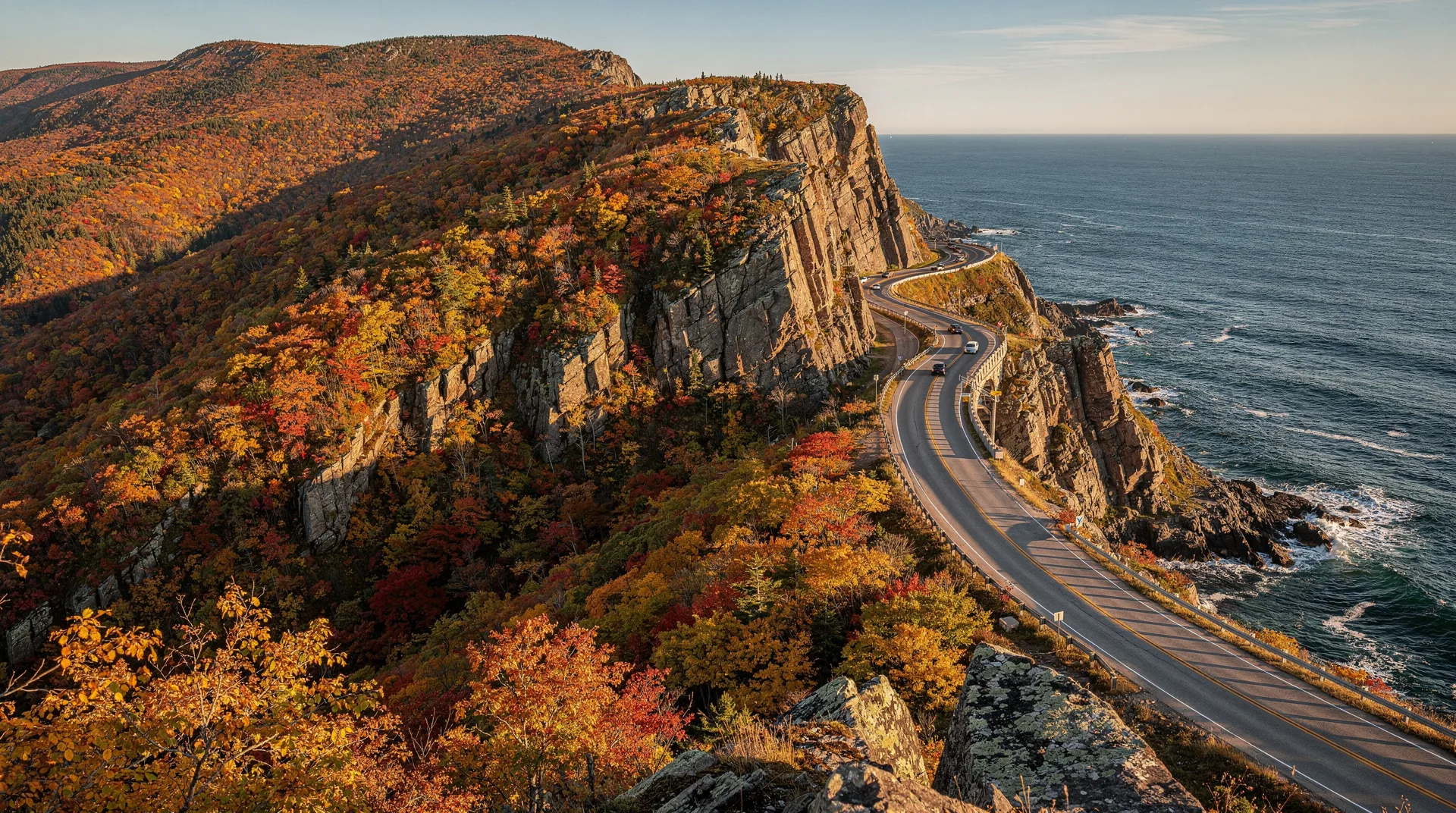
5 days in Cape Breton: the perfect Cabot Trail loop
Overview
Cape Breton Island offers one of the most concentrated packages of spectacular scenery in eastern North America. Five days is the right amount of time to experience it fully — enough to drive the complete Cabot Trail at a pace that allows hiking, whale watching, and genuine exploration, plus time to discover the island’s quieter pleasures: the Bras d’Or Lake, the Acadian culture of Cheticamp, the highland barrens at sunset.
This itinerary is built around the Cabot Trail (a 298-km loop around the northern tip of the island), the Cape Breton Highlands National Park, and the surrounding communities. A rental car is essential; the trail is the road, and the road is the attraction.
| Day | Focus | Notes |
|---|---|---|
| 1 | Arrive Sydney / Baddeck | Alexander Graham Bell museum |
| 2 | Cabot Trail west — Cheticamp | Acadian culture, national park entrance |
| 3 | Skyline Trail + northern tip | Best hike on the island |
| 4 | Eastern coast — Ingonish | Keltic Lodge, Middle Head Trail |
| 5 | Baddeck + Bras d’Or Lake | Departure from Sydney or Halifax |
Best season: Late September to mid-October for autumn foliage (the most spectacular time visually). July-August for whale watching, hiking, and all services. June is excellent with fewer crowds.
At a glance
Start/end: Sydney (Cape Breton) Airport or Halifax (extra driving)
Car required: Yes
Total driving: Approximately 700-800 km including the full Cabot Trail loop
Budget range: CAD $1,400–$2,200 per person excluding flights
Day 1: Arriving in Baddeck
Baddeck, on the shores of Bras d’Or Lake, is the classic Cabot Trail base — perfectly positioned for either direction of the loop. It is also home to one of the most underrated museums in Atlantic Canada.
Alexander Graham Bell National Historic Site
Alexander Graham Bell, inventor of the telephone, spent the last 35 years of his life at his estate Beinn Bhreagh near Baddeck. The national historic site downtown houses a remarkable collection of his inventions beyond the telephone: hydrofoil boats (tested on Bras d’Or Lake), early aviation experiments, and medical research. This is not a dry technology museum — it is a portrait of an extraordinary mind.
Allow 2-3 hours. The site overlooks the lake; combine with a lakeside walk after the museum.
Baddeck also makes sense as a place to settle in before the loop. Unpack, check the car, and read the Cabot Trail guide over dinner so the next morning starts with a clear idea of the stops. If you are still comparing island destinations, the Cape Breton vs PEI guide explains how the two differ, and the Cape Breton destination page and Baddeck page give more background on the area.
Bras d’Or Lake
The lake (technically a tidal estuary connected to the Atlantic by two narrow channels) is a UNESCO Biosphere Reserve. Bald eagle watching, kayaking, and sailing are all available from Baddeck. The view across the water from the town waterfront in the late afternoon, with the drumlins of the opposite shore reflected in calm water, is one of the finest in the Maritimes.
Eating in Baddeck
The Highwheeler Café and Baddeck Lobster Suppers (a local version of the PEI lobster supper tradition) are both reliable choices for the first evening. Order the locally caught seafood.
Browse Cape Breton Island tours and experiencesDay 2: The western Cabot Trail — Cheticamp and the park entrance
Start the Cabot Trail clockwise: drive north from Baddeck through Baddeck River and Margaree Harbour before turning north toward Cheticamp. The western coastal section begins here, with the Gulf of St. Lawrence appearing on your left.
Cheticamp: the Acadian gateway
Cheticamp is the largest Acadian community on Cape Breton — a working fishing village where French is spoken naturally on the street and the hooked-rug tradition produces some of the finest examples of the craft in Canada. The co-operative gallery on the main street and the Les Trois Pignons museum both display exceptional rug-hooking work.
Try rapure (rappie pie) at one of the local restaurants for lunch — a traditional Acadian dish of grated potato and salt cod or chicken, slow-baked, that is considerably better than its description suggests.
Whale watching from Cheticamp: Several operators run 2-3 hour whale watching tours from the wharf. Pilot, minke, and humpback whales are common in the gulf. The season runs June through October.
Into the national park
Cape Breton Highlands is a Parks Canada national park — entry requires a park pass (a day pass runs around CAD $8-10 per adult, or a Discovery Pass covers a year of visits to all Parks Canada sites; buy it at the gate or the visitor centre). See the Parks Canada Discovery Pass guide if you’re combining this trip with other national parks.
The national park entrance is 3 km north of Cheticamp. The highway immediately begins climbing — a series of switchbacks that gain 400 metres of elevation before reaching the highland plateau. The views over the gulf on the ascent are continuous and extraordinary.
Stop at the French Mountain pullout for the first highland panorama. Continue to the Corney Brook day-use area for a short trail to a canyon viewpoint.
End the day in Cheticamp or at a small property near the park entrance. Reserve accommodation in Cheticamp ahead — it is limited.
The Acadian side of the island is worth slowing down for. The Acadian heritage guide gives context for what you see in Cheticamp, and the Cape Breton Highlands National Park guide covers the trails and viewpoints you will be passing through over the next two days.
Day 3: The Skyline Trail and the northern tip
This is the day that most visitors remember longest. The Skyline Trail is the finest hike in Cape Breton Highlands and one of the best coastal hikes in eastern Canada.
Skyline Trail (9.3 km loop)
The trail begins at a parking area on the Cabot Trail north of Cheticamp — arrive before 9am in summer to secure parking (it fills by mid-morning). The trail climbs through mixed forest for about 4 km before emerging on coastal barrens at the headland edge. The final kilometre runs along a boardwalk above cliff edges dropping 430 metres to the Gulf of St. Lawrence.
Moose are almost always present on the open barrens — sometimes at remarkable proximity. Pilot whales are frequently visible in the gulf below. At sunset (ranger-led programs run in summer), the western light over the highlands is extraordinary.
Allow 3-4 hours for the full loop. Bring layers, water, and a snack, since the wind on the headland can feel much cooler than the forest section. The Pleasant Bay destination page is useful for planning where to sleep after the hike.
The northern tip and Pleasant Bay
Continue north through the highland section, stopping at the North Mountain lookout (the highest roadside viewpoint on the trail at over 450m). Descend to Pleasant Bay — a small fishing village at the base of the western highlands.
Whale watching at Pleasant Bay: Small local operators run intimate tours from Pleasant Bay harbour. Pilot whale encounters are highly reliable; pods of 30-50+ animals are common in summer. This is one of the best places in Nova Scotia for pilot whale encounters. See our Atlantic Canada whale watching guide for more detail.
Continue to Cape North (optional side road to Meat Cove — 14 km gravel, worth it for the view over the northernmost point) and find accommodation near Pleasant Bay or Cape North.
Day 4: Eastern coast — Ingonish and the Atlantic shore
From Cape North, the eastern Cabot Trail winds down to Ingonish along a coast that feels genuinely different from the western section: the Atlantic rather than the gulf, fishing villages rather than highland drama.
Middle Head Trail (4.4 km return)
This peninsula walk from the Keltic Lodge resort at Ingonish Beach threads through spruce forest to an exposed headland above the Atlantic. Seals are frequently seen in the water below the cliffs. The return views of Ingonish Bay from the tip are among the best on the island.
Keltic Lodge
Even if you’re not staying here, the Keltic Lodge at Ingonish Beach is worth stopping at for the setting — a red-roofed Arts and Crafts resort on the Middle Head peninsula, opened in 1940, with views across Ingonish Bay that have been making people stop and stare for 80 years. The restaurant is open to non-guests; lunch with the view is worthwhile.
Franey Trail (7.4 km loop)
The Franey climbs to 535 metres — the highest accessible viewpoint in the park — with a 360-degree panorama over Ingonish Bay, the Atlantic, and the highlands. The ascent is steep and demanding; the summit fire tower views justify every step.
Highlands Links Golf Course
Designed by Stanley Thompson in 1941, Highlands Links is consistently ranked among the top 10 public golf courses in Canada. If golf is in your plans, book well ahead.
After a day of hiking, the Atlantic side is a good place to relax. Lingering over a long lunch is easier here than on the western side, and the Canadian cuisine guide and East Coast lobster guide will help you choose what to order when seafood is on the menu.
Browse Nova Scotia tours and Cape Breton experiencesDay 5: Baddeck and departure
Drive back to Baddeck via the Englishtown ferry (a short cable-ferry crossing that cuts off a road detour and is a pleasant experience in itself) or the main highway through St. Ann’s and North River.
Use the morning for any remaining Baddeck exploration — the Farmers’ Daughter Country Market near Baddeck stocks excellent local produce and prepared food for departure provisions.
Departing from Sydney: Sydney Airport (YQY) is 75 km from Baddeck (about 1 hour). Direct flights to Halifax, Toronto, and seasonal routes operate from Sydney; flying out of Sydney rather than Halifax saves 3 hours of driving if your onward routing allows.
Departing from Halifax: Drive 4 hours from Baddeck via Trans-Canada Highway (400 km). This is manageable if your flight departs in the late afternoon or evening. For the wider region, the driving Atlantic Canada guide and the Halifax destination page help if you are building a longer trip around this one.
Clockwise or counter-clockwise?
This itinerary drives the Cabot Trail clockwise (Baddeck to Cheticamp first, Ingonish last), which puts the highland switchbacks and the Skyline Trail on the ocean side of the road for the best unobstructed views on the ascent. Driving counter-clockwise works too and some visitors prefer it for photography light in the afternoon. See the Cabot Trail direction guide for a detailed comparison before you commit to a route.
Beyond the Cabot Trail: Louisbourg and Bird Island
If a sixth day is possible, the Fortress of Louisbourg — a reconstructed 18th-century French fortress town near Sydney, staffed by costumed interpreters — is one of the best living-history sites in Canada and a natural add-on for visitors flying out of Sydney. Allow a half-day and expect a ticketed entry.
Bird Island boat tours, departing from the Big Bras d’Or area near Englishtown, visit seabird colonies (Atlantic puffins, razorbills, bald eagles) a short boat ride from the Cabot Trail. See the Bird Island Cape Breton guide for season and booking detail — it pairs naturally with a Day 5 detour if your flight is in the afternoon.
Celtic music: Cape Breton’s Scottish and Acadian musical heritage runs deep, and informal kitchen ceilidhs happen in Baddeck, Cheticamp, and along the trail through summer. See the Celtic music in Cape Breton guide for where to find a session.
Budget guide
| Category | Budget/person | Moderate/person |
|---|---|---|
| Accommodation (4 nights) | CAD $500 | CAD $800 |
| Food | CAD $280 | CAD $450 |
| Car rental + fuel | CAD $280 | CAD $350 |
| Activities (whale watching, park pass) | CAD $100 | CAD $200 |
| Total (excl. flights) | ~$1,160 | ~$1,800 |
Practical tips
Skyline Trail parking: Arrive before 9am in July-August. The parking lot fills, and late arrivals face a long walk from overflow parking or a wasted trip.
Accommodation: Book Cheticamp and Ingonish accommodation 4-6 weeks ahead in summer. Options are limited at both ends of the northern section. Baddeck has more choices; book the Keltic Lodge months ahead if you want it.
Cell coverage: Spotty throughout the northern section of the Cabot Trail. Download offline maps before leaving Baddeck.
Moose: Moose-vehicle collisions are a genuine hazard at dawn and dusk, particularly on the highland section. Slow down after 6pm and before 9am.
October visitors: Autumn colour on Cape Breton typically peaks in the second to third week of October. Book accommodation many months ahead — October is the most sought-after time and the most limited in availability.
Variations
Wildlife focus: Add a morning at Meat Cove (gravel road from Cape North) for the most remote headland viewpoint on the island, and replace the Franey Trail with a guided birding tour from Pleasant Bay.
Cycling the Cabot Trail: A small number of cyclists complete the Cabot Trail each season. It is challenging (significant elevation gain, some narrow sections with traffic) but the scenery rewards the effort. Sag support and cycling tour operators are available.
If arriving from Halifax by car: Add the Antigonish Highland Games (July, if your dates align) or the Canso Causeway crossing stop. The crossing from mainland Nova Scotia to Cape Breton Island is a symbolic moment worth appreciating.
Frequently asked questions about 5 days in Cape Breton: the perfect Cabot Trail loop
Do I need more than 5 days for the Cabot Trail?
Five days gives a full experience. If you add Bras d’Or Lake sailing, southern Cape Breton (the Mabou area and Inverness), or a full day on each of the Franey and Skyline trails, a week is better. Three days is the minimum for any real experience of the trail.
Can I hike the Skyline Trail year-round?
The park is open year-round but the trail can be icy and difficult November through April. The boardwalk is impressive in any season for those prepared for cold and potential ice; ranger programs don’t run outside summer.
What is the best way to see autumn colour on the Cabot Trail?
Drive the trail between October 5-20 in most years. The Margaree Valley and the highland forest near the Skyline Trail headland are the most spectacular sections. Early October adds October 1-5 for colour; mid-October (10-18) is statistically most likely to be at peak. Book accommodation by July for October weekends.
Do I need to pay to enter Cape Breton Highlands National Park?
Yes. Like every Parks Canada national park, Cape Breton Highlands requires a park pass — a day pass (around CAD $8-10 per adult) or a Discovery Pass for repeat or multi-park visits. It is not free, even for a quick drive-through of the highland section.