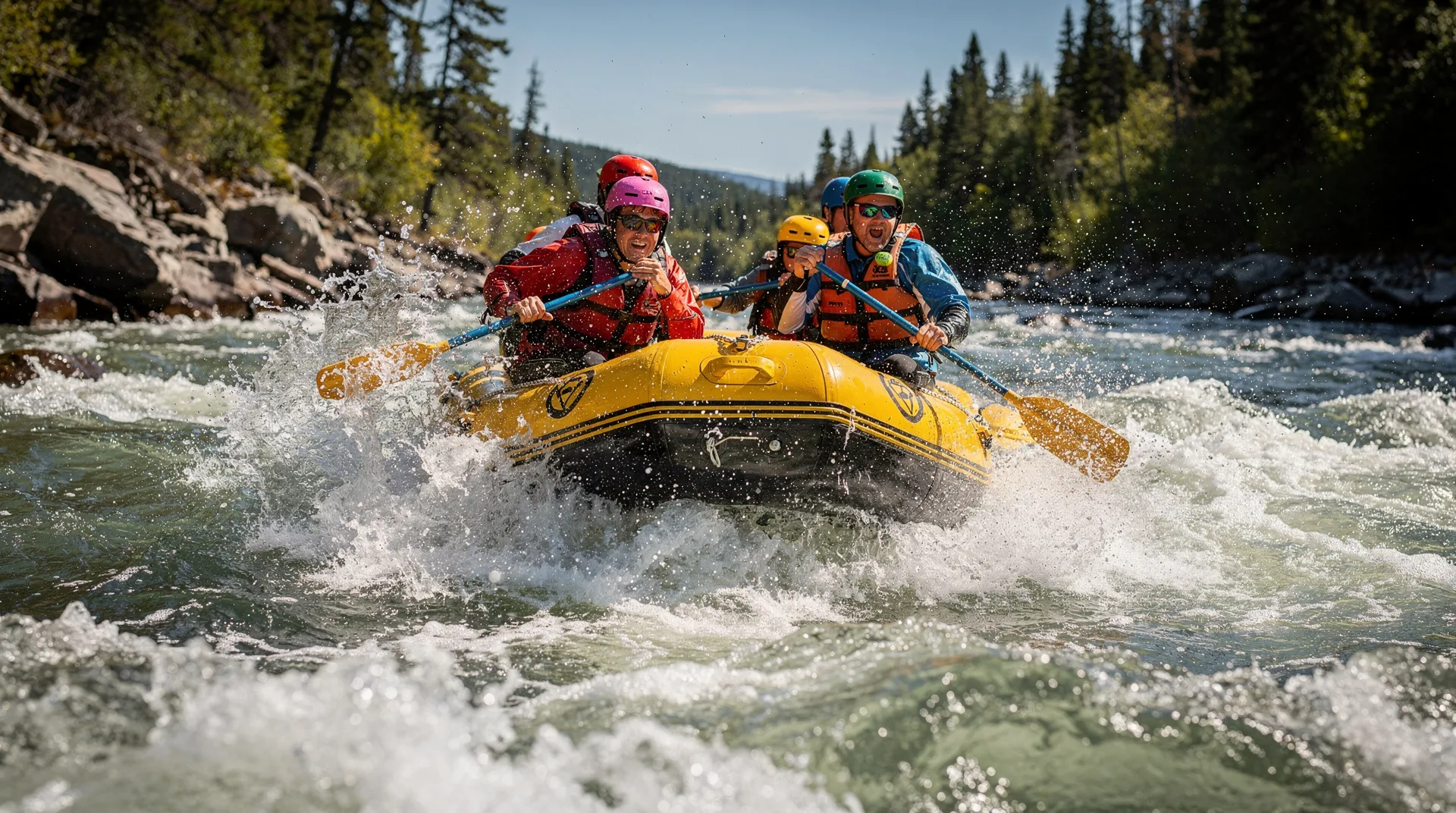
White-water rafting in BC: best rivers and outfitters
What is the best river for white-water rafting in BC?
The Chilliwack/Vedder River and the Fraser Canyon are the most accessible from Vancouver (1.5–2 hours). For bigger water, the Elaho and Squamish Rivers near Squamish offer Class III–IV rapids in a dramatic mountain setting. The Thompson River near Kamloops has the highest volume and some of BC's biggest commercially rafted rapids.
British Columbia’s river system is among the largest and most varied in Canada — hundreds of rivers draining from the Rockies and Coast Mountains to the Pacific, with elevation changes that create everything from gentle float-trip water to expert-only Class V rapids. For visitors, the commercial rafting industry has made the best of that water accessible without technical experience. On any of the major commercially rafted rivers, you are in an experienced guide’s raft, wearing a wetsuit, PFD, and helmet, getting briefed on paddle technique and safety before you hit the first rapid.
The result is one of the most reliably exciting day activities available anywhere in BC.
At a glance
| Where | Rivers across BC, from the Chilliwack near Vancouver to the Thompson near Kamloops |
| Cost | Around CAD $90-220 per person for a day trip, more for multi-day expeditions |
| Time needed | Half-day to full day for most trips; 2-3 days for Thompson/Fraser expeditions |
| Getting there | Self-drive or operator shuttle from Vancouver, Squamish, or Kamloops |
| Best time | May-June for peak snowmelt volume; July-September for warmer, lower-water trips |
Understanding white-water classifications
White-water rapids are classified on a scale from Class I (moving flatwater) to Class VI (unraftable, extreme danger). Commercially operated rafting in BC typically covers Class II through Class V, with most family-friendly trips on Class III and guided adventure trips reaching Class IV–V.
Class II: Easy rapids with small waves. Suitable for all ages and non-swimmers with a PFD.
Class III: Moderate rapids with waves to 1 metre, some maneuvering required. Suitable for most people with basic swimming ability.
Class IV: Powerful, turbulent water requiring specific paddle commands and technique. Some risk of swimming (falling out of the raft). Suitable for fit adults and teenagers.
Class V: Very difficult, violent water with serious risk of swimming. Only for fit, experienced adults on trips with expert guides.
Best rivers in BC for rafting
Chilliwack River (Vedder River)
Distance from Vancouver: 1.5 hours
Class: III–IV
Best season: April–July (peak snowmelt)
Duration: Half-day to full day
The Chilliwack River is the closest major white-water to Metro Vancouver and runs through the Fraser Valley east of Chilliwack. The river is in a forested canyon setting and has consistent Class III–IV rapids in spring and early summer when snowmelt is driving high flows. This is one of the best options for first-time rafters who want genuine white water without a long drive.
The season is tightly linked to snowmelt — April through June offers the highest flows and most exciting water. By July the river drops and the character changes; many operators shift to other rivers for August.
Elaho and Squamish Rivers
Distance from Vancouver: 1 hour 15 minutes
Class: III–IV (Elaho), II–III (lower Squamish)
Best season: May–September
Duration: Full day (Elaho requires river approach)
The Elaho River, deep in the mountains north of Squamish, is one of BC’s finest intermediate-to-advanced rafting rivers. The scenery is exceptional — the Elaho Valley contains some of the largest old-growth Douglas fir trees in the province, with the river cutting through a narrow canyon of ancient forest. The put-in requires a drive or jet boat up the Squamish River to access the Elaho, which adds to the expedition feel.
The lower Squamish River below the Elaho confluence is calmer and makes a good family float trip option.
Squamish outfitters offer day trips from the Squamish area that are easy to combine with other Sea-to-Sky activities — the Stawamus Chief hike or the Garibaldi Lake trail on a multi-day Squamish itinerary.
Fraser River Canyon (Hell’s Gate)
Distance from Vancouver: 2.5–3 hours
Class: III–IV
Best season: May–September
Duration: Half-day or full day
The Fraser River Canyon between Hope and Lytton is the most historically significant waterway in BC — the gold rush of 1858 followed this route, and the canyon walls bear witness to both Indigenous history and the CPR railway construction. The Hell’s Gate section, where the entire Fraser River squeezes through a narrow rock gap, is the most dramatic section.
Commercially rafted sections vary by operator — some focus on the calmer but scenically spectacular upper canyon, others target the more active Class III–IV sections near Boston Bar. The airtram at Hell’s Gate (gondola across the gorge) is a popular tourist attraction for non-rafters in the same area.
Thompson River
Distance from Vancouver: 4 hours (Lytton/Kamloops)
Class: III–IV (some IV+ at peak flows)
Best season: June–September
Duration: Full day to multi-day
The Thompson River, particularly the lower Thompson canyon between Lytton and Kamloops, has some of BC’s largest-volume commercially rafted white water. The river is big, powerful, and the canyon scenery — dry grasslands above, cottonwood bottomlands along the river — is strikingly different from the coastal and Sea-to-Sky rafting environments.
At peak flows in June, the Thompson’s rapids are significant Class IV. By August the river drops and the Class III character makes it more accessible. Multi-day Thompson River trips operate from June through September and include camping on the river banks.
Adams River (near Salmon Arm)
Distance from Vancouver: 4.5 hours
Class: II–III
Best season: June–September
Dual attraction: Salmon run viewing in October
The Adams River near Roderick Haig-Brown Provincial Park is most famous for the sockeye salmon run in October, but it also offers gentle white-water experiences in summer that are ideal for families and beginners. The river canyon is beautiful and wildlife sightings (bears, eagles) are common.
Book white-water rafting and adventure tours from Vancouver on GetYourGuideWhat to expect on a commercial rafting trip
Typical trip structure
Morning pickup or meeting point: Most day trips involve either a Vancouver pickup (add 30–60 minutes to your day) or meeting at the operator’s base near the river. Confirm logistics when booking.
Orientation and safety briefing: All trips begin with a 30–45 minute safety session covering paddle commands (“forward paddle,” “back paddle,” “high side,” “hold on”), how to stay in the raft, and what to do if you swim. This briefing is mandatory and genuinely important — listen carefully.
Gear fitting: Wetsuit (most of the river season requires one), PFD, helmet, and paddle are provided. Most operators also provide splash jackets and booties. Bring a change of clothes for after and a bag to store valuables on shore.
The rafting: Guides row or guide paddle-boats (where guests paddle on command) through the rapids. Most commercial BC rafting uses paddle rafts on gentler rivers and oar-guided boats on more technical water.
Post-trip: Lunch or snacks are typically included. Operators provide changing facilities and some have showers.
What to wear and bring
- Swimsuit or quick-dry shorts (worn under wetsuit)
- Old running shoes or sandals with heel strap that can get wet
- Sunscreen (applied before wetsuits go on — you will not reapply easily)
- Cash for tips (guides work hard; tipping is standard)
- Waterproof camera or phone case if you want photos
- A sense of humour about getting wet and cold
Leave jewellery, expensive watches, and anything that cannot get completely wet at home or in the vehicle.
Choosing an outfitter
BC’s commercial rafting industry is regulated by the provincial government. All commercial rafting operators must carry appropriate insurance, maintain approved safety equipment, and employ guides with relevant certification (Canadian Recreational Canoeing Association or equivalent).
What to look for:
- Years in operation (experienced operators have refined logistics and safety)
- Guide-to-guest ratio (6–8 guests per guide is standard for Class III–IV)
- What is included (wetsuit, gear, lunch, transport)
- Reviews specifically mentioning guide quality — the guide experience defines the trip
Well-regarded BC rafting outfitters include:
Canadian Outback Adventures (Chilliwack and Fraser Canyon): Long-established operation with excellent safety record and a range of difficulty options.
Sunwolf Outdoor Centre (Squamish/Elaho): River-focussed outdoor centre near Squamish with a riverside property for accommodation.
REO Rafting Resort (Nahatlatch River, near Boston Bar): Adventure resort format with rafting as the centrepiece, plus accommodation.
Kumsheen Rafting Resort (Thompson River): Lytton-based operation with decades of Thompson River experience.
Costs
| River / trip type | Typical cost (CAD) |
|---|---|
| Half-day, Class II–III | $90–130/person |
| Full day, Class III–IV | $150–220/person |
| Multi-day Thompson/Fraser | $400–700/person (2–3 days) |
| Squamish Elaho full day | $170–240/person |
Prices typically include wetsuit, gear, guide, and lunch or snacks. Transport from Vancouver is usually extra.
Safety
Commercial white-water rafting in BC has a very good safety record under current regulations. That said, it is an adventure activity with inherent risk.
- Follow all guide instructions without question during rapids — this is not the moment for independent interpretation
- Swim on your back feet-first if you come out of the raft, with arms out to the sides
- Grab a throw bag if one is tossed to you — grab the bag (or attached line), not the rope itself
- Helmets are non-negotiable in Class IV+ water
- Non-swimmers should stick to Class II–III family trips with experienced guides
Combining rafting with other BC activities
Squamish: Combine Elaho rafting with the Stawamus Chief hike or rock climbing — Squamish has more outdoor adventure per square kilometre than almost anywhere in BC.
Fraser Canyon: Combine rafting with a Hell’s Gate visit, the Historic Yale site (gold rush history), and a stop in Hope for lunch on the return to Vancouver.
Thompson River area: Combine a summer rafting trip with a fall salmon run at Adams River (October) — plan a second trip for the sockeye season if timing allows. See the BC salmon runs guide.
Frequently asked questions about White-water rafting in BC: best rivers and outfitters
Do I need to know how to swim to go rafting?
Most commercial Class II–III trips accept non-swimmers who are comfortable in water while wearing a PFD. Class IV+ trips typically require the ability to swim. Confirm with your operator — they will ask about swimming ability during booking.
Is rafting suitable for children?
Most BC rafting operators accept children aged 7–10 and above for Class II–III trips, and 14–16 for Class IV. Some operators set the minimum at 12 for all trips. Always confirm the minimum age for your specific trip.
What is the best month for rafting in BC?
May and June offer the highest water volumes and most exciting rapids on snowmelt-driven rivers (Chilliwack, Elaho). The Thompson and Fraser are good through the summer. August and September are lower-water months on most rivers — still rafted, but character changes. Check with your operator for current conditions.
Are there weight limits for rafting?
Some operators have upper weight limits for wetsuits and harnesses. Confirm when booking if this is a concern.
Is rafting worth doing if I’m only in Vancouver for a few days?
Yes, if you have a spare day. The Chilliwack/Vedder is close enough (around 1.5 hours) to fit a half-day trip into a short Vancouver stay without derailing the rest of your itinerary. For a longer window, base a day near Squamish or Whistler and combine rafting with a hike or the gondola.
Building rafting into a wider BC trip
Rafting rarely needs to be a stand-alone day. Chilliwack and Fraser Canyon trips work well as an add-on to a Vancouver-based stay, while Elaho and Squamish River trips slot naturally into a Sea-to-Sky itinerary based around Squamish or Whistler. If you’re heading into the interior anyway, Kamloops and Golden both sit near major rafting rivers and make sensible overnight bases. For the wider seasonal picture across the province, see our best time to visit BC guide.