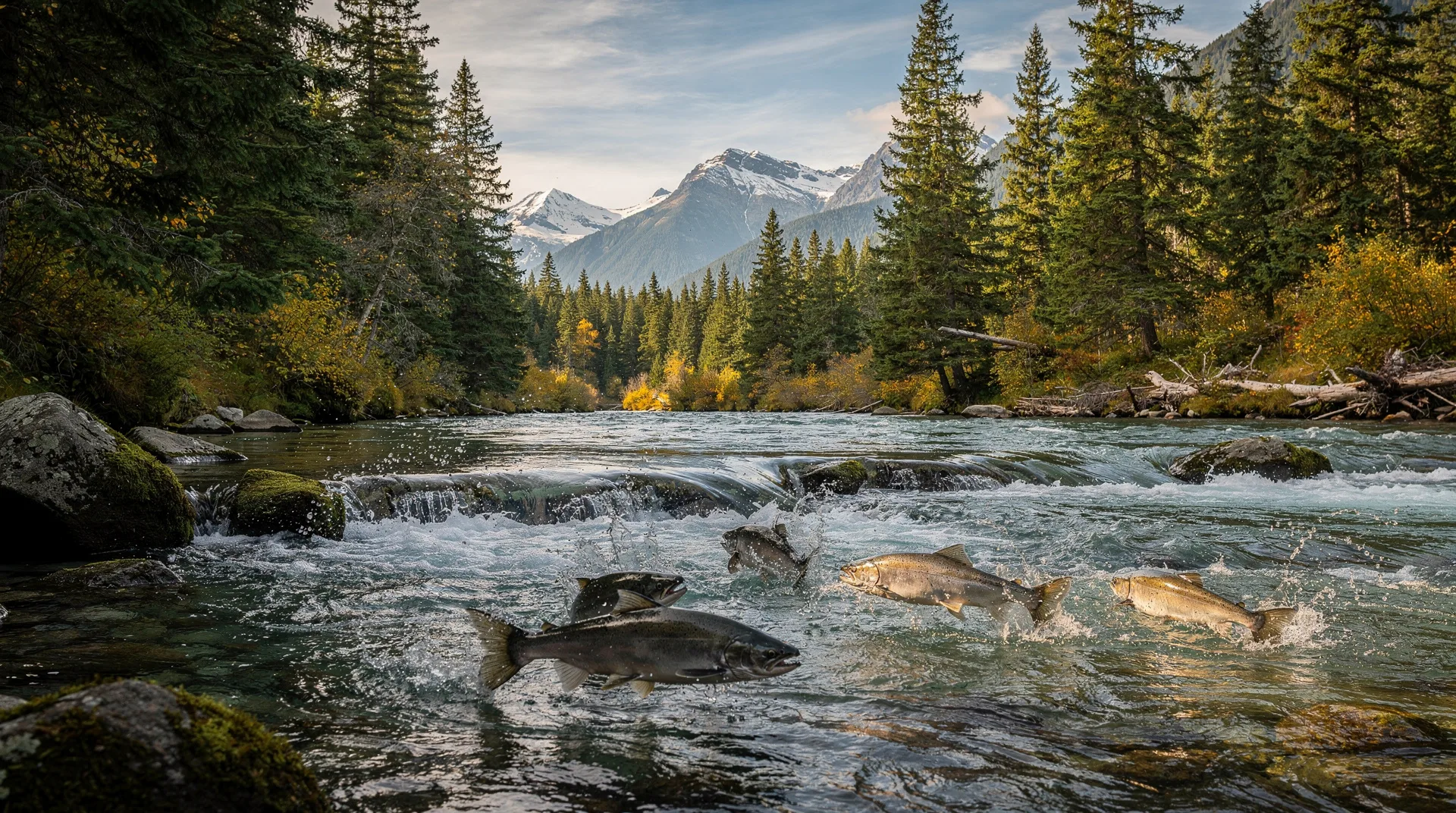
BC salmon runs: when and where to watch the world's greatest migration
When is the best time to see the salmon run in BC?
Salmon runs happen at different times for different species. Sockeye peak in the Adams River in October; coho arrive in rivers October–November; pink salmon (odd years) run August–September. The Adams River sockeye run in a dominant year (next: 2026) is the largest and most spectacular, with millions of salmon in a short river section.
Every autumn, Pacific salmon return from the ocean to the rivers and streams where they were born to spawn and die — a migration encoded in their biology over millions of years and now one of the most powerful wildlife spectacles in North America. British Columbia’s river systems are the final destination for billions of salmon that have crossed the Pacific Ocean, grown large and strong in the Gulf of Alaska and the North Pacific, and now navigate precisely back to their natal streams by some combination of geomagnetic sensing, smell, and mechanisms that science has not entirely explained.
| At a glance | |
|---|---|
| Where | Adams River (Roderick Haig-Brown Provincial Park, near Salmon Arm), Goldstream Provincial Park (near Victoria), Fraser River tributaries |
| Cost | Viewing is free; park day-use parking may apply. Guided wildlife tours run roughly CAD $80–180 per person |
| Time needed | Half a day for Goldstream from Victoria; a full day trip from Vancouver for the Adams River |
| Getting there | Adams River: around 3.5 hours from Vancouver via Highway 1. Goldstream: about 20 minutes from Victoria, bus-accessible |
| Best time | Sockeye peak at the Adams River in October (2026 is a dominant year); Goldstream chum run October–November |
How to plan a salmon run trip around a dominant year
Because run size swings so dramatically on the four-year sockeye cycle, the single most important planning decision is simply which year you are visiting in. A dominant year like 2026 can bring ten to fifty times more fish than an off-cycle year, so if your travel dates are flexible, build the trip around the Adams River’s October peak rather than the reverse.
Accommodation in Salmon Arm and Chase books out early in dominant years — reserve as soon as your dates are fixed, ideally several months ahead. If you can only travel in an off-cycle year, Goldstream Provincial Park is a more reliable bet: chum and coho return there every year in broadly similar numbers, so the experience is less of a gamble even if the scale is smaller than a dominant Adams River run.
Photography tips for salmon runs
Salmon photography rewards patience over gear. A telephoto lens (200mm+) helps for eagles and bears without disturbing them, but the salmon themselves are often close enough for a standard lens from a bank or bridge. Overcast days produce better colour saturation on the red sockeye than harsh midday sun, and a polarising filter cuts glare off the water surface, which matters enormously for seeing fish beneath it rather than just reflections. Morning light is both the best light and the best time for wildlife activity, so an early start pays off twice over. Tripods are rarely necessary given daylight shooting conditions, but a monopod helps with a heavier telephoto if you’re also chasing eagles in flight.
The salmon run is not just a wildlife event. It is an ecological event of profound consequence — the fish that die after spawning decompose in riparian zones, delivering marine-derived nutrients to forests hundreds of kilometres from the ocean. The nitrogen and carbon from salmon bodies fertilise the trees, the berries, the insects, and the birds and mammals that feed on them. Bears that eat salmon contribute nutrients to forest soils through their scat. Eagles carry salmon carcasses into the forest canopy. The great coastal temperate rainforest of BC is, in a measurable sense, built partly from the sea — via salmon.
Pacific salmon species in BC
Sockeye (red salmon): The most iconic BC species for mass runs. Sockeye turn brilliant red with a green head when they spawn, creating a visual spectacle unmatched by any other species. The Adams River sockeye run is the most famous event.
Coho (silver salmon): October–November arrivals in coastal streams. Favoured by sport anglers. Coho runs are visible in small coastal streams on Vancouver Island, the Lower Mainland, and the north coast.
Chinook (king salmon): The largest Pacific salmon species (to 50 kg). Chinook run earlier (June–October depending on the river) and in smaller numbers than sockeye. The Harrison River chinook run in the Fraser system is notable.
Pink (humpback) salmon: The most numerous species. Pink salmon run on a two-year cycle — strong odd years, very weak even years — in August and September. When pink salmon are in, they are in enormous numbers (hundreds of thousands in productive rivers). 2025 and 2027 are odd years; the Vancouver Island and north coast pink runs can be phenomenal.
Chum (dog salmon): October–November runners, typically in coastal streams. Larger than pink, smaller than coho. The Goldstream River near Victoria has notable chum runs.
The Adams River sockeye run
The Adams River, near Salmon Arm in the BC interior (3.5 hours from Vancouver), hosts what is arguably the most spectacular salmon run in the world on a cyclical basis. Sockeye return to the Adams in all four years of their cycle, but on a “dominant year” — when the dominant generation (hatched 4 years earlier during a peak year) returns — the numbers are extraordinary.
Dominant year cycle: Every four years, the dominant cycle returns in concentrations of 2–4+ million fish. The most recent dominant runs were 2010, 2014, 2018, and 2022. 2026 is a dominant year. If you have any opportunity to visit the Adams River in October 2026, it is a dominant run year and the spectacle will be at its peak potential.
What you see: The Adams River runs through Roderick Haig-Brown Provincial Park, a 987-hectare protected area specifically designated to protect the salmon run. The river is short (12 km) and shallow, making the salmon visible from shore throughout. At peak run, the river runs red with sockeye — a literal current of fish so dense that individual fish are difficult to distinguish. The smell is intense (decomposing fish are part of the cycle from the moment fish arrive). Bears, eagles, and other predators concentrate around the river.
When to go: Peak Adams River sockeye run is typically the second and third weeks of October. The exact timing shifts by a week or two year to year depending on water temperature and run size. The Salmon Society and Roderick Haig-Brown Provincial Park monitor and post run updates.
The Salute to the Sockeye event: In dominant years, Parks Canada and the Adams River Salmon Society organise viewing events, educational programming, and guided walks. Attendance can reach 100,000+ visitors during the peak week of a dominant run.
Getting there: Salmon Arm is 3.5 hours from Vancouver via Highway 1 (Trans-Canada). The park entrance is at the east end of Shuswap Lake at Chase, BC. No public transit serves the park.
Goldstream Provincial Park (Victoria area)
Goldstream Provincial Park, 19 km northwest of downtown Victoria on Highway 1, provides one of the most accessible salmon run viewing experiences in BC. The Goldstream River hosts chum salmon runs in October–November, with coho following into December. The runs are not as massive as the Adams River, but the accessibility — 20 minutes from Victoria, bus-accessible, with paved viewing areas and extensive interpretive programming — makes Goldstream the ideal salmon run experience for visitors based in Victoria.
What you see: Chum salmon (typically 3,000–10,000 fish in a good year) in a clear, small river that winds through old-growth Douglas fir and arbutus forest. The fall foliage combined with the salmon, the eagles, and the sound of the river is one of the finest seasonal natural experiences in southern BC.
Eagles: Bald eagles concentrate at Goldstream during the salmon run in remarkable numbers — up to 200+ eagles have been counted in the park during peak run. Eagle density here rivals Churchill and Alaska for concentrated bald eagle viewing.
Interpretive program: BC Parks runs the Goldstream Nature House with staff and volunteers who provide salmon life cycle interpretation throughout the fall. The hands-on salmon education is excellent for children.
Getting there: Highway 1 to Goldstream. Bus service from Victoria (Western Communities buses). Free parking at the provincial park lot.
Browse Victoria and Vancouver Island wildlife tours on GetYourGuideFraser River runs
The Fraser River is the most salmon-productive river in the world by total biomass, draining 228,000 square kilometres of BC and carrying the bulk of the province’s sockeye, chinook, coho, and pink salmon runs. The river is too large and turbid for the kind of direct salmon observation possible at the Adams River or Goldstream, but several tributary and delta locations offer excellent viewing.
Harrison River: The Harrison River, entering the Fraser near Harrison Hot Springs, hosts late-season chinook and chum runs in October–November. The confluence area is famous for the concentration of bald eagles that arrives to feed — the Harrison River eagle count is one of the highest in Canada during peak chum season. The town of Harrison Hot Springs (with its hot springs resort) is within easy reach, making the eagle and salmon viewing a pleasant day trip from Vancouver.
Vedder/Chilliwack River: The Chilliwack River and its tributaries host coho and chum runs visible from the river banks east of Chilliwack. The same river system that attracts white-water rafters in spring becomes a salmon viewing destination in fall.
Pitt River and Alouette River: Closer to Vancouver (Pitt Meadows and Maple Ridge), these Fraser tributaries host chum and coho visible to observers in October and November.
Vancouver Island salmon runs
Vancouver Island has dozens of salmon-bearing rivers and streams, with runs across all five Pacific species. The most accessible include:
Goldstream River (Victoria area): Covered above. The definitive Victoria-area salmon experience.
Englishman River (Parksville): Coho runs in October–November. The Englishman River Estuary is a provincial wildlife management area with good river access.
Little Qualicum River (Parksville area): One of the few rivers in BC with all five Pacific salmon species. The hatchery at Little Qualicum Falls has educational viewing infrastructure.
Campbell River: A city whose identity is defined by salmon. Campbell River has hosted sport salmon fisheries since the early 1900s; the Quinsam River hatchery is open for fall salmon viewing.
Stamp River / Somass River (Port Alberni): Major chinook runs in late summer, coho in fall. The Port Alberni area has significant fishing culture and multiple river viewing opportunities.
What to look for: salmon behaviour during the run
Spawning behaviour: In shallow, clear rivers, you can observe spawning directly. The female digs a redd (nest) in gravel using her tail — a process called “redding” that creates visible disturbed gravel patches. The male attends the female, chasing rival males. After egg deposition and fertilisation, both fish move downstream and begin dying.
Post-spawn fish: The red-bodied sockeye and other post-spawn fish do not die instantly — they spend days in the river in declining health before dying. The colour intensifies as spawning approaches and the fish’s body converts protein to eggs and sperm. After spawning, the fish stop eating and decline rapidly.
Carcasses: Carcasses are a normal and essential part of the salmon run ecology. A river full of salmon carcasses in October is a healthy, functional system, not a problem. The carcasses feed eagles, ravens, bears, mink, otters, and eventually beetles, flies, and aquatic invertebrates. The nitrogen from marine-sourced protein moves from the carcasses into the surrounding forest — a flow measurable in the tree rings of streamside conifers.
Wildlife associated with salmon runs
The salmon run concentrates wildlife in remarkable ways:
Bald eagles: Congregate at salmon rivers in extraordinary numbers during peak run — 50–500 eagles at productive locations. September through November is BC’s best eagle viewing season.
Black bears: Feed intensively on salmon in August–October to build fat reserves for hibernation. Bears are regularly seen fishing at smaller rivers accessible from road.
Grizzly bears: In grizzly range (coastal BC, the Rockies, northern BC), grizzlies are the dominant fishing predator. See the grizzly bear viewing guide for locations.
River otters, mink, ravens, herons: All associated with salmon run rivers.
Explore BC wildlife tours and seasonal experiences across Canada on GetYourGuideConservation context
BC’s Pacific salmon runs have declined significantly over the past 50 years due to habitat loss, overfishing, climate change (ocean temperature affecting survival), hatchery practices that have reduced wild genetic diversity, and pollution. The 2019 Fraser River sockeye run was one of the worst in recorded history. The 2022 run was better but still below historic averages.
Viewing salmon runs contributes to public support for salmon conservation — seeing the scale and the ecological connections firsthand generates the kind of emotional investment that abstractions cannot. The Salmon Society, Pacific Salmon Foundation, and various First Nations organisations actively monitor and advocate for salmon habitat and population health.
Practical planning
Timing variability: Run timing shifts by 1–3 weeks year to year based on ocean conditions, river temperature, and run size. Check local fish hatchery or provincial fisheries department updates in the weeks before your visit.
Viewing vs fishing: Salmon viewing and salmon fishing are both legal activities in specific rivers during specific seasons. Commercial and sport fishing seasons are regulated separately from viewing. Check Fisheries and Oceans Canada (DFO) for current regulations at specific rivers.
Adams River 2026: If visiting BC in October 2026, the Adams River is a dominant-run year and should be a high priority. Book accommodation in Salmon Arm or Chase early — the event draws large crowds.
Related guides
- Spirit bear tours guide — spirit bears and grizzlies fishing on Great Bear Rainforest salmon streams
- Grizzly bear viewing in BC guide — bear viewing at Knight Inlet during salmon season
- Storm watching guide — Tofino’s winter character, a contrast to fall salmon season
Frequently asked questions about BC salmon runs: when and where to watch the world’s greatest migration
Can I touch the salmon?
No. At provincial and national park viewing areas, touching salmon, disturbing spawning beds, or entering the river is typically prohibited. Observe from the bank.
Is the Adams River run every year?
Sockeye return to the Adams every year, but in greatly varying numbers. The dominant run (every four years) brings millions of fish; off-cycle years bring tens of thousands. 2026 is a dominant year.
What does a sockeye salmon look like when spawning?
Sockeye salmon transform dramatically from their ocean silver colour to a brilliant crimson red body with a green head as they enter fresh water for spawning. The transformation is complete by the time they reach their spawning grounds. Males develop a hooked jaw (kype) and a humped back. The sight of a clear river filled with red and green sockeye is one of the most striking natural images in Canada.
Are salmon runs the same every year?
No. Run sizes vary enormously year to year, driven by ocean survival rates, hatchery contributions, and the four-year cycle for most species. A large run year (like a dominant Adams River year) produces 10–50 times more fish than an off-year. Local fish hatcheries and DFO post run size estimates in August–September for the upcoming fall runs.
What time of day is best for salmon viewing?
Dawn and mid-morning are typically best for active fish behaviour and clear light conditions for photography. The fish are present throughout the day but may be more active and more visible in lower light. Eagles tend to concentrate at feeding times (morning), which also correlates with peak fish activity.
Do I need a guide to see the salmon run?
No — the Adams River and Goldstream Provincial Park are both self-guided viewing sites with marked paths, interpretive signage, and (during the Salute to the Sockeye event) volunteer-led walks included free with your visit. A guided wildlife tour adds value mainly for spotting bears and eagles you might otherwise miss, not for finding the salmon themselves.
Is salmon run viewing suitable for young children?
Yes, with some caveats. The Adams River and Goldstream paths are flat, stroller-friendly, and have interpretive programming aimed at families. The smell of decomposing fish and the sight of dying salmon can be intense for very young or sensitive children, so it’s worth preparing them beforehand for what they’ll see.