Tundra Buggy Churchill: How the Tours Work and What to Book
What is a tundra buggy and how do I book one in Churchill?
Tundra buggies are purpose-built high-clearance vehicles that cross Churchill's coastal tundra for polar bear viewing. Book 6–12 months ahead for peak season (late October to mid-November). Day tours cost CAD $600–$900 per person; multi-night Tundra Buggy Lodge programmes cost CAD $7,000+.
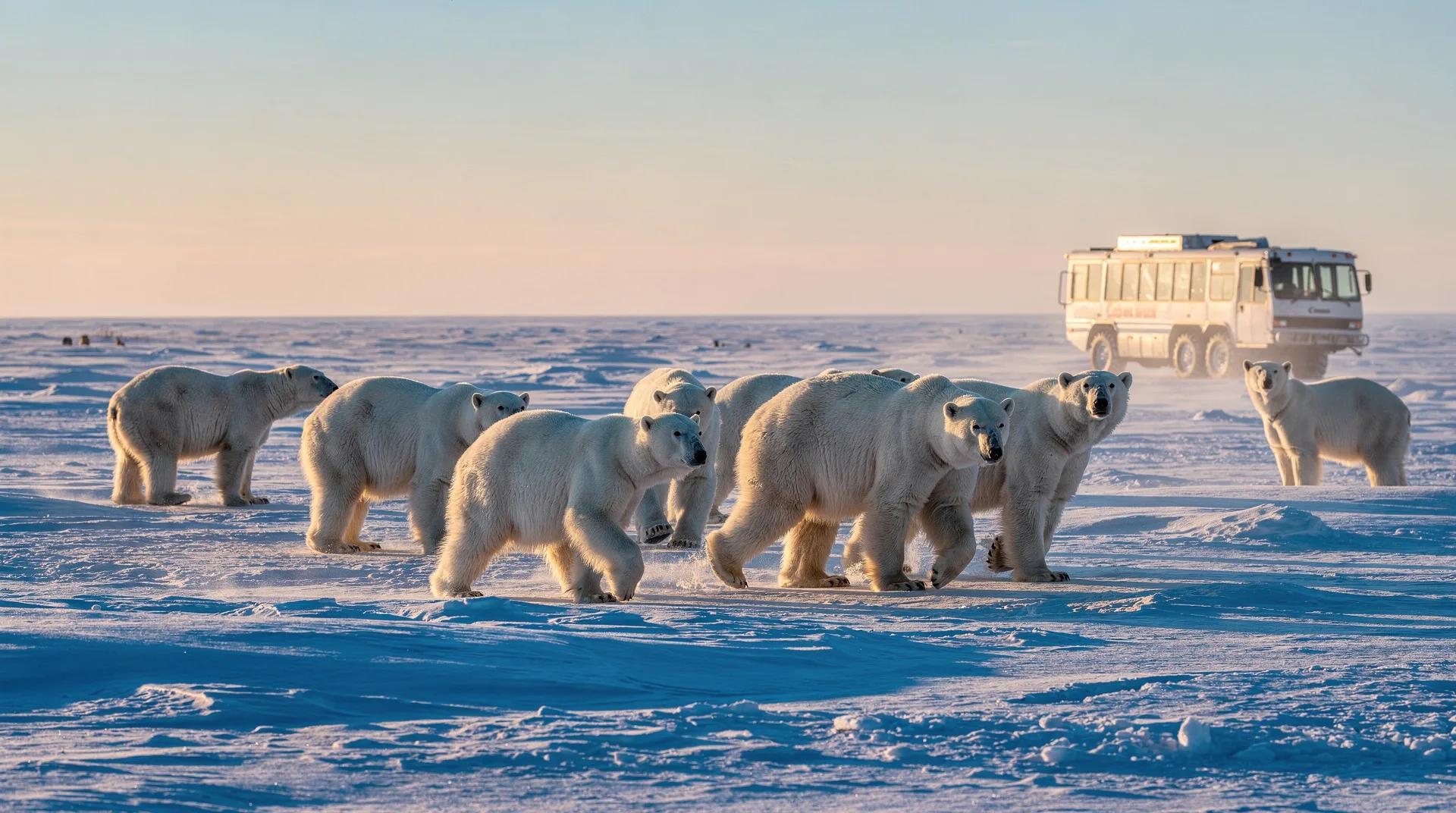
The tundra buggy is the most distinctive wildlife tour vehicle in Canada. Purpose-built for the rocky, boggy coastal tundra east of Churchill, these enormous rolling observation platforms are how most visitors experience the annual polar bear gathering along Hudson Bay. Understanding how they work, who operates them, and how to book the right tour for your trip is the single most important part of planning a Churchill bear season visit.
This guide covers the vehicle itself, the different tour formats, the main operators, cost expectations, and the practical reality of a day or a week on the tundra.
At a glance
| Details | |
|---|---|
| Where | Churchill Wildlife Management Area, coastal tundra east of Churchill, Manitoba |
| Cost (day tour) | Around CAD $600–$900 per person |
| Cost (multi-night lodge) | Around CAD $7,000–$12,000+ per person |
| Time needed | 1 day minimum; 4–6 nights for the full lodge programme |
| Getting there | Fly into Churchill (no road access); most visitors arrive via Winnipeg |
| Best time | Roughly late October to mid-November for peak bear activity |
What a tundra buggy is
Tundra buggies are specialised off-road vehicles built to cross terrain that would defeat ordinary 4x4s while inflicting minimal environmental damage. The typical buggy is around 11 metres long, 3 metres wide, and sits on tyres nearly 2 metres tall — inflated to very low pressure to spread the vehicle’s weight across a wide footprint.
Standard features include:
- Heated interior cabin with seating oriented toward windows
- Large windows that slide open fully for unobstructed photography
- A rear observation deck — an outdoor platform where guests stand for close-range viewing
- Onboard washroom (important on 8-hour tours)
- A galley for hot drinks and packed lunches
- Storage for camera gear and outer clothing
The vehicles are slow by highway standards — cruising at 15–25 km/h on the tundra — but well-suited to moving across terrain that a regular vehicle cannot cross at all. The large tyres allow the buggy to cross soft bogs, rocky beaches, and occasional shallow water.
How buggies interact with the environment
Tundra buggies have operated in the Churchill area since the 1970s. Their environmental impact was carefully considered from the beginning: the low tyre pressure spreads weight to avoid permafrost damage, the operators stay on established tracks within the Churchill Wildlife Management Area, and the vehicles are specifically designed not to cause the kind of cumulative damage that ordinary off-road vehicles would in the same terrain.
The bears have grown up with the buggies. Polar bears in the Churchill population see buggies as large, static, vaguely interesting features of the landscape — worth investigating briefly and then ignoring. Bears sometimes approach to sniff at tyres or stand against the side of a vehicle, but the habituation is carefully maintained: no feeding, no close approach with intent to provoke, no stress-inducing behaviour by guides.
This balance — bears that accept buggy presence without being stressed by it — is what makes the close-range viewing possible.
Tour formats
There are two main tour formats and a handful of specialised variants.
Day tundra buggy tours
The standard Churchill experience. Typical schedule:
7:00–8:00am. Pick-up from Churchill accommodation. Transfer to launch point (15–20 minutes).
8:30am. Board the buggy.
9:00am–4:00pm. On the tundra. The buggy moves between bear locations, stopping for extended viewing, with lunch served onboard.
4:30–5:00pm. Return to Churchill.
A day tour typically encounters 10–30 bears in peak season depending on weather and bear distribution. Most operators include transfers, lunch, hot drinks, and experienced naturalist guides. Cost: CAD $600–$900 per person per day. You can also compare guided wildlife tours in Canada before choosing.
Multi-night tundra buggy lodge
The premium Churchill product. Tundra Buggy Lodge is a connected set of buggy carriages — accommodation, dining, lounge — that are parked overnight in the Wildlife Management Area. Guests sleep on the tundra, watching bears at dawn through their bedroom windows, and spend full days moving between viewing locations in a dedicated day buggy.
Programme length. Typically 4–6 nights.
Cost. CAD $7,000–$12,000 per person for multi-night programmes, depending on duration and operator. The premium over day tours buys time on the tundra at dawn, dusk, and overnight — when bear activity is often highest — and eliminates the daily return to town.
Operator. Frontiers North Adventures is the primary operator. Demand is high; booking 12 months ahead is standard.
Remote wilderness lodge programmes
Not strictly tundra buggy operations, but in the same category of premium Churchill experience. Churchill Wild operates remote fly-in lodges — Seal River Heritage Lodge, Dymond Lake Lodge, Nanuk Polar Bear Lodge — offering ground-level bear viewing with bear guards rather than from vehicles. The experience is different: intimate, quieter, and more focused on walking in bear country.
Cost. CAD $12,000–$18,000 per person per week.
Experience. Exceptional. For travellers prioritising environment immersion over guaranteed high bear counts, the remote lodges often feel more authentic than buggy operations.
Specialty tours
Some operators offer photography-focused tours with smaller groups, longer tundra days, and dedicated photography guides. Others run charter-style trips for custom groups. These typically cost significantly more and book further ahead.
The main operators
The Churchill tundra buggy industry is small — a handful of operators divide the available tundra access permits.
Frontiers North Adventures. The largest and longest-established operator. Runs the Tundra Buggy Lodge and a substantial day-tour operation. Widely regarded as the industry standard for experience and safety.
Natural Habitat Adventures. US-based tour operator with exclusive access to Tundra Buggy experiences through Frontiers North. Packages include all accommodations, transfers, and activities — favoured by American travellers who want a single-booking experience.
Great White Bear Tours. A separate operator running day tundra buggy tours in a slightly different area of the Wildlife Management Area. Good quality, slightly lower cost, often available when Frontiers North is sold out.
Lazy Bear Expeditions. Combines in-town lodge accommodation with buggy tours and dog sledding, walking tours, and other activities. Good for travellers wanting a more mixed itinerary.
Churchill Wild. Operates the remote fly-in lodges mentioned above rather than buggies, but is often included in the broader “Churchill bear viewing” market.
Booking directly with operators is generally straightforward; booking through specialist tour operators (Nat Hab, Quark Expeditions, World Wildlife Fund partners) adds packaging convenience and sometimes exclusive access at a premium.
When tours run
The season is short and predictable.
Early October. Tours run but bear numbers are lower. Lower cost and less competition for seats; suitable for travellers who want a shoulder experience.
Late October to mid-November. Peak. Every seat, every bed, every activity is at maximum demand.
Mid-to-late November. Season winds down as ice forms and bears move offshore. Last dates are typically around November 15; after that, tours are not offered.
Booking timelines
Timelines are a strict function of supply and demand.
12–18 months ahead. Tundra Buggy Lodge, Churchill Wild lodges, premier dates with top operators. Book as soon as your travel dates are firm.
6–12 months ahead. Standard day tundra buggy tours on peak dates.
3–6 months ahead. Shoulder-date day tours (early October, mid-November), some mid-tier operators.
Last-minute. Cancellations occasionally open up seats within 2 weeks of departure. Join waitlists with multiple operators.
What to expect on a tour
Bears. Yes. The question is not “will we see bears” but “how many and at what distance.” Average day-tour sightings in peak season are 10–25 individual bears, with more in good years and fewer on slow weather days.
Distance. Bears routinely approach within 10 metres of parked buggies. Some days, bears walk directly under the observation deck or rest against the vehicle’s side. Other days, most bears are more distant — 20 to 50 metres — and photography requires longer lenses.
Activity. Bear behaviour ranges from deep rest (most bears, most of the day) to intense activity. Sub-adult males sparring is the most reliable “active” behaviour — 30-minute or longer play-fighting matches. Mothers moving with cubs are less common but more affecting. The best single wildlife moments are unpredictable.
Other wildlife. Arctic foxes regularly accompany buggy tours, scavenging around bear activity. Snowy owls perch within view. Ravens follow the buggies. Ptarmigan, hares, and occasional caribou round out the secondary species list.
Weather. Often the limiting factor. Blowing snow, -30°C wind chill, or low cloud can limit visibility or force early return. Most tours run in all but extreme weather; expect occasional weather-curtailed days.
Photography
Serious photographers should plan with these points in mind:
- 300–600mm telephoto essential; 400–500mm is the sweet spot for bear close-ups
- Second body with wide-to-medium zoom (24–105mm) for context and environment
- Tripod optional — most bear photography is hand-held
- Battery management: drainage is severe in cold; carry 4+ spare batteries inside clothing
- The rear observation deck is the primary shooting location; arrive on it early for the best positions
- Shoot through open windows or from the deck for unobstructed images; glass degrades quality
Some tours offer photography-focused days with extra flexibility. If your priority is photographs, book one of these. For activities around your trip, browse Canada tours and activities.
What to pack
See the Churchill polar bears destination page packing list. Critical items: -40°C insulated boots, heavy parka, mittens, balaclava, hand warmers, multiple base layers. The tundra buggy is heated but you will spend significant time on the unheated observation deck.
Getting to Churchill
There is no road access to Churchill — the town is reached by air or, more slowly, by rail. Most tundra buggy visitors fly from Winnipeg, a roughly 2-hour flight, since flights are typically bundled into tour packages by Frontiers North and other operators. Some travellers take the VIA Rail train from Winnipeg instead — a scenic but much slower option (around 40+ hours) that appeals to those with extra time rather than those trying to maximise tundra days. See Churchill: how to get there for the full breakdown of flight and rail options, and Churchill cost guide for how transport fits into an overall trip budget.
Beyond the bears
Bear season isn’t the only reason to visit Churchill. Summer (roughly July–August) brings beluga whale kayaking and boat tours on the Churchill River (see Beluga kayaking Churchill), and the aurora season overlaps with parts of the bear season on clear nights — see Aurora Churchill for viewing odds and timing. Travellers building bear season around other Churchill activities should also check Churchill in November for what a late-season visit adds and subtracts compared to peak October dates. For the broader Churchill polar bear picture beyond the buggies themselves, see Polar bears Churchill.
Frequently asked questions about Tundra Buggy Churchill
Can beginners or non-photographers enjoy a tundra buggy tour?
Yes. While the guide above covers photography in detail, the core experience — close, safe wildlife viewing from a heated vehicle with an expert naturalist guide — doesn’t require any special skill or gear beyond warm clothing. Day tours are designed for general visitors as much as specialists.
Is Churchill safe to visit given the polar bear population?
Yes, when following standard precautions. Churchill town has bear-monitoring patrols and residents are experienced with bear safety; visitors stay within town or aboard tundra buggies and guided vehicles rather than walking in the Wildlife Management Area unescorted. Guides and operators are highly experienced with bear behaviour and maintain safe viewing distances at all times.
Related reading
- Churchill polar bears
- Churchill polar bear season
- Churchill logistics
- Polar bear tundra buggy Churchill
- Churchill cost guide
- Churchill 5-day polar bear itinerary
The tundra buggy is the reason Churchill delivers the bear viewing it does. The vehicles allow close, safe, sustained observation of wild polar bears in a way that exists nowhere else in the world. Book well ahead, prepare for the weather, and understand that a good day on the tundra is one of the most rewarding wildlife experiences available anywhere.