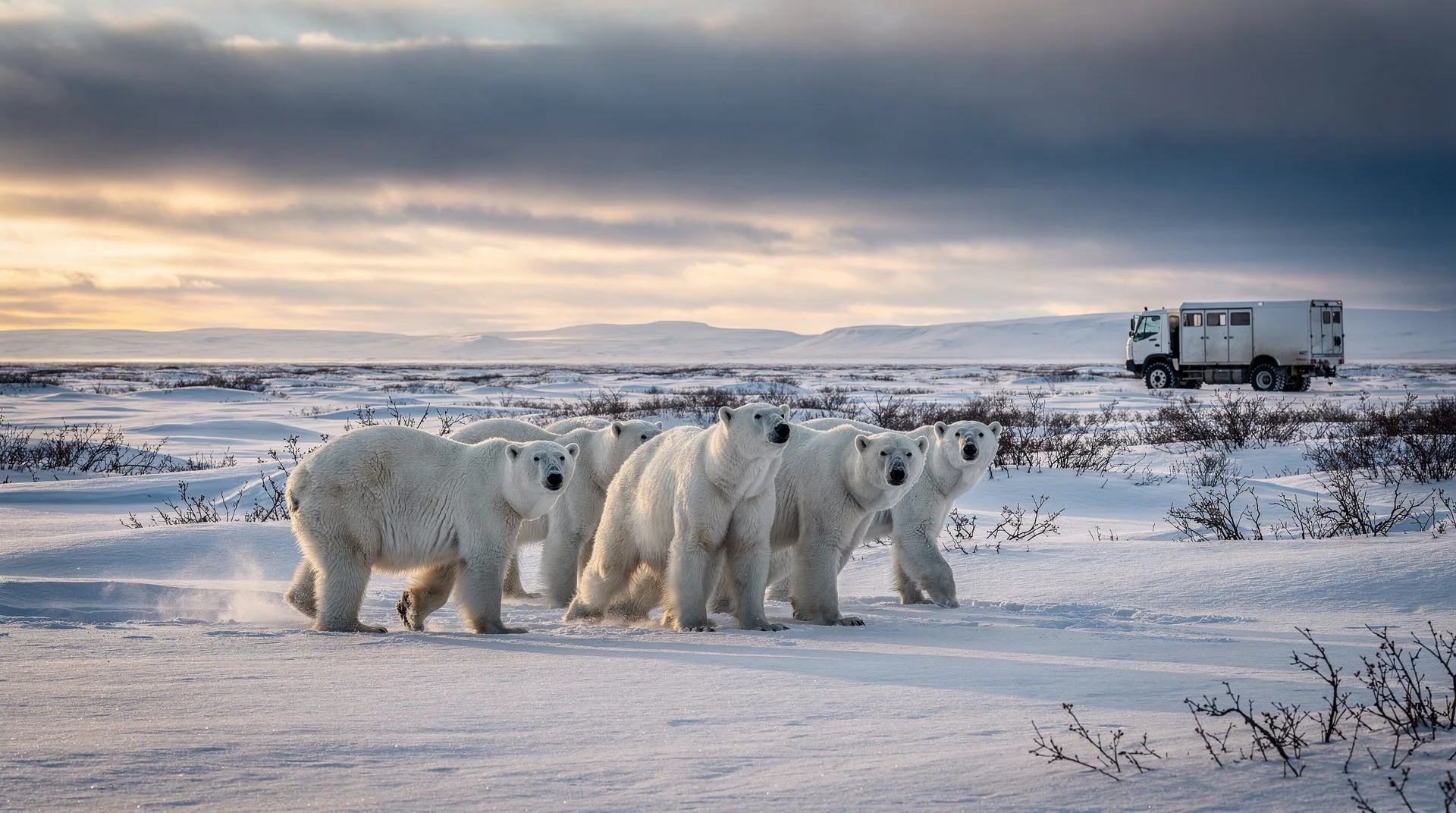
Churchill Polar Bear 5-Day Itinerary
At a glance
Where: Churchill, Manitoba, on the Hudson Bay coast — reached only by plane or train, no road connects it to the rest of Canada Cost: around CAD $3,500-5,000 per person for 5 days including flights, accommodation and two tundra buggy tours Time needed: 5 days gives two full buggy tours; 4 days is workable but tighter, 6-7 days adds margin for weather delays Getting there: fly Winnipeg to Churchill (about 2 hours) or take the VIA Rail Hudson Bay train (roughly 2 days from Winnipeg, seasonal reliability varies) Best time: late October to mid-November for polar bear season on land; belugas instead in July-August
Churchill requires commitment. The journey is neither quick nor cheap, and the rewards are proportional to the effort. This 5-day itinerary covers the essential elements of a polar bear season visit — arriving via Winnipeg, three full days in Churchill with a mix of tundra buggy tours and on-foot exploration, and a final return day — structured to maximise wildlife encounters without over-scheduling.
The itinerary assumes peak polar bear season (late October to early November) and arrival by air from Winnipeg. All Churchill accommodation and tundra buggy tours must be booked well in advance — 6–12 months is realistic for peak season. This itinerary does not work without pre-booked tours.
Before you go: booking checklist
Churchill’s limited capacity means that logistics must be resolved before you set a departure date:
- Tundra buggy tours: Book directly with Frontiers North Adventures, Natural Habitat Adventures, or another licensed Churchill operator. Peak October-November slots fill by spring of the same year for popular dates.
- Churchill accommodation: Book your Churchill hotel or lodge immediately after securing tour slots. Lazy Bear Lodge, Tundra Inn, and Iceberg Inn all fill in peak season.
- Winnipeg overnight: A central Winnipeg hotel for Day 1 arrival. Exchange District or The Forks area is convenient.
- Flights Winnipeg–Churchill: Book as soon as your Churchill dates are confirmed. Calm Air and Perimeter Aviation routes fill for peak dates.
- Travel insurance: Essential, including medical evacuation coverage. There are no specialist medical facilities in Churchill.
Day 1: Winnipeg — arrival and pre-trip orientation
Fly or take VIA Rail to Winnipeg. If arriving from eastern Canada, this is a simple hub connection. If arriving internationally, allow a full day for immigration and potential connection issues.
Winnipeg afternoon: Check in to your hotel (Exchange District recommended) and spend the afternoon at The Forks — the historic market at the river junction that is the natural starting point for any Manitoba visit. The food hall provides dinner options ranging from perogies to bannock to Vietnamese to local craft beer.
Evening: The Assiniboine Park Zoo’s Journey to Churchill exhibit is open year-round. If you have never seen a polar bear, this is useful preparation — the zoo’s Churchill habitat holds polar bears, Arctic foxes, tundra wolves, and seals in environments designed to reflect the wild habitat. Bears in the wild are larger and more dramatic than the zoo suggests, but the encounter calibrates expectations.
Alternatively, an evening walk through the Exchange District’s heritage buildings, followed by dinner at one of the excellent independent restaurants, is the right way to begin a Manitoba wildlife trip. If you want extra activities around the trip, you can browse tours and activities across Canada.
Day 2: Winnipeg to Churchill — arrival day
Morning: Take the morning flight from Winnipeg to Churchill. The 2-hour flight crosses Manitoba’s boreal forest and muskeg, with the tundra visible below in the final approach. Carry camera and lens in your carry-on — the window views on descent can be productive.
Arrival in Churchill: The airport is small and the Calm Air/Perimeter arrivals process is simple. Transfer to your accommodation. The Churchill townsite is compact — most hotels are within walking distance of the airport and everything in town is within comfortable walking distance.
Afternoon: Churchill orientation walk — the town is small enough that walking its full extent takes under an hour. Key landmarks:
- The Polar Bear Alert Program signage and bear safety notices throughout town
- The Parks Canada office near the harbour (worth stopping to ask about current bear sightings and any trail advisories)
- Cape Merry — a short walk to the headland at the mouth of the Churchill River, with views over the estuary and Hudson Bay, and the ruins of historic fortifications across the water
Late afternoon: Cape Merry at sunset in late October provides extraordinary light — low-angle amber, with Hudson Bay partially frozen and partially open, and the potential for polar bears visible on the shoreline from the headland. Carry bear spray. Do not walk this area alone; walk in groups of three or more and pay attention to surroundings.
Evening: Dinner at Churchill’s limited restaurant options (Lazy Bear Lodge dining room if staying there; Gypsy’s or another town restaurant if not). An evening briefing from your tour operator — most run pre-tour orientations for the following day’s buggy excursion.
Day 3: Full-day tundra buggy tour
The main event. Your tundra buggy tour departs from Churchill at approximately 7:30–8:00am, departing before dawn to reach the Wildlife Management Area by first light.
Morning on the tundra: The first bears of the day are typically resting on tundra ridges or moving along the coastline as light increases. The guide positions the buggy for optimal viewing and photography. In late October, temperatures are -10°C to -25°C on the tundra; the buggy’s interior is heated, and the observation deck is where you will spend significant time — dress accordingly.
Mid-morning: Young males often begin play-fighting as the morning warms slightly. These sparring sessions — the bears rising on hind legs, wrestling with apparent goodwill — are the characteristic Churchill spectacle and among the most photographed wildlife behaviours in Canada.
Midday: Lunch on board (provided). Bears rest during the middle of the day; the guide uses this time to reposition toward areas with higher bear density.
Afternoon: Activity increases again in the late afternoon. As the day’s light quality improves toward sunset, the photography opportunities are at their best — the golden-hour light on cream-coloured bear fur against the frost-bleached tundra is the classic Churchill image.
Return to Churchill: Approximately 4:30–5:00pm. Review the day’s photography, warm up, and rest.
Evening: The Churchill Northern Studies Centre (23 km east of town) hosts evening lectures on polar bear ecology, tundra biology, and climate change research during bear season. Transport is arranged by the centre. These lectures are excellent context for what you have seen during the day and are strongly recommended.
Book your Churchill tundra buggy tourDay 4: Second buggy tour and town exploration
Morning: Second full-day tundra buggy tour. Bear concentrations shift day to day depending on wind direction, temperature, and ice conditions. Your second tour will cover different ground than Day 3 and will almost certainly produce different encounters.
If the bay is partially frozen by Day 4 (late October to early November is the transition period), you may see bears beginning to venture onto ice — a different behavioural mode from the land-based waiting of earlier in the season.
Evening: Free time in Churchill for self-guided exploration.
Dog sled introductory session: Several Churchill operators offer evening or late-afternoon dog sled experiences — not full wilderness excursions but introductory sessions with working sled dog teams. If your operator offers this, it is a worthwhile addition to the itinerary. The experience of a team of huskies pulling a sled across tundra (even a short training course) has a different quality than any vehicle-based activity.
Northern lights possibility: If the evening is clear and geomagnetic activity is moderate or high, northern lights are possible in late October. The aurora season runs through Churchill’s autumn and winter. Your tour operator or accommodation will often alert guests when aurora is visible.
Day 5: Morning exploration and departure
Early morning: Last opportunity in Churchill. Depending on your flight time, either:
- A guided walking tour in and around town with a bear guard (if your operator offers this and you have not yet done it)
- A return to Cape Merry for the morning light and a last look at the bay
- Visiting the Churchill Heritage Museum (small but informative on the town’s history, the HBC fur trade, and the Dene and Cree peoples of the region)
Midday: Return to Winnipeg by the noon or afternoon flight.
Winnipeg evening: If your onward flight is the next day, one more night in Winnipeg allows a visit to anything missed on Day 1 — the Canadian Museum for Human Rights is the primary recommendation if you had only a brief Winnipeg visit outbound.
Practical notes
What to pack: See the complete packing list in the polar bear season guide. Key items: insulated parka rated to -30°C minimum, insulated boots to -40°C, heavy mittens, balaclava, hand warmers, and camera batteries kept warm inside clothing.
Bear safety: Churchill operates under a Polar Bear Alert Program. Follow all safety guidelines: do not walk alone at night, pay attention to posted bear warnings, and carry bear spray on any outdoor excursion. Your operator and accommodation will brief you on arrival.
Photography: A 300–600mm telephoto lens is the primary tool. Keep batteries inside your clothing between shots. The observation deck is open and cold — dress for stationary time in -20°C conditions.
Budget (per person): See the Churchill cost guide for detailed breakdowns. Total cost for a 5-day independent trip of this format: approximately CAD $3,500–$5,000 per person including flights, accommodation, and tours.
Getting to Churchill: your options
There is no road to Churchill — flying from Winnipeg (Calm Air or Perimeter Aviation, about 2 hours) is the fastest option and what this itinerary assumes. The VIA Rail Hudson Bay train from Winnipeg is the scenic alternative, running roughly 2 days each way through the boreal forest and muskeg, but schedules can be affected by track conditions on this remote line — check current status before relying on it for tight connections. See the how to get to Churchill guide for a full comparison of train versus flight, including cost.
If you can only spare 3-4 days, a single tundra buggy tour with a compressed Winnipeg stopover is possible, but two full days on the tundra (as in this itinerary) meaningfully improves your odds of varied bear behaviour and better light, since bear activity and weather both shift day to day.
Beyond the buggy: other ways to see the bears
Walking safaris and helicopter tours: A small number of operators offer guided walking excursions in bear-proofed areas and helicopter flights over the tundra for aerial bear spotting — both are pricier add-ons worth asking your tour operator about if the standard buggy format doesn’t excite you as much as a different vantage point.
Combining bears with beluga season: Churchill’s beluga whales pass through in July-August, an entirely different (and less expensive) season from the October-November bear peak. Some travellers prefer to split a single Manitoba trip across two visits rather than try to combine both in one window — the Churchill polar bears experience guide has a first-person account of what to expect.
Frequently asked questions about Churchill Polar Bear 5-Day Itinerary
Is 5 days enough for a Churchill polar bear trip?
Yes, for most travellers. Five days allows two full tundra buggy tours plus a Churchill orientation day, which is enough to see meaningful bear behaviour across different conditions. Tighter 3-4 day trips are possible but leave less margin if weather disrupts a tour day.
Can I see polar bears without a tundra buggy tour?
Not reliably or safely. Bears are dangerous and the Polar Bear Alert Program actively manages human-bear encounters in town; walking safaris exist with licensed guides in controlled areas, but the tundra buggy remains the standard, safest way to see bears at close range in the Wildlife Management Area.
Related reading
- Churchill polar bear season: October–November guide
- Churchill polar bear tundra buggy tours: complete guide
- Churchill trip cost: what to budget
- How to get to Churchill: train, flight and tour options
- Wapusk National Park: polar bear denning area
Five days in Churchill is enough to experience the polar bear season fully — enough time for two full buggy tours, for the rhythm of the tundra in late October to establish itself, and for the bears to stop being astonishing and become familiar. It is only when they become familiar that you realise how extraordinary they are.