Indigenous cultural experiences in BC: tours and heritage sites
What are the best Indigenous cultural experiences in BC?
The Squamish Lil'wat Cultural Centre in Whistler, the Museum of Anthropology in Vancouver (UBC), the Royal BC Museum in Victoria, and the U'mista Cultural Centre in Alert Bay are the top cultural institutions. For immersive experiences, First Nations-led tours in Haida Gwaii, the Great Bear Rainforest, and the Sea-to-Sky corridor are exceptional.
British Columbia is the most culturally diverse Indigenous region in Canada. More than 200 First Nations call BC home, speaking approximately 34 distinct Indigenous languages — a linguistic and cultural diversity that reflects thousands of years of adaptation to ecosystems ranging from Pacific coastal rainforest to interior plateau grasslands to subarctic boreal forest. Before European contact, BC’s Indigenous peoples had developed some of the most sophisticated and materially complex cultures in North America — evidenced by the elaborate totem pole traditions of the coastal peoples, the potlatch ceremony systems, the cedar canoe technologies, the fisheries management practices that sustained salmon populations for millennia.
That cultural heritage is not a historical artefact. BC’s First Nations are living communities with active governance, ongoing cultural practice, and an expanding role in tourism, environmental stewardship, and economic development. Indigenous tourism in BC increasingly means visiting places and experiences owned, operated, and interpreted by First Nations themselves — not historical curiosities managed by outsiders, but contemporary expressions of cultural continuity.
This guide covers the best Indigenous cultural experiences in BC with an emphasis on First Nations-operated and First Nations-benefiting visits.
Cultural institutions and museums
Museum of Anthropology, UBC (Vancouver)
The Museum of Anthropology at the University of British Columbia holds one of the world’s finest collections of Northwest Coast Indigenous art and material culture. The Great Hall — a towering glass structure specifically designed to house totem poles and large carved works — is one of the most extraordinary museum spaces in Canada.
The collection includes monumental works from the Haida, Tsimshian, Tlingit, and other Northwest Coast cultures, alongside research collections spanning BC and global anthropology. The outdoor Haida houses and poles, designed in collaboration with master carver Bill Reid and architect Arthur Erickson, situate the works in an outdoor landscape that approaches the original context of large-scale carving.
Bill Reid Gallery of Northwest Coast Art (downtown Vancouver) complements MOA with a focused collection centred on the work of Bill Reid, the Haida artist who was among the most important revivalists of Northwest Coast carving in the 20th century. Reid’s The Spirit of Haida Gwaii sculpture at the Vancouver International Airport is among the most visible Indigenous artworks in Canada.
Royal BC Museum (Victoria)
The Royal BC Museum has comprehensive coverage of BC First Nations cultures in its First Peoples gallery — one of the finest provincial museum collections of Northwest Coast material. The museum is undergoing a major renovation; confirm gallery access before visiting.
U’mista Cultural Centre (Alert Bay, Cormorant Island)
Alert Bay, on Cormorant Island off the north end of Vancouver Island, is accessible by BC Ferries from Port McNeill. The U’mista Cultural Centre houses the Kwakwaka’wakw potlatch collection — ceremonial objects confiscated by the Canadian government in 1922 when Indigenous ceremonies were banned, now repatriated and displayed in a purpose-built facility that tells the full story of that confiscation, the ban, and the repatriation.
The potlatch ban (1885–1951) criminalised a central institution of Northwest Coast Indigenous culture and caused profound cultural harm. U’mista tells this story with directness and power. The collection of coppers, masks, and regalia, displayed in a format that mirrors the original potlatch display context, is culturally charged in a way that no mainstream museum presentation can match.
Squamish Lil’wat Cultural Centre (Whistler)
The Squamish Lil’wat Cultural Centre at the base of Whistler Mountain is a joint project of the Squamish Nation and the Lil’wat Nation, representing two culturally distinct First Nations whose territories overlap in the Whistler area. The building itself is a significant architectural achievement — a longhouse-inspired design in wood and stone with a soaring interior space housing art, canoes, and cultural objects.
Guided tours are led by Squamish and Lil’wat educators and cover the distinct cultures, languages, and histories of both nations. A traditional meal experience (bannock, smoked salmon) is available. The centre is the most accessible First Nations cultural institution in the Sea-to-Sky corridor and well worth 2–3 hours on any Whistler visit.
Browse Whistler cultural experiences and outdoor tours on GetYourGuideTotem pole sites
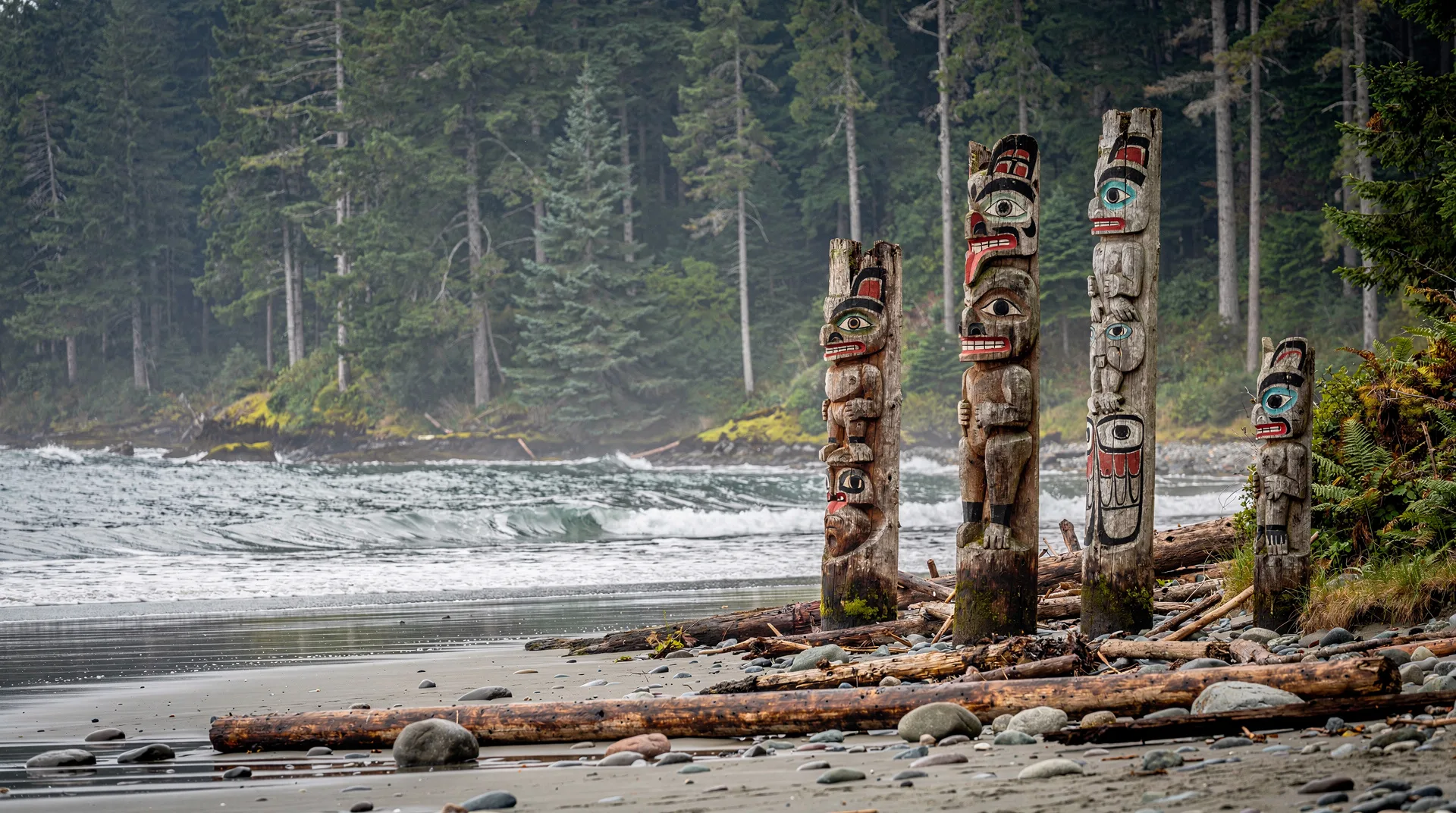
Totem poles — monumental carved cedar columns recording family histories, crests, and ceremonies — are among the most distinctive art forms in the world and are specific to the Northwest Coast of North America. BC has the densest remaining concentration of standing totem poles, ranging from urban park settings to remote coastal villages.
Stanley Park (Vancouver)
Stanley Park’s totem pole display at Brockton Point is one of the most-visited Indigenous heritage sites in Canada. The poles represent multiple Northwest Coast nations and were assembled over several decades. While the setting is not original context (the poles were moved from their home communities), interpretive signage provides background on the carvings and their origins.
For a deeper understanding of totem pole traditions, the Museum of Anthropology (UBC) provides considerably more cultural context than Stanley Park.
Ksan Historical Village (Hazelton)
Ksan, near the confluence of the Skeena and Bulkley Rivers in the Hazelton area, is a reconstructed Gitxsan village with standing plank houses and totem poles created by contemporary Gitxsan carvers in the 1960s–70s as part of a cultural revival. The village museum and cultural centre tell the history of the Gitxsan people and their connection to the Skeena River.
Ksan is a 7-hour drive from Vancouver — not a casual day trip, but a genuine destination in the context of a northern BC itinerary.
Haida Gwaii
Haida Gwaii (the Queen Charlotte Islands) is the ancestral territory of the Haida Nation and one of the most significant Indigenous cultural landscapes in the world. Gwaii Haanas National Park Reserve and Haida Heritage Site, jointly managed by Parks Canada and the Haida Nation’s Council of the Haida Nation, protects ancient Haida village sites — including Sgang Gwaay (Anthony Island), a UNESCO World Heritage Site.
The ancient poles at Sgang Gwaay are in their original locations, weathering in the coastal air as the Haida intended — these are not museum objects. The village site, accessible only by guided boat tour with Haida Watchmen (caretakers) present, is one of the most powerful cultural heritage experiences in Canada. The standing poles are accompanied by fallen poles returning to the earth, and the Watchmen interpret the site with authority and directness.
Access: Flights from Vancouver to Masset or Queen Charlotte City (Skidegate) on Haida Gwaii; the Gwaii Haanas interior requires a permit, water taxi, and guided Watchmen tour.
First Nations-led tours and experiences
Talaysay Tours (Vancouver)
Talaysay Tours operates Indigenous-led tours in Vancouver, including a Talking Trees walk in Stanley Park that reframes the park’s old-growth forest through Squamish Nation ecological knowledge, and a sea kayak tour with Indigenous interpretation on Burrard Inlet.
Haida Style Expeditions (Haida Gwaii)
Haida-operated boat tours to Gwaii Haanas and cultural sites throughout Haida Gwaii. These tours provide access to Haida cultural interpretation that no outside operator can replicate.
Kitasoo/Xai’xais Spirit Bear Lodge (Klemtu)
The Kitasoo/Xai’xais Nation’s Spirit Bear Lodge in Klemtu combines wildlife viewing (spirit bears, grizzlies, whales) with cultural experiences — traditional meals, carving demonstrations, and interpretation of Kitasoo/Xai’xais history and relationship to the Great Bear Rainforest. See the spirit bear tours guide for details.
Tla-o-qui-aht Tribal Parks (Tofino area)
The Tla-o-qui-aht First Nation on Clayoquot Sound has established a tribal parks framework for their territory around Tofino. Cultural tours, canoe journeys, and interpretive experiences with Tla-o-qui-aht guides provide connection to the Nuu-chah-nulth cultural landscape of the BC west coast.
Book Indigenous cultural tours and experiences in Vancouver on GetYourGuideReconciliation and responsible Indigenous tourism
Indigenous cultural tourism in Canada operates in a post-Truth and Reconciliation Commission context. Visitors should be aware of several principles:
Whose land are you on? BC has more unceded Indigenous territory than any other province — the majority of BC was never surrendered by treaty. Understanding that you are a guest on specific First Nations territories is the starting point.
Whose cultural interpretation is leading? The best Indigenous tourism experiences are ones where First Nations communities control the interpretation, own the operation, and benefit directly. Ask who is leading, who owns the operation, and whether revenue goes to the community.
Photography and cultural sensitivity: At cultural sites, ceremonies, and private gatherings, always ask before photographing. At established tourism operations, guides will tell you what is and is not appropriate.
Language: Many BC First Nations are actively revitalising their languages — place names in Indigenous languages (Haida Gwaii instead of Queen Charlotte Islands; Squamish instead of Howe Sound as a geographic name) reflect cultural ownership. Use them.
The 94 Calls to Action: The Truth and Reconciliation Commission’s 2015 report and its 94 Calls to Action include several that touch on tourism and cultural heritage. Educating yourself on reconciliation context before visiting improves the quality of the experience and contributes to respectful relationships.
Practical visitor information
Museum of Anthropology: 6393 NW Marine Drive, Vancouver. Open Tuesday–Sunday. Admission approximately CAD 25 (adults), free for UBC students. First Nations guided tours available seasonally.
Squamish Lil’wat Cultural Centre: 4584 Blackcomb Way, Whistler. Open Tuesday–Sunday. Admission approximately CAD 20 (adults). Guided tours twice daily.
U’mista Cultural Centre: Front Street, Alert Bay. Ferry from Port McNeill (BC Ferries). Admission by donation (suggested CAD 10–15). Open Tuesday–Saturday in summer, reduced hours off-season.
Gwaii Haanas (Sgang Gwaay): Permit required from Parks Canada. Water taxi from Queen Charlotte City. Haida Watchmen program operates June–September.
Related guides
- Spirit bear tours guide — Kitasoo/Xai’xais Nation territory and lodge-based wildlife tourism
- Inside Passage guide — coastal travel passing through multiple First Nations territories
- BC Ferries guide — for reaching Alert Bay and remote coastal communities
Frequently asked questions about Indigenous cultural experiences in BC: tours and heritage sites
How many First Nations are in BC?
BC has 204 First Nations (also called bands), more than any other province. They represent approximately 34 distinct Indigenous languages in six language families. This diversity reflects BC’s varied ecosystems — different resources, different environments, different cultural adaptations.
Is it appropriate to visit totem pole sites?
Yes, with respect. Public totem pole sites (Stanley Park, Ksan, etc.) are managed for public access. For living community sites, follow the instructions of community members or guides and do not enter private spaces without invitation.
What is the potlatch?
The potlatch is a ceremonial feast and gift-giving tradition of the Northwest Coast peoples. It serves as the mechanism for affirming family histories, establishing social relationships, marking life transitions, and redistributing wealth. It was banned by the Canadian government from 1885 to 1951 — a period that caused deep cultural harm. The potlatch is now practised openly and is central to cultural revitalisation across many coastal First Nations.
Are there Indigenous restaurants in Vancouver?
Yes. Salmon n’ Bannock (Cambie Street) is an Indigenous-owned restaurant featuring dishes from BC and Canadian Indigenous food traditions — bannock (Indigenous fry bread), bison, wild salmon, and Indigenous ingredient preparations. It is one of the few Indigenous-owned and -operated restaurants in Vancouver.