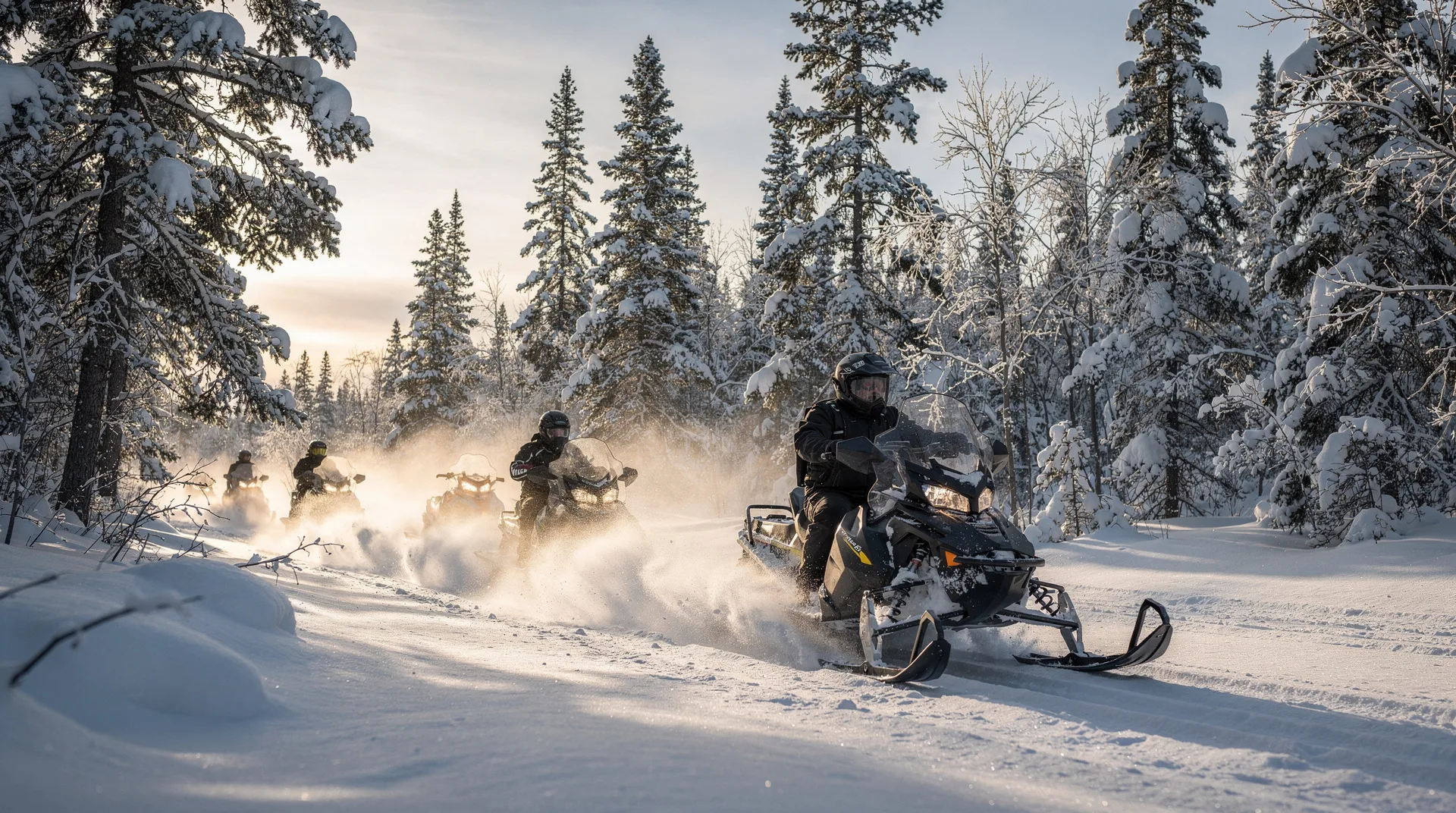
Snowmobile tours in Canada: Quebec, Ontario and Yukon adventures
Do I need experience to go on a snowmobile tour in Canada?
No prior experience is required for guided tours — operators provide a 20–30 minute training session before departure. A valid driver's licence is required to operate a snowmobile. First-timers can cover 100+ km on a guided day tour through forest and frozen lake terrain.
Snowmobiling in Canada is not a niche activity. Quebec alone has 33,000 km of groomed and marked snowmobile trails — more than the Trans-Canada Highway and its branches combined — forming an interconnected network that reaches from the US border to the boreal north, linking towns, traversing frozen lakes, and threading through forests that see no other winter traffic. In the Yukon, snowmobile routes follow the same paths that dog sledders and gold rush prospectors once travelled. In Ontario, the trail network connects fishing lodges and hunting camps to civilization across lakes that would be impassable in summer.
Snowmobiling here is a mode of winter travel with deep cultural roots — not just a recreational activity. That cultural depth is part of what makes guided snowmobile tours one of the more memorable Canadian winter experiences.
| At a glance | |
|---|---|
| Where | Quebec Laurentians, Saguenay-Lac-Saint-Jean, Ontario Muskoka/Cochrane, Yukon Whitehorse/Dawson |
| Cost | Around CAD 180-350/person half-day, 300-550/person full-day |
| Time needed | Half-day minimum; full-day or multi-day for the best routes |
| Getting there | Quebec: 1-2 hrs from Montreal; Ontario: 2-2.5 hrs from Toronto; Yukon: fly into Whitehorse |
| Best time | December through March, sometimes into April in the north |
Why take a guided snowmobile tour
Guided tours remove the logistical complexity from snowmobiling. You arrive at the operator’s base, receive training (typically 20–30 minutes covering controls, braking, and trail etiquette), are assigned a machine, and follow a guide through pre-scouted routes on maintained trails. Equipment is provided, fuel is included, and the guide handles route-finding and safety management.
For visitors without snowmobile experience, a guided tour also prevents the common error of getting a machine stuck in deep snow off-trail — something that happens to new riders with some regularity and is much less amusing than it sounds at -20°C in a remote forest.
Guided tours range from 2-hour introductory sessions to multi-day expeditions covering hundreds of kilometres with lodge-to-lodge accommodation.
A snowmobile day also fits neatly into a wider winter trip. Many visitors pair it with Quebec winter activities such as ice hotels and sleigh rides, or with a day of dog sledding in Canada for a very different way of travelling over snow. If you want the Quebec-specific picture of trails and clubs, our Quebec snowmobiling guide goes deeper.
Quebec: the snowmobile capital of the world
Quebec’s claim to be the world’s premier snowmobiling destination is credible. The 33,000 km of the Trans-Québec Snowmobile Network (IQTTQ) is the largest groomed snowmobile trail network on earth. The network connects all regions of the province, is maintained by regional snowmobile clubs (federated under the Fédération des clubs de motoneigistes du Québec), and intersects with hundreds of service points — fuelling stations, auberges (inns), and restaurants that cater specifically to snowmobilers.
Laurentians region (closest to Montreal)
The Laurentians offer the most accessible Quebec snowmobiling for Montreal-based visitors. Trail 23, the primary north-south corridor through the Laurentians, passes through Saint-Donat, Mont-Tremblant, and Labelle — a full day of riding from Montreal’s northern suburbs through classic Quebec countryside.
If you are building a base around the resort village, see Mont-Tremblant and the Montreal to Mont-Tremblant transfer guide for how to get there without a car hassle.
Guided tours from Mont-Tremblant take riders through the Laurentian forest, across Lac des Femmes, and along river valley corridors. Half-day tours (2–3 hours, approximately 80–100 km) and full-day tours are widely available.
Key operators: Multiple outfitters around Mont-Tremblant and Saint-Donat offer guided tours from CAD 180–350 per person for a half-day, including machine, fuel, and equipment.
Saguenay–Lac-Saint-Jean region
The Saguenay–Lac-Saint-Jean region is considered the heartland of Quebec snowmobile culture. Lac Saint-Jean (one of the larger inland lakes in Quebec) freezes by late December and the ice provides some of the most exhilarating open-lake riding in the province — flat, fast, and visually striking.
Guided lake tours, forest trail circuits through the boreal, and multi-day touring packages connecting small towns around the lake are all available. The region receives heavy snowfall (2+ metres annual average) and has excellent natural snow conditions from December through March.
Quebec City area
Several operators based in and around Quebec City offer snowmobile tours into the Laurentian hills north of the city — accessible as a day trip from the capital. Combining snowmobiling with the Quebec Winter Carnival (held in late January–early February) makes for an exceptional winter trip.
See our Quebec Winter Carnival guide for festival planning.
Browse guided snowmobile tours and winter adventure experiences across CanadaOntario: wilderness routes and lake country
Ontario’s snowmobile trail network — the Recreational Trails of Ontario (OFSC network) — covers over 30,000 km of trails, with particular concentration in the Muskokas, Haliburton Highlands, Algoma District (near Sault Ste. Marie), and the vast boreal north.
Muskoka and Haliburton
The cottage country north of Toronto transforms completely in winter. The lakes that are recreational playgrounds in summer become snowmobile highways — wide, flat, and fast. The Muskoka Lakes snowmobile trails are accessible from Gravenhurst, Bracebridge, and Huntsville.
Day tours from Huntsville take riders across Lake of Bays, through Algonquin Park boundary trails, and along river corridors. The scenery is beautiful, the snowmobile infrastructure (fuelling, warming huts) is well-developed, and the proximity to Toronto (2–2.5 hours) makes it an accessible weekend option.
Cochrane and Polar Bear Express country
The northern Ontario town of Cochrane is the departure point of the Polar Bear Express train (summer) and a hub for serious snowmobile touring in winter. The trail network north of Cochrane extends into genuinely remote boreal territory — routes to Kapuskasing, Hearst, and ultimately toward James Bay for the most committed riders.
Several Cochrane-based operators run guided winter wilderness tours that include snowmobile travel, overnight lodging in remote camps, and a rawness of northern Ontario that southern Ontario cannot replicate.
Yukon: remote wilderness snowmobiling
Yukon snowmobiling operates at a completely different scale from Quebec and Ontario. Routes here traverse mountain passes, frozen rivers, and taiga wilderness that has barely changed since the Klondike gold rush. The Yukon has no network of roadside auberges — you are in genuine wilderness, and tour operators manage the logistics carefully.
Whitehorse area
Guided snowmobile tours from Whitehorse reach into the boreal forest of the Ibex Valley, along the frozen Yukon River, and up into the foothills of the Coast Mountains. Day tours (4–6 hours) cover 80–150 km of varied terrain.
Many Whitehorse snowmobile operators combine the experience with Northern Lights viewing — heading out at dusk to watch the aurora from open terrain and returning after dark. This combination (snowmobile + aurora) is one of the most sought-after Yukon winter experiences.
Book Whitehorse snowmobile tours with northern lights viewingDawson City area
Dawson City’s gold rush history is visible in the snowmobile trails that follow the original mining routes into the Klondike valleys. Day and multi-day tours from Dawson take riders through Bonanza Creek (where gold was first discovered in 1896), up to the Midnight Dome overlook, and through the vast Yukon backcountry.
For a broader look at what the territory offers in the cold months, the Yukon destination page and our guide to northern lights in Yukon help you decide how many nights to give the trip.
Multi-day snowmobile expeditions
For the most immersive experience, multi-day snowmobile touring in Quebec covers distances and terrain that single-day tours cannot approach.
Quebec’s Trans-Québec Trail: Several operators offer guided multi-day packages — typically 3–5 nights — following sections of the main trail network between towns, with accommodation at snowmobiler-specific auberges and gîtes along the route. Packages from CAD 800–1,500 per person for 3 nights include machine rental, accommodation, breakfast, and guiding.
Saguenay–Lac-Saint-Jean circuit: A 4-day circuit around the lake covers approximately 700–900 km, connecting the major communities and crossing the lake multiple times. One of the classic Canadian snowmobile routes.
Choosing a region: Quebec vs Ontario vs Yukon
| Region | Trail network | Scenery | Best for |
|---|---|---|---|
| Quebec | 33,000 km groomed, auberge-linked | Boreal forest, frozen lakes | First-timers, multi-day touring, Quebec winter carnival combos |
| Ontario | 30,000 km (OFSC), cottage country + far north | Muskoka lakes, remote boreal near Cochrane | Toronto-based weekenders, Algonquin fringe riding |
| Yukon | Unmarked backcountry routes, no roadside auberges | Mountain passes, frozen rivers, taiga | Wilderness riders combining with aurora viewing |
Licence and age requirements
Driver’s licence: In all provinces, operating a snowmobile on trails and public land requires a valid driver’s licence. International licences are generally accepted.
Age minimums: Operators typically require riders to be at least 18 (sometimes 16 with parental consent for supervised riding). Passengers must meet minimum age/weight requirements set by the operator.
Trail passes: Quebec snowmobile trails require a valid trail pass (included in most guided tour packages). The FCMQ day pass is approximately CAD 50; season pass is approximately CAD 260.
Costs in CAD
| Experience | Estimated cost (CAD) |
|---|---|
| Half-day guided tour (Quebec/Ontario) | 180–350/person |
| Full-day guided tour | 300–550/person |
| Multi-day guided package (3 nights, Quebec) | 900–1,500/person |
| Snowmobile rental (self-guided, per day) | 200–350 |
| Quebec trail pass (day) | 45–55 |
| Yukon guided day tour | 280–450/person |
Cold-weather planning goes beyond the ride itself. Our Canada in winter and packing list guides cover the wider clothing and logistics picture, which is useful if snowmobiling is only one stop on a longer itinerary such as the Quebec winter 7-day itinerary.
What to bring and wear
Snowmobiling generates wind chill even on a calm day — at 80 km/h, a -10°C day feels like -25°C or colder on exposed skin. Operators provide helmets and typically snowmobile suits, but dressing correctly underneath matters.
Base layers: Thermal base layer (merino wool or synthetic) top and bottom.
Mid-layer: Fleece or insulated vest under the provided snowmobile suit.
Neck gaiter and balaclava: Essential. The gap between helmet and collar is where wind chill hits hardest.
Hand warmers: Even with insulated gloves (usually provided), hand warmers are appreciated on cold days.
Waterproof boots: Your feet sit still on the machine while the rest of you moves — feet get cold faster than on active winter sports. Good insulated winter boots to -30°C are recommended.
Where to stay
Quebec Laurentians: Stay in Mont-Tremblant or Saint-Donat for access to guided tours. Snowmobiler-friendly auberges exist throughout the Laurentian trail network if you are touring independently.
Muskoka (Ontario): Huntsville and Bracebridge have hotels, inns, and rental cottages. The Deerhurst Resort near Huntsville is a full-service resort with proximity to the trail network.
Whitehorse: City hotels — the Days Inn Yukon and High Country Inn are convenient bases for snowmobile operators.
See our Aurora watching guide for combining northern lights experiences with Yukon winter trips.
Frequently asked questions about Snowmobile tours in Canada: Quebec, Ontario and Yukon adventures
Is snowmobiling safe for complete beginners?
Yes, with a reputable operator and a proper briefing. The main risks for new riders are going too fast (most operators set speed governors on beginner machines), leaving the marked trail (where you can get stuck), and forgetting to brake appropriately in soft snow. A 20-minute briefing before departure covers all of this. Follow your guide, stay on marked trails, and do not exceed your comfort level.
How far does a typical guided day tour cover?
A full-day guided tour in Quebec typically covers 150–300 km. A half-day tour covers 80–120 km. In the Yukon, terrain is more varied and distances are typically shorter for a given number of hours.
Can children ride as passengers?
Yes — most operators allow children as passengers with the driver. Minimum weight and age varies by operator (typically 5+ years, minimum 20–25 kg). Children require a properly fitting helmet (operators provide these in various sizes). Discuss with operators when booking.
What is the snowmobiling season in Canada?
Quebec and Ontario: December through March (sometimes into April in northern areas). The Yukon: December through April, with the most reliable snow conditions January through March.
Do I need travel insurance for snowmobiling?
Check your travel insurance policy carefully. Many standard travel insurance policies exclude motorized vehicle accidents or require an adventure sports rider. Specifically confirm that snowmobiling is covered before departure. Operators carry their own liability insurance covering guided activities.
Is snowmobiling better in Quebec or the Yukon for a first tour?
Quebec is the easier introduction: shorter half-day options, a huge network of auberges for warming up and eating, and gentler forest and lake terrain. The Yukon is more remote and scenic but tours run in smaller windows and often combine with aurora viewing, which suits travellers already planning a northern lights trip rather than a snowmobile-first visit.