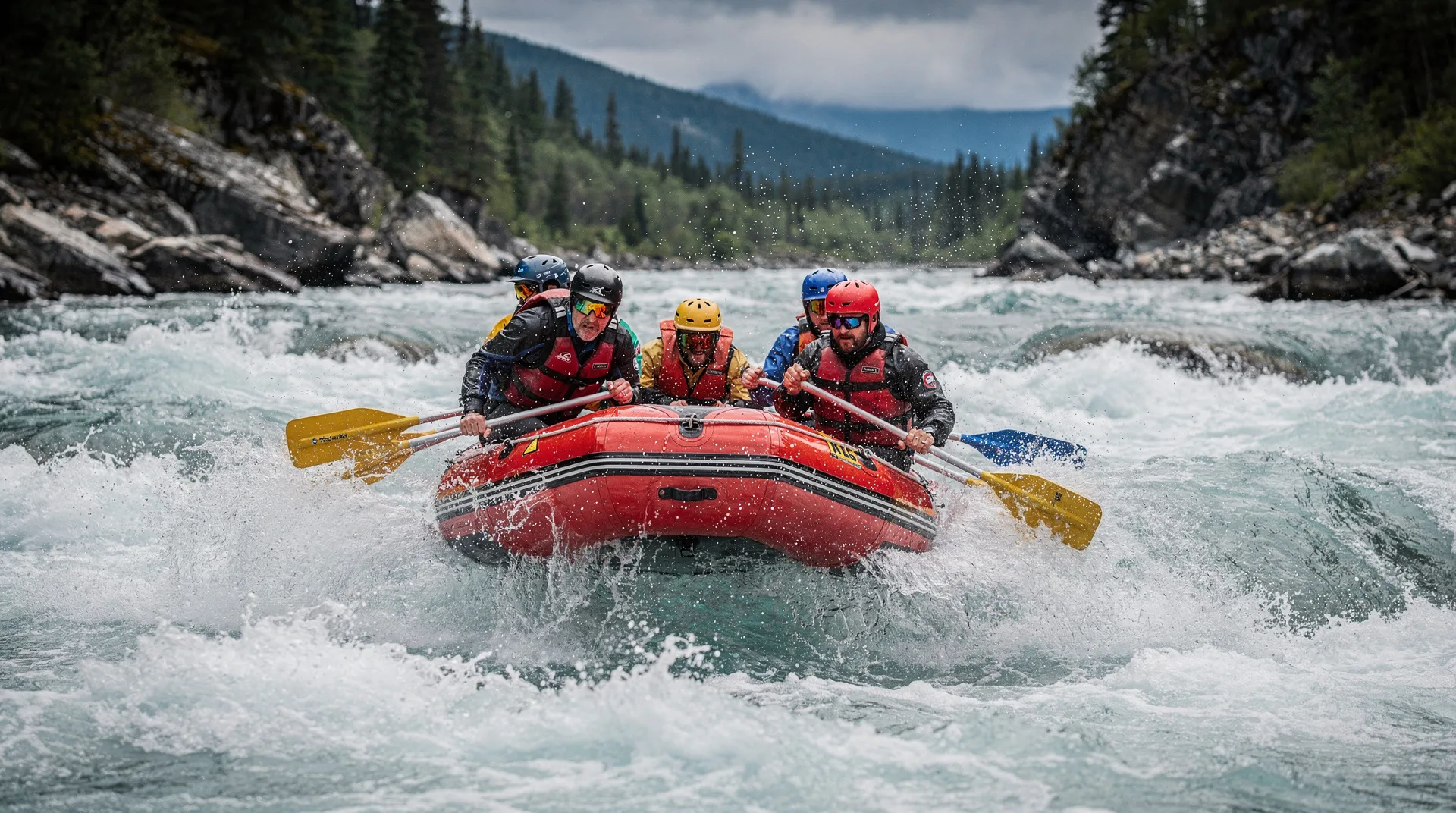
Whitewater rafting on the Ottawa River: Ontario and Quebec's best rapids
Is the Ottawa River good for whitewater rafting?
Yes — the Ottawa River is one of the top whitewater rafting destinations in North America, with Class III to Class V rapids running through the Ottawa Valley on the Ontario-Quebec border. Commercial rafting operators offer half-day, full-day, and multi-day trips suitable for beginners through experts, with the most intense rapid sections around Beachburg, Ontario and Lachute, Quebec.
| At a glance | |
|---|---|
| Where | Ottawa Valley, around Beachburg, Ontario and Rivière-Rouge/Lachute, Quebec |
| Cost | Around CAD 65-85 half-day, CAD 99-150 full-day per person |
| Time needed | Half-day to full weekend (camping packages available) |
| Getting there | About 2 hours’ drive from Ottawa; some operators run bus transport from the city |
| Best time | June-July for the best balance of big water and warmth; May for the most extreme rapids |
The Ottawa River doesn’t look threatening from the city’s riverfront promenades. But drive two hours upstream from Ottawa and the river transforms. The Ottawa Valley narrows, the Canadian Shield bedrock forces the water through granite channels, and the result is some of the most powerful commercially raftable whitewater in eastern North America. Hydraulics the size of school buses, standing waves that swallow rafts whole, and drops that send entire eight-person boats airborne — the Ottawa River offers a spectrum of intensity that few rivers anywhere can match.
What makes the Ottawa particularly well suited to rafting is the combination of volume and consistency. The river runs high enough through the spring and summer to maintain Class IV and V water on the upper sections while offering gentler Class III routes for families and first-timers. Multiple operators compete for business on both the Ontario and Quebec sides of the river, driving service quality high and prices competitive. And the surrounding Ottawa Valley offers camping, accommodations, and a full outdoor tourism infrastructure that makes the river easy to visit even without prior whitewater experience.
Understanding the Ottawa River’s whitewater
River sections and rapid classifications
The Ottawa River’s rafting geography divides into two broad zones.
The upper section around Beachburg, Ontario (near the Wilderness Tours resort) is the heart of the commercial rafting industry. This stretch runs approximately 25 km and contains the river’s most famous rapids: McCoy’s Chute (Class V), the Lorne (Class V), Coliseum (Class IV+), and Garvin’s Chute (Class IV+). These are rapids that have defined North American commercial rafting since the industry developed here in the 1970s.
The lower section around Rivière-Rouge and Lachute in Quebec provides a slightly gentler but still exhilarating experience, with rapids generally ranging from Class III to Class IV. This section is popular with families and groups who want high-energy rafting without the sheer intensity of the upper section’s Class V drops.
Rapid classification explained:
- Class III: Regular waves, small drops, some maneuvering required — suitable for most adults including beginners
- Class IV: Long, difficult rapid with powerful irregular waves, possible large drops — suitable for fit adults after orientation
- Class V: Extremely difficult, long, violent rapids — operators typically screen participants; swimming these is dangerous
Spring vs. summer water levels
Spring runoff (April–May) raises the Ottawa River to its highest levels and most powerful flows. Spring rafting is spectacular — the volume of water creates hydraulics and waves that are larger and more violent than anything seen in summer. Many operators offer “extreme” spring programs specifically for this high-water season.
Summer water levels (June–September) are lower and more moderate, though still Class IV–V on the upper section. The river is warmer (18–22°C surface temperature versus 8–12°C in spring), swimming holes become accessible, and the experience skews toward fun rather than sheer intensity.
Best operators on the Ottawa River
Wilderness Tours (Beachburg, Ontario)
Wilderness Tours has operated on the Ottawa River since 1972 and is the largest and most established operator on the river. Their resort at Beachburg has camping, glamping, and cabin accommodation directly on the water, plus a beach, volleyball courts, and evening entertainment — many guests make a weekend of it rather than just a single-day trip.
They run three distinct rafting programs: a beginner/family route focused on the Class III sections, a standard mixed-water day that includes some Class IV, and a hardcore program hitting the Class IV–V upper canyon sections. Multi-day packages combining camping and rafting are available and represent excellent value compared to booking separately.
OWL Rafting (Foresters Falls, Ontario)
OWL Rafting, operating from Foresters Falls about 20 minutes from Beachburg, is the other long-standing giant of Ottawa River rafting. Their day programs are similar in structure to Wilderness Tours, and they have a loyal following who prefer their guides and atmosphere. OWL’s campground is well maintained and popular for weekend packages.
The choice between OWL and Wilderness Tours often comes down to dates and availability — on peak summer weekends, both fill quickly and booking a few weeks ahead is advisable.
Equinox Adventures (Ottawa)
For visitors who want to combine Ottawa city sightseeing with a rafting day, Equinox Adventures offers full-day guided trips departing from Ottawa with transportation to and from the river included. This eliminates the need for a rental car and makes the experience accessible to travellers staying in the city.
Browse Ottawa River and Canada adventure tours on GetYourGuide for additional day trip options departing from Ottawa.
Rafting Québec (Rivière-Rouge sector)
On the Quebec side, Rafting Québec operates from the Rivière-Rouge sector near Lachute and offers a very competitive full-day program on the lower section of the Ottawa/Rouge system. Their routes are typically Class III–IV, making them an excellent choice for first-timers or families with older children. The scenery is beautiful and the guides are bilingual French-English.
Find day trips and adventure activities from Toronto and eastern Canada on GetYourGuide for options connecting urban visitors to Ontario and Quebec’s outdoors.
River Run (Beachburg)
River Run Rafting, also based at Beachburg, is a smaller operator that appeals to groups seeking a less resort-style experience. Their guide-to-raft ratio tends to be high and the emphasis is on safety education and river reading. Good choice for groups where some members have no prior experience.
Best time of year
May (high water): The most intense rafting of the year. Snowmelt from the Laurentian Highlands drives the river to peak volume. Class V rapids are at their most powerful. Water temperature is cold (8–12°C), wetsuits are mandatory, and the experience is more extreme than at any other time. Not recommended for first-timers.
June–July (optimal): The ideal combination of volume and warmth. The river has dropped slightly from spring peak but is still running strong Class IV–V. Water temperatures are comfortable in wetsuits and some sections allow swimming. This is the busiest booking period.
August (summer peak): Lower water levels create some technical changes — a few Class V sections become Class IV, but others become more technical as water concentrates in channels. August is warm, the river is swimmable, and the social atmosphere at riverside resorts is at its best.
September (shoulder): Excellent rafting at lower volume, beautiful autumn foliage beginning in the valley, fewer crowds. Some operators have reduced schedules after Labour Day. For those who dislike crowds, early September offers good conditions.
Season at a glance
| Month | Water level | Water temp | Crowds |
|---|---|---|---|
| May | Highest, most powerful | Cold, 8-12°C | Light — experienced rafters only |
| June-July | Strong, still Class IV-V upper | Comfortable in wetsuit | Busiest — book 3-6 weeks ahead |
| August | Lower, more technical in places | Warm, swimmable | Busy, social resort atmosphere |
| September | Lower, gentler | Cooling | Light — good for avoiding crowds |
How to book and what to bring
Booking: Weekend slots in June and July fill 3–6 weeks ahead for the major operators. Weekday bookings are more flexible. Spring extreme programs fill even faster due to their limited availability. Book directly with operators or through aggregators for date flexibility.
What operators provide: Wetsuit, wetsuit booties, paddle jacket, PFD, helmet, paddle, safety instruction. All rafts and guide equipment are included.
What to bring:
- Athletic clothes to wear under the wetsuit (shorts and a rash guard or synthetic base layer — no cotton)
- Secure footwear that will stay on your feet (old sneakers, sandals with straps, or water shoes)
- Dry clothes and towel for after
- Sunscreen
- Secure sunglasses strap if wearing glasses
- A dry bag for personal items (most operators sell or rent these)
- Prescription medications if needed
- Willingness to get completely wet
What to leave behind: Jewellery, loose electronics, and anything you’d regret losing in a Class V rapid. Most operators have secure storage at their base.
Costs in Canadian dollars
Half-day beginner rafting: CAD 65–85 per person Full-day standard program: CAD 99–135 per person, including wetsuit gear Full-day Class IV–V program: CAD 115–150 per person Weekend package (2 days rafting + camping): CAD 220–310 per person Spring extreme one-day: CAD 130–165 per person Multi-day packages (3 days): CAD 350–500 per person all-inclusive
Prices generally include equipment rental but check what is included when comparing operators — some charge separately for wetsuits or meals.
Safety and what to expect on the water
Ottawa River operators have excellent safety records built over decades of commercial rafting. The risks are real but managed.
Swimming Class IV–V rapids: It happens. Every orientation covers the defensive swimming position (feet downstream, on your back, toes up) and how to re-enter a raft. Most swims are brief and controlled. The guides position safety kayakers at the base of major drops specifically to assist swimmers.
Physical requirements: Most operators require participants to be able to swim and to be in reasonable physical health. Weight limits exist for some programs (typically 113 kg / 250 lbs maximum). Children under 12 are generally restricted to Class III sections.
Pregnancy and medical conditions: Whitewater rafting is contraindicated during pregnancy and for those with recent back injuries, shoulder dislocations, or heart conditions. Check with your doctor and inform the operator of relevant conditions at booking.
Listen to your guide: The pre-trip safety briefing is not optional theatre. It covers the high-side command (everyone throws their weight to one side to prevent a flip), the low-brace position, and what to do if you fall out. Guides have managed hundreds of trips on each rapid; their commands are based on real-time reading of water that is flowing differently every day.
Where to stay nearby
Wilderness Tours Resort (Beachburg): On-site camping (tents and RVs), glamping tents, and private cabins. Booking accommodations directly with the rafting resort is the simplest option for weekend packages. Campsite from CAD 40/night; cabins from CAD 180/night.
Ottawa: The city is 2 hours downstream and offers the full range of hotels from budget chains to luxury properties. Suitable as a base if combining rafting with Ottawa sightseeing.
Pemberton/Renfrew: The town of Renfrew, Ontario, 30 minutes from Beachburg, has motels and B&Bs for those who prefer off-site accommodation. Petawawa and Pemberton also have options.
For more eastern Canada adventure ideas, see the guide to skating the Rideau Canal, the Algonquin Provincial Park guide, and the best hikes in Canada overview.
Building rafting into a wider trip
Rafting works best as one highlight in a longer route rather than the only reason to travel. Most visitors anchor themselves in Ottawa, where the Parliament Hill guide and the Ottawa weekend itinerary cover the city side of the trip. The guide to day trips from Ottawa gives more ideas for the days when you are not on the water, and the Outaouais region on the Quebec bank of the river is a natural neighbour for anyone crossing the border between provinces.
If you are arriving from further away, the Toronto to Ottawa guide and the Toronto to Ottawa road trip itinerary show how to break up the drive, while the guide to trips from Montreal suits travellers coming from the Quebec side. Since the river sits well outside the city, it is worth reading about renting a car in Canada before you decide how to reach the put-in.
Rafting also pairs well with other paddling and outdoor days. If the river whets your appetite, the overview of whitewater rafting across Canada compares other regions, and the packing list helps you pull together the layers and dry clothes you will want for a day that starts cold and ends in the sun. For a calmer day on the water afterwards, the Ontario canoeing routes are a gentler follow-up.
Ottawa River vs other Canadian whitewater
Compared to the more famous Athabasca and Sunwapta rivers near Jasper, the Ottawa River offers consistently bigger, more technical water — its Class IV-V sections rival anything in western Canada, while the Rockies rivers are generally gentler and more scenic-focused.
Compared to BC’s white water rafting rivers, the Ottawa has the advantage of proximity to a major city (2 hours from Ottawa versus a longer haul to most BC rivers) and a longer, more established commercial season. If your priority is the biggest, most technical water reasonably close to a major eastern Canadian city, the Ottawa River has no real rival; if scenery and glacier-fed mountain backdrops matter more than pure water intensity, the Rockies rivers are the better choice.
Frequently asked questions about Whitewater rafting on the Ottawa River: Ontario and Quebec’s best rapids
Can I go rafting if I can’t swim?
Some operators accept non-swimmers on Class III sections with extra precautions, but the majority require participants to be able to swim for Class IV–V programs. The PFD will keep you afloat, but the ability to swim confidently helps you manage a swim through rapids correctly. Be honest with the operator at booking.
What is the minimum age for Ottawa River rafting?
Class III family sections typically accept children aged 7–8 minimum. Class IV–V programs usually require a minimum age of 12–14 depending on the operator and the section. Children must be able to follow commands quickly and handle cold water. Check with your specific operator.
Do I need to bring my own wetsuit?
No. Wetsuits, wetsuit boots, and paddle jackets are standard equipment included with all Ottawa River rafting programs. You will wear a 3mm or 5mm wetsuit over your own synthetic base layers.
Is Ottawa River rafting dangerous?
Commercial rafting on the Ottawa River has a strong safety record, but it is a legitimate adventure sport with real risks. Class V rapids can pin swimmers against rocks, and capsizes are not uncommon on extreme water days. Operators mitigate risk through guide training, safety kayakers, mandatory equipment, and thorough orientation. Serious injuries are rare; minor bruises and adrenaline are common.
How far in advance should I book?
For June and July weekends, 3–6 weeks is realistic for the major operators. Spring extreme programs and holiday weekends (Victoria Day, Canada Day) can sell out 2 months ahead. Weekdays in summer and all September slots are bookable with much less lead time.
What if the weather is bad?
Rafting runs in rain — it makes no practical difference once you’re in a wetsuit. Thunderstorms cause temporary holds on the river. Lightning is the primary weather cancellation trigger; cold temperatures, overcast skies, and light rain do not stop trips. Operators communicate weather cancellations directly with participants.
Which is better for a first-timer, Ontario or Quebec side operators?
For genuine first-timers, the Quebec-side operators around Rivière-Rouge and Lachute, running mostly Class III-IV, are the gentler entry point. The Ontario-side operators at Beachburg (Wilderness Tours, OWL Rafting) offer beginner programs too, but they’re also the gateway to the Class IV-V upper canyon, so double-check which specific program you’re booking rather than assuming “Ontario side” means the intense version.
Can I go rafting on the Ottawa River without a car?
It’s harder than on the Athabasca in Jasper, but not impossible — Equinox Adventures and some other operators run bus transport directly from Ottawa, which removes the need for a rental car. Without that option, a car is effectively required to reach Beachburg or Rivière-Rouge.
Can I combine rafting with an Ottawa city visit?
Yes. Ottawa is a 2-hour drive from Beachburg. Many operators offer bus transport from Ottawa to the river, making a combination trip straightforward. The city’s major attractions — Parliament Hill, the National Gallery, the Byward Market — are easily covered over a day or two before or after rafting.