Quebec Christmas Markets: Old Quebec, Montreal and Beyond
When are Quebec's Christmas markets open?
Most Quebec Christmas markets run from late November through December 24. Old Quebec's German-inspired Christmas market operates in the Quartier Petit-Champlain from late November to Christmas Eve. Montreal's German Christmas Market in the Old Port runs a similar schedule. Several smaller markets in the Eastern Townships and Laurentians open on November weekends.
December in Quebec has a quality that no other month can match. The first serious snowfalls arrive in late November, dusting the cobblestones of Old Quebec and the iron staircases of Montreal’s Plateau with white. The historic buildings and fortifications, already extraordinary in other seasons, take on a fairy-tale quality under snow and festival lighting. And across the province, Christmas markets bring the warmth of mulled wine, artisan crafts, and the particular atmosphere of French-Canadian holiday culture to outdoor squares and pedestrian streets.
Quebec’s Christmas markets draw on both European tradition (particularly Alsatian and German influences, reflecting the province’s history of cultural exchange) and distinctly local elements — maple products, Inuit-inspired crafts, Quebec artisan cheese and charcuterie, and the warm, convivial atmosphere that the province does better than almost anywhere. This guide covers the major markets, their timing, and how to make the most of a December visit to Quebec.
| At a glance | |
|---|---|
| Where | Old Quebec (Petit-Champlain) and Montreal’s Old Port, plus smaller markets in the Laurentians and Eastern Townships |
| Cost | Free to enter and browse; mulled wine, food and crafts typically CAD 5-20 per item |
| Time needed | Half a day is enough for one market; a full day if combining a market with wider Old Quebec or Old Montreal sightseeing |
| Getting there | Both major markets are walkable from the historic cores, or reachable by metro (Montreal) |
| Best time | Late November through December 24; evenings and weekday visits are least crowded |
Old Quebec Christmas market: Marché de Noël allemand de Québec
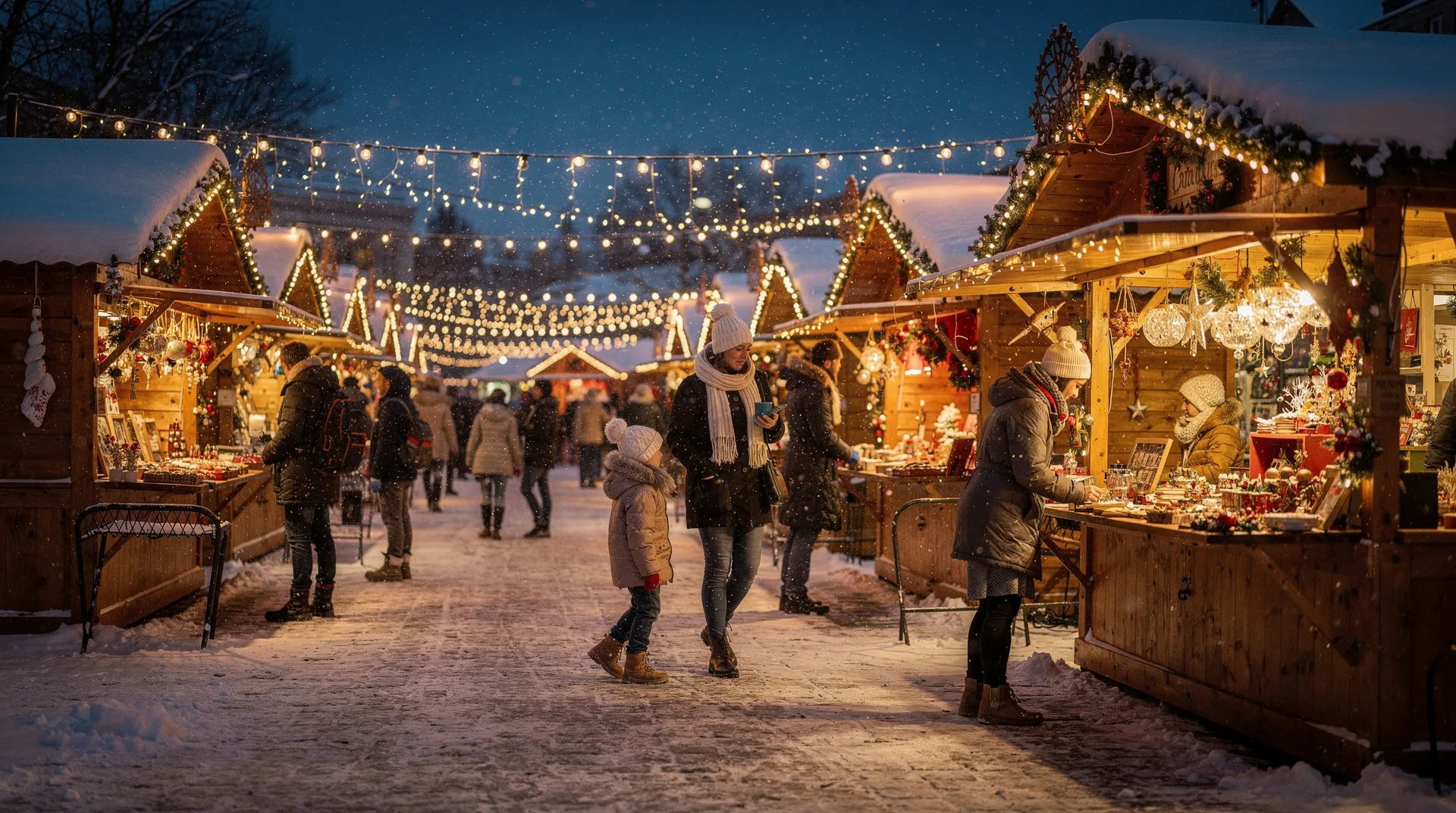
The Christmas market in Quebec City’s Quartier du Petit-Champlain is among the most atmospherically perfect Christmas market settings in North America. Rue du Petit-Champlain — already one of the most photogenic streets in Canada with its narrow, sloping lane and heritage stone buildings — is transformed in December with wooden market stalls, strings of lights, and decorations that nod explicitly to the Alsatian Christmas market tradition.
The setting
The Petit-Champlain market occupies the foot of Cap Diamant, in the Lower Town beneath the Château Frontenac. Visitors descend via the funicular from the Upper Town (Haute-Ville) or climb the Escalier Casse-Cou (the “Breakneck Stairs”) — the oldest stairway in North America. The surrounding streets, including Place Royale (the birthplace of French civilization in North America, where Samuel de Champlain founded the city in 1608), add historical depth to the holiday atmosphere.
The market typically runs from late November through December 24, with stalls operating daily. Evening visits — when the market is illuminated and snow is frequently falling — are the most evocative.
What to find
Artisan crafts: Quebec and local artisans dominate the stall offerings — hand-turned wooden objects, ceramics, glasswork, hand-knitted items, and leather goods from Quebec producers. Quality is generally higher than the mass-produced imports that dilute many European Christmas markets.
Food and drink: Vin chaud (mulled wine), hot cider, and crêpes are the sustaining street foods. Several stalls sell maple confections — maple butter on fresh-baked baguette being a particular local speciality. Traditional Québécois foods including tourtière (meat pie) and sugar pie appear in various forms.
German connection: The market’s official “German” designation reflects a twinning relationship between Quebec City and Bremerhaven; several stalls sell German ornaments, lebkuchen (gingerbread), and glühwein alongside the Quebec artisan offerings.
Book a Quebec City Christmas walking tour through Old Town and Petit-ChamplainMontreal’s German Christmas Market (Marché de Noël allemand de Montréal)
Montreal’s largest and most established Christmas market occupies the esplanade of the Old Port of Montreal, in the heart of Vieux-Montréal. The market runs from late November through Christmas Eve and draws approximately 300,000 visitors annually.
The Old Port setting
The Old Port (Vieux-Port) waterfront, with its 19th-century stone warehouses and views over the St. Lawrence River to the south shore, provides a dramatic winter backdrop. The market’s wooden stalls are arranged in rows along the esplanade, with a central performance area for live music, choir performances, and children’s events.
The surrounding Vieux-Montréal — the oldest neighbourhood in the city, with cobblestone streets and the extraordinary Basilique Notre-Dame de Montréal — amplifies the market’s atmosphere. Walking from the market through Place d’Armes to the basilica on a December evening, with the building’s facade illuminated and snow on the cobblestones, is one of Montreal’s finest experiences.
What makes the Montreal market distinctive
Scale and variety: The Old Port market is considerably larger than the Quebec City market, with more stalls (typically 80 to 100) and a broader mix of vendors — crafts, food, decorations, and clothing from both Quebec artisans and international vendors.
German authentic stalls: The market’s German partnership means authentic Bavarian market products — original ornaments from Nuremberg, traditional German Christmas biscuits, handcrafted nutcrackers — alongside the local Quebec offerings.
Ice rink integration: The Old Port’s outdoor ice rink, one of Montreal’s best, operates adjacent to the market from late November onward. Skating at dusk in the market atmosphere, then warming up with a cup of vin chaud, is the ideal Montreal Christmas market experience.
Evenings and weekends: The market is busiest on Saturday evenings and in the weeks leading up to Christmas Eve. Weekday visits, particularly Tuesday through Thursday evenings, offer a more relaxed atmosphere with shorter queues at food stalls.
Book a Montreal Christmas and Old Port highlights guided tourRegional Christmas markets in Quebec
Beyond Montreal and Quebec City, a number of smaller Christmas markets in the regions offer experiences that the large city markets cannot replicate — scale is smaller, but atmosphere is often more intimate and the artisan quality higher.
Marché de Noël de Tremblant, Laurentians
The pedestrian village at the base of Mont-Tremblant ski resort is an ideal Christmas market setting: car-free cobblestones, mountain backdrop, and a resort village that is fully operational and beautifully lit throughout December. The market here focuses on artisan crafts and regional food products, with wooden stalls arranged through the village’s main street.
The combination of Christmas market and ski season opening (Tremblant typically opens in late November) makes this particularly attractive for visitors who want to combine holiday market atmosphere with early-season skiing. The resort’s hotels and condo accommodation are available from the market’s opening.
Eastern Townships markets
The Eastern Townships (Cantons-de-l’Est) are natural Christmas market territory — the region’s farmhouse and vineyard culture, heritage architecture, and European roots provide ideal context. Several notable markets run through December:
Marché de Noël de Granby: One of the larger regional markets, held in the civic centre area of Granby with local artisan emphasis.
Marchés de Noël, Magog and Orford: The lakeside town of Magog hosts a smaller market focused on quality artisan crafts, and the Orford Arts Centre (Musée des beaux-arts de Sherbrooke) typically presents a curated craft fair through December.
Vignobles en fête de Noël: Several Eastern Townships vineyards — the region has over 40 — open their cellars for Christmas market events in November and December. These typically involve wine tasting combined with artisan stall markets on the vineyard property, with vin chaud made from the estate’s own production.
Marché de Noël de Sherbrooke
The Eastern Townships’ largest city hosts a substantial Christmas market in its downtown core through December, with a strong focus on Quebec artisan crafts and regional food products.
What to buy at Quebec Christmas markets
Quebec Christmas markets offer genuinely distinctive products that make meaningful gifts and souvenirs:
Maple products: The range goes well beyond maple syrup. Maple butter, maple sugar, maple vinegar, maple wine, and maple-infused spirits are all available from Quebec producers. Sugar shack operators often have market stalls in December selling their year’s production.
Quebec artisan foods: Regional cheeses (Quebec has an extraordinary artisan cheese tradition — look for raw-milk cheeses from Île d’Orléans, Charlevoix, and the Laurentians), cured meats from local charcuteries, artisan preserves, and organic honeys.
Indigenous crafts: Several market stalls carry Inuit and First Nations crafts — soapstone carvings, beadwork, and prints from Quebec’s northern communities. These are among the most genuinely distinctive and culturally significant products available.
Local ceramics and glasswork: Quebec has a strong craft tradition in both ceramics and blown glass. Several producers maintain market stalls at the major markets in Quebec City and Montreal.
Wood crafts: The province’s forestry heritage translates into a tradition of high-quality wooden objects — turned bowls, carved figures, and decorative pieces from Quebec hardwoods.
December weather and what to expect
December in Quebec is genuinely cold, and snow is reliable in both major cities by mid-month.
| City | December avg low | December avg high | Snow probability |
|---|---|---|---|
| Montreal | -12°C | -3°C | High by mid-December |
| Quebec City | -16°C | -6°C | Higher than Montreal; reliably white |
| Laurentians | -17°C | -7°C | Reliable snow from late November |
| Eastern Townships | -12°C | -4°C | Variable; usually white by Christmas |
For Christmas market visits, the dress code is full winter gear: insulated boots, a quality down jacket or equivalent, warm hat, gloves, and a scarf. Standing at outdoor market stalls for an hour is colder than walking, so hand warmers are a useful addition. Most markets have warm indoor refuge spaces — cafés adjacent to the market, or heated tents within the stall area — for warming breaks.
The practical advantage of the cold: outdoor Christmas markets are vastly more atmospheric in genuine winter than in the mild December conditions of many European markets. Snow on the market roofs, breath visible in the lantern light, and the contrast between cold outdoor air and a warm cup of vin chaud in hand is the complete market experience.
Christmas beyond the markets
Quebec’s December extends beyond the market stalls:
Reveillon (Christmas Eve dinner): The traditional Québécois Christmas Eve is centred on a large family meal after Midnight Mass. Traditional dishes — tourtière, ragoût de pattes (pork knuckle stew), bûche de Noël cake — reflect the province’s French-Canadian culinary heritage. Many Quebec City and Montreal restaurants offer réveillon menus on December 24, allowing visitors to participate in the tradition.
Basilique Notre-Dame Midnight Mass: The Basilique Notre-Dame in Montreal’s Old Town has been the city’s most prestigious venue for Christmas Midnight Mass for centuries. The extraordinary blue-and-gold interior, lit by thousands of candles, makes this one of the most beautiful Midnight Mass experiences in North America. Tickets are required for the main Christmas services.
Old Quebec under snow: The winter lighting of Old Quebec through December — including the illumination of the Château Frontenac, the festooned streets of Petit-Champlain, and the ice rinks of the Plains of Abraham — makes the city worth visiting in December well beyond the market itself.
New Year’s Eve (Saint-Sylvestre): Both Montreal and Quebec City celebrate New Year’s Eve with large public events. Quebec City’s outdoor celebrations on the Plains of Abraham typically include live concerts and fireworks. Montreal’s celebrations range from large Old Port events to neighbourhood parties across the city.
Getting there and practical logistics
From the US or international: Montreal-Trudeau International Airport is the main gateway, with Quebec City’s Jean-Lesage Airport as the secondary option. See the Quebec entry gateways guide for a complete comparison. December is a peak travel period — book flights early, particularly around Christmas week and the New Year.
Between cities: VIA Rail’s service between Montreal and Quebec City runs multiple times daily, takes approximately 3 hours 20 minutes, and drops passengers at central stations in both cities. See the VIA Rail within Quebec guide for schedules and booking. Driving is the alternative, with Highway 40 or 20 covering the 270-kilometre distance in approximately 2.5 to 3 hours in clear conditions.
Markets and transit: Both the Old Port Montreal market and the Petit-Champlain Quebec City market are easily accessible by metro (Montreal) and walking from the Old City (Quebec City). No car is needed for the major markets.
Montreal vs Quebec City: which market fits your trip
If you can only visit one city in December, the choice comes down to what you want from the trip rather than the market alone. Montreal offers more scale — a bigger market, an adjacent ice rink, and the wider dining and nightlife of a large city, which suits travellers wanting a full urban December break. Quebec City offers atmosphere concentrated into a smaller, more walkable space — Petit-Champlain under snow is arguably the most photogenic Christmas market setting in North America, and the compact Old City means less time moving between sights.
Comparing the year-round versions of both cities in Quebec City vs Montreal is useful background, since the same trade-offs (scale versus intimacy) apply in December as in any season. Travellers with the full week available should simply do both — VIA Rail within Quebec makes the connection straightforward without a car.
Related guides
- Quebec in winter: carnival, ice hotel and skiing
- Quebec City vs Montreal as a first-timer entry point
- VIA Rail within Quebec: Montreal to Quebec City and beyond
- 7 days in Quebec: Montreal, Quebec City and a day in Charlevoix
Frequently asked questions about Quebec Christmas Markets: Old Quebec, Montreal and Beyond
Are Quebec Christmas markets free to enter?
The outdoor markets in both Quebec City and Montreal are free to enter and browse. Some specific events within the markets — concerts, workshops, or children’s activities — may require tickets or registration. Food and drink stalls operate with normal pricing. The Hôtel de Glace and other winter attractions near Quebec City are separate experiences with their own admission.
Is December a good time to visit Quebec City for the first time?
Yes, with realistic expectations about the cold. Old Quebec under December snow is one of the most beautiful urban winter scenes in North America. The Petit-Champlain market, the Château Frontenac illuminated against dark winter skies, and the city’s excellent restaurants and cafés all operate at full capacity. If the cold is a concern, dress appropriately and plan activities with indoor breaks built in — the city is entirely functional and welcoming in winter.
What is the difference between the Montreal and Quebec City Christmas markets?
Scale and setting. Montreal’s market is larger, more diverse in its stall offerings, and set against the broader backdrop of the Old Port and Vieux-Montréal. Quebec City’s market is smaller and more intimate, but the Petit-Champlain setting — possibly the most photogenic Christmas market street in North America — is unmatched for atmosphere. If you can visit both (they are 270 kilometres and an easy train ride apart), do so.
How cold is too cold to enjoy the markets outdoors?
Most visitors manage comfortably down to around -15°C with proper winter gear, since the markets are designed around that reality — heated tents, hot drinks, and nearby indoor cafés are built into the experience. Below roughly -20°C, even locals shorten their time outdoors, so check the forecast and plan for a warm indoor break every 45-60 minutes if a cold snap coincides with your visit.