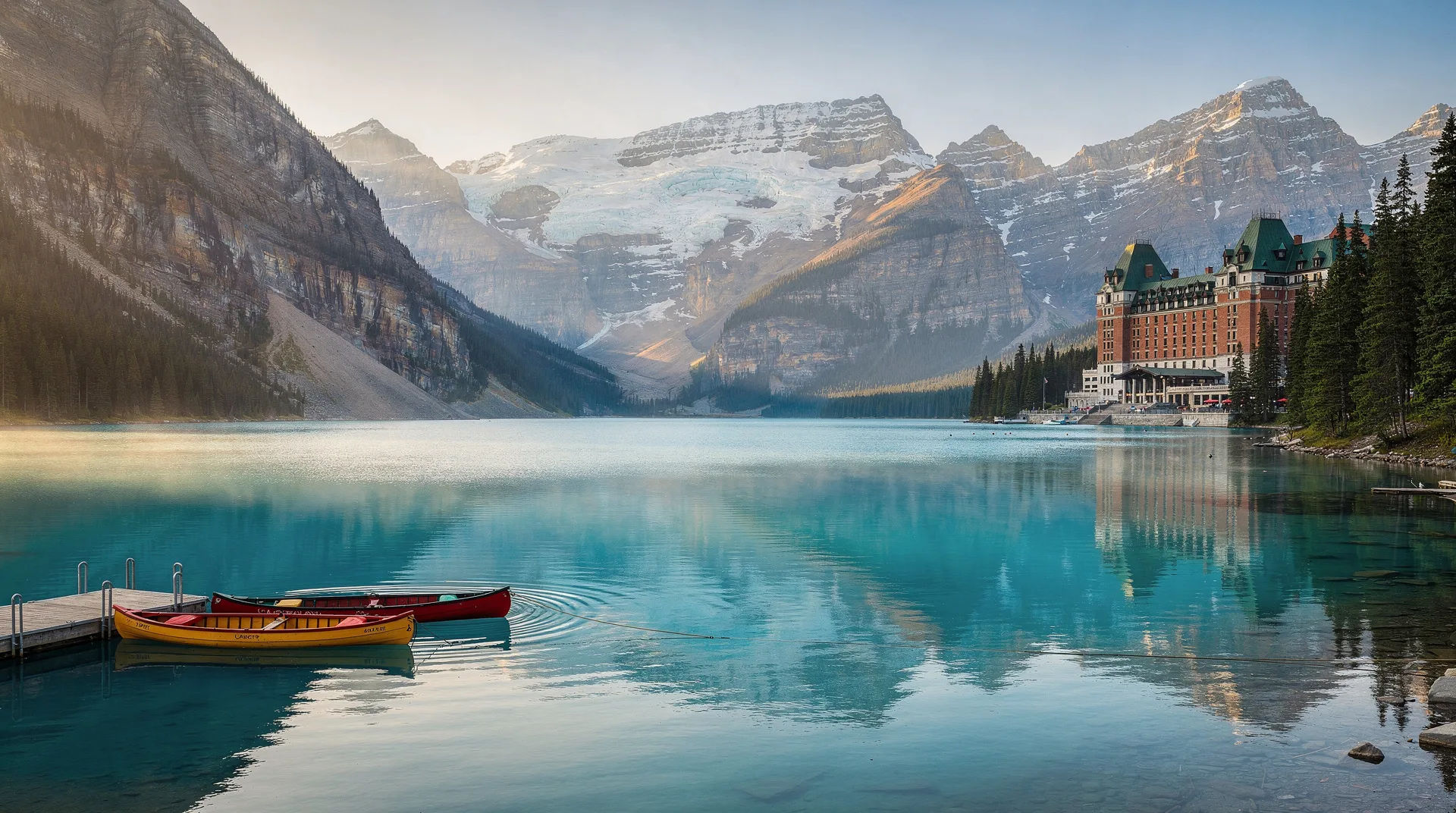
Moraine Lake vs Lake Louise: a deep dive comparison
Is Moraine Lake better than Lake Louise?
Most visitors rate Moraine Lake slightly higher for raw visual impact — the Valley of the Ten Peaks is more dramatic than Lake Louise's single glacier view. But Lake Louise is more accessible (no timed shuttle reservation required), has more hiking options, and the Chateau adds a historic grandeur that Moraine Lake lacks. Visit both if possible.
Both Moraine Lake and Lake Louise are among the most photographed natural landscapes in the world. Both are in Banff National Park, 14 km apart by road (and about 11 km via the Moraine Lake trail connector). Both feature turquoise glacially-fed water, soaring peaks, and the kind of scenery that exceeds most visitors’ expectations.
They are also quite different experiences — in scale, in access logistics, in hiking options, and in the overall mood of a visit. This guide makes a thorough comparison to help you prioritise and plan.
At a glance
| Moraine Lake | Lake Louise | |
|---|---|---|
| Where | Banff National Park, 14 km from Lake Louise village | Banff National Park, Lake Louise village |
| Cost to reach | Around CAD 8 shuttle return, plus a Parks Canada park pass (day pass or Discovery Pass) | Free lakeshore shuttle, plus a park pass; paid parking at the Chateau structure |
| Time needed | Around 2-3 hours for the Rockpile and lakeshore | Around 1.5-2 hours for the lakeshore, longer with a hike |
| Getting there | Shuttle reservation, bike, or guided tour only in peak season | Shuttle from the Park and Ride, or drive with a paid parking reservation |
| Best time | Sunrise, June-September, or larch season in late September | Sunrise or early morning, year-round (winter for skating) |
The basic facts
| Moraine Lake | Lake Louise | |
|---|---|---|
| Elevation | 1,884 m | 1,731 m |
| Lake length | 600 m | 2.4 km |
| Colour source | Valley of the Ten Peaks glaciers | Victoria Glacier |
| Access (peak season) | Shuttle only (reservation required) | Shuttle to lakeshore; car to parking structure |
| Walking distance from parking | 300 m (Rockpile) | 0 m (directly at lake) |
| Hiking options | Moderate; limited day hike range | Extensive; multiple multi-hour routes |
| Facilities | Small lodge, café, canoe rental | Fairmont Chateau Lake Louise, restaurants |
| Year-round access | No (road closes October-May) | Yes |
The scenery
Lake Louise
Lake Louise is 2.4 km long and sits at the base of a wide U-shaped glacial valley. The Victoria Glacier descends from Mount Victoria (3,464 m) at the head of the valley; the Fairmont Chateau Lake Louise sits at the eastern (near) end, its green-roofed towers reflected in the turquoise water.
The colour of the lake — produced by rock flour ground from the glacier and suspended in the meltwater — is most vivid from June through August and shifts from a deep turquoise to a brighter blue-green depending on the light and viewing angle.
The view from the lakeshore looking west toward the glacier is beautiful, framed, and deeply familiar from a million images. The depth of the valley, the height of the surrounding peaks (mostly over 3,000 m), and the scale of the glacier combine to produce a scene that consistently exceeds visitors’ expectations even when they arrive with high expectations.
What makes it special: The completeness of the scene — lake, glacier, framing peaks, the Chateau as a human element — and the extraordinary clarity of the water.
Moraine Lake
Moraine Lake is smaller — 600 m long — but its setting is more concentrated and, to most visitors’ eyes, more dramatic. The Valley of the Ten Peaks forms the western wall of the lake’s valley: ten named peaks all above 3,000 metres, forming an almost unbroken ridge of rock and ice that completely fills the head of the valley.
The Rockpile viewpoint — a natural moraine of large boulders at the northeast end of the lake — provides the defining view from above, looking southwest across the lake toward the Ten Peaks. This is the view that appeared on the Canadian $20 bill from 1969 to 1979.
The lake’s colour is typically described as more vivid than Lake Louise — a deeper, more saturated turquoise — though this varies significantly by time of year, time of day, and weather.
What makes it special: The overwhelming scale of the Ten Peaks backdrop, the viewpoint elevation that reveals the lake’s full shape and colour, and the relative smallness of the lake in proportion to the surrounding mountains — which makes everything feel bigger.
The verdict on scenery: Most visitors, in honest retrospect, find Moraine Lake slightly more jaw-dropping. The Ten Peaks wall has a drama that the single Victoria Glacier view at Lake Louise, while beautiful, does not quite match. But this is close, and individual response varies.
Access
Lake Louise
Lake Louise lakeshore is accessible from the Lake Louise Park and Ride (via shuttle) during peak season, or by parking at the Fairmont Chateau Lake Louise parking structure (a reserved-parking system operates; charges apply). Access to the parking structure is restricted on peak days to vehicles with paid parking reservations or hotel guests.
The practical approach for day visitors: take the Parks Canada lakeshore shuttle from the Park and Ride. No advance reservation required for the lakeshore shuttle (unlike Moraine Lake), though you should arrive early at the Park and Ride to ensure a timely departure.
Lake Louise is accessible year-round. The lake freezes in winter and is used for skating; the Chateau is open through the winter season.
Moraine Lake
During peak season (late May/early June through mid-October), Moraine Lake Road is closed to private vehicles. Access is by Parks Canada shuttle (advance reservation required through reservation.pc.gc.ca), by bicycle (11 km from Lake Louise village, paved, 200 m elevation gain), or by joining an organised tour with access arrangements.
Shuttle reservations open in April and sell out within minutes to hours for July and August dates. This is the critical planning bottleneck for Moraine Lake.
Outside the peak restriction period (before late May and after mid-October), vehicles can drive the road directly — but the road is often snow-covered or icy in those windows, and there is no guarantee of conditions.
The access verdict: Lake Louise is more accessible. Moraine Lake is harder to reach due to the shuttle reservation requirement. If you fail to get a shuttle booking, your options are limited (cycling, organised tour, or accepting you will not see it this trip). See our Moraine Lake shuttle guide for the full booking strategy.
Hiking
From Lake Louise
Lake Louise is a starting point for some of the finest full-day hikes in Banff National Park:
Plain of Six Glaciers (13.8 km return, 365 m elevation gain): The finest hike from Lake Louise. The trail climbs past the lake’s western shore, passes close to the Victoria Glacier, and ends at the Plain of Six Glaciers Teahouse — one of two historic hike-in teahouses in the park. Outstanding alpine scenery throughout; cash only at the teahouse.
Lake Agnes Tea House (7.4 km return, 380 m elevation gain): A popular and rewarding hike climbing through forest to Lake Agnes, a small alpine lake with a moraine backdrop. The Lake Agnes Teahouse serves light meals and tea; cash only.
Big Beehive (11 km return, 520 m elevation gain): Extends the Lake Agnes hike to a rocky ridge with panoramic views of Lake Louise far below.
Saddleback and Fairview Mountain (10.6 km return, 600-1,000 m elevation gain): Climbs to Saddleback Pass with views of the Ten Peaks, then optionally continues to the summit of Fairview Mountain for one of the finest lake views in the park.
From Moraine Lake
Larch Valley and Sentinel Pass (11.6 km return, 725 m elevation gain): The outstanding hike from Moraine Lake. The trail climbs steeply through subalpine forest into Larch Valley — a high alpine cirque filled with subalpine larch trees that turn gold in late September (larch season). The option to continue to Sentinel Pass gives views of both the Ten Peaks and the Lake Louise valley.
Consolation Lakes (5.8 km return, 65 m elevation gain): A gentler option heading south from Moraine Lake to two smaller alpine lakes in a different valley. Less visited than Larch Valley, excellent for those wanting a quieter walk.
Wenkchemna Pass (19 km return, 700 m elevation gain): A full-day commitment to the col between the Ten Peaks. Rarely done by casual visitors; extraordinary scenery for those with the fitness and time.
The verdict on hiking: Lake Louise has more options and greater range of difficulty. The Plain of Six Glaciers is longer and arguably more impressive than any single Moraine Lake hike. But Larch Valley from Moraine Lake — particularly during larch season in late September — is one of the most memorable walks in the Canadian Rockies.
Book a guided Moraine Lake and Lake Louise tour from BanffPhotography
Lake Louise
Best for: The Chateau-and-glacier reflection shot from the lakeshore, morning mist over the lake, sunrise turning the peaks pink behind the glacier.
Best time: Sunrise (the sun reaches the lake face about an hour after dawn in summer; the water is glassy and the light is warm). The classic reflection shot requires calm conditions — wind ruins the mirror effect.
Challenges: The lakeshore path can be crowded by 9 AM in summer, making foreground-clear photography difficult. The shuttle timing means many photographers arrive at 9-10 AM when the light is already past its best.
Moraine Lake
Best for: The Rockpile viewpoint overview, showing the lake’s full shape and colour with the Ten Peaks wall behind it. This is among the most dramatic wide-angle landscape shots in Canada.
Best time: Morning, from approximately 7:00-9:30 AM, when the sun illuminates the east-facing peaks across the lake. The water colour is most vivid before noon.
Challenges: The Rockpile viewpoint becomes very crowded after the first shuttle arrives. The early (6:30-7:00 AM) shuttle is by far the best for photography — arrive before most people and have the platform largely to yourself.
The verdict on photography: Moraine Lake offers the more iconic shot — the overview from the Rockpile is more dramatic and compositionally complete than any single Lake Louise viewpoint. Lake Louise offers more flexibility and more diverse composition options. Both reward early arrival.
Facilities and atmosphere
Lake Louise
The Fairmont Chateau Lake Louise is the defining feature of the Lake Louise experience — a grand early-1900s CP Railway hotel with restaurants, bars, and a full range of hotel facilities. Non-guests can use the dining facilities (though the main restaurant requires reservations) and the lakeshore. The presence of the Chateau adds a layer of historical grandeur and creature comfort that Moraine Lake entirely lacks.
Canoe and rowboat rentals are available from the Chateau boathouse.
Moraine Lake
A smaller lodge (the Moraine Lake Lodge) operates on the north shore. Its restaurant and café are open to day visitors; the canoe dock rents canoes from approximately 8 AM.
The atmosphere at Moraine Lake is more remote and more focused — there is less to do beyond experiencing the lake itself, which for most visitors is entirely sufficient.
Costs compared
Neither lake is free to visit — both sit inside Banff National Park, so a Parks Canada park pass is required regardless of which one (or both) you choose. Beyond the pass, Moraine Lake adds the shuttle fare (around CAD 8 return) or a guided tour price (roughly CAD 80-150 per person), while Lake Louise’s lakeshore shuttle has historically run free with a park pass, though paid parking at the Chateau structure applies if you drive. Canoe rental is available at both lakes, priced similarly at around CAD 100-140 per hour depending on the season. For a wider view of Rockies park costs, see our Banff park pass guide.
Which one suits your trip style
If your trip revolves around long alpine hikes and you want maximum flexibility on any given morning, lean toward Lake Louise — you can walk straight from the parking structure without a reservation gamble. If your priority is the single most dramatic photograph of the trip and you are willing to plan months ahead for a shuttle seat, Moraine Lake is worth the extra logistics.
Families with young children or anyone short on time often do better at Lake Louise, where the lakeshore itself is flat and immediate, with the option to add a short hike like Lake Agnes Tea House if energy allows. For a broader look at timing either visit around the crowds, see our best time to visit Banff guide.
Can you visit both in one day?
Yes — this is what most visitors do, and it is manageable with proper planning.
The standard approach:
- Drive to Lake Louise Park and Ride by 6:00-6:30 AM
- Take the 6:30-7:00 AM Parks Canada shuttle to Moraine Lake (pre-booked)
- Spend 2-3 hours at Moraine Lake (Rockpile, Lakeshore Trail, canoe)
- Return shuttle to the Park and Ride
- Take the lakeshore shuttle to Lake Louise
- Spend 1.5-2 hours at Lake Louise (lakeshore walk, optional Lake Agnes hike)
- Return to Banff by early afternoon
The logistical constraint is the Moraine Lake shuttle reservation, which must be booked months in advance for July-August dates. If you have the shuttle booking, visiting both is straightforward. See our 3-day Banff itinerary for a full day-by-day plan.
Book a full-day Banff, Lake Louise and Moraine Lake tourIf you can only visit one
Choose Lake Louise if:
- You cannot get a Moraine Lake shuttle reservation
- You want more hiking options, including the teahouses
- You are visiting outside peak season (October-May) when Moraine Lake Road is closed
- You have limited mobility and want to be closer to facilities
- You prefer a historical grand-hotel atmosphere
Choose Moraine Lake if:
- You can book the shuttle and want the most dramatic single viewpoint
- You are visiting in late September for larch season
- Photography is a priority
- You prefer a smaller, more remote atmosphere
If you can visit both: Do so. They are different enough to complement rather than duplicate each other, and both reward the early morning effort.
Frequently asked questions about Moraine Lake vs Lake Louise: a deep dive comparison
Which lake has a better colour?
Both are equally vivid turquoise-to-blue-green lakes fed by glacial meltwater. Moraine Lake is sometimes described as slightly more vivid due to the concentration of rock flour from the ten surrounding glaciers. The colour of both lakes is most intense July through August and fades through September as glacial melt decreases.
Is it worth visiting Lake Louise in winter?
Yes — uniquely so. The lake freezes completely in winter and is used for ice skating. The frozen lake with the Chateau and the snow-covered peaks is one of the most beautiful winter scenes in Canada. The Chateau is fully operational year-round. Moraine Lake Road is impassable in winter.
How early do I need to arrive at the Lake Louise Park and Ride?
For the first Moraine Lake shuttle (6:30 AM), arrive at the Park and Ride no later than 6:15 AM — the buses depart on schedule. For the Lake Louise lakeshore shuttle, no reservation is required, but the Park and Ride parking fills up early on peak summer days — aim to arrive before 8:00 AM for easy parking.
For more planning, see our Moraine Lake shuttle guide, 3 days in Banff itinerary, and best time to visit Banff.
Do I need a park pass to visit either lake?
Yes. Both Moraine Lake and Lake Louise are inside Banff National Park, so a valid Parks Canada day pass or Discovery Pass is required regardless of which lake you visit or how you arrive (shuttle, bike, or private vehicle in the off-restriction window). See our Banff park pass guide for current pricing.
Is Moraine Lake worth it if I can’t get a shuttle reservation?
If shuttle tickets sell out, a guided tour with its own vehicle access allocation is the most reliable backup, followed by cycling the 11 km road from Lake Louise village. If neither works for your dates, Lake Louise alone — reached without a reservation via the free lakeshore shuttle — is a completely satisfying substitute rather than a consolation prize.