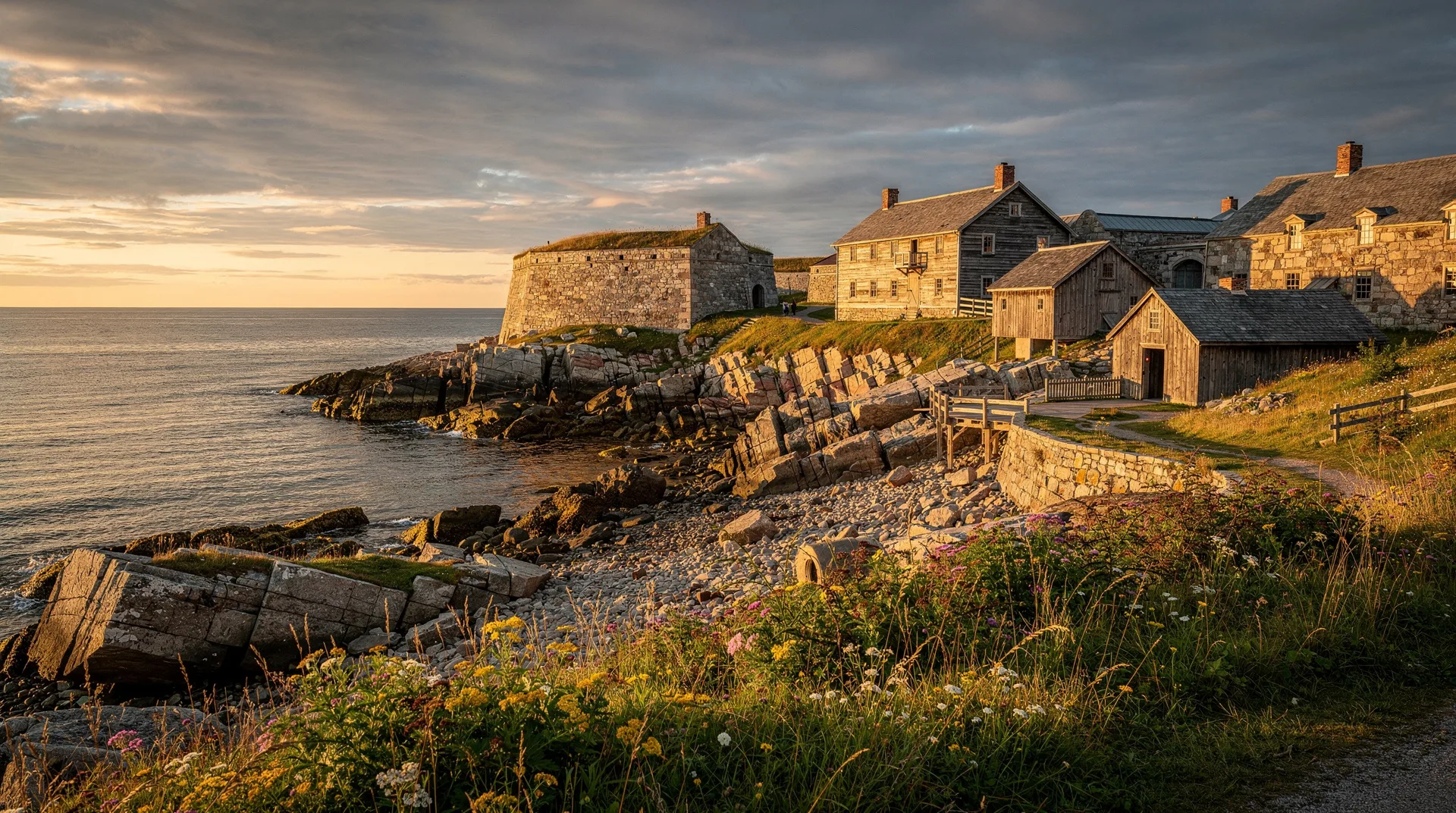
Fortress of Louisbourg: how to plan your visit
What is the Fortress of Louisbourg and is it worth visiting?
The Fortress of Louisbourg is the largest historical reconstruction in North America — a 1/5 scale rebuild of a 1744 French fortified town on Cape Breton. Costumed interpreters, cannons, bakeries, and homes recreate daily life. Essential for history travellers; allow a full day.
The Fortress of Louisbourg is a remarkable thing: the largest historical reconstruction in North America, a substantial portion of a French fortified town as it existed in 1744 rebuilt on the original foundations on a windswept peninsula on Cape Breton’s southeast coast. The fortress operated as France’s principal military and commercial base in North America for barely half a century (1713-1758) before being besieged twice by British forces, captured, and finally demolished. The 1960s reconstruction project — aimed at creating employment for Cape Breton coal miners displaced by the closing of the local coal industry — rebuilt roughly a quarter of the original fortified town.
Today Louisbourg is a living museum. Costumed interpreters live and work inside reconstructed buildings. Cannon fire at scheduled times. Bakers actually bake bread in the fortress ovens. Soldiers drill in the King’s Bastion. Visitors can spend a full day moving between the fortress streets, homes, bakeries, taverns, and military installations, encountering the 1744 town in a genuinely immersive way that few historical sites anywhere achieve.
| At a glance | Details |
|---|---|
| Where | Louisbourg, Cape Breton, Nova Scotia — 40 km south of Sydney |
| Cost | Around CAD 18-22 adult admission; Discovery Pass accepted |
| Time needed | 4-6 hours for a full visit |
| Getting there | Rental car required; no public transit |
| Best time | July-August for full programming; June/September for lower crowds |
What the Fortress actually is
The Fortress of Louisbourg was a French military base and commercial port on Cape Breton Island (then called Île Royale), founded in 1713 after France ceded Newfoundland and mainland Nova Scotia to Britain in the Treaty of Utrecht. Louisbourg served as France’s naval stronghold in the North Atlantic, the headquarters for the Atlantic cod fishery, and the administrative centre for France’s remaining North American possessions.
The town was spectacularly wealthy by mid-18th century — fish exports, rum distilleries, a naval shipyard, brick and tile manufacturing. Its population reached 4,000 at peak. The fortifications were some of the most ambitious in North America.
The end came in two sieges: a first British capture in 1745 (followed by an Anglo-French treaty that returned the fortress to France), and a second British siege in 1758 during the Seven Years’ War that resulted in the destruction of the fortifications and the exile of the French population.
The site sat in ruins for 200 years. Archaeologists began mapping the foundations in the 1920s. Serious reconstruction began in 1961 and continues (at smaller scale) today.
What’s reconstructed: approximately one-quarter of the original town, including the King’s Bastion, the Governor’s Wing, the Chartier house, the De Gannes house, the Ordonnateur’s residence, the bakery, the Destouches house, the tavern and barracks, the engineer’s quarters, and several military installations. About 50 buildings.
What isn’t: the harbour fortifications, the lower town facing the harbour, most private residences, and the marine shipyard were not reconstructed. Foundations remain visible and interpretive signs explain what stood where.
The visit experience
A full Louisbourg visit takes 4-6 hours. The site is compact but dense with interpretation, and the combination of living history programming and architectural detail rewards slower pacing.
Arrival and orientation
The visitor centre is located outside the fortress gates. From here, visitors board horse-drawn wagons or walk (10 minutes) to the fortress itself. The approach, like the original 18th-century arrival, brings you to the fortress gates where costumed French soldiers check your “credentials.”
Living history programming
The fortress runs daily programming throughout the summer:
- Cannon firings — scheduled multiple times daily at the ramparts
- Musket drills — French infantry soldiers demonstrate drill
- Bakery — the bakers make 18th-century soldiers’ bread; bread is for sale
- Cooking demonstrations — period cooks prepare 18th-century dishes in residential kitchens
- Children’s games — period toys and activities
- Music — period music performances
- Changing of the guard ceremonies
Schedules are posted at the visitor centre and throughout the fortress.
Key buildings to see
King’s Bastion (central fortification) — the largest reconstructed building and the military heart of the fortress. The Governor’s rooms are on the upper levels; the soldiers’ barracks and the Chapel are below. The ramparts offer views over the town and the sea.
Governor’s Wing — the reconstructed apartments of the governor of Île Royale. Period furnishings, interpreter-led tours.
De Gannes House — a substantial merchant house with period interiors.
Chartier House — another merchant residence, smaller scale, well-interpreted.
The Engineer’s House and workshops — showing the technical side of 18th-century military building.
Tavern and barracks — lower-end of the class spectrum; the soldiers’ and workmen’s life.
Bakery — active, producing bread, with the smell of baking bread a recurring feature of walking through the fortress.
Dining at the fortress
Three restaurants within the fortress serve period-inspired meals at three different class levels:
- Hôtel de la Marine — officers’ mess scale; more formal, higher price point, genuine 18th-century recipes
- L’Épée Royale — middle-class dining; lighter options
- L’Hôtel de Soldats — soldiers’ canteen; simple, cheap, hearty
Reservations are recommended for Hôtel de la Marine during peak summer. The food is genuinely interesting — period recipes adapted for modern palates, with historical context from the servers.
Beyond the fortress
Louisbourg Lighthouse Trail — a scenic coastal trail (3 km loop) starting from the lighthouse adjacent to the fortress. Dramatic coastal views and the foundation of the first lighthouse in North America.
Louisbourg town itself — small fishing community a few kilometres from the fortress with restaurants and small museums.
Practical information
Location: 259 Park Service Road, Louisbourg, Nova Scotia. 40 km south of Sydney.
Season: late May through mid-October, with peak programming July-August. Winter access is limited to self-guided walking.
Hours: typically 9:30am-5:30pm daily in season. Check Parks Canada website for current hours.
Admission: adult around $18-22 CAD; discounted for families, seniors, and students. Parks Canada Discovery Pass accepted.
Duration: 4-6 hours for typical visits.
Accessibility: partial. The fortress streets are rough (cobblestones, gravel) and many building interiors include staircases. Wheelchair access is available to several key buildings; contact Parks Canada before visiting if mobility is a concern.
Weather preparation: Louisbourg is on a peninsula exposed to the North Atlantic. Wind and fog are frequent. Dress for 5-8°C cooler than Sydney. Layers, waterproof outerwear, and sturdy walking shoes essential.
Parking: free at the visitor centre.
Food: the three fortress restaurants plus a café at the visitor centre. Outside food is permitted in picnic areas but not in the fortress.
When to visit
July and August — full programming, maximum interpreter presence, most restaurants operating, good weather (though fog is frequent). Peak season and most crowded.
June and September — excellent shoulder windows. Programming is nearly full; crowds are lower; weather is variable but can be outstanding.
Mid-May to early June and early-October — early and late season. Reduced programming but significantly lower crowds and accommodation prices.
Off-season (mid-October to mid-May) — the fortress is closed to interpretive programming but the grounds are accessible for self-guided walking at reduced or no fee. Not recommended unless you’re an enthusiast who wants the austere off-season experience.
Getting there
From Sydney (Cape Breton’s largest town): 45 minutes’ drive via Routes 4 and 22. Sydney has the Cape Breton regional airport (YQY) with flights from Halifax and Toronto.
From Baddeck: 1.5 hours’ drive via Routes 105 and 22.
From Halifax: 4.5 hours’ drive. Typically done with overnight in Sydney or Baddeck.
Public transit: limited. A rental car is essentially required.
Who the fortress is best for
History enthusiasts: essential. There is nothing comparable in scale and quality in North America.
Families with children 7+: excellent — the living history format engages children in ways that static museums cannot. Younger children may find the long format tiring.
Travellers interested in French-Canadian and Acadian heritage: the fortress provides context for 18th-century French North American life that is difficult to get elsewhere.
International visitors: particularly European visitors with background in 18th-century history find the reconstruction remarkable.
Archaeology and historical reconstruction enthusiasts: the scale and quality of the reconstruction project itself is a major attraction.
Combining with a Cape Breton trip
Louisbourg fits into a Cape Breton visit several ways:
1-day Sydney/Louisbourg combination: drive from Baddeck or Sydney, full day at Louisbourg, evening back to base.
2-day Sydney base: with Louisbourg as the anchor day, explore Sydney (the Glace Bay coal mining heritage, the Celtic Gallery, Sydney waterfront) on a second day.
Integrated with Cabot Trail: Sydney/Louisbourg as the southern segment of a broader Cabot Trail loop. Most 4-5 day Cape Breton itineraries include one day at Louisbourg.
The Cape Breton 5-day itinerary typically reserves one full day for Louisbourg.
Pairing the fortress with nearby stops
Because the fortress deserves an unhurried day, the best companions are the ones you can enjoy on the days either side. Baddeck makes a comfortable base for the northern half of the island, and Sydney is the natural overnight for the southeast. If you want the scenery that Louisbourg’s coastline only hints at, the Cabot Trail guide and the Cape Breton Highlands National Park guide cover the drives and trails that fill the days around your fortress visit. The Cabot Trail direction guide helps you decide which way to loop so Louisbourg lands at the start or end of your trip rather than as an awkward detour.
Music is a good evening counterpoint to a day spent in 1744. The Celtic music guide explains where to hear live fiddle and step-dance sessions on the island, and it pairs well with a night in Sydney or Baddeck. Travellers who enjoy the French colonial story can continue it with the Acadian heritage guide and the New France heritage guide, which place Louisbourg alongside the other chapters of French presence in Canada.
For the practical side of reaching the island, the driving Atlantic Canada guide covers road conditions and planning, and the Cape Breton vs PEI comparison is useful if you are still deciding how to divide your time between the two. If you are building a longer route, the Maritimes loop itinerary and the Atlantic Canada 10-day itinerary show where a Louisbourg day fits naturally.
Louisbourg in the broader context
The fortress is one of Atlantic Canada’s three UNESCO-level heritage sites (alongside Lunenburg and L’Anse aux Meadows). For heritage travellers planning an Atlantic trip, all three are essential stops:
- Louisbourg — 18th-century French colonial military heritage
- Lunenburg — 18th-century British colonial settlement
- L’Anse aux Meadows — 11th-century Norse settlement (Newfoundland)
Together they span 1,000 years of European presence in Atlantic Canada.
Book Cape Breton guided tours including LouisbourgIs Louisbourg worth a full day?
Yes. The combination of scale, interpretation quality, living-history programming, and the physical presence of the reconstruction makes Louisbourg one of the most substantive historical sites in Canada. Compressed into a half day, visitors leave feeling rushed. Given a full day with restaurant stops and interpreter conversations, it becomes one of the most memorable parts of a Cape Breton trip.
For first-time visitors to Atlantic Canada with any interest in history, Louisbourg belongs on the must-see list alongside the Cabot Trail and the Peggy’s Cove-Lunenburg axis.
Photography and what to bring
Louisbourg is exposed and often windy, so hand-held photography of the cannon firings and drills works better than tripod setups in most weather. Interior building shots are dim (period lighting only in many rooms) — a fast lens or higher ISO helps. Bring a light jacket even in July; the peninsula runs noticeably cooler than inland Cape Breton. Comfortable closed shoes are essential given the cobblestones and gravel paths throughout the site.
A typical full-day visit plan
Arrive at opening (9:30am) to beat tour bus crowds and catch the first cannon firing and musket drill of the day. Spend the late morning working through the King’s Bastion and Governor’s Wing, when interpreters are freshest and less rushed. Have lunch at one of the three fortress restaurants — booking Hôtel de la Marine ahead if you want the higher-end option. Spend the afternoon on the smaller merchant houses (De Gannes, Chartier) and the bakery, finishing with the Louisbourg Lighthouse Trail if energy and weather allow. This pacing avoids the mid-afternoon crowd crush that builds once tour buses from Sydney arrive.
Frequently asked questions about Fortress of Louisbourg
Is the Fortress of Louisbourg suitable for a rainy day?
Yes, to a large extent — several buildings including the King’s Bastion have substantial interior space, and light rain does not stop most outdoor programming (cannon firings and drills continue in all but severe weather). Heavy, sustained rain makes the visit less pleasant since much of the experience is outdoor walking between buildings, so check the forecast and bring waterproof layers if rain is likely.
Can I visit Louisbourg without a guided tour?
Yes — general admission is self-guided, and costumed interpreters throughout the site provide context as you move through at your own pace. Organised bus tours from Sydney or Baddeck are an alternative for visitors without a car, but a self-guided visit with the included living-history programming is the standard and recommended way to experience the fortress. If you would rather pair it with organised excursions elsewhere on your trip, you can browse guided tours across Canada.