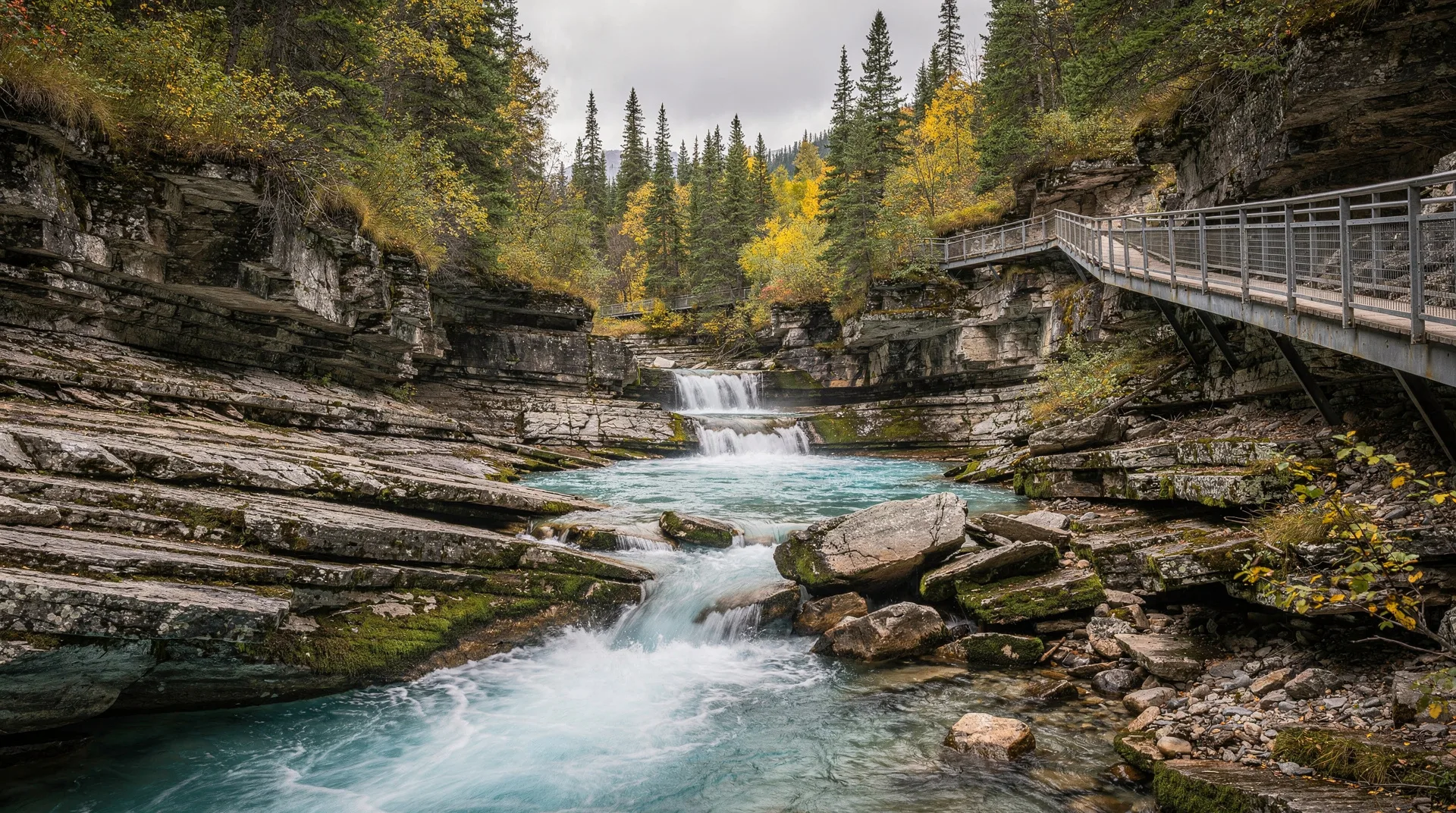
Johnston Canyon: Banff's most-visited waterfall hike
How long does the Johnston Canyon hike take?
Plan 45 minutes return to the Lower Falls (2.2 km), 2 hours return to the Upper Falls (5.4 km), or 4 to 5 hours return to the Ink Pots (11 km). Arrive before 8 am or after 5 pm to avoid the worst crowds, especially between June and September.
Johnston Canyon is the single most-visited waterfall hike in the Canadian Rockies — Parks Canada estimates well over a million people walk its catwalks every year. The reasons are obvious the moment you step onto the trail. A series of suspended steel walkways is bolted directly into the limestone walls of a narrow slot canyon, carrying you inches above rushing turquoise water, behind sheets of spray, and into a natural amphitheatre where Johnston Creek plunges 30 metres over the Upper Falls. The whole thing feels engineered for wonder, which is almost the problem: on a July afternoon the catwalks can be shoulder-to-shoulder, and the parking lot fills before breakfast.
This guide covers all three trail options — Lower Falls, Upper Falls, and the longer trek to the Ink Pots — plus the logistics that matter most: parking, the Bow Valley Parkway shuttle, the winter icewalk experience, and the timing tricks that turn a frustrating crowd day into a quiet morning.
At a glance
| Where | Johnston Canyon day-use area, Bow Valley Parkway (Highway 1A), 25 km west of Banff town |
| Cost | Free to hike; a Parks Canada park pass is required within Banff National Park |
| Time needed | 45 min to the Lower Falls; 2 hrs to the Upper Falls; 4-5 hrs to the Ink Pots |
| Getting there | Own car, the seasonal Bow Valley Parkway shuttle, or a tour from Banff/Calgary |
| Best time | Before 8 am or after 5 pm, June-September; mid-December to March for the icewalk |
Trail overview
Trailhead: Johnston Canyon day-use area, Bow Valley Parkway (Highway 1A), 25 km west of Banff town Lower Falls: 2.2 km return, 30 m elevation gain, 45 minutes Upper Falls: 5.4 km return, 120 m elevation gain, 2 hours Ink Pots: 11 km return, 215 m elevation gain, 4 to 5 hours Trail surface: Paved catwalks and packed gravel to the Upper Falls; forest trail and open meadow beyond Difficulty: Easy to the Lower Falls; easy–moderate to the Upper Falls; moderate to the Ink Pots Dogs: Permitted on leash Accessibility: The paved catwalks to the Lower Falls are accessible to strollers and most mobility devices with assistance; beyond that, stairs and steeper grades begin
The first 1.1 km to the Lower Falls is the most photographed stretch of trail in Banff National Park. The catwalks hug the canyon wall where the canyon is narrow enough that you can almost touch both sides. A short tunnel at the Lower Falls viewing platform opens directly onto the waterfall — expect to get misted, and expect a queue to enter the tunnel during peak hours.
From the Lower Falls the trail continues through mixed forest, climbing gradually past several smaller cascades to the Upper Falls at 2.7 km. Two viewing platforms serve the Upper Falls: a lower one at the base of the drop, and an upper one that looks out over the top of the falls from a fenced cliff edge. Both are worth the short extra distance.
Beyond the Upper Falls the scenery changes completely. The trail climbs out of the canyon, crosses a forested ridge, and descends into an open meadow where seven small cold-water springs well up through mineral-stained clay — the Ink Pots. The contrast between the busy canyon and the empty meadow at the far end is one of the reasons experienced Banff hikers make the full trip.
Lower Falls
The Lower Falls is the showcase waterfall for casual visitors. The drop is only about 10 metres, but the geometry is extraordinary: the creek has carved a narrow slot directly through the limestone, and the falls pour into a deep plunge pool at the bottom. The short rock tunnel on the viewing platform is the photographic icon of the whole canyon.
Expect a queue to enter the tunnel between 10 am and 4 pm from June through September. The platform accommodates about six people at a time. Five minutes of patience usually gets you through. Footing inside the tunnel is wet year-round — wear shoes with grip.
Upper Falls
The Upper Falls is the larger of the two main drops at 30 metres. It is more cinematic and less claustrophobic than the Lower Falls, but the crowd pattern is similar. The base platform sits so close to the falls that spray coats the railing in summer.
From the base platform a short set of stairs climbs to the upper viewpoint at the lip of the falls. The upper view is less visited and worth the extra 5 minutes: you look straight down the drop with the canyon opening out below.
Ink Pots
The Ink Pots are the hidden reward of Johnston Canyon. Seven shallow pools of cold water, each two to three metres across, bubble up through mineral-rich clay in the middle of a wide alpine meadow. The colours range from opaque jade to deep ink blue depending on sediment and light — the pots look artificial at first glance, like small swimming pools set into the grass.
The meadow itself is spacious and sunny. Johnston Creek winds through it, and the Sawback Range rises sharply on the far side. Almost nobody walks this far — the ratio of visitors at the Lower Falls to visitors at the Ink Pots is roughly 50 to 1. This is the best place on the trail for a picnic, and in early morning or late afternoon you will often have the meadow nearly to yourself.
Allow 1.5 to 2 hours each way beyond the Upper Falls, plus time to relax at the pots.
Parking and the Bow Valley Parkway shuttle
Johnston Canyon parking is the single biggest logistical problem for summer visitors. The lot holds approximately 130 vehicles and typically fills by 8:30 am from late June through early September. When the main lot is full, Parks Canada closes access and directs drivers to overflow parking further along the Bow Valley Parkway, which is rarely a quick fix.
Your best options:
- Arrive before 8 am or after 5 pm. The lot empties after 4 pm as morning hikers leave. Evening light on the catwalks is also better for photography.
- Take the Parks Canada Bow Valley Parkway shuttle when it is operating (typically late June through early September). The shuttle runs from Banff town and Lake Louise with a scheduled stop at Johnston Canyon. Book on reservation.pc.gc.ca — reserve in advance, as walk-up availability is unreliable in peak weeks.
- Cycle the Bow Valley Parkway. The Parkway is closed to vehicles east of Johnston Canyon from early May through late June each year for wildlife corridor protection — a five-week window when cycling is ideal. From the Banff townsite bike paths it is approximately 26 km to Johnston Canyon.
- Visit in shoulder season. May, late September, and October still offer flowing water (except in deep winter) with a fraction of the crowds.
You do not need a separate reservation to visit Johnston Canyon itself — only a valid Banff National Park pass, which is covered by the Banff park pass or a Parks Canada Discovery Pass.
The winter icewalk
The Johnston Canyon icewalk is one of the best-known winter experiences in the Canadian Rockies. From roughly mid-December through late March (exact window depends on cold-snap timing each year), the waterfalls freeze into sculpted columns of blue ice, and the creek becomes a frozen ribbon threading through the canyon. The catwalks stay open all winter.
Essential gear for the icewalk:
- Ice cleats or microspikes — these are not optional. The catwalks are slick year-round and lethal when frozen. You can rent from any outdoor store in Banff town for about CAD 12 to 15 per day.
- Warm layers including insulated boots. The canyon traps cold air; temperatures on the catwalks in January are typically 5 to 10 degrees colder than in Banff town.
- Traction poles (optional but recommended for the return descent)
- Headlamp if visiting for sunset or the commonly-offered evening guided walks
Guided icewalk tours are widely available and worth considering for first-time winter visitors. Most tours include cleats, a thermos of hot chocolate, and transport from Banff — a good package at around CAD 95 to 115 per person. The climbers you will sometimes see on the frozen Upper Falls are on commercial ice-climbing trips; the route is a classic Canadian Rockies WI4 pitch.
Book Johnston Canyon guided tours and winter icewalksBest times to visit
| Season | What to expect | Crowds |
|---|---|---|
| May | High water from spring melt, cool air, partial Parkway closure | Low |
| June | Peak water flow, long daylight, spring flowers | Moderate |
| July–August | Warm weather, full access, heaviest crowds | Very high |
| September | Cooler temperatures, fall colour in the meadow | Moderate |
| October | Quiet trail, some ice formation, Ink Pots brown but peaceful | Low |
| Mid-Dec–Mar | Frozen icewalk, blue ice columns, crisp air | Moderate (weekends busy) |
| April | Transition month — partial ice, melting catwalks, slippery | Low |
Safety and etiquette
- Stay on the catwalks. Every year a small number of visitors scramble off-trail onto slick rocks. Injuries and occasional fatalities occur. The catwalks exist precisely because the canyon walls are not safe.
- Do not climb the ice in winter unless you are an equipped, experienced ice climber. Spectating at a respectful distance is fine.
- Give cyclists the right of way on the Parkway during the spring closure window.
- Bear spray is worth carrying on the Ink Pots section, which passes through active grizzly habitat.
- Keep dogs on a short leash on the catwalks — they are narrow and the metal grating can injure paws.
Photography tips
The Lower Falls tunnel is the trail’s iconic shot, but it’s also the most congested spot on the route — early morning light and a near-empty tunnel go together, since both reward the same before-8 am strategy. A polarising filter reduces glare on wet rock and spray; a longer shutter speed smooths the moving water at the Upper Falls, useful if you carry even a small travel tripod.
In winter, photograph the blue ice columns in flat, overcast light to avoid blown-out highlights, and keep spare batteries warm inside a jacket pocket — cold weather drains them fast.
Park pass requirement
Johnston Canyon itself has no entry fee, but it sits inside Banff National Park, so every vehicle needs a valid Parks Canada day pass or annual Discovery Pass, checked at the park gates rather than at the trailhead. See our Banff park pass guide for current pricing and how to buy one before you arrive, and the broader Parks Canada Discovery Pass guide if you’re visiting multiple parks on the same trip.
Where to stay nearby
Most visitors base themselves in Banff town, 25 km east. The Bow Valley Parkway also has a handful of small rustic lodges (Johnston Canyon Lodge, Storm Mountain Lodge, Castle Mountain Chalets) with a waitlist in peak season. Lake Louise village is 30 km west and a convenient combined base if you are also doing the Moraine Lake shuttle or the Larch Valley and Sentinel Pass hike.
A half-day at Johnston Canyon pairs neatly with a drive along the rest of the Bow Valley Parkway, which is itself one of the best wildlife-spotting roads in Banff — elk, deer, and occasionally bears use the corridor actively. Slow down and keep windows open.
Building a day around the canyon
Johnston Canyon works best as one stop in a larger Banff day rather than the whole plan. A morning on the catwalks leaves the afternoon free for something with a different feel, such as the views from the Banff Gondola on Sulphur Mountain, a soak at the Banff Upper Hot Springs after a cold icewalk, or a slower wander around Lake Minnewanka. If the canyon has left you wanting more trail time, the Tunnel Mountain hike and the Sulphur Skyline trail are good next steps from Banff town. If you would rather not plan every stop yourself, guided tours in Banff can bundle the canyon with other highlights.
Hikers who enjoy the mix of water and rock here often like the Grassi Lakes hike near Canmore, and anyone comparing the two bases can read our Banff vs Canmore breakdown before booking a bed. For a wider look at what the area offers, the Banff National Park guide and the roundup of best tours in Banff cover the rest of the valley.
Getting here and moving on
Most people reach the canyon from Banff town or from the Lake Louise side. If you are arriving from the city, our guide to driving from Calgary to Banff explains the road in, and the Banff to Jasper drive picks up the story if you are continuing north along the Icefields Parkway. Travellers without a car can look at Roam transit in Banff for local bus options, though the canyon itself is best reached by the seasonal shuttle described above.
If you are planning more than a single stop, the 3-day Banff itinerary slots Johnston Canyon in alongside the other headline sights, and the Lake Louise hikes overview is a natural follow-up for a second hiking day.
Frequently asked questions about Johnston Canyon: Banff’s most-visited waterfall hike
Can you visit Johnston Canyon without hiking?
The first 400 metres of catwalk is nearly flat and reveals the canyon immediately. Many visitors with limited mobility or young children turn back here and still consider the visit worthwhile. The drop-off at the main platform is spectacular on its own.
Is Johnston Canyon worth it with kids?
Yes — it is one of the best family hikes in Banff. Children are almost universally delighted by the catwalks, the tunnels, and the spray. The distance to the Lower Falls is manageable for most children over three. Bring a carrier for toddlers.
How cold does it get on the icewalk?
Typical January daytime temperatures on the catwalks are minus 12 to minus 20 Celsius, occasionally colder during cold snaps. Dress for two layers warmer than the reading in Banff town. Hand warmers help significantly.
Are dogs allowed?
Dogs are permitted on leash throughout the trail. The metal catwalk grating can be hard on paws — some owners use booties. Do not leave dogs in vehicles at the parking lot; Banff summers are hot enough to be dangerous.
Can I do Johnston Canyon as a day trip from Calgary?
Yes — Calgary to Johnston Canyon is 1 hour 45 minutes each way. A very early start makes it feasible, but most visitors prefer to combine it with an overnight in Banff or Canmore.
Do I need a park pass to visit Johnston Canyon?
Yes. The hike itself is free, but the canyon sits inside Banff National Park, so a valid Parks Canada day pass or Discovery Pass is required for the vehicle, as described in the Banff park pass guide.
Is the Ink Pots hike worth the extra distance?
For most visitors, yes. The canyon section below sees the vast majority of foot traffic; the meadow and springs at the Ink Pots are dramatically quieter and offer a completely different atmosphere. If you only have an hour, skip it — but with 4-5 hours available it is the section repeat visitors say they wish they’d done the first time.