Indigenous tourism in Canada: experiences led by First Nations, Inuit and Métis communities
Where can visitors experience Indigenous-led tourism in Canada?
Every province and territory has Indigenous-led tourism experiences. The national authority is the Indigenous Tourism Association of Canada (ITAC), which lists certified operators at destinationindigenous.ca. Book direct with First Nations, Inuit and Métis operators wherever possible.
Canada is home to more than 630 First Nations, four Inuit regions (Inuvialuit, Nunavut, Nunavik, Nunatsiavut), and a distinct Métis Nation across the Prairie provinces and parts of Ontario and BC. Indigenous peoples have been on this land for thousands of years before the arrival of Europeans, and their cultures, governments, and languages are not historical artefacts — they are living traditions practised today, in communities that have become, over the past two decades, a substantial and growing force in Canadian tourism.
This guide is an overview of what Indigenous-led tourism in Canada looks like in 2026, how to find it, and how to travel in it well. It is not a “visit the Indigenous people” catalogue. The premise from start to finish is that these are experiences created, owned and operated by Indigenous communities, that the economic benefit should stay with those communities, and that the cultural content belongs to the nations telling it.
| Where | Nationwide — BC, Alberta, Quebec and the territories have the most developed networks |
| Cost | Cultural centres typically CAD 15-30; guided experiences from around CAD 80; multi-day northern trips (Nunavik, Nunavut) can run into the thousands |
| Time needed | A half-day minimum per site; a dedicated region (BC coast, Quebec’s Wendake-Mashteuiatsh corridor) rewards 2-4 days |
| Getting there | Most sites near major cities are drivable; Nunavut, Nunavik and parts of the NWT require flights |
| Best time | Late spring through early autumn for most land-based and cultural programming; powwow season is roughly May-September |
The framing matters
Canadian tourism language around Indigenous peoples has changed significantly. Older phrases — “visit a Native village”, “meet the Indians”, “authentic tribal experience” — belong to an earlier era and are not used by serious operators or by the communities themselves. The contemporary and correct framing is Indigenous-led experiences, which recognises that First Nations, Inuit and Métis communities are the authors of their own tourism, not exhibits inside anyone else’s.
A few language specifics worth carrying:
- Indigenous is the preferred umbrella term in Canada. It covers First Nations, Inuit and Métis.
- First Nations refers to the original peoples south of the Arctic, excluding Inuit and Métis.
- Inuit (singular: Inuk) are the Indigenous peoples of the Canadian Arctic. The word is already plural — “the Inuits” is incorrect.
- Métis are a distinct Indigenous people descended from First Nations and European (primarily French and Scottish) ancestors, with their own language (Michif), history, and nationhood.
- Individual nations have their own names for themselves that often differ from the English names you may have been taught. Squamish is Skwxwú7mesh; Mohawk is Kanien’kehá:ka; Ojibwe is Anishinaabe; Haida is X̱aayda. Where a community uses its own name, use it — and don’t stress the pronunciation on first attempt.
Canada is also, currently, in an active period of Reconciliation following the 2015 report of the Truth and Reconciliation Commission, which documented the Canadian residential school system and its intergenerational effects. Visitors are not expected to be experts on any of this, but arriving with a basic awareness that the current moment is one of active relationship-rebuilding, not a fait accompli, helps in every interaction.
The Indigenous Tourism Association of Canada
The single most important resource for visitors is the Indigenous Tourism Association of Canada (ITAC). ITAC is an Indigenous-led national body that represents and certifies Indigenous tourism operators across the country. Its public-facing platform is destinationindigenous.ca, which lists member businesses by region and type of experience.
Using ITAC-certified operators:
- Ensures the business is genuinely owned and operated by Indigenous people
- Provides a baseline of professional and safety standards
- Channels your spend into the community rather than outside intermediaries
- Links into the provincial Indigenous tourism associations — Indigenous Tourism BC, Indigenous Tourism Alberta, Indigenous Tourism Ontario, Tourisme Autochtone Québec, and equivalents in the Atlantic provinces, Prairies, and territories
For any Indigenous-focused travel planning in Canada, destinationindigenous.ca is the first stop.
Region by region
This is a pan-Canadian pillar; each region has deeper dedicated guides. What follows is a map of signature experiences, organised by region, with indicative examples — not a ranking.
British Columbia
BC has more distinct First Nations than any other province and one of the most developed Indigenous tourism ecosystems in the country. The provincial body is Indigenous Tourism BC (indigenousbc.com).
- Squamish Lil’wat Cultural Centre in Whistler — a jointly operated centre by the Skwxwú7mesh (Squamish) and Lil̓wat7úl (Lil’wat) Nations. Exhibitions, carving demonstrations, traditional weaving, café. One of the most visitor-ready Indigenous experiences in Canada.
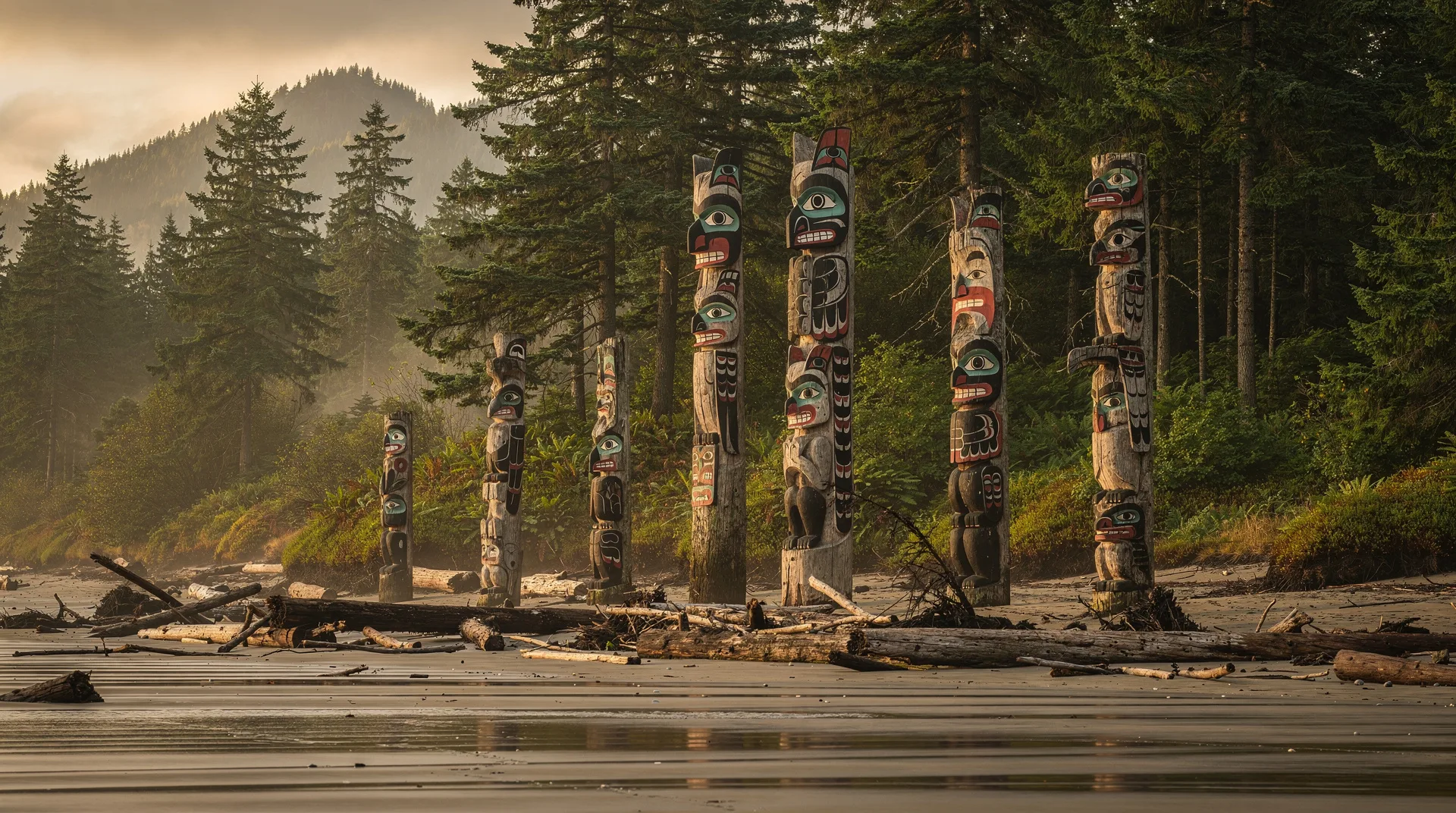
- Haida Gwaii — the archipelago of the Haida Nation off BC’s north coast. Haida-led tours through Gwaii Haanas National Park Reserve, National Marine Conservation Area Reserve, and Haida Heritage Site, including visits to SG̱ang Gwaay (a UNESCO World Heritage site with standing Haida mortuary poles). The Haida Heritage Centre at Ḵay Llnagaay in Skidegate is the cultural anchor. This is a trip that rewards time and intention — see Haida Gwaii destination guide.
- U’mista Cultural Centre (Alert Bay, Vancouver Island) — the Kwakwaka’wakw Nations’ cultural centre, holding a returned collection of potlatch regalia confiscated under Canada’s anti-potlatch laws. A powerful story, told by the community.
- Talaysay Tours and similar Squamish-led walking and canoe tours around Vancouver and the Sunshine Coast.
- Kʼómoks, Tla-o-qui-aht, Ahousaht — Nations on Vancouver Island’s west coast offering kayak, cultural, and traditional-food experiences, some paired with Tofino and Clayoquot Sound tourism.
Alberta
Alberta’s Indigenous tourism is anchored by Blackfoot, Cree, Stoney-Nakoda, Tsuut’ina and Métis experiences. The provincial body is Indigenous Tourism Alberta (indigenoustourismalberta.ca).
- Blackfoot Crossing Historical Park (Siksika Nation, east of Calgary) — a striking architectural museum and cultural centre at the site of the signing of Treaty 7 in 1877. Blackfoot history, language, and ceremony told by the Siksika themselves.
- Head-Smashed-In Buffalo Jump (Piikani territory, southwest Alberta) — a UNESCO World Heritage site and interpretive centre covering 6,000 years of buffalo hunting on the plains, developed with the Blackfoot Confederacy.
- Mahikan Trails and Warrior Women (Jasper and Canmore areas) — Indigenous-led guided walks combining Canadian Rockies hiking with Indigenous ethnobotany and history.
- Métis Crossing (north of Edmonton) — the cultural gathering centre of the Métis Nation of Alberta, with wildlife park, lodging, and traditional skills programming.
Saskatchewan
- Wanuskewin Heritage Park (near Saskatoon) — a nationally significant archaeological and cultural site representing Northern Plains First Nations history, built on a 6,000-year-old bison-jump and campsite complex. Museum, trails, restaurant, daily cultural programming. On the tentative list for UNESCO World Heritage inscription.
- Fort Walsh and Cypress Hills experiences — including Nakoda and Blackfoot-related programming on a landscape that was never glaciated and holds deep cultural significance.
Manitoba
- Turtle Lodge and community visits in Anishinaabe territory in southeastern Manitoba, through specific community invitations and organised programmes.
- Churchill cultural context — Inuit and Dene history of the Hudson Bay coast, featured in the Itsanitaq Museum and in many polar bear and beluga operators’ briefings.
- Manitoba Métis Federation programming and events — the Métis Nation’s historical heartland is the Red River Valley.
Ontario
Ontario has a vast and varied Indigenous presence — Haudenosaunee (Six Nations), Anishinaabe, Oji-Cree and Cree nations, plus urban Indigenous communities in Toronto and Ottawa.
- Great Spirit Circle Trail (Manitoulin Island, Anishinaabe territory) — one of Canada’s longest-running Indigenous tourism organisations, offering cultural workshops, guided walks, and storytelling in the world’s largest freshwater island.
- Six Nations of the Grand River — tours, cultural centre, and the largest First Nations reserve by population in Canada.
- Toronto’s Indigenous-led experiences — guided walks, Indigenous culinary experiences at Ku-kum Kitchen and NishDish, programming at Harbourfront Centre.
Quebec
Quebec has 11 First Nations and the Inuit of Nunavik, and one of Canada’s most mature Indigenous tourism networks. See the dedicated Indigenous tourism in Quebec guide for the detailed coverage.
Highlights: Wendake (Huron-Wendat, 15 minutes from Quebec City) with its Hôtel-Musée Premières Nations and Onhwa’ Lumina night walk; Mashteuiatsh and Essipit (Innu, Lac-Saint-Jean and Côte-Nord); Manawan (Atikamekw, Lanaudière) for remote cultural immersion; Kahnawà:ke (Kanien’kehá:ka/Mohawk) across the river from Montreal.
Atlantic Canada
- Membertou First Nation (Cape Breton, Nova Scotia) — a Mi’kmaq community with a large heritage park, hotel, convention centre, and culture-led programming. One of the most visitor-ready Mi’kmaq experiences.
- Eskasoni Cultural Journeys (Cape Breton) — a Mi’kmaq-led cultural walking tour through a traditional community setting.
- Metepenagiag Heritage Park (New Brunswick) — Mi’kmaq archaeological and cultural site on a 3,000-year-old village location.
- Lennox Island (Prince Edward Island) — Mi’kmaq community with cultural centre and guided experiences.
- Hopedale and Nain (Nunatsiavut, Labrador) — Inuit communities with Moravian mission history and a particular cultural weight, accessible via the Labrador coastal boat or by air.
The territories
- Yukon: Carcross/Tagish First Nation and Carcross Commons, Kwanlin Dün Cultural Centre in Whitehorse, Tombstone Territorial Park (Tr’ondëk Hwëch’in territory). The Yukon First Nations Culture and Tourism Association (yfnct.ca) coordinates. A number of Yukon bison ranching and wildlife operations are Indigenous-led.
- Northwest Territories: Dene and Métis communities across the Mackenzie Valley, with Tlicho (Behchokǫ̀) cultural programming and Great Slave Lake experiences.
- Nunavut: Inuit art and cultural experiences in Iqaluit (the Nunatta Sunakkutaangit Museum), Cape Dorset / Kinngait (Canada’s most celebrated printmaking community), and specialised outpost camps in season. Independent travel to Nunavut is expensive and complex; most visitors go on organised cultural or wildlife trips.
- Nunavik (northern Quebec): Inuit communities in a land of national parks and extraordinary Arctic landscapes. Highly specialist travel.
Pow-wows and public events
Pow-wows are open community gatherings held across Canada from late spring through autumn. They are social and cultural events — not religious ceremonies — with regalia dancing, drumming, singing, and food. Most pow-wows welcome respectful visitors and have clear, published photography and etiquette guidelines. Large, well-known pow-wows include those at Kahnawà:ke (QC, July), Manito Ahbee (Winnipeg, May), Wendake (QC, August), Six Nations (ON, July), and many more.
Indigenous film and arts festivals — Présence autochtone / Montreal First Peoples’ Festival (August), imagineNATIVE (Toronto, October), and others — are important contemporary Indigenous cultural platforms and accessible to any visitor in the host city at the right time of year.
Culinary experiences
Contemporary Indigenous cuisine has become one of the most interesting food stories in Canada. Look for chefs and restaurants such as:
- Salmon n’ Bannock (Vancouver) — Indigenous-owned restaurant with a modern take on traditional foods
- Ku-kum Kitchen (Toronto)
- La Traite (Wendake, QC) inside the Hôtel-Musée Premières Nations
- NishDish (Toronto) — Anishinaabe chef-led
- Seasonal and community-based pop-ups across the country
Expect to encounter bison, game, freshwater fish, native plants (three sisters corn-bean-squash, saskatoons, cedar), bannock, and contemporary interpretations of traditional dishes.
Etiquette — travelling well
A brief, direct set of guidance:
- Book direct with Indigenous-owned operators. Start at destinationindigenous.ca or the relevant provincial Indigenous tourism body.
- Ask before photographing people, ceremonies, regalia, or sacred items. Many events have explicit photo rules; follow them. If in doubt, ask.
- Land acknowledgement is a norm, not a performance. You will hear guides, teachers, and officials open events by acknowledging whose traditional territory you are on. Listen; do not feel obliged to perform your own version.
- Use the community’s name for itself where possible. “Haida Gwaii” rather than “Queen Charlotte Islands”; “Kanien’kehá:ka” if a Mohawk community uses that form.
- Do not handle sacred objects — drums, regalia, medicine — unless specifically invited.
- Understand that some experiences are not for visitors. Certain ceremonies are for community members only; certain sites are closed to outsiders; some seasonal activities are not tourism. Respect this.
- Buy authentic Indigenous art from Indigenous sources. Look for the Igloo Tag on Inuit art and for direct sales from artists or community-owned galleries. Avoid mass-produced souvenirs imitating Indigenous styles — these undercut the artists.
- Tip guides and workshop hosts at the standard Canadian rate (15–20%) if not included. Cultural guiding is still guiding.
- Do not romanticise or stereotype. Indigenous peoples in Canada are contemporary peoples with contemporary lives, businesses, and concerns. The tour guide driving the shuttle has a mortgage and a smartphone. The elder speaking at a cultural centre is a living person, not a mystical archetype.
- Do not treat Reconciliation as your personal project. Visitors are not expected to resolve a multi-generational national conversation on a week-long trip. Showing up, spending money with Indigenous operators, and listening well is meaningful enough.
A note on bookings and intermediaries
Most genuine Indigenous-led experiences are best booked direct with the community-owned operator, either through their own website or through ITAC / provincial Indigenous tourism listings. General travel-marketplaces sometimes resell these experiences; sometimes they do not.
For a trip that combines general Canadian sightseeing with Indigenous-led experiences, a hybrid approach works: book general tours through whichever channel is easiest, and book Indigenous-led experiences direct. This keeps the margin with the community and keeps the cultural content in the community’s hands.
Browse general Canada tours on GetYourGuideThis single link is included for convenience on general Canada touring alongside an Indigenous-focused itinerary. For Indigenous-led experiences themselves, start at destinationindigenous.ca and book direct with the operator — that is where the value of this kind of tourism actually lives.
Building a trip around it, not bolting it on
Most first-time visitors treat an Indigenous experience as one stop within a bigger trip — a couple of hours at a cultural centre wedged between other sightseeing. That works fine for a light introduction, but the strongest trips give at least one region real priority: BC’s coast (Squamish Lil’wat, then Haida Gwaii if time allows), the Wendake-to-Lac-Saint-Jean corridor in Quebec, or Manitoulin Island paired with a Georgian Bay loop from Toronto. Rushing a cultural centre visit under an hour usually means missing the guided programming — the part that actually makes it worthwhile rather than a static exhibit.
Budget accordingly: a cultural centre entry is inexpensive relative to most Canadian attractions, but the guided land tours, floe-edge expeditions and multi-day cultural immersions (Manawan in Quebec, for instance) cost meaningfully more and need lead time to book. Treat cultural centres as the accessible entry point and save the guided, land-based experiences for when you have both budget and advance notice.
Frequently asked questions
Do I need to book Indigenous experiences far in advance?
Cultural centres and museums are usually walk-in. Guided land tours, floe-edge expeditions and multi-day community stays are small-scale and seasonal, so book weeks to months ahead for a summer trip.
Is Indigenous tourism only relevant in remote areas?
No — some of the most accessible experiences are close to major cities: Squamish Lil’wat Cultural Centre is on the route to Whistler from Vancouver, and Wendake is 15 minutes from Quebec City. See Indigenous tourism in Quebec for that corridor in detail.
Related reading
- Indigenous tourism in Quebec: a guide to First Nations experiences
- Quebec First Nations guide
- Haida Gwaii destination guide
- Wendake destination guide
- Squamish destination guide
- Aurora viewing in Churchill
- Canada destination overview
Indigenous tourism is one of the clearest windows onto the country Canada actually is — not the country of its marketing campaigns, and not the country of its difficult 19th and 20th century history, but the contemporary country where more than 600 First Nations, the Inuit, and the Métis Nation are writing their own tourism, their own food scene, their own art markets, and — increasingly — their own terms of welcome. Travel into that on the communities’ terms, and you will come home with a much more honest picture of Canada than any guidebook itinerary can give you.