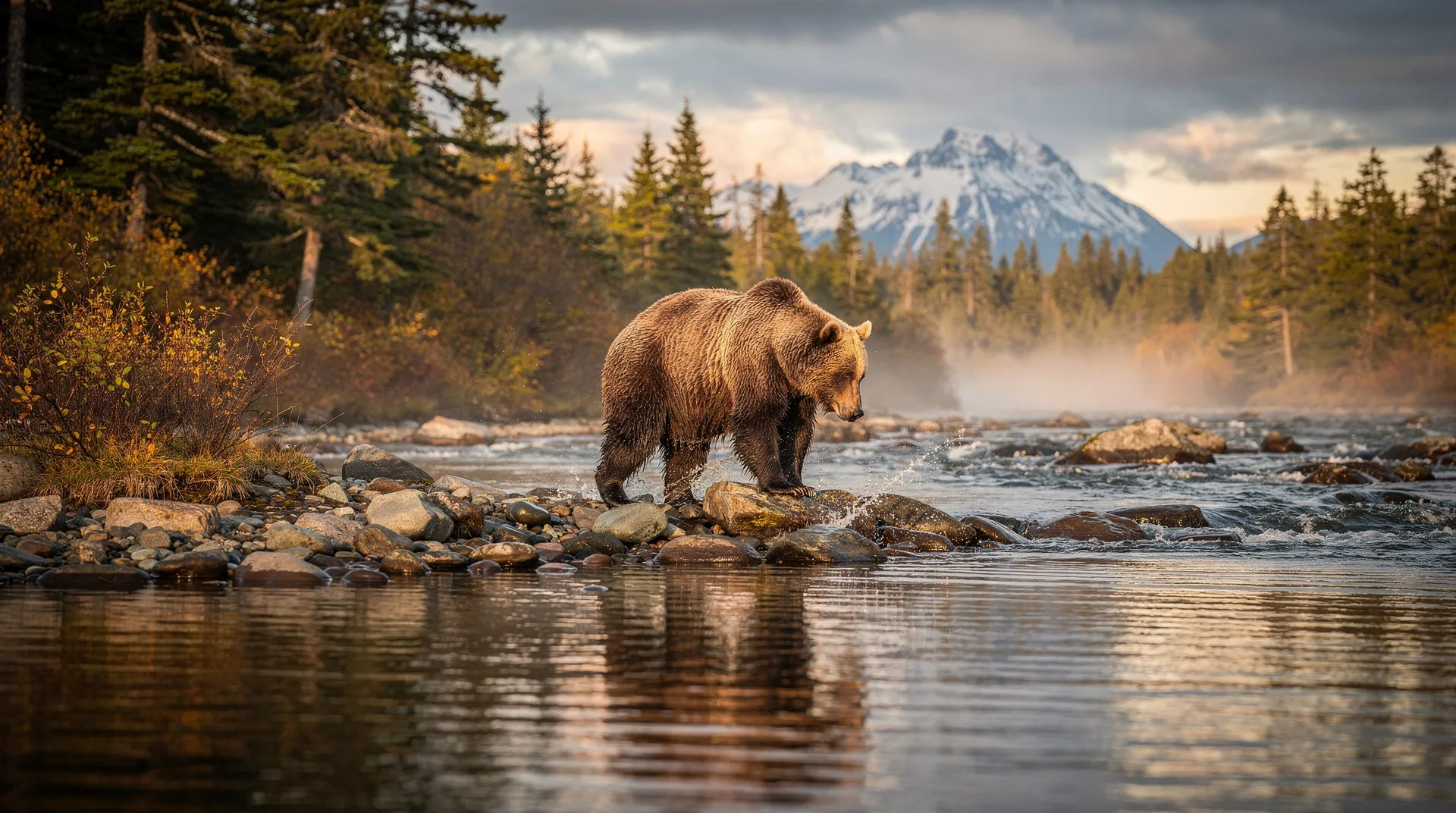
Grizzly bear viewing in BC: when, where and best tours
Where is the best place to see grizzly bears in BC?
Knight Inlet (on the BC central coast) is the most accessible grizzly bear viewing location, with excellent salmon-season sightings from riverside platforms. Khutzeymateen Grizzly Bear Sanctuary near Prince Rupert is a dedicated sanctuary with spring meadow viewing. The Great Bear Rainforest broadly offers the most immersive multi-species experience.
British Columbia is home to approximately 15,000 grizzly bears — roughly 25% of the world’s remaining grizzly bear population. The province’s scale, its relatively intact salmon rivers, and the conservation management of the past three decades have allowed the grizzly to persist here when it has declined or disappeared across most of its historical range. For wildlife visitors, that means BC has access to grizzly bear viewing experiences that are simply not available at comparable quality anywhere else in the lower 48 states, and rivalled only by Alaska among destinations accessible to the general traveller.
The viewing experiences range from standing on a platform above a salmon stream watching bears fish two metres below you, to observing bears in a protected sanctuary accessible only by floatplane, to encountering bears from small ships in the channels of the Great Bear Rainforest. All of these are possible within BC’s tourism infrastructure.
At a glance
| Where | Knight Inlet, Khutzeymateen Sanctuary, and the wider Great Bear Rainforest on BC’s central and north coast |
| Cost | Around CAD 600-1,100/person for a guided day trip |
| Time needed | A day trip is possible; 2-3 nights gives a far better chance of varied sightings |
| Getting there | Floatplane or boat from Campbell River, Port Hardy, Telegraph Cove, or Prince Rupert |
| Best time | Mid-August through October for the salmon run; May-June for spring estuary viewing |
Understanding grizzly bears in BC
Grizzly bears (Ursus arctos horribilis) are not consistently present at any single location year-round. Their activity patterns are driven by food availability — and the most reliable and spectacular food source, from a viewing perspective, is the Pacific salmon run.
When salmon enter the coastal rivers and streams in late summer and fall, grizzlies congregate at the best fishing spots in remarkable numbers. A single productive stream can attract dozens of bears within a short stretch of river. The bears are so focused on fishing — building up the fat reserves that sustain them through winter hibernation — that they are often remarkably tolerant of quiet human observers in established viewing locations.
Outside salmon season, grizzlies feed on vegetation, berries, and ground squirrels across much of their range, and are less predictably located and observed.
Best locations for grizzly bear viewing in BC
Knight Inlet and Glendale Cove
Knight Inlet is a 100 km fjord on BC’s central coast, accessible by floatplane from Campbell River or by small boat from Telegraph Cove. At the head of the inlet, Glendale Cove has a salmon stream that draws large numbers of grizzlies every August and September.
The viewing infrastructure here is the most developed and accessible in BC. Elevated viewing platforms positioned above the river allow bears to pass within metres of visitors — in some cases, the platforms are designed so bears walk directly under them. The combination of reliable bear presence, professional guiding, and established platform infrastructure makes Knight Inlet the best choice for first-time grizzly viewers who want predictability and proximity.
Season: Late August through October (salmon run timing). Spring viewing in May–June at tidal meadows is the secondary season — bears feeding on sedges are less concentrated but provide a different and appealing behavioural context.
Access: Floatplane from Campbell River (40 minutes) or from Port Hardy; boat tours from Telegraph Cove on northern Vancouver Island.
Khutzeymateen Grizzly Bear Sanctuary
The Khutzeymateen is the only protected area in Canada designated specifically for grizzly bear conservation — a 44,300-hectare sanctuary near Prince Rupert that is home to approximately 50 grizzly bears and accessible only by floatplane or boat. There is no road access, and the sanctuary can only be visited with a licensed guide.
The spring viewing season (May–early July) is the primary opportunity — bears emerge from denning and feed on estuary sedges in the narrow valley, observable from zodiacs on the estuary water. The setting is extraordinary: a mountain-ringed fjord with bears visible on the flats below, undisturbed by any development or road noise.
The Khutzeymateen is the definitive dedicated grizzly bear sanctuary experience in Canada and the right destination for those who prioritise protected, undisturbed wildlife over convenience of access.
Season: May–early July primarily; some operators run fall salmon-season trips.
Access: Floatplane from Prince Rupert (30 minutes), or multi-day small ship expeditions from Prince Rupert.
Great Bear Rainforest (broadly)
The Great Bear Rainforest’s river systems host grizzly bears throughout their salmon-season range. Spirit bear (Kermode bear) viewing lodges in Klemtu and on Princess Royal Island routinely observe grizzlies on the same streams as spirit bears. Small ship expeditions through the Great Bear Rainforest encounter grizzlies on beach and river in the context of a broader ecosystem experience.
The advantage of the Great Bear Rainforest broadly is diversity — a single day can involve grizzly bears, spirit bears, humpback whales, and wolf sightings. The disadvantage is that no single location guarantees the sheer bear density of Knight Inlet’s established viewing stations.
Tweedsmuir Provincial Park (interior BC)
BC’s largest provincial park, Tweedsmuir has a significant grizzly population in the Bella Coola Valley. The Atnarko River system is an important salmon stream with good fall bear activity. Access is by road through the Chilcotin (Highway 20) or by floatplane. This is a more independent and less infrastructure-developed viewing experience than Knight Inlet.
Browse wildlife tours and nature experiences across Canada on GetYourGuideBest season for grizzly viewing
| Season | Location | What you see |
|---|---|---|
| May–June | Khutzeymateen, Knight Inlet | Bears on estuary sedges, spring behaviour, mating |
| July–early August | Broadly distributed | Berry feeding, dispersed activity |
| Mid-August–October | Knight Inlet, Great Bear Rainforest rivers | Salmon season, peak bear density, fishing behaviour |
The salmon-season window (August–October) is the prime viewing period by a significant margin. The concentration of bears, the fishing behaviour, and the sheer spectacle of large bears navigating crowded streams make this the most rewarding time.
What to expect on a guided tour
Knight Inlet bear viewing (typical day trip or overnight)
Day trip from Campbell River:
- 7 am departure, floatplane to Knight Inlet Lodge (40-minute flight)
- Morning: zodiac ride up Glendale Cove to viewing platforms
- 2–4 hours at the platforms, watching bears fish in the river below
- Return to lodge for lunch
- Afternoon: bear viewing session from a different platform or river section
- Return floatplane to Campbell River, arrive approximately 6 pm
Overnight package: Same structure over 2–3 days, with the advantage of dawn and dusk bear activity, zodiac exploration of the inlet, and a more relaxed pace.
What the actual experience is like
You are standing or sitting on a platform 2–4 metres above a clear salmon stream. Below you, salmon are so densely packed in the shallows that the water appears to boil with movement. A grizzly bear — 150–300 kg, moving with a gait that communicates absolute calm and purpose — wades into the stream and lunges. It may catch a salmon immediately, carry it to shore, and begin eating with an efficiency that is slightly disturbing to witness. It may miss six times and look annoyed. Cubs may wrestle with each other on the bank while their mother fishes.
Occasionally a dominant bear arrives and displaces others from the best fishing spot. Bears establish fishing hierarchies. The older, more experienced bears have favourite positions; younger bears wait on the margins. The social dynamics visible from a platform viewpoint over several hours are genuinely revelatory.
Your guide narrates continuously — identifying individual bears by facial features and scars, explaining the salmon lifecycle, describing the nutrient cycle that connects the ocean to the forest via bear predation.
Grizzly bear safety
Commercial grizzly viewing from established platforms is an extremely safe activity — the platforms are designed to keep people out of the bears’ interaction space, and the bears are habituated to human presence at the platforms. The risk profile is lower than a day hike in grizzly territory.
Independent hiking in grizzly habitat is different. If you are hiking in the BC interior or coastal areas known to have grizzlies:
- Make noise while hiking (talking, hand clapping, bear bells)
- Carry bear spray in an immediately accessible location
- Cook and store food away from sleeping areas
- Never approach a bear — if a bear approaches you, stand your ground
- Identify yourself as human calmly and back away slowly if the bear does not move on
The bear spray is specifically for charge situations — it is effective at reducing injury when a bear charges, but must be deployed correctly (spray a cloud at 6–10 metres, into the wind, not on yourself).
Costs
| Experience | Duration | Cost (CAD) |
|---|---|---|
| Knight Inlet day trip (floatplane) | 1 day | $600–900/person |
| Knight Inlet 2-night package | 3 days | $1,800–2,800/person |
| Khutzeymateen day tour (floatplane) | 1 day | $700–1,100/person |
| Great Bear Rainforest expedition | 7–10 days | $6,000–12,000/person |
Day trip prices include flights and guiding. Overnight packages include accommodation and meals.
Explore wildlife and nature tours across Vancouver Island on GetYourGuideGrizzly viewing vs other Canadian wildlife trips
Grizzly viewing in coastal BC is one of several distinct wildlife experiences Canada offers, and it’s worth understanding how it differs before booking. Alberta’s Rockies-side grizzly encounters, covered in our Alberta wildlife watching guide, are typically brief roadside or trailside sightings rather than the sustained, close-range platform viewing available at Knight Inlet — Alberta is a bonus on a road trip, not a dedicated wildlife expedition.
If you’re weighing grizzly viewing against other flagship wildlife trips, our wildlife itinerary and broader Canadian wildlife guide put it in context alongside polar bears at Churchill and whale watching on both coasts.
Access matters too: most BC grizzly viewing departs from Vancouver Island hubs like Campbell River and Telegraph Cove, so it pairs naturally with an island-based trip rather than a mainland Rockies itinerary. Anyone travelling independently in bear country between tours should also read our wildlife safety guide — the safety expectations around a guided platform are very different from hiking in grizzly habitat unaccompanied.
Combining grizzly viewing with other BC wildlife
Spirit bears: The Great Bear Rainforest lodges combine grizzly and spirit bear viewing. See the spirit bear tours guide for Kermode bear specifics.
Salmon runs: The salmon that attract bears are themselves extraordinary wildlife spectacles. See the BC salmon runs guide for context on the migration and viewing locations beyond the bear-viewing context.
Whale watching: Northern BC’s coast has extraordinary cetacean diversity — humpback whales are common in Great Bear Rainforest channels. A multi-day expedition combines grizzly viewing with whale encounters naturally.
Frequently asked questions about Grizzly bear viewing in BC: when, where and best tours
What is the difference between a grizzly bear and a black bear?
Grizzly bears (Ursus arctos horribilis) are significantly larger (150–300 kg vs 60–150 kg for black bears), have a pronounced shoulder hump of muscle, a dished facial profile, and shorter, rounded ears. Black bears have a straighter facial profile, no shoulder hump, and more pointed ears. In BC, both are common — black bears vastly outnumber grizzlies.
Can I see grizzly bears without a guide?
In areas accessible by road (Tweedsmuir, northern BC), yes — if you know where bears congregate and have proper bear safety training and equipment. The Knight Inlet and Khutzeymateen viewing, however, requires a licensed guide by regulation. Independent visitors are not permitted at either.
Is there hunting of grizzly bears in BC?
BC banned grizzly bear trophy hunting in 2017. Grizzly bears can be legally harvested by First Nations under their Aboriginal rights, but commercial trophy hunting is prohibited.
How reliable are sightings at Knight Inlet during salmon season?
During August and September at established Knight Inlet operations, grizzly bear sightings at the river platforms are extremely reliable — operators report 98–100% sighting rates during the peak salmon run window. This is one of the highest wildlife viewing sighting rates available anywhere.
Are grizzly bears endangered in BC?
Grizzlies are not endangered in BC overall, but certain populations are at risk. The province manages grizzly bears by population unit — some units are healthy, others are under pressure from habitat loss, road development, and hunting pressure. The overall BC population is considered stable.
How far in advance should I book a grizzly viewing tour?
For peak salmon season (mid-August through September) at Knight Inlet or Khutzeymateen, book several months ahead — capacity is limited by the number of licensed operators and viewing platforms, and the best dates sell out early. Shoulder-season spring trips (May-June) can usually be booked with a few weeks’ notice.
Can I combine grizzly viewing with a Vancouver Island trip?
Yes — most Knight Inlet departures originate from Campbell River or Telegraph Cove on Vancouver Island, so a grizzly viewing day or overnight slots naturally into a wider island itinerary alongside Tofino or Pacific Rim time.