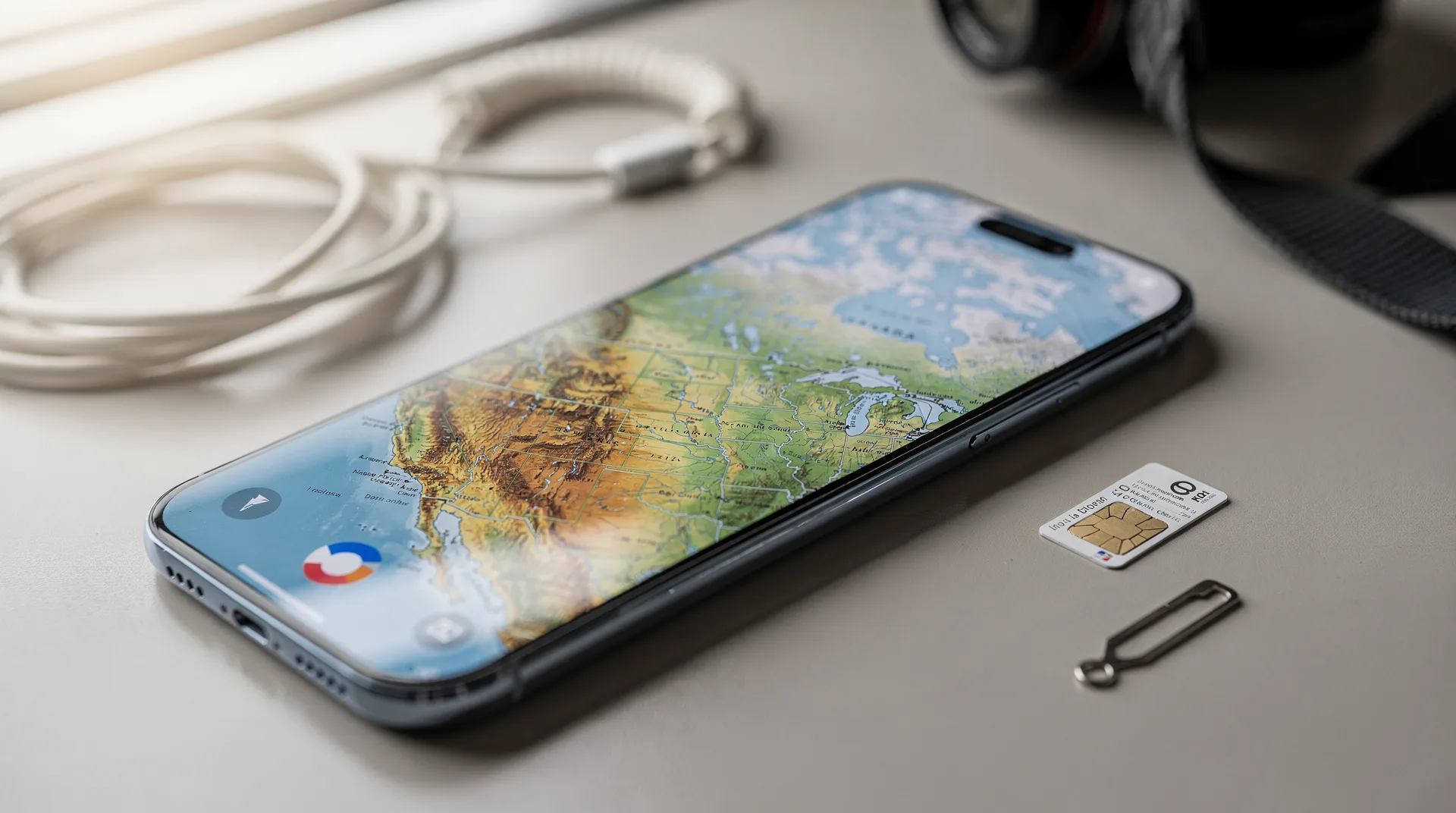
eSIM and internet in Canada: best options 2026
What is the best way to get internet in Canada as a visitor?
An eSIM is the most convenient option for most visitors — install before departure, activate on arrival. Airalo, Holafly, and Nomad are the most popular options for Canada. Alternatively, a local SIM from Koodo, Lucky Mobile, or Fido is cheap and offers excellent coverage.
Staying connected in Canada is easy in cities and along major highways — and significantly more challenging in national parks, northern Canada, and remote wilderness areas. Understanding the landscape of eSIMs, local SIM cards, Canadian carriers, and wifi availability will help you choose the right option for your trip and set realistic expectations about coverage.
| Best for | Most visitors with an eSIM-capable phone |
| Typical cost | Around USD $10-20 for a 2-week eSIM plan, or CAD $30-55/month for a local prepaid SIM |
| When to buy | Install the eSIM before departure, activate on landing; buy a local SIM at the airport or a carrier store on arrival |
| Coverage caveat | Excellent in cities and along highways; patchy to none in national parks, backcountry and the North |
| Backup option | A satellite communicator (Garmin inReach, SPOT) for wilderness trips beyond mobile coverage |
Mobile coverage in Canada: what to know first
Canada’s mobile network coverage is excellent in all cities, towns, and along major transportation corridors. Where it falls short is in remote areas — and Canada has a lot of remote area.
In national parks: Cell coverage in Banff and Jasper towns is good. On trails, in backcountry areas, and at many viewpoints and campgrounds, coverage can be minimal or non-existent. Moraine Lake, for example, has extremely poor cell service. The Icefields Parkway has patchy coverage throughout.
In northern Canada: The Yukon, Northwest Territories, and Nunavut have very limited mobile coverage outside of settlements. The major highway corridors have some coverage, but significant stretches do not.
In rural provinces: Rural New Brunswick, Newfoundland outports, and remote parts of Quebec and Ontario have limited coverage. Most tourist destinations in these areas have decent coverage, but don’t assume it.
For wilderness trips, a satellite communicator (Garmin inReach, SPOT) is the appropriate connectivity solution — not a mobile network.
The three main Canadian carriers
Canada has three dominant mobile carriers: Rogers, Bell, and Telus. These three own most of the spectrum and physical infrastructure. All other carriers (including discount brands) operate on networks owned by one of these three.
Rogers: Strong coverage in Ontario, Quebec, and BC. Coverage can be thinner in Atlantic Canada and the Prairies.
Bell: Strong overall coverage, particularly good in Quebec and the Maritimes. Generally considered to have the most national coverage.
Telus: Strong in Western Canada (BC and Alberta). Good coverage in the Rockies. Similar national coverage to Bell overall.
The practical implication: for most visitors, which carrier you choose (or which carrier your eSIM uses) matters most in remote areas. For city travel, all three are equivalent.
eSIM options for Canada
eSIM (embedded SIM) technology lets you install a carrier profile digitally — no physical SIM card needed. eSIMs activate on arrival and are increasingly the best option for visitors to Canada who have a compatible device.
Compatible devices: Most iPhones from the iPhone XS (2018) onwards support eSIM. Many Android phones from 2019+ also support eSIM. Check your specific device before purchasing. Dual-SIM devices can run an eSIM alongside your home SIM, letting you receive calls on your home number while using the eSIM for data.
Top eSIM providers for Canada (2026)
Airalo
The largest global eSIM marketplace. For Canada:
- 1GB/7 days: approximately USD $4.50
- 3GB/30 days: approximately USD $10
- 10GB/30 days: approximately USD $19
- 20GB/30 days: approximately USD $28
Uses Rogers or Bell network (specified at checkout for some plans). Easy installation via the Airalo app. Data-only plans (no voice calls or SMS). Good choice for budget-conscious travellers with a short or moderate data need.
Holafly
Unlimited data plans — the key differentiator. For Canada:
- 5 days unlimited: approximately USD $19
- 15 days unlimited: approximately USD $34
- 30 days unlimited: approximately USD $44
Unlimited data means no tracking how much you’ve used. Speeds are throttled after a daily high-speed threshold in some plans. Data-only. Good for travellers who want simplicity.
Nomad
Similar model to Airalo. Competitive pricing for medium-to-large data packages:
- 5GB/30 days: approximately USD $15
- 10GB/30 days: approximately USD $21
Uses Telus network on some plans — good for BC and Alberta travel.
Saily (by Nord)
Backed by the team behind NordVPN. Competitive rates and reliable service:
- 3GB/30 days: approximately USD $9.99
- 10GB/30 days: approximately USD $18.99
GigSky
Premium pricing but reliable service. Good for business travellers who want a premium-brand experience. USD $25–40 for 5GB.
How to choose an eSIM
- Short city trip (1–5 days): Airalo 1–3GB plan is more than enough
- 2-week standard trip: Airalo or Nomad 5–10GB plan
- Rockies trip with heavy navigation and photo uploads: 10GB+ or an unlimited Holafly plan
- Data-heavy travellers (video streaming, remote work): Unlimited Holafly
Install the eSIM before you leave home, but only activate it when you land in Canada. Check your device’s eSIM installation instructions carefully — the process is simple but varies slightly by device.
Local SIM card options
If you prefer a physical SIM card, or if your device doesn’t support eSIM, buying a local Canadian SIM is straightforward.
Where to buy
- Airports: Bell, Rogers, and Telus have kiosks at major Canadian airports. Convenient but slightly more expensive than retail stores.
- Carrier stores: All three main carriers have retail stores in every major city. Discount brands (Koodo, Fido, Lucky Mobile) also have retail presence.
- Electronics stores: Best Buy, The Source (Radio Shack in Canada), and some pharmacies (Shoppers Drug Mart) sell prepaid SIM starter kits.
Best discount carriers for visitors
Koodo (Telus network): Koodo’s prepaid plans offer good value. A 1-month prepaid plan with 5–15GB data runs CAD $35–55. Coverage mirrors Telus, which is strong in Western Canada.
Fido (Rogers network): Rogers-backed discount brand. Prepaid options from CAD $35/month. Solid choice for Eastern Canada.
Lucky Mobile (Bell network): Bell’s budget brand. Prepaid plans from approximately CAD $30/month. Simple and reliable.
Freedom Mobile: An independent carrier (acquired by Shaw, then Rogers, but operated separately). Competitive pricing but coverage is limited to urban areas. Not recommended for national park or rural travel.
Fizz: Active in Quebec and Ontario. App-based management, competitive prices, Videotron/Rogers network. Popular among Montreal visitors.
Activation
Most Canadian prepaid SIMs can be activated in the store or online immediately. You’ll typically need to provide a credit card and optionally an email address. No ID required for prepaid plans.
Wifi in Canada
Public wifi
Coffee shops: Tim Hortons, Starbucks, Second Cup, and most independent coffee shops offer free wifi. Tim Hortons particularly — there’s one on almost every block in Canadian cities, all with free wifi.
Libraries: Public libraries in all Canadian cities offer free wifi and computer terminals. No membership required for day visitors in most cities.
Transit stations and airports: All major Canadian airports have free wifi. SkyTrain stations in Vancouver, Toronto subway stations, and Montreal metro stations all have wifi in the stations (not on the trains themselves, though cellular coverage on some underground sections is improving).
Hotels: Virtually all Canadian hotels include free wifi in 2026. Business-class hotels may charge for premium speeds in some cases. Hostels include free wifi universally.
Shopping malls: Guest wifi available at most major malls.
Restaurants: Most mid-range and upscale restaurants have wifi for customers. Fast food chains (McDonald’s, Tim Hortons) have free wifi.
Wifi calling and messaging
With a good wifi connection, apps like WhatsApp, iMessage, FaceTime, and Signal work perfectly in Canada — even if you have no local SIM. For travellers who mainly need messaging rather than data access on the go, a minimal eSIM paired with wifi calling can cover most needs at low cost.
What to do in areas with no coverage
National parks
Download offline content before entering the parks:
- Google Maps offline: Download maps for the Banff/Jasper area before arrival
- Gaia GPS or AllTrails: Download offline trail maps for hiking
- iNaturalist: Works offline for species identification
- Reservations and confirmations: Download all PDFs and booking confirmations before leaving cell coverage
Parks Canada campground and trail maps are also available for download from the Parks Canada app. If you plan to book guided tours across Canada, save the confirmations offline too.
Satellite communication
For backcountry camping, extended wilderness hiking, or remote road trips, a personal locator beacon (PLB) or two-way satellite communicator is strongly recommended:
- Garmin inReach Mini 2: The most popular option. Two-way messaging, GPS tracking, and SOS function. Monthly subscription plans from approximately USD $15/month.
- SPOT Satellite GPS Messenger: Similar function at a slightly lower price point.
- Personal Locator Beacon (PLB): One-way emergency signal only (no messaging). No subscription fee. Registered with local search and rescue. Less feature-rich but simpler and cheaper for emergency-only use.
Rent rather than buy for a single trip — gear rental shops in Banff, Jasper, and Vancouver all offer inReach device rentals.
Data usage tips for Canada travel
What uses data and how much
Understanding data consumption helps you pick the right plan:
| Activity | Approximate data use |
|---|---|
| Google Maps navigation (1 hour) | 50–100MB |
| Instagram scrolling (1 hour) | 300–500MB |
| Video calls (1 hour, standard quality) | 500MB–1GB |
| Streaming video (1 hour, HD) | 1.5–3GB |
| Email and messaging (all day) | 50–100MB |
| Photo uploads to cloud (per 100 photos) | 500MB–2GB |
For a typical 2-week trip with navigation, social media, and messaging: 3–5GB is usually sufficient if you use wifi when available. Power users or remote workers need 15GB+.
Tips to reduce data usage
- Download Google Maps offline for the regions you’re visiting
- Set music and podcast apps to download content on wifi
- Turn off automatic photo uploads on cellular
- Set apps to update only on wifi
- Use Airplane Mode in areas with no signal (searching for signal drains battery and has no benefit)
Roaming from home
Some visitors find their home carrier’s roaming plans competitive for Canada:
- UK carriers: Most major UK carriers (EE, Vodafone, O2, Three) offer North America add-ons for CAD $5–15/day or bundle packages for Canada travel.
- European carriers: EU roaming doesn’t apply to Canada. Check your carrier’s specific Canada roaming rate before relying on it.
- Australian carriers: Telstra and Optus international day packs often include Canada at AUD $5–10/day.
- US carriers: T-Mobile’s Magenta plan includes Canada unlimited calling and texting with data; a significant advantage for US travellers making a side trip to Canada.
Compare your home carrier’s Canada roaming cost to an eSIM before deciding. For anything over 5–7 days, an eSIM or local SIM is almost always cheaper.
eSIM vs local SIM: which one
| eSIM | Local physical SIM | |
|---|---|---|
| Setup | Install before departure, activate on landing | Buy and activate after arrival (airport kiosk or store) |
| Best for | Short trips, city-only travel, simplicity | Longer stays, needing a Canadian phone number for calls |
| Voice calls | Usually data-only | Included on most plans |
| Typical cost | Around USD $10-30 for 2-4 weeks | Around CAD $30-55/month |
| Device requirement | eSIM-capable phone (iPhone XS+, most Android 2019+) | Any unlocked phone |
For a Rockies-heavy trip through Banff and Jasper, either works — the limiting factor is park coverage, not the SIM type. If your itinerary also includes a VIA Rail journey across the Prairies, download offline maps before boarding since corridor coverage is inconsistent outside stations.
Connectivity on the road
Long driving days are part of most Canada itineraries, and coverage drops the moment you leave a highway corridor. Before a multi-day drive, download the route in Google Maps offline, note the towns with cell service along the way, and carry a paper map as backup — GPS apps still work without data once maps are cached. This matters especially for national parks and Rockies road trips where fuel and lodging planning benefit from knowing where you will (and won’t) have signal. Comprehensive travel insurance is worth arranging before you go, separately from connectivity — a satellite communicator gets you a signal, not medical coverage.
Staying connected on popular itineraries
Where you go shapes what you need from your phone far more than which provider you pick. A few common routes show how that plays out.
Western Canada by road or rail. A trip along the Icefields Parkway is the classic example of a connectivity gap: you will be in and out of signal for long stretches, so cache your maps and playlists in advance. The same logic applies if you plan to drive from Calgary to Banff and onward to Jasper. Airport and townsite coverage is reliable, and the gaps appear once you are between the two.
Quebec and Ontario. Big cities such as Montreal and Toronto are the easiest places in the country to stay online, with wifi in cafés, stations and hotels. If you are following a longer Quebec itinerary, expect solid signal in towns and weaker service once you leave the main roads for rural areas or the coast.
Atlantic Canada. A Cape Breton or Newfoundland drive rewards the same habits: download maps before you set off, and treat any signal on the scenic stretches as a bonus rather than a promise.
Planning the rest of the trip. Connectivity is one item on a longer checklist. You can also browse Canada day tours and activities to book ahead while you still have a signal. Our first-time visitors guide and plan your trip pages cover the other basics, and the getting around guide helps you match your transport choices to the places where you will actually have a signal.
Recommendations by traveller type
City-only travellers: An Airalo or Nomad eSIM with 5GB is more than enough. Wifi is ubiquitous in Canadian cities.
National parks and Rockies travellers: 10GB eSIM minimum. Download all offline maps before entering the parks. Accept that coverage will be patchy on trails — this is fine.
Remote Canada and northern wilderness travellers: A Garmin inReach or PLB is more important than mobile data. Buy a 30-day eSIM for the stretches you have coverage; rely on the satellite device for the rest.
Remote workers visiting Canada: Unlimited Holafly or a local SIM with a large data bucket (15GB+). Test speeds in your specific location — some smaller towns have only 4G LTE, not 5G. Wired ethernet or 5G mobile in cities is generally fast enough for video calls.
Short city breaks (3–4 days): Minimal eSIM plus wifi calling handles almost everything. A 1GB Airalo plan is sufficient with wifi available everywhere in cities.
Frequently asked questions about eSIM and internet in Canada: best options 2026
Can I use my European phone in Canada?
Yes, if it’s unlocked. Most modern smartphones are unlocked by default or can be unlocked through your home carrier. Check that your phone is unlocked before buying an eSIM or local SIM. GSM frequencies used in Canada (800/850/1900MHz for 4G, various bands for 5G) are compatible with most international phones.
Is 5G available in Canada?
Yes — Rogers, Bell, and Telus all operate 5G networks in major Canadian cities (Toronto, Vancouver, Montreal, Calgary, Ottawa, Edmonton). 5G coverage extends along some major transportation corridors. Rural areas and most national parks have 4G LTE at best.
How fast is mobile internet in Canada?
4G LTE speeds in Canadian cities typically deliver 30–80 Mbps download, sufficient for video streaming. 5G in urban centres can reach 200–500 Mbps. In rural and remote areas, speeds can drop to 5–15 Mbps on 4G or even slower on older 3G infrastructure in very remote locations.
Do eSIMs work on older iPhones?
eSIM requires iPhone XS (2018) or later. iPhone 6, 7, and 8 do not support eSIM — use a physical local SIM instead.
Can I receive calls on a data-only eSIM?
No — most tourist eSIM plans (Airalo, Holafly, Nomad) are data-only. For calls, use WhatsApp, FaceTime, or similar over data. If you need a Canadian phone number for calls, buy a local prepaid SIM (Koodo, Fido, Lucky Mobile) which includes voice and SMS.
What should I do if my eSIM doesn’t activate on arrival?
Restart your phone first. Check that eSIM is enabled in your settings and that the carrier profile shows as installed. In areas with poor coverage (like arriving at a smaller regional airport), wait until you reach a city before troubleshooting activation. Contact your eSIM provider’s customer support — Airalo and Holafly both have 24-hour support via their apps.
Is there good wifi in national parks in Canada?
In parks towns (Banff, Jasper, Lake Louise village): yes — hotels, restaurants, and coffee shops have wifi. In campgrounds and on trails: mostly no. Plan on being offline for significant portions of a national park visit. See our packing list guide for offline preparation tips.
Should I buy my eSIM before I leave home or wait until I arrive?
Buy it before you leave — most providers let you install (but not activate) the eSIM profile ahead of time, so it’s ready the moment you land. Waiting until arrival means relying on airport wifi to download and install it, which adds friction right when you’re tired and want a working phone.
Does a Canada eSIM also work if I cross into the US on the same trip?
Rarely. Most Canada-specific eSIM plans are Canada-only; combined Canada+US or North America plans exist from the same providers (Airalo, Holafly, Nomad) but cost more and need to be bought separately. Check the plan’s coverage map before assuming it carries over the border.