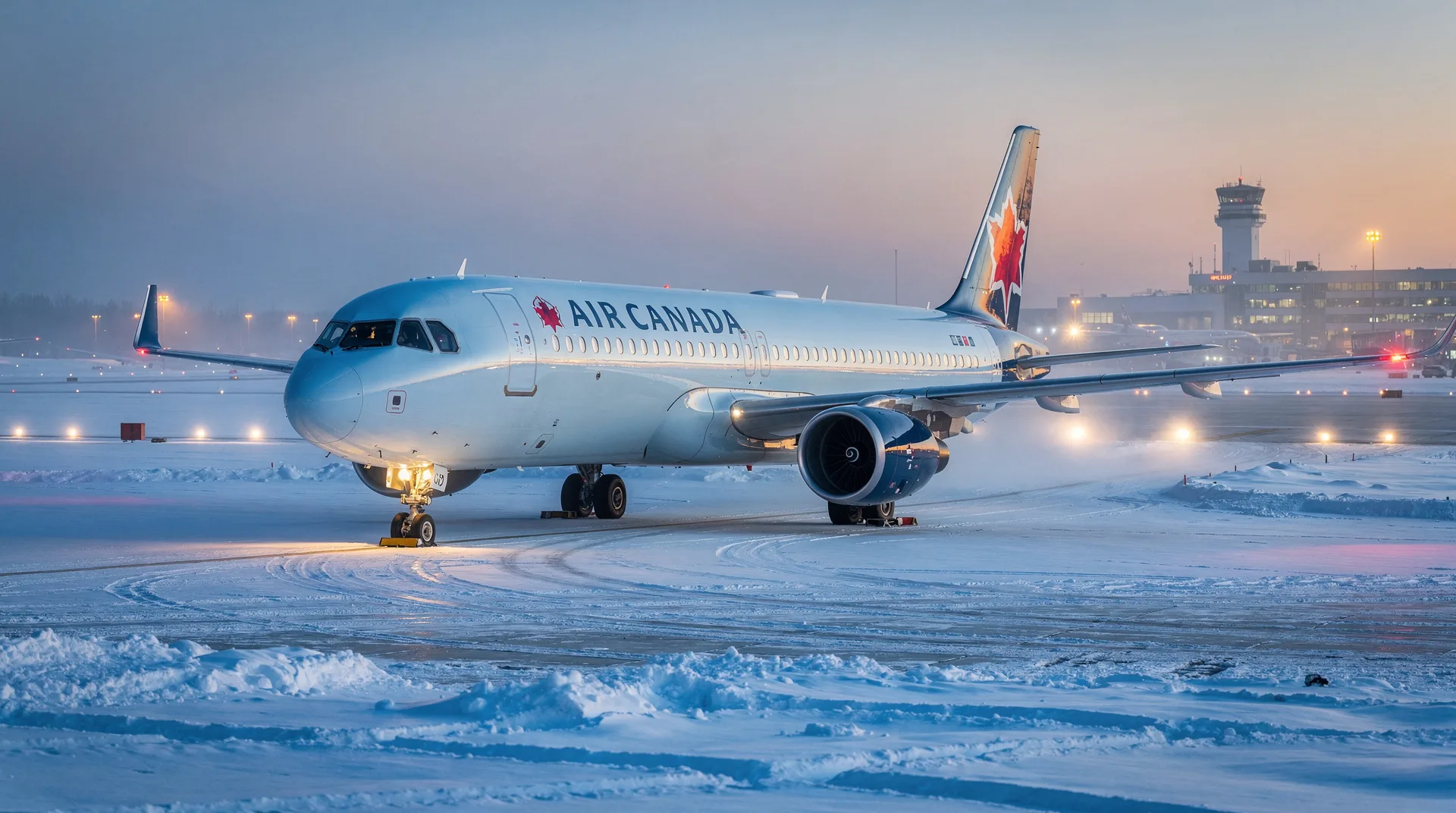
Domestic flights in Canada: best airlines and booking tips
Which is the best airline for domestic flights in Canada?
Air Canada and WestJet are the two main full-service carriers with the widest networks. For budget routes, Flair and Porter are worth considering — but check total costs including baggage before booking.
| At a glance | |
|---|---|
| Where | Nationwide — relevant for most Canada itineraries covering more than one region |
| Cost | Around CAD 120–450 return for most domestic corridors; CAD 400–700 for northern routes like Vancouver–Whitehorse |
| Time needed | 1–5 hours flying time depending on route |
| Getting there | Book via Google Flights, Skyscanner, or direct airline sites |
| Best time to book | 4–8 weeks ahead; January–February and shoulder season for the cheapest fares |
Canada is one of the few countries in the world where domestic flights are genuinely necessary for most trips. The distances are enormous: Toronto to Vancouver is 4,400km — farther than London to Cairo. Driving coast to coast takes five or six days of solid driving. For many routes, flying is the only practical option.
Understanding how to navigate Canada’s domestic airline market — which carriers to use, when to book, how to manage baggage costs, and when the train or bus is actually a better choice — can save significant money and reduce stress considerably.
Canada’s domestic airline landscape
Air Canada
Canada’s largest airline and the national carrier. Air Canada operates the most comprehensive domestic network, connecting virtually every major city and many smaller ones. It’s the default choice for most domestic routes and offers:
- The widest range of flight times and connections
- Aeroplan loyalty programme (one of Canada’s most valuable travel reward programmes)
- Business Class (Signature Class) on major routes
- Reliable baggage handling
- Star Alliance membership for international connections
Air Canada fares are not the cheapest — but they include more flexibility and often more generous baggage allowances in basic fare classes. Book through aeroplan.com or aircanada.com; occasionally better prices appear through third-party sites.
WestJet
Canada’s second-largest airline, operating a hybrid model between full-service and low-cost. WestJet is strongest in Western Canada and is the preferred carrier for many travellers on routes between BC, Alberta, and Ontario. Key points:
- Competitive pricing, especially with advance booking
- WestJet Rewards programme (decent but less valuable than Aeroplan)
- Strong Calgary hub (useful for Rockies trips)
- Generally friendly service and good on-time performance
- Dreamliner fleet on some domestic routes (very comfortable)
WestJet and Air Canada compete directly on most major routes, so comparing prices between the two consistently before booking is worth the five minutes it takes.
Porter Airlines
The overlooked gem of Canadian domestic aviation. Porter operates primarily in Eastern Canada, with its main hub at Billy Bishop Toronto City Airport (YTZ) — which is right downtown, connected to the city by a short pedestrian tunnel. Key advantages:
- Complimentary snacks, beer, wine, and coffee on all flights (unusual for any airline at this price point)
- Free carry-on bags included in the base fare
- Excellent on-time performance
- Flying from a downtown airport avoids the Pearson Airport ordeal
- Porter expanded significantly in 2023–2024 and now serves western Canada routes too
For Eastern Canada routes (Toronto–Montreal, Toronto–Ottawa, Toronto–Halifax, Toronto–Quebec City), Porter often beats Air Canada and WestJet on total value.
Flair Airlines
Canada’s deepest-discount carrier. Flair operates on major routes at headline prices that can be 30–50% cheaper than Air Canada or WestJet — but the model requires scrutiny. Points to know:
- Almost nothing is included: carry-on bags, checked bags, and seat selection all cost extra
- Flights are often at inconvenient times (early morning, late night)
- Delays and schedule changes are more common than with the major carriers
- No frills — bring your own food and entertainment
- Customer service is more limited
Flair works well for travellers who can travel carry-on only, are flexible on timing, and are prepared for occasional operational issues. Calculate the full cost (fare + baggage + fees) before assuming Flair is cheaper.
Lynx Air
Similar model to Flair — ultra-low-cost with add-on fees for almost everything. Lynx serves fewer routes than Flair and has been operationally volatile. Worth checking for routes it serves, but verify current operational status as airlines in this category have historically had reliability issues in Canada.
Jazz Aviation / Air Canada Express
Regional services operated on behalf of Air Canada using smaller turboprop and regional jet aircraft. Covers smaller cities and remote communities. Booked through Air Canada’s system.
Pacific Coastal, Central Mountain Air, and other regional carriers
For truly remote destinations — small BC towns, northern communities — smaller regional carriers are sometimes the only option. These are booked through aggregators or directly; Air Canada codeshares with some.
How to book domestic flights in Canada
Best booking tools
- Google Flights: Excellent price comparison across dates and carriers. Use the calendar view to identify the cheapest days.
- Skyscanner: Catches some fares Google Flights misses, particularly on Flair and Lynx.
- Kayak: Another solid comparison tool; the “hacker fares” (combining two different airlines for outbound and return) occasionally produce savings.
- Direct airline websites: Once you know the fare you want, book directly with the airline. It simplifies changes and avoids third-party booking fees.
When to book for the cheapest fares
- Advance booking: 4–8 weeks ahead is typically the sweet spot for domestic Canadian fares. Last-minute bookings (under 2 weeks) are almost always expensive.
- January and February: The cheapest months for domestic travel in Canada. Avoid Christmas/New Year (hugely expensive).
- Shoulder season travel: Mid-September to mid-October and May to mid-June see lower domestic fares and better award availability.
- Mid-week flights: Tuesday, Wednesday, and early Thursday departures are typically cheaper than Friday afternoon and Sunday evening (the peak commuter times).
Flexibility saves money
Canadian domestic fares fluctuate significantly. If you can be flexible on departure time (morning vs. evening) and day of week, you’ll consistently find lower fares. Avoid the YYZ (Toronto Pearson)–YVR (Vancouver) route on Friday afternoons and Sunday evenings — it’s the most heavily travelled and therefore most expensive domestic corridor.
Key domestic routes: what to expect
Toronto (YYZ/YTZ) to Vancouver (YVR)
The busiest domestic route in Canada. Flights take 5 hours. Prices range from CAD $180–450 return in advance booking to CAD $600+ last minute. Served by Air Canada, WestJet, Flair, and Lynx.
Tip: if departing Toronto, consider Porter from YTZ (downtown) vs. Air Canada/WestJet from Pearson (YYZ, 45–60 minutes from downtown). The downtown convenience of YTZ often makes Porter worth a small premium.
Toronto to Montreal
The corridor where taking a different option might be better than flying. The flight is 1 hour 15 minutes, but once you add 90 minutes to Pearson, security, boarding, and baggage claim, the total travel time is 4–5 hours door to door. VIA Rail’s Montreal–Toronto train takes 4 hours 40 minutes city centre to city centre with no airport hassle. Porter from Billy Bishop cuts the airport pain significantly. This is one route where the train genuinely competes. See our Via Rail guide.
Toronto to Calgary
Gateway to the Rockies. Flights take about 4 hours and are competitive — typically CAD $200–400 return in advance booking with Air Canada or WestJet. Calgary (YYC) is a major hub for Rockies trips; the drive from Calgary to Banff is 90 minutes.
Vancouver to Calgary
Short flight (1 hour) but useful for Rockies access from BC. Alternatively, the drive via the Trans-Canada is stunning and takes about 9–10 hours. Some travellers drive one way and fly the other.
Vancouver to Whitehorse (Yukon)
The main route for northern lights trips to the Yukon. Air Canada and Air North (regional carrier) serve this route. Prices are higher (CAD $400–700 return) due to limited competition. Book well ahead for winter travel.
Yukon aurora borealis night tour from Whitehorse — the top reason to make the journey northToronto to Halifax or St John’s
Atlantic Canada is underserved by budget airlines. Air Canada and WestJet dominate. Prices are CAD $300–500+ return. Porter now serves some Atlantic routes. Worth checking all three.
Baggage rules by airline (2026)
| Airline | Carry-on | Checked bag | Notes |
|---|---|---|---|
| Air Canada (Basic) | 1 personal item only | Not included | Carry-on costs extra on Basic fare |
| Air Canada (Standard+) | 1 carry-on + 1 personal | 1 included | |
| WestJet (Econo) | 1 carry-on + 1 personal | Not included | CAD $35–40 per bag |
| Porter (Basic) | 1 carry-on + 1 personal | Not included | Carry-on always free |
| Flair | Personal item only | Extra fee | Carry-on ~CAD $28–50; checked ~CAD $35–65 |
| Lynx | Personal item only | Extra fee | Similar to Flair |
Always check current baggage fees on the airline website before booking. Rules change frequently and fees apply per segment on connecting flights.
When to skip flying: better alternatives
Flying is not always the right choice in Canada. Consider alternatives for these routes:
Toronto–Montreal: VIA Rail is genuinely competitive on time and far more pleasant. See our Via Rail guide.
Toronto–Ottawa: Via Rail’s corridor train is 4 hours, departs from downtown, and is often cheaper than flying when you factor in airport time.
Vancouver–Victoria: BC Ferries is the standard option — a beautiful 1.5-hour crossing through the Gulf Islands, far more enjoyable than flying.
Vancouver–Whistler: Sea-to-Sky Highway is one of the world’s great drives; bus and tour options also available. Flying makes no sense.
Calgary–Banff: 90-minute drive; no flights needed.
See our public transport guide and RV and camper van guide for ground alternatives.
Airport-specific tips
Toronto Pearson (YYZ)
Canada’s busiest airport. Allow 2.5–3 hours before departure; security queues can be long. NEXUS (fast-track security for pre-approved travellers) is worth it for frequent Canada visitors. The LINK train between terminals 1 and 3 is free.
Billy Bishop (YTZ)
Toronto’s downtown island airport is a joy compared to Pearson. Check-in 60–75 minutes before departure is sufficient. The pedestrian tunnel from the city is about 5 minutes walk from the terminal. Served mainly by Porter.
Vancouver (YVR)
Canada’s most pleasant major airport. Well-designed, good food options, efficient. Allow 2 hours. The Canada Line SkyTrain connects the airport to downtown in 26 minutes (CAD $9–10 including transit fare).
Calgary (YYC)
Clean, efficient, not too large. 25-minute drive to downtown. No train connection — taxis, Uber, or rental car are the options.
Recommendations by traveller type
Budget travellers: Check Flair and Porter for relevant routes, but always calculate total costs including baggage. Carry-on only is the key to making budget airlines worthwhile.
Time-sensitive travellers: Air Canada’s Aeroplan status provides priority boarding, free upgrades, and lounge access — worth accruing if you travel domestically more than a few times per year.
Families: Air Canada and WestJet are more family-friendly for seat selection, changing reservations, and handling issues. Budget airlines with children add complexity.
Rockies travellers: Fly into Calgary (YYC) rather than Kelowna or Edmonton for most Rockies trips. Car rental from YYC is the most efficient gateway.
Flying in for the Rockies or other national parks
If your domestic flight is the first leg of a national park trip, the airport you choose matters as much as the fare. For the Rockies, Calgary (YYC) is the standard gateway — see the Calgary destination guide and plan a rental car pickup at the airport, since public transit doesn’t reach Banff or the surrounding parks.
Remember that flying gets you to the gateway city only — entry to Banff, Jasper, Yoho and other Parks Canada sites still requires a separate park pass, which is not included in any flight or airport transfer. International visitors should also confirm their eTA or visa status before booking connecting domestic flights, since a rejected eTA can unravel an entire itinerary booked around it.
Connecting flights and multi-city itineraries
Many Canada itineraries combine a major city with a more remote destination — Toronto plus the Rockies, or Vancouver plus the Yukon for northern lights. In these cases, compare the total cost and time of an open-jaw itinerary (flying into one city and out of another) against a return-to-origin routing; open-jaw often costs little more and saves a full day of backtracking. Regional connections — Calgary to Whitehorse, or Vancouver to Kelowna for Okanagan wine country — are usually cheaper and more frequent through Vancouver or Calgary hubs than booked as standalone one-way fares from Toronto.
Frequently asked questions about Domestic flights in Canada: best airlines and booking tips
How early should I arrive at Canadian airports?
For domestic flights: 90 minutes minimum, 2 hours in peak periods (summer, Christmas, March break). For international departures: 2.5–3 hours. Toronto Pearson security is the worst in Canada and can take 45+ minutes at peak times.
Can I carry cannabis on domestic flights in Canada?
Cannabis is legal in Canada, but Transport Canada rules apply. Small amounts (up to 30g) are permitted in carry-on or checked baggage on domestic flights. You cannot fly internationally with cannabis under any circumstances.
Do I need ID for domestic flights in Canada?
Government-issued photo ID is required. A driver’s licence or passport works. From November 2025, NEXUS cards and enhanced driver’s licences are also accepted. Standard provincial ID cards are acceptable.
Are there loyalty programmes worth joining for domestic Canada travel?
Air Canada’s Aeroplan is the most valuable Canadian loyalty programme — it partners with dozens of international airlines and the points are highly redeemable. WestJet Rewards is simpler but useful if you fly WestJet regularly. See our budget guide for more on maximising travel value.
Can I book a one-way domestic flight in Canada?
Yes — one-way domestic fares in Canada are generally not penalty-priced (unlike some other countries). However, one-way fares can sometimes be close to return fares — always check both and choose the cheaper option.
What is the most reliable domestic airline in Canada?
Air Canada and Porter consistently rank highest for on-time performance and reliability. WestJet is generally reliable. Budget carriers (Flair, Lynx) have more variable track records.
How do I get between Canadian cities without flying?
VIA Rail (trains), Greyhound alternatives (FlixBus, regional bus services), BC Ferries for coastal routes, and long-distance driving (Canada has excellent highways). See our public transport guide for a full breakdown.
Is it cheaper to fly into Calgary or Edmonton for the Rockies?
Calgary (YYC) is almost always the better choice for a Rockies trip — it’s closer to Banff (90 minutes versus roughly 4 hours from Edmonton) and has more competitive fares from most major cities due to higher route volume. Edmonton makes more sense only if your trip specifically includes Jasper as a primary destination and you’re approaching from the north.
Do domestic flights in Canada require a park pass or eTA?
No — a domestic flight itself doesn’t require a park pass; that’s only needed once you enter a Parks Canada site like Banff or Jasper. However, if you’re a visa-exempt international visitor connecting through a domestic flight, you’ll need a valid eTA for your original entry into Canada. See our Canada eTA and visa guide.