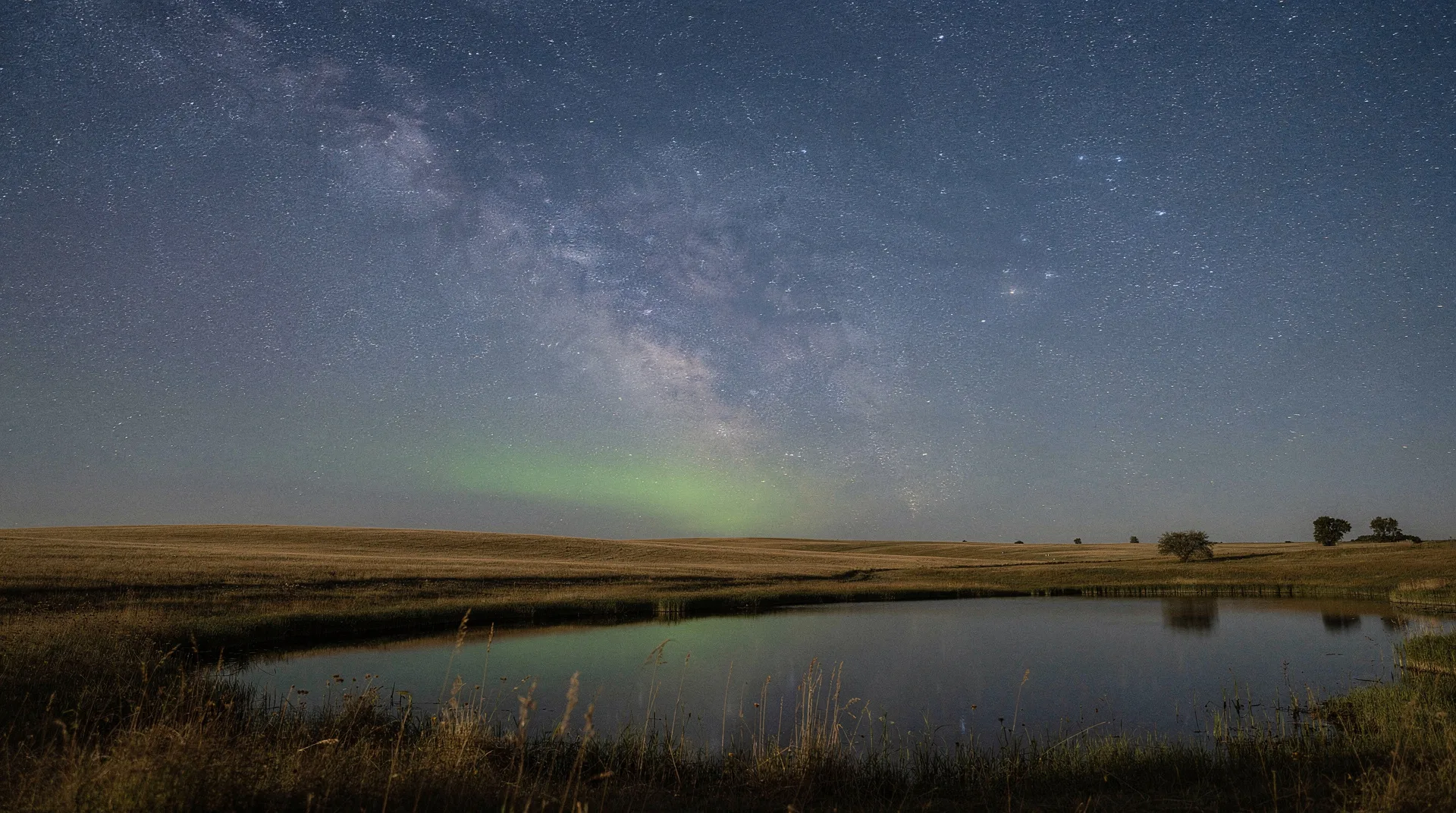
Saskatchewan Dark Sky Preserves: Grasslands & Cypress Hills
Where is the best stargazing in Saskatchewan?
Grasslands National Park and Cypress Hills Interprovincial Park are Saskatchewan's two designated dark sky preserves. Both offer exceptionally dark skies due to low population density and elevation (Cypress Hills). Grasslands is more remote; Cypress Hills is more accessible and has summer observatory programs.
Saskatchewan has a gift that most Canadians do not know it possesses: some of the darkest night skies in the country. The combination of low population density, flat terrain with unobstructed horizons, a continental climate that produces clear nights more reliably than the coasts, and two designated dark sky preserves makes the province one of the genuinely excellent stargazing destinations in Canada — and one of the most under-visited by travellers specifically interested in night sky observation.
The two primary sites are Grasslands National Park in the south and Cypress Hills Interprovincial Park on the southwest border with Alberta. Each has a distinct character: Grasslands is more remote, more austere, and arguably more dramatic; Cypress Hills has infrastructure and organised programming that makes it more accessible for casual stargazers.
| At a glance | |
|---|---|
| Where | Southern Saskatchewan, near the Montana and Alberta borders |
| Cost | Grasslands requires a Parks Canada park pass (day pass or Discovery Pass); Cypress Hills has a provincial park day-use fee |
| Time needed | A full evening minimum; 2-3 days to combine both parks properly |
| Getting there | Self-drive only — no public transport; Grasslands destination page has road details |
| Best time | New-moon nights, July-September |
Grasslands National Park
Grasslands National Park protects one of the last significant remnants of the mixed-grass prairie that once covered the entire southern plains — the native fescue and spear grasses that grew here before the plough arrived, grazed by enormous bison herds and home to black-tailed prairie dogs, burrowing owls, ferruginous hawks, and rattlesnakes.
The park sits in extreme southern Saskatchewan, on the border with Montana, far from any major city. Val Marie (population around 100) is the nearest community and the park’s visitor services base. Regina is 250 kilometres away; Saskatoon is further still. This remoteness is precisely what makes Grasslands’ skies so dark.
The Frenchman River Valley in the park’s West Block is the best viewing location — an eroded badland valley carved into the flat prairie, with dark coulee walls framing a broad sky and the valley floor providing a natural amphitheatre for night sky observation. The valley’s badland formations add foreground interest to astrophotography: hoodoos, eroded buttes, and the characteristic moonscape of carved prairie clay visible under the Milky Way.
The East Block of the park, further from Val Marie, is even more remote and correspondingly darker. Access requires navigating unmaintained roads — a high-clearance vehicle is advisable — and there are no facilities. This is where to go for complete darkness and solitude.
The park itself is one of the few places in Canada where bison have been reintroduced to native grassland: a herd of approximately 60 plains bison roams the West Block. Their presence at night — dark shapes moving in the grassland while stars fill the sky — is an experience connecting the contemporary visitor to the prairie as it existed before European settlement.
Bortle class: Grasslands’ darkest zones approach Bortle class 2 — among the very darkest designations, where the Zodiacal Light is visible, airglow is detectable, and the Milky Way casts faint shadows. For context, most Canadian cities are Bortle 7–8 (light-polluted suburbs); Banff is roughly Bortle 4. Grasslands at its best approaches conditions found in the most remote deserts and ocean crossings.
Cypress Hills Interprovincial Park
Cypress Hills is Saskatchewan and Alberta’s longest-established dark sky preserve, designated in 2004. The park’s elevation — rising 600 metres above the surrounding prairie — combined with dry prairie air and distance from major cities produces exceptional sky clarity.
The park’s advantage over Grasslands is accessibility. Cypress Hills has campgrounds, a visitor centre, an observatory, and organised stargazing events. It is reachable from Medicine Hat (Alberta), Swift Current (Saskatchewan), and several smaller communities without requiring extensive off-road travel.
The Cypress Hills Observatory operates summer public viewing programs with volunteer astronomers providing telescopes and instruction. Dates are posted on the park’s events calendar. These programs are ideal for casual visitors — no equipment required, knowledgeable guides, and the social experience of a dark sky event.
Self-guided stargazing: The park has designated dark sky viewing areas with basic orientation signage. The Saskatchewan section’s East Block campground and the Alberta section’s Elkwater area both provide suitable viewing conditions. On clear moonless nights in summer (July–September), the Milky Way is visible to the naked eye as a distinct, textured band — not a faint smear but a structure with identifiable dark lanes, star clusters, and the pale glow of the galactic core.
The plateau horizon: From the Cypress Hills plateau rim, the flat prairie below extends to the horizon in a perfect circle. The viewing horizon is effectively 360 degrees unobstructed — a sphere of dark sky available for observation. This is unusual even among dark sky preserves, where forests or terrain often limit the lower sky.
Bortle class: Cypress Hills’ core areas achieve approximately Bortle 3 — very dark by Canadian standards, with the Milky Way visible in excellent detail and the horizon glow of distant cities detectable but not dominant.
Planning your visit
Best months: July, August, and September offer the combination of warm (or at least tolerable) overnight temperatures, the Milky Way core high in the sky (its peak altitude occurs around midnight in late July), and relatively reliable clear nights on the prairie. June and early July have shorter nights at this latitude.
Moon phase: The primary constraint on dark sky viewing is the moon. A full moon illuminates the landscape and obscures all but the brightest stars; a new moon produces true darkness. Plan visits around the new moon period (two or three nights either side of new moon) for optimal conditions.
Equipment for stargazing:
- No equipment required for casual observation — the Milky Way is visible to the naked eye in both parks
- Binoculars reveal star clusters, nebulae, and the structure of the Milky Way in detail
- A telescope enables deep-sky objects (galaxies, globular clusters, planetary nebulae)
- For astrophotography: DSLR or mirrorless camera with manual mode, wide-angle lens (14–24mm), tripod, remote shutter release. Starting exposure settings: ISO 3200, f/2.8, 15–25 seconds
Red light: Preserve your night vision by using only red-light torches after dark. White light from a phone screen or headlamp destroys dark adaptation in seconds; recovery takes 20–30 minutes.
Temperature: Both parks can be cold overnight even in summer — prairie temperatures drop quickly after sunset. Bring more insulation than you think you need for a three-hour session under the sky.
Setting up for a long night
Arrive while there is still daylight. Walking your chosen spot before dark lets you find a flat patch of ground, note where the nearest road or trail lies, and decide which direction you want your camera or chair to face. On open prairie, distances deceive in the dark, and a spot that looked close at sunset can feel far away once the only light is a red torch.
Give your eyes time. Dark adaptation builds slowly, and the first half hour often feels disappointing before the sky suddenly fills in. Visitors who give up early miss the moment when faint structure appears in the Milky Way. A reclining chair or a mat makes a real difference, because craning your neck for an hour is the quickest way to cut a session short.
If you have never photographed the night sky, the settings above are a starting point rather than a rule. Test shots at high magnification on your camera screen will tell you whether stars are sharp, and the aurora photography guide explains focusing and exposure habits that transfer directly. Photographers who want to compare conditions elsewhere may also enjoy the stargazing in Jasper guide and the Quebec dark sky preserves for a sense of how different the prairie horizon feels.
Pack for the setting as much as for the sky. The packing list covers layers and small essentials, and the Canada wildlife safety guide is worth a read before you sit in the dark near open grassland where animals move at night. Anyone sleeping in the parks should also check the Canadian camping rules.
Best months for stargazing
| Month | Sky darkness | Weather | Crowds |
|---|---|---|---|
| June | Good, short nights | Warm, occasional storms | Light |
| July | Excellent, Milky Way core high near midnight | Warm, generally clear | Moderate (Cypress Hills programs) |
| August | Excellent | Warm, driest month | Moderate |
| September | Very good, longer nights | Cooling fast, clear air | Light |
| October-April | Good skies but very cold overnight | Cold to extreme cold | Minimal |
Wildlife and other reasons to stay after dark
Both parks reward visitors well beyond the night sky. Grasslands is one of the best places in Canada to see black-tailed prairie dogs, and its bison herd and burrowing owls make it worth arriving well before dusk — see our broader Canadian wildlife guide for what else to look for on the prairies.
Cypress Hills has strong birding, particularly in the forested plateau sections that feel distinctly out of place amid the surrounding grassland; see the birding in Canada guide for regional highlights. If you’re chasing night skies specifically, our aurora photography guide has camera settings that carry over directly from aurora shooting to Milky Way shooting.
Basing yourself nearby
Neither park has extensive lodging on-site beyond campgrounds, so most visitors base in a nearby town and drive in for the evening. Regina and Saskatoon are the closest cities with full services, though both are a substantial drive from the parks themselves — Val Marie and Maple Creek are the practical bases for an overnight stargazing trip.
Adding daytime stops to the trip
A stargazing detour works best when the days are as full as the nights. The prairies reward slow travel: small museums, heritage sites and wide skies in every direction. Wanuskewin near Saskatoon and Batoche offer Indigenous and Métis history, while Moose Jaw is an easy stop on the way west. Across the Alberta line, Writing-on-Stone Provincial Park and Head-Smashed-In Buffalo Jump pair naturally with a Cypress Hills visit. The Grasslands park destination page gives more on daytime exploring, and if you would rather not drive everything yourself, you can browse guided tours across Canada for the days around your stargazing nights.
Because distances are long and services are thin, think about logistics early. Our guides to car rental in Canada and gas stations and highways help you plan fuel and vehicle choice, and the best time to visit Canada puts the prairie season in a wider context. If your trip continues west, the Calgary destination page is a convenient gateway.
Getting there
Grasslands National Park: Val Marie is 250 kilometres south of Swift Current via Highway 4 and then secondary roads. Swift Current is on the Trans-Canada Highway, roughly halfway between Moose Jaw and Medicine Hat. There is no public transport to Val Marie — a vehicle is essential.
Cypress Hills Interprovincial Park: The Saskatchewan section (East Block) is reached from Maple Creek, 27 kilometres north on Highway 21. Maple Creek is 90 kilometres east of Medicine Hat on the Trans-Canada. The Alberta section (Elkwater) is directly accessible from Medicine Hat via Highway 41.
Find Saskatchewan and prairies experiences on GetYourGuideRelated reading
- Cypress Hills Interprovincial Park: prairie oasis and dark sky
- Aurora viewing in Churchill: season, tours and best nights
- Prince Albert National Park: Grey Owl and Saskatchewan wilderness
- Prairies road trip: 7 days
- Moose Jaw Saskatchewan: tunnels, spas and prairie heritage
Saskatchewan’s dark sky preserves are among the best arguments for the prairies as a travel destination in their own right rather than a region to cross on the way elsewhere. The Milky Way over the Frenchman River Valley at 2am — bison grazing in darkness, the badlands invisible except as darker shapes against the star-brightened horizon — is an experience that has nothing to do with the more celebrated parks and everything to do with the particular silence and scale of the northern grasslands at night.
Frequently asked questions about Saskatchewan Dark Sky Preserves
Do I need a permit to stargaze in Grasslands National Park?
You need a valid Parks Canada park pass (day pass or Discovery Pass) to be in the park, the same as for any Parks Canada national park. There is no separate permit for night sky viewing itself.
Which is darker, Grasslands or Cypress Hills?
Grasslands is slightly darker, with its remotest zones approaching Bortle class 2 versus Cypress Hills’ Bortle class 3 — but both are exceptional by any Canadian standard, and Cypress Hills’ accessibility often makes it the more practical choice.