Cape Breton vs PEI: which Atlantic island?
Should I visit Cape Breton Island or Prince Edward Island?
Cape Breton is for dramatic coastal scenery, Highland culture, and serious hiking on the Cabot Trail. PEI is for red sand beaches, Anne of Green Gables, world-class seafood, and a gentle pastoral atmosphere. They are an hour apart by ferry or road — combining both in one trip is the most satisfying Atlantic Canada itinerary.
| Cape Breton | PEI | |
|---|---|---|
| Best for | scenery + hiking + music | beaches + food + gentle pace |
| Time needed | 2-4 days minimum | 2-3 days minimum |
| Getting there | fly Halifax, drive ~3-3.5 hrs | fly Charlottetown, or ferry from NS |
| Best time | July-Aug, or fall for foliage | July-Aug for beaches |
Atlantic Canada’s two most distinct island destinations sit practically side by side — Cape Breton Island at the northern tip of Nova Scotia, and Prince Edward Island just across the Northumberland Strait. They draw visitors for almost entirely different reasons, and together they represent the most complete introduction to Maritime Canada that a single trip can offer.
Cape Breton is rugged, dramatic, and musically alive — a highland landscape of sea cliffs and forested mountains, with a Celtic cultural tradition that traces directly to the Scottish Highlanders who settled here in the 18th and 19th centuries. The Cabot Trail is widely considered one of the best coastal drives in North America.
Prince Edward Island is gentle, pastoral, and charmingly self-possessed — Canada’s smallest province, famous for red sand beaches, the world’s best oysters, and the literary legacy of Anne of Green Gables. It is an island that takes its food seriously and its pace deliberately.
Location and getting there
Cape Breton Island
Cape Breton is connected to mainland Nova Scotia by the Canso Causeway, making it technically accessible by road year-round. Halifax, the regional hub, is about 290 km south of the Cabot Trail entrance near Baddeck — roughly 3 hours by car.
Halifax Stanfield International Airport (YHZ) is the main gateway, with connections to Toronto, Montreal, and a small number of international routes. Many visitors fly into Halifax and drive north, a journey that takes 3–3.5 hours to reach the main Cabot Trail circuit.
Cape Breton Highlands National Park is on the island’s northern end, and the Cabot Trail circles it — a 298 km loop with the majority of the dramatic scenery on the Cape Breton and Aspy Bay coasts.
Prince Edward Island
PEI is accessible by car via the 12.9 km Confederation Bridge from Cape Jourimain, New Brunswick — a bridge that allows year-round land access since 1997. By ferry, Northumberland Ferries runs a seasonal service (May to mid-December) from Caribou, NS to Wood Islands, PEI (75 minutes). Charlottetown Airport (YYG) serves Toronto and Montreal directly.
PEI is compact — 5,660 km², about the size of Delaware — and can be driven coast to coast in under 2 hours. Charlottetown, the capital, is the natural base.
| Cape Breton | PEI | |
|---|---|---|
| Connection to mainland | Canso Causeway (road) | Confederation Bridge (road) |
| Ferry option | No | Yes, seasonal from NS |
| Nearest major airport | Halifax (290 km from Cabot Trail) | Charlottetown (YYG) or Halifax (ferry) |
| Province | Nova Scotia | Prince Edward Island (separate province) |
| Area | 10,311 km² | 5,660 km² |
The Cabot Trail vs PEI’s coastal drives
Cabot Trail
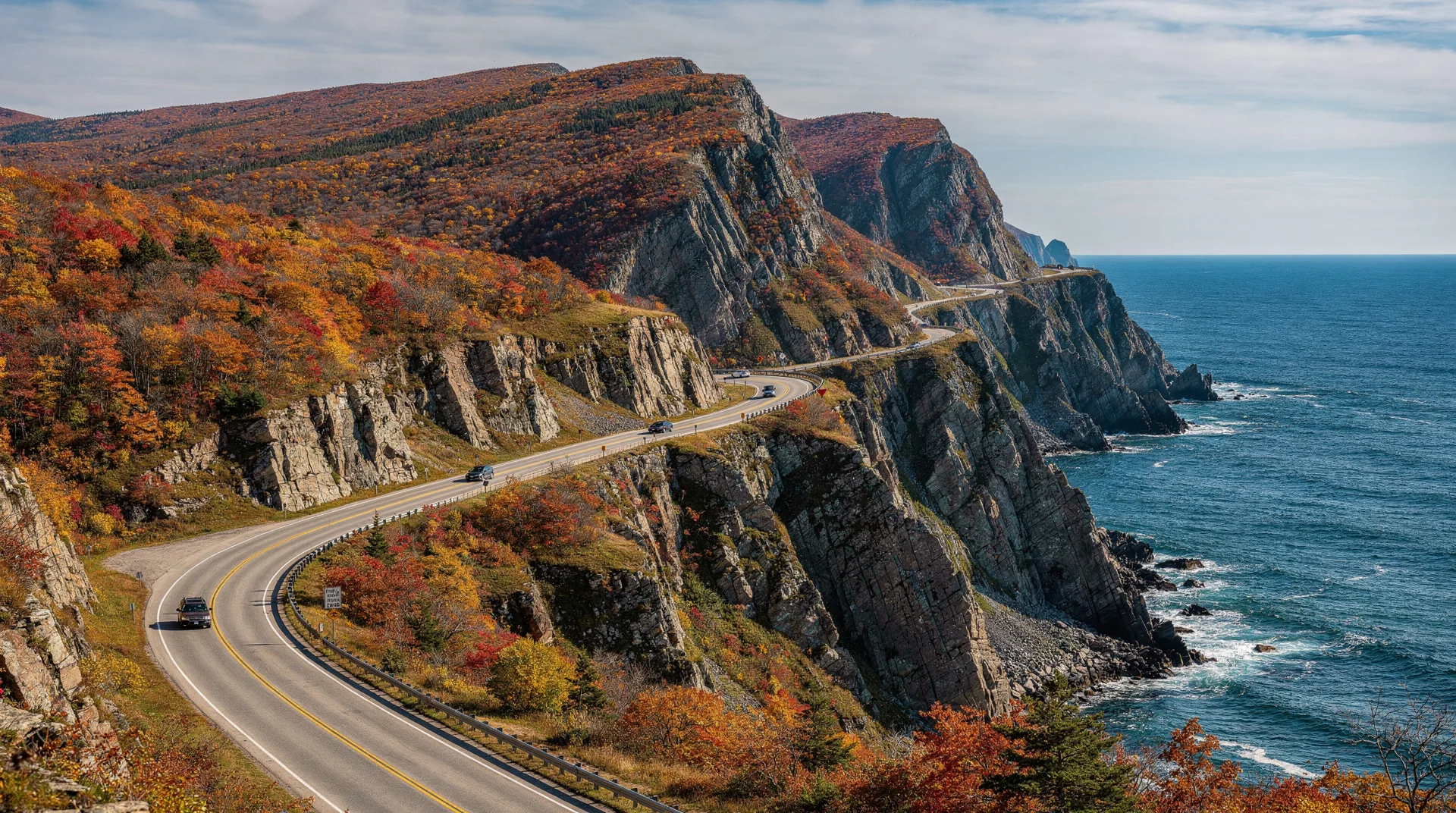
The Cabot Trail is Cape Breton’s defining attraction — a 298 km loop road around the northern Cape Breton Highlands. The most dramatic sections run along the Gulf of St. Lawrence coast on the western side (the Cape Breton coast from Chéticamp to Pleasant Bay) and the Atlantic coast on the northeastern side. The views from the high coastal barrens — sea cliffs dropping hundreds of metres to the ocean — are in a different category from most North American coastal drives.
Most visitors drive the loop in 2–3 days, stopping for hikes, whale watching, Celtic music sessions, and the various viewpoints. The Skyline Trail (7.2 km, moderate), which runs along the cliff edge above the Gulf of St. Lawrence, is the single best hike on the trail and one of the best in Atlantic Canada.
Wildlife along the Cabot Trail: Moose are commonly seen on the road, particularly at dawn and dusk — drive carefully. Minke and pilot whales are visible offshore from several viewpoints in summer. Bald eagles are frequent. The highlands also support coyotes and black bears.
Fall on the Cabot Trail: The Cabot Trail is one of North America’s premier fall foliage destinations. The hardwood forests of the highlands turn brilliant red, orange, and gold from late September to mid-October. Accommodation books up months in advance for peak fall weekends.
PEI’s scenic drives
PEI has its own system of three colour-coded scenic drives — the Blue Heron Drive (90 km, central PEI), the Points East Coastal Drive (375 km, eastern PEI), and the North Cape Coastal Drive (220 km, western PEI). None match the Cabot Trail for drama, but they deliver a different quality: pastoral red soil farmland, hidden coves, wooden fishing wharves, and the easy, unhurried pace of island life.
Greenwich (PEI National Park) on the north shore has extraordinary parabolic sand dunes and a boardwalk over a fragile interdune pond — one of the most ecologically significant landscapes in the province. The red sand beaches of the national park are warm enough to swim in July and August (water temperature reaches 20°C).
Culture and music
Cape Breton: Celtic traditions
Cape Breton has one of the most concentrated Celtic musical traditions in the world. The fiddling tradition — descended directly from Scottish Highland settlers — is kept alive in kitchen parties, ceilidhs (traditional community music sessions), and the Celtic Colours International Festival held each October. Mabou, Inverness, and Baddeck are the heartland.
Breton music is not a tourist recreation — it is a living tradition. Finding a ceilidh at a local hall or a fiddle session in a Cape Breton pub is genuinely easy in summer, and the musicianship is extraordinary.
Gaelic is still spoken by a small community in Cape Breton, making it one of a handful of remaining North American communities with living Gaelic language use.
PEI: Anne of Green Gables and culinary culture
PEI’s cultural identity is defined by two things above all: L.M. Montgomery’s Anne of Green Gables — the 1908 novel set on the island that created one of children’s literature’s enduring characters — and exceptional food, particularly seafood.
Green Gables Heritage Place near Cavendish is the most visited literary heritage site in Canada, drawing particularly large numbers of Japanese visitors (Anne is enormously beloved in Japan). The Anne experience extends to Charlottetown’s theatre productions, heritage inns, and the Confederation Centre of the Arts.
The food culture on PEI is genuinely remarkable for a small island. PEI oysters are considered among the world’s finest — the cold, clean waters of the Northumberland Strait produce oysters of exceptional flavour, harvested and served directly from local producers. PEI mussels are similarly renowned. The spring lobster season (May to June) draws food visitors from across North America.
Food and drink
Cape Breton eating
Cape Breton has honest, hearty cooking shaped by its Highland and Acadian heritage. Acadian cuisine (tourtière meat pies, rappie pie — a potato and meat casserole that is an acquired taste) appears on Acadian menus in the Chéticamp area. Lobster is abundant and straightforward. The fish chowders in roadside restaurants along the Cabot Trail are some of the best in Nova Scotia.
The drinking culture is relaxed — local craft breweries and the Cape Breton distillery (the only legal rum distillery in Nova Scotia) reflect the island’s artisanal turn.
PEI eating
PEI food is a reason to visit on its own. Start with the oysters — Malpeque Bay oysters and the newer premium varieties (Raspberry Point, Pickle Point, Lucky Lime) are available from waterfront shacks and high-end restaurants alike. The lobster suppers at local community halls (New Glasgow Lobster Suppers, New London’s Bay Fortune) are a beloved institution — communal tables, whole lobsters with drawn butter, chowder, and pie. Simple, perfect.
The PEI potato — grown in that distinctive red iron-oxide soil — is genuinely different. French fries served at roadside stands taste like they came from a different planet than supermarket potatoes.
Charlottetown small group tours include food culture and the island’s key attractions. Halifax-based tours cover Maritime Atlantic Canada broadly.
Hiking and outdoor activity
Cape Breton
Cape Breton Highlands National Park has over 26 trails covering 170+ km within the park boundaries. The Skyline Trail is the crown jewel. Other strong options:
- Lone Shieling Trail (1 km return, easy): Through a 350-year-old maple forest to a replica of a Scottish crofter’s hut — a short but memorable walk.
- Middle Head Trail (4.6 km return, easy): Along the narrow strip of land between Ingonish Harbour and Ingonish Bay — panoramic water views.
- Franey Trail (7.6 km return, moderate): Ascent to the top of Franey Mountain for 360° views over the Ingonish area.
- Glasgow Lakes Lookoff Trail (16 km return, strenuous): Into the highland barrens for views over the Atlantic.
Cape Breton Island tours and outdoor experiences include guided hiking and whale watching options.
PEI
PEI is a cycling and walking destination more than a hiking one — the terrain is flat, making it ideal for cyclists. The Confederation Trail runs 470 km across the island on a former railway bed, through small towns, farmland, and coastal areas. Well-paved and signposted for all levels.
PEI National Park along the north shore has beach walks, sandstone cliff walking, and the Greenwich dune system hike (5 km). The island is not a serious hiking destination by Cape Breton or Rockies standards, but the gentle walking through pastoral landscapes is pleasant.
PEI outdoor and cultural experiences cover cycling, kayaking, and coastal tours.
Cost comparison
Both destinations are moderately priced by Canadian standards — less expensive than the Rockies or major cities.
| Category | Cape Breton | PEI |
|---|---|---|
| Mid-range accommodation | CAD $130–$250/night | CAD $120–$230/night |
| Lobster dinner | CAD $35–$60/person | CAD $30–$55/person (lobster suppers) |
| Cape Breton NP entry | CAD $11.70/adult/day | CAD $11.70 (PEI NP) |
| Whale watching tour | CAD $45–$65/person | N/A |
| Casual lunch | CAD $15–$25 | CAD $14–$22 |
PEI is modestly cheaper than Cape Breton, particularly for accommodation. Both are significantly cheaper than the Rockies or Toronto-Vancouver.
Crowds and timing
Both destinations see peak crowds in July and August. Fall is the best time to visit Cape Breton (foliage, Celtic Colours festival in October, fewer tourists). PEI’s beaches are most swimmable in July and August — fall visits mean slower pace but cooler water temperatures.
Best for…
Choose Cape Breton if you:
- Want dramatic coastal scenery and serious hiking
- Are interested in Celtic music and Highland culture
- Value an active, scenery-first itinerary
- Want to visit in fall for foliage and the Celtic Colours festival
- Are on a driving tour of Nova Scotia
Choose PEI if you:
- Want beach culture and warm water swimming
- Love seafood (oysters, lobster, mussels)
- Are interested in Anne of Green Gables
- Want a gentle, pastoral atmosphere rather than dramatic wilderness
- Are cycling or travelling with children
Do both if you:
- Have 7+ days in Atlantic Canada
- Want the full Maritime island experience
- Are driving a Maritime road trip from Halifax
Planning the logistics
If you’re combining both islands, the ferry-versus-bridge decision matters for routing — our Confederation Bridge vs ferry to PEI guide breaks down cost and timing for each option. For pacing, the Cape Breton 5-day itinerary and PEI 5-day itinerary both work as standalone trips or as halves of a combined Maritime loop.
On PEI specifically, Cavendish beaches and PEI lobster suppers are the two things most first-time visitors build their days around. On the Cape Breton side, the full Cabot Trail guide and our Celtic music in Cape Breton guide go deeper than the summary above.
Our verdict
Cape Breton for the more extraordinary landscape experience — the Cabot Trail is genuinely one of the great coastal drives in North America and deserves its reputation.
PEI for the more complete cultural and culinary experience — nothing else in Canada delivers oysters, lobster suppers, and pastoral charm in quite the same package.
For the perfect Atlantic Canada trip: fly into Halifax, drive north to Cape Breton (3 days on the Cabot Trail), then cross to PEI by ferry from Caribou to Wood Islands, spend 3 days on the island, and return via the Confederation Bridge to New Brunswick, connecting onward to Montreal or flying from Charlottetown.
See also: East vs West Canada, Summer vs winter in Canada, Best time to visit Canada.
Frequently asked questions about Cape Breton vs PEI: which Atlantic island?
Is the Cabot Trail better in fall or summer?
Both seasons are excellent but for different reasons. Summer brings warm temperatures, whale watching, wildflowers on the barrens, and longer daylight hours for driving and hiking. Fall brings the foliage — the hardwood forests turn brilliant October red and gold — and the Celtic Colours International Festival in mid-October. Many regular visitors prefer fall for the combination of colour and smaller crowds. Accommodation books out months in advance for peak fall foliage weekends.
Is PEI worth visiting without children?
Yes. Anne of Green Gables is the cultural anchor, but the island’s food scene (oysters, lobster suppers, farm-to-table dining), cycling culture (Confederation Trail), and coastal beauty are compelling for adult visitors. Food-focused travellers in particular find PEI extraordinary — the combination of PEI oysters and Malpeque Bay shellfish with excellent wine is hard to replicate.
Can I combine Cape Breton and PEI in one trip?
Yes — they are well-positioned for a combined itinerary. The most common route: Halifax → Cape Breton (Cabot Trail, 2–4 nights) → Northumberland Ferries from Caribou, NS to Wood Islands, PEI → PEI (2–3 nights) → Charlottetown → Confederation Bridge to New Brunswick → onward travel. Alternatively, reverse the route. Total time needed: 7–10 days.
When is the best time to visit PEI?
July and August are the warmest and most active months — beach season, peak lobster dining (though spring lobster season is also excellent), and the full range of tourist facilities. Late May and early June offer the spring lobster season with smaller crowds. September is warm, quieter, and often beautiful. Avoid November to April unless specifically seeking local winter culture.
What is Cape Breton’s music scene like?
Cape Breton has one of the most alive Celtic music traditions in the world. The fiddle tradition is distinct from mainland Canadian or Irish playing — faster, more rhythmically complex, and directly descended from Scottish Highland styles. Ceilidhs (community music events) happen throughout summer at local halls. The Celtic Colours International Festival (October) brings performers from Scotland, Ireland, Brittany, Galicia, and the global Celtic diaspora. For music enthusiasts, Cape Breton is a serious pilgrimage destination.
Is Cape Breton or PEI more expensive?
They are similar in cost — both are below the Canadian average for tourism destinations. Cape Breton accommodation tends to run slightly higher in peak season due to limited inventory along the Cabot Trail. PEI’s lobster suppers offer some of the best value fine dining in Canada.
Is Confederation Bridge or the ferry better for getting to PEI?
It depends on your route. The Confederation Bridge (from New Brunswick) is faster and toll-free entering PEI, with a toll charged only on the way out. The Northumberland Ferries crossing from Caribou, NS to Wood Islands, PEI is seasonal (May-December) but turns the trip into a scenic 75-minute crossing — the natural choice if you’re coming from Cape Breton. See our Confederation Bridge vs ferry guide for full detail.
Which island has better hiking?
Cape Breton, by a wide margin. Cape Breton Highlands National Park has over 26 trails and genuine elevation on the Skyline, Franey, and Fishing Cove trails. PEI is flat and better suited to cycling the Confederation Trail than serious hiking.