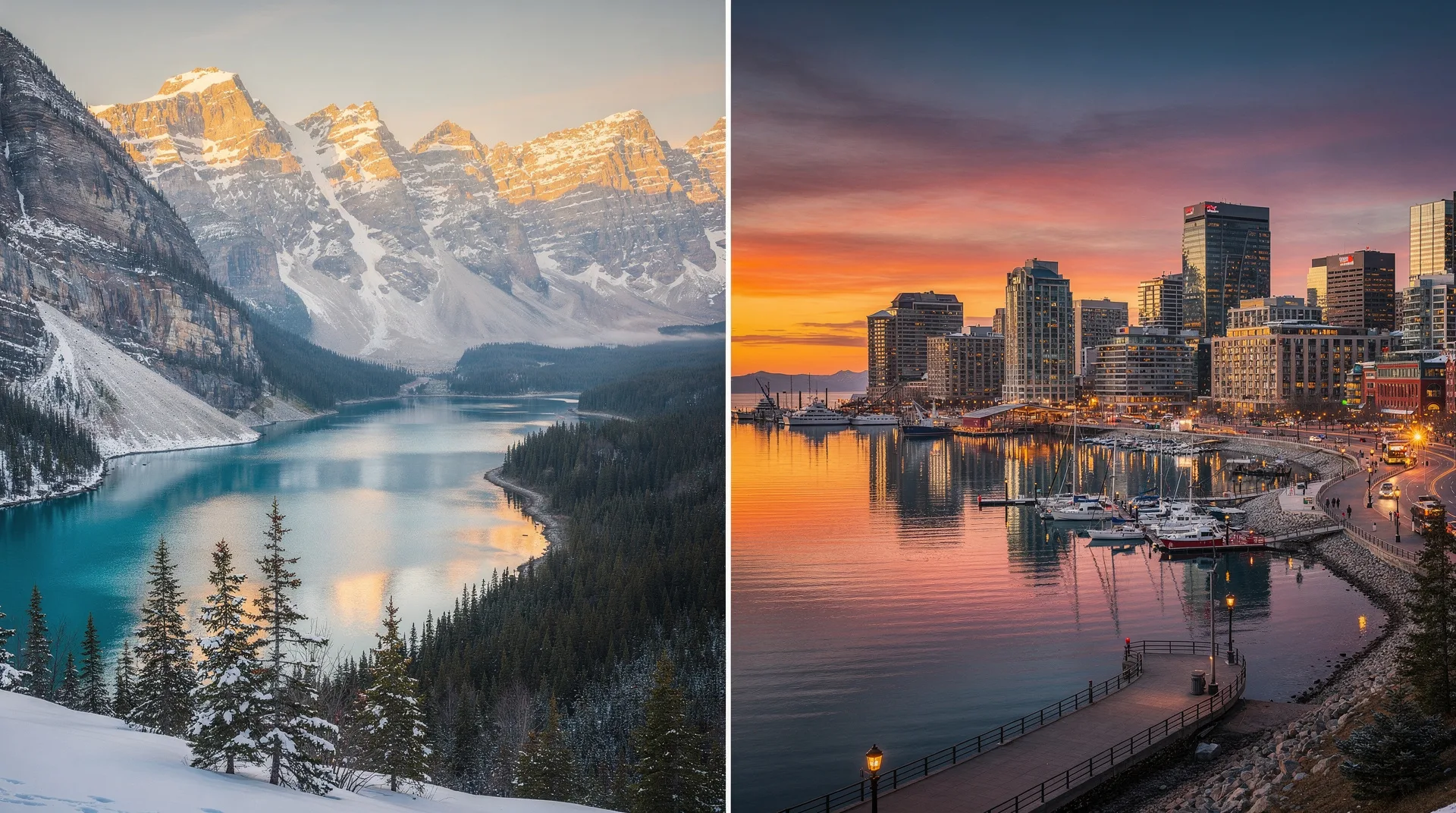
Eastern vs Western Canada: which to choose?
Should I visit Eastern or Western Canada first?
Visit Western Canada first if mountains, national parks, and outdoor adventure are your priority. Visit Eastern Canada first if you want diverse cities, French Canadian culture, and a mix of history and nature. Both regions are outstanding — your choice depends on what draws you to Canada in the first place.
Canada is the second-largest country on earth. At 9.98 million square kilometres, it spans six time zones and contains landscapes ranging from Pacific rainforest to Arctic tundra, from the Great Lakes to the St. Lawrence Valley, from Rocky Mountain glaciers to the Bay of Fundy. No single trip covers it all.
The most common planning question for first-time visitors: east or west? This guide breaks the country into its two broadest regions — Eastern Canada (Ontario, Quebec, and the Atlantic provinces) and Western Canada (British Columbia, Alberta, and the Prairie provinces) — and gives you the information to make the right choice for your trip.
The essential character of each region
Eastern Canada is a study in contrasts: the dense, multicultural cities of Toronto and Montreal, the French-language culture of Quebec, the tidal drama of the Maritime provinces, and the quieter, historic cities of Ottawa and Halifax. It is a region where city life, cultural variety, and natural scenery exist in close proximity without any single element dominating.
Western Canada is anchored by the Canadian Rockies — one of the most dramatic mountain landscapes on earth — and bookended by Vancouver on the Pacific coast and the Prairie cities of Calgary and Edmonton. It is a region that rewards outdoor-first travellers. The scenery is on a scale that can be difficult to process: glaciers visible from highways, turquoise lakes in national parks, and a coastline along British Columbia that rivals Norway for rugged beauty.
The divide is roughly geographic. Everything east of Manitoba is “Eastern Canada” for practical tourism purposes. Everything from Saskatchewan westward is “Western Canada.”
What Eastern Canada offers
Cities
Toronto is Canada’s largest city and most international entry point — a global metropolis with world-class museums (Royal Ontario Museum, Art Gallery of Ontario), a staggering diversity of cuisines, and the CN Tower as its most recognisable landmark. It is the most cosmopolitan city in Canada and, by many measures, in North America. See our Toronto vs Montreal comparison.
Montreal is the cultural surprise of eastern Canada — a bilingual city with European bones, a legendary food scene (bagels, smoked meat, poutine, fine French cuisine), late-night culture, and summer festivals that transform the city. It is cheaper than Toronto and, to many visitors, more memorable. See our Quebec City vs Montreal guide.
Quebec City is the only walled city in North America north of Mexico — a UNESCO World Heritage site with cobblestone streets, the imposing Chateau Frontenac, and a distinctly French atmosphere. Winter Carnival (late January to mid-February) is one of the great cold-weather festivals in the world.
Ottawa is Canada’s capital, home to excellent museums (Canadian Museum of History, National Gallery of Canada) and the Rideau Canal — in winter, the world’s largest naturally frozen skating rink.
Halifax is the gateway to the Maritime provinces — a compact harbour city with a strong music scene, excellent seafood, and proximity to the dramatic coastal scenery of Nova Scotia.
Natural highlights
Niagara Falls: Just 130 km from Toronto, the most visited natural attraction in Canada. The Canadian side has better views; the American side has easier access from New York State. See our Niagara Falls Canadian vs US side comparison.
Bay of Fundy has the world’s highest tidal range — up to 16 metres between low and high tide. Walking the ocean floor at low tide and returning to find it 12 metres underwater four hours later is genuinely extraordinary.
Cape Breton Island (Nova Scotia) is home to the Cabot Trail, widely considered one of the best coastal drives in North America — dramatic cliffs, Celtic culture, and some of Canada’s best fiddle music. See our Cape Breton vs PEI guide.
Prince Edward Island is Canada’s smallest province — red sand beaches, Green Gables, and some of the best seafood (particularly lobster and oysters) in the country.
Agawa Canyon (Ontario): A spectacular autumn foliage destination accessible by scenic rail tour from Sault Ste. Marie. See our Agawa Canyon guide.
Thousand Islands: The St. Lawrence River between Ontario and New York State contains over 1,800 islands — a scenic boat-trip destination.
What Western Canada offers
Cities
Vancouver is the most scenically situated city in Canada — mountains to the north, Pacific Ocean to the west, and a forested peninsula (Stanley Park) at its heart. It is the gateway to Whistler, the BC coast, and Victoria on Vancouver Island. See our Vancouver vs Toronto comparison.
Calgary is the practical base for the Canadian Rockies — 90 minutes from Banff by car, with a large international airport and a western character shaped by oil, ranching, and the famous Calgary Stampede (July).
Edmonton is Alberta’s capital, positioned as the gateway to Jasper and northern Canada. It has strong museum and arts institutions, and its position near the 53rd parallel makes it excellent for northern lights viewing in winter.
Victoria is the provincial capital of British Columbia on Vancouver Island — a compact, walkable harbour city with British-influenced architecture, excellent gardens, and whale watching on its doorstep.
Natural highlights
Canadian Rockies (Banff, Jasper, Yoho, Kootenay national parks): The centrepiece of western Canada — glaciers, turquoise lakes, abundant wildlife, and mountain scenery that draws visitors from across the world. Banff is the most accessible; Jasper the most wild. See our Banff vs Jasper comparison.
Icefields Parkway is the 232 km highway connecting Banff and Jasper through the heart of the Rocky Mountain icefields. Widely considered one of the world’s great scenic drives.
Whistler: North America’s largest ski resort and a year-round mountain destination, 125 km north of Vancouver on the Sea-to-Sky Highway.
Haida Gwaii (BC): Remote archipelago off the northern BC coast with ancient Haida culture, temperate rainforest, and wildlife found nowhere else. A destination for experienced travellers seeking something genuinely remote.
Great Bear Rainforest (BC): The largest intact temperate rainforest in the world, home to the rare Kermode “spirit bear” (a white-coated black bear), grizzlies, humpback whales, and wolves.
Churchill (Manitoba): On the edge of Hudson Bay, Churchill is the polar bear capital of the world in October and November, and one of the most reliable aurora borealis locations in Canada from November to March.
Cost comparison
The cost differential between east and west is not dramatic, but there are meaningful differences.
| Category | Eastern Canada | Western Canada |
|---|---|---|
| Accommodation (mid-range) | CAD $150–$350/night | CAD $200–$400/night |
| National park entry | N/A (Gatineau Park is free) | CAD $11.70/day (Banff, Jasper) |
| Meals (casual) | CAD $15–$25 | CAD $18–$28 |
| Internal transport | Good train/bus network | Car or organized tour more common |
| Flights to region | Toronto (YYZ) best connected | Vancouver (YVR), Calgary (YYC) both good |
Montreal reduces the average cost of an eastern trip significantly — it is 20–30% cheaper than Toronto across accommodation and dining.
Western Canada’s national park fees add to the cost, but the Discovery Pass (CAD $75.25/adult) covers all Parks Canada sites for 12 months and pays for itself quickly.
Getting around
Eastern Canada
Eastern Canada has the better ground transportation network for tourists travelling without a car. VIA Rail connects Toronto, Ottawa, Montreal, and Quebec City with regular, comfortable service. Regional bus services (FlixBus, Megabus) cover the same corridor cheaply.
The Maritime provinces are harder to cover without a car — the scenery is along coastal roads, and public transportation between Halifax, Cape Breton, and PEI is limited. A rental car is recommended for any Maritime itinerary.
Western Canada
Western Canada is more car-dependent outside Vancouver. The Rockies require a car or organized tour for full flexibility — Parks Canada has introduced shuttle systems at peak locations (Moraine Lake, Lake Louise), but the Icefields Parkway is best explored by car. Calgary and Edmonton have regional airports; Vancouver has the major international gateway.
Organized tours are particularly good value in western Canada: multi-day Rockies itineraries cover logistics, accommodation, and guides efficiently. A multi-day Calgary, Banff, and Jasper tour removes the need for a rental car entirely.
Sample itineraries
10 days in Eastern Canada
- Days 1–3: Toronto (CN Tower, ROM, Distillery District, Niagara Falls day trip)
- Days 4–6: Montreal (Old Montreal, Mile End, Mount Royal, food tour)
- Days 7–8: Quebec City (Old City, Plains of Abraham, Chateau Frontenac)
- Days 9–10: Halifax or Cape Breton day trip
10 days in Western Canada
- Days 1–2: Vancouver (Stanley Park, Granville Island, Gastown)
- Day 3: Sea-to-Sky Highway — Squamish, Whistler
- Days 4–6: Banff (Lake Louise, Moraine Lake, Banff Gondola, hot springs)
- Day 7: Icefields Parkway drive to Jasper
- Days 8–9: Jasper (Maligne Lake, Athabasca Falls, Miette Hot Springs)
- Day 10: Jasper to Edmonton for departure
3-week cross-Canada
Fly into Toronto, travel east to Montreal and Quebec City by train, then fly from Montreal (or Toronto) to Calgary for the Rockies. Finish in Vancouver and fly home. This is the classic first-time Canada circuit and covers both regions without backtracking.
See our east vs west Canada itineraries and from Toronto guide for more detail.
Best for…
Choose Eastern Canada if you:
- Are primarily interested in cities and cultural experiences
- Want to experience French Canadian culture in Quebec
- Are on a tighter budget (Montreal is significantly cheaper)
- Want to cover multiple destinations by public transport without a car
- Are interested in maritime landscapes, tidal phenomena, and Atlantic seafood
- Value history and colonial architecture
Choose Western Canada if you:
- Have mountains, glaciers, and national parks as your primary motivation
- Want world-class skiing (Whistler, Banff)
- Are flying from Asia or the Pacific Rim (Vancouver is the natural gateway)
- Want the single most iconic Canada landscape experience (the Rockies)
- Are interested in coastal BC wilderness (Great Bear Rainforest, Haida Gwaii, whale watching)
Our verdict
For a first trip to Canada with no particular preference: Western Canada delivers the most immediately iconic Canadian imagery — the Rocky Mountain landscape is what most visitors picture when they think of Canada. The Banff-Jasper-Icefields Parkway corridor is genuinely one of the great travel experiences in the world.
For a first trip to Canada with urban or cultural priorities: Eastern Canada. Toronto and Montreal together offer one of the most compelling city itineraries in North America, and Quebec City is utterly distinct.
For a long first trip (3+ weeks): Cover both, entering through one gateway and exiting through the other.
There is no wrong answer. Canada is large enough that both regions could fill multiple separate trips. The traveller who says “I’ve done Canada” after one region is invariably planning their return.
See also: Best time to visit Canada, First time visitors guide, Summer vs winter in Canada.
Frequently asked questions about Eastern vs Western Canada: which to choose?
Is Western Canada or Eastern Canada more expensive?
Western Canada runs slightly higher on average — particularly accommodation in Banff and Vancouver. Eastern Canada’s cost is pulled down significantly by Montreal, which is among the most affordable major cities in North America for visitors. The difference is not dramatic; neither region is especially cheap by international standards.
Which region is better for families with children?
Both regions are excellent for families. Western Canada’s national parks, wildlife viewing, and outdoor activities provide natural engagement for children. Eastern Canada’s museums (particularly in Toronto and Montreal) are exceptional for children, and Niagara Falls is a reliable crowd-pleaser. Families with young children who prefer structured city experiences may find eastern Canada easier to manage.
Can I see northern lights in Eastern or Western Canada?
Both regions offer aurora borealis opportunities, but the northern lights are more reliably visible at higher latitudes. Churchill in Manitoba (technically Western Canada) is one of the best aurora destinations in the world. Northern Ontario and Quebec also have viewing potential, but require travel away from urban light pollution. Jasper’s Dark Sky Preserve is excellent in fall and early winter.
Which is better in winter?
Western Canada: ski season at Whistler and Banff runs December through April, making winter an ideal time to visit. Eastern Canada: Quebec City’s Winter Carnival (January-February) is exceptional, and Montreal has an excellent winter culture. Toronto winters are cold and grey without the ski access to soften them. Overall edge to Western Canada for winter visitors who ski.
How do I travel between Eastern and Western Canada?
Flying is the standard approach — direct flights between Toronto or Montreal and Calgary or Vancouver take 4–5 hours. The VIA Rail Canadian train covers Toronto to Vancouver in 4 days and is a unique travel experience rather than a practical commute. Driving is possible but takes 4–5 days minimum. See our scenic train routes guide for the train option.
Is it better to fly into Toronto or Vancouver for a first Canada trip?
Toronto (YYZ) has the best international connections from Europe, the Middle East, and the US East Coast. Vancouver (YVR) has the best connections from Asia-Pacific. For most European visitors, flying into Toronto and out of Vancouver (or reverse) makes an efficient open-jaw circuit that covers both regions without backtracking.